July 28, 2026
When the Wrong Coal Grade Becomes a Grid Crisis: Understanding Indonesia's Medium-Rank Coal Procurement Response
Coal-fired power generation has a precision requirement that rarely makes headlines: the fuel grade delivered to a plant must closely match the specifications its boiler was engineered to handle. When that alignment breaks down, the consequences are not abstract. Output degrades, capacity factors fall, and in a grid with tight supply margins, the lights go out. This is the technical reality behind Indonesia's accelerated Indonesia medium-rank coal purchases and the rolling blackouts that struck the Java grid in mid-2026.
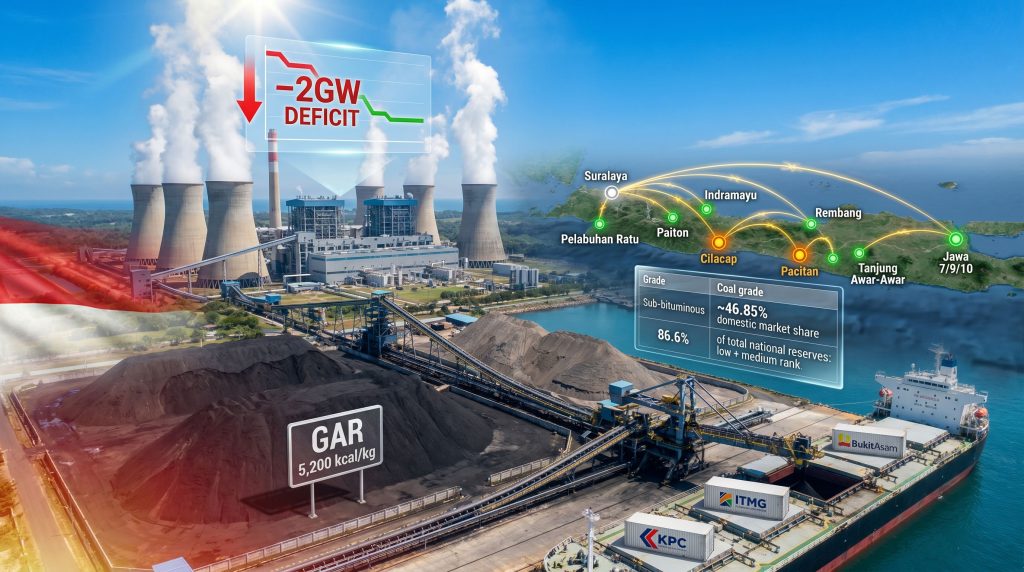
The story is not one of a supply shortage in the conventional sense. Coal was arriving at power stations. The problem was that the coal being delivered was predominantly lower-rank material, with calorific values falling short of the GAR 5,200 kcal/kg threshold that the affected plants were designed to operate on. The result was de-rated output across multiple facilities, compounded by the simultaneous technical disconnection of two baseload independent power producers (IPPs), pushing the Java grid into a 2GW power deficit and triggering PLN's load-shedding protocol.
When big ASX news breaks, our subscribers know first
Understanding Coal Grade Classification and Why GAR 5,200 kcal/kg Is the Critical Threshold
Coal is classified by a combination of calorific value (CV), moisture content, ash content, and sulfur levels. The CV, expressed in kilocalories per kilogram on a Gross As-Received (GAR) basis, is the primary determinant of how much energy a given mass of coal can release when combusted.
Sub-bituminous coal, broadly categorised as medium-rank, typically falls in the range of 4,500 to 6,000 kcal/kg GAR. The 5,200 kcal/kg threshold is significant because it represents the lower boundary of operational compatibility for the boiler designs installed across the Java coal fleet. Below this figure, combustion efficiency falls, steam generation rates decline, and the plant's achievable output drops below its nameplate capacity, a condition known in the industry as de-rated capacity.
Technical Note: De-rated capacity is the gap between what a plant is designed to generate at full specification and what it can actually produce when burning fuel outside its design parameters. Even a modest CV shortfall of 300–400 kcal/kg can reduce output by several percentage points per unit, and across a fleet of 12–15 large plants, this compounds into gigawatts of lost generation.
Indonesia's coal reserves are heavily skewed toward lower and medium-rank material. Approximately 86.6% of total national reserves are classified as low to medium rank. While this makes medium-rank sub-bituminous coal the dominant grade in the domestic supply system, the commercial dynamics of the sector often work against getting the right grade to the right plant at the right time. Furthermore, coal supply challenges across the region have added additional pressure to domestic procurement priorities.
How the Java Grid's Coal Fleet Was Affected: Plant Specifications and the Scale of the Problem
The breadth of facilities affected by the GAR 5,200 kcal/kg shortfall illustrates just how widespread the grade mismatch had become. Across both the western and eastern sections of the Java grid, plants designed for medium-rank coal were receiving lower-specification material.
| Power Plant | Units Affected | Required Coal Grade (GAR) | Grid Zone |
|---|---|---|---|
| Suralaya | Units 1-8 | 5,200 kcal/kg | West Java |
| Paiton | Units 1, 2, 9 | 5,200 kcal/kg | East Java |
| Jawa | Units 7, 9, 10 | 5,200 kcal/kg | Java grid |
| Pelabuhan Ratu | All units | 5,200 kcal/kg | West Java |
| Lontar | All units | 5,200 kcal/kg | West Java |
| Labuan | All units | 5,200 kcal/kg | West Java |
| Indramayu | All units | 5,200 kcal/kg | West Java |
| Rembang | All units | 5,200 kcal/kg | Central Java |
| Pacitan | All units | 5,200 kcal/kg | East Java |
| Tanjung Awar-Awar | All units | 5,200 kcal/kg | East Java |
The combined nameplate capacity across these facilities is substantial. When every plant on this list simultaneously operates at reduced efficiency due to below-specification fuel, the cumulative output loss can easily exceed the 2GW deficit that PLN reported.
The Dual Trigger: Grade Mismatch and Baseload IPP Outages
The blackouts were not caused by a single failure but by two converging pressures occurring simultaneously:
- Progressive de-rating across the coal fleet as lower-rank coal was substituted for GAR 5,200 kcal/kg material, gradually eroding available generation capacity
- Technical disconnection of two baseload IPPs at Cilacap and Pacitan, removing significant chunks of firm generation from the grid in a compressed timeframe
The combination pushed available supply below real-time demand thresholds. PLN's operational response, implementing rolling load shedding to preserve grid frequency and prevent cascading failures, was the correct intervention given the circumstances. One of the disconnected IPPs was restored to service over the following weekend, with the second expected back online within the week.
Indonesia's Energy Ministry Procurement Response: Structure and Speed
Indonesia's Ministry of Energy and Mineral Resources (ESDM) moved quickly, forming a cross-sector procurement team specifically tasked with securing adequate volumes of GAR 5,200 kcal/kg coal for the affected Java grid plants. This structure bypasses the slower cadence of standard procurement cycles and allows contracts to be signed under accelerated timelines.
Three major producers were identified as the primary suppliers under this emergency procurement framework:
-
Kaltim Prima Coal (KPC): One of Indonesia's highest-output thermal coal operations, located in East Kalimantan. KPC is a joint venture between PT Bumi Resources and Rio Tinto, producing coal across a range of specifications including medium-rank grades suitable for domestic power generation.
-
Indo Tambangraya Megah (ITMG): A major integrated coal mining group with operations across Kalimantan, ITMG produces coal across multiple CV bands and has the logistics infrastructure to mobilise large volumes rapidly.
-
Bukit Asam: The state-owned producer, Bukit Asam has a direct mandate supporting domestic energy security. Its mines in South Sumatra produce sub-bituminous coal that is well-suited to domestic power plant specifications.
Operational Note: The coal secured through this procurement is not intended to replace existing stockpiles wholesale. Instead, it will be used for blending operations, mixing medium-rank material with lower-rank coal already present at plant sites to lift the effective CV of the fuel blend up to or near the 5,200 kcal/kg specification threshold.
The Economics and Engineering of Coal Blending as an Emergency Fix
Coal blending is the standard operational response across Asian coal-fired power markets when fuel grade mismatches arise. The practice allows plant operators to achieve a target composite CV without replacing their entire existing fuel inventory. The process follows a straightforward sequence:
- Assess existing stockpiles: Measure the average CV, moisture, and ash content of lower-rank coal already stored at the plant
- Calculate the required blend ratio: Determine what proportion of GAR 5,200 kcal/kg coal is needed to bring the combined fuel mix to an acceptable specification
- Procure targeted volumes: Source precisely the quantity of medium-rank coal needed to achieve the blend, rather than over-ordering
- Execute controlled mixing: Combine fuel grades at the stockpile or on the conveyor feed, maintaining blend ratios within acceptable tolerances
- Monitor combustion performance: Track boiler efficiency, steam temperature, and output capacity as the blended fuel is consumed, adjusting ratios as needed
This approach is faster and more cost-effective than attempting to flush existing stockpiles entirely. It also makes the emergency procurement volumes more manageable from a logistics standpoint, since operators only need to source the incremental medium-rank coal required to achieve specification rather than a full replacement volume. However, supply chain impacts from broader trade pressures can complicate even well-structured blending programmes.
The DMO Framework: A Structural Gap Between Volume Compliance and Grade Delivery
Understanding why this grade mismatch developed requires examining Indonesia's Domestic Market Obligation (DMO). The DMO mandates that coal miners sell 25% of annual production to the domestic market, at prices that can be discounted by up to approximately USD 30 per tonne below export parity.
The intent is clear: ensure domestic power plants are adequately supplied. The unintended consequence is more nuanced. Because the DMO governs volume compliance rather than grade-specific delivery, miners fulfilling their domestic obligations have a commercial incentive to supply lower-rank coal domestically while directing higher-CV grades toward premium export markets. According to research into Indonesia's coal sector dynamics, this tension between domestic obligation and export incentive has been a long-standing structural feature of the market.
Policy Gap: Indonesia's DMO framework is structured around tonnage targets. There is currently no systematic mechanism requiring that the coal supplied to specific domestic power plants matches the CV specifications those plants were designed to operate on. This creates conditions where DMO compliance can coexist with functional fuel shortages at individual facilities.
This is not a hypothetical risk. The Java blackout episode demonstrates it in concrete terms. Plants were receiving coal. They were not receiving the right coal.
The structural fix would require the DMO framework to incorporate grade-matching provisions, tying domestic supply obligations not just to volume but to CV bands that correspond with the technical requirements of receiving facilities. This is a more administratively complex undertaking, but the cost of not implementing it, measured in gigawatts of lost capacity and hours of rolling blackouts, is now quantifiable.
The next major ASX story will hit our subscribers first
Indonesia's Coal Market Architecture: Production, Exports, and Domestic Demand
To understand the broader context of Indonesia medium-rank coal purchases, it helps to situate the domestic procurement challenge within the wider market structure.
| Coal Category | Share of Reserves | 2025 Domestic Market Share | Primary Application |
|---|---|---|---|
| Low-rank (lignite/sub-bituminous) | ~17.5% | Minor | Cement, local power |
| Medium-rank (sub-bituminous) | ~69.1% (combined with low) | ~46.85% | Domestic power + Asian export |
| Bituminous / Higher-CV | ~13.4% | Growing at 7.86% CAGR | Premium export markets |
| Low + medium rank combined | 86.6% | Dominant | Domestic + regional trade |
Indonesia captured approximately 34% of global seaborne coal trade in 2023, holding its position as the world's largest thermal coal exporter. Roughly 80% of produced coal is exported, with China, India, South Korea, and the Philippines representing the dominant destination markets. Coal accounted for approximately 11.4% of Indonesia's total export value in 2022, underlining how central the commodity is to national revenue.
Domestically, power generation absorbs approximately 56.95% of Indonesia's coal consumption, with PLN and its affiliated IPPs representing the anchor demand base. Sub-bituminous medium-rank coal remains the most cost-effective grade for delivery to the Java-Bali load centres given its prevalence in Kalimantan's producing regions and the established logistics corridors to Java's port-connected power stations. In addition, Asian bulk commodity demand from regional industrial growth continues to shape how Indonesian producers allocate supply between domestic and export channels.
A less-discussed but increasingly significant domestic demand driver is Indonesia's metals processing sector, particularly nickel smelting. The iron, steel, and metallurgy segment is expanding at approximately 8.68% CAGR, partially driven by the country's push to process nickel ore domestically before export, a policy that has generated substantial coal demand from steel and metals processing facilities.
Indonesia's Export Orientation and Its Domestic Consequences
Indonesia's export-first commercial structure, underpinned by strong demand from Asian industrial economies, means that domestic coal allocation decisions are always made in the shadow of international price signals. The global steel outlook for 2025 and beyond suggests sustained regional industrial coal demand, which consequently sustains the commercial pressure on Indonesian producers to prioritise export-grade material. Furthermore, analysis of Indonesia's electricity demand and the coal sector highlights that the tension between export revenue maximisation and domestic supply adequacy is not a new challenge but one that has intensified as both domestic power demand and export volumes have grown simultaneously.
Short-Term Market Implications of Accelerated Procurement
The ESDM's emergency procurement activity has several near-term market implications worth tracking:
- Spot market tightness for medium-rank grades: Accelerated contract signing compresses normal lead times and can temporarily redirect volumes that would otherwise reach spot market buyers in China, India, and South Korea
- Price signal for GAR 5,200 kcal/kg material: Higher-CV grades within the sub-bituminous range typically command export premiums of approximately USD 15–20 per tonne over lower-rank alternatives; emergency domestic procurement at this specification may exert modest upward pressure on regional pricing
- Logistics bottlenecks at Java ports: A rapid influx of medium-rank coal shipments to multiple receiving facilities simultaneously can create congestion at smaller port terminals not dimensioned for surge deliveries
Over the longer term, Indonesia's coal market is projected to grow at a CAGR of 6.24%, reaching approximately 1.28 billion tonnes by 2031. Medium-rank sub-bituminous coal will remain structurally central to both domestic dispatch and seaborne export trade across that horizon, given its dominance of the national reserve base.
Frequently Asked Questions: Indonesia Medium-Rank Coal Purchases
What is GAR 5,200 kcal/kg coal and why is it the critical specification for Java grid plants?
GAR stands for Gross As-Received, a measurement of calorific value that reflects the energy content of coal in its delivered state, including its natural moisture. The 5,200 kcal/kg threshold represents the minimum fuel specification for the boiler designs installed across the affected Java coal fleet. Coal delivered below this figure causes measurable output de-rating, where the plant's actual achievable generation falls below its engineered nameplate capacity.
Is Indonesia buying medium-rank coal from overseas?
No. Indonesia is the world's largest thermal coal exporter and a major domestic producer of sub-bituminous medium-rank coal. The current procurement activity involves Indonesian state entities directing medium-rank coal volumes from Indonesian mining companies, specifically KPC, ITMG, and Bukit Asam, toward Indonesian power plants. This is an internal domestic reallocation, not international purchasing.
What caused the 2GW power deficit on the Java grid?
Two simultaneous factors converged: first, progressive de-rating of coal plant output as below-specification lower-rank coal was burned in boilers designed for GAR 5,200 kcal/kg material; second, the technical disconnection of two baseload IPPs at Cilacap and Pacitan. The combined effect reduced available supply below real-time demand, triggering PLN's load-shedding protocol and producing the rolling blackouts.
How does the DMO affect coal grade delivery to domestic power plants?
The DMO mandates 25% of annual production be sold domestically at prices discounted up to approximately USD 30/t below export parity. Compliance is measured by volume rather than grade specification. This creates an incentive structure where miners can satisfy their DMO obligations using lower-rank coal while allocating higher-CV grades to premium export markets, potentially leaving domestic plants under-supplied with the specific coal quality they require.
Key Takeaways: What the Java Blackouts Reveal About Coal Grade Risk
- Grade specificity is as operationally critical as volume: A plant receiving sufficient tonnage of the wrong coal specification is functionally in the same position as a plant receiving no coal at all, in terms of its achievable output
- The DMO requires grade-matching provisions: Volume-only compliance creates structural misalignment between supply and plant technical requirements; this episode provides a clear policy case for reform
- Blending is the fastest near-term operational solution: Emergency procurement of medium-rank coal for blending with existing lower-rank stockpiles restores boiler efficiency without requiring a complete fuel replacement
- Export orientation concentrates domestic grade risk: Indonesia's 80% export ratio and premium-grade prioritisation for international buyers can systematically leave domestic plants exposed to CV shortfalls
- Medium-rank coal's structural dominance is long-term: With sub-bituminous coal comprising approximately 46.85% of domestic market share in 2025 and 86.6% of reserves classified as low to medium rank, Indonesia's reliance on medium-rank coal for both power dispatch and export revenue will persist well beyond 2031
This article is intended for informational purposes only and does not constitute financial or investment advice. Statistics and projections cited reflect publicly available market data and are subject to revision as conditions evolve. Readers should conduct independent verification of all figures before making commercial or investment decisions.
Want to Track the ASX Mining Stocks Positioned Around Indonesia's Coal Supply Crunch?
Discovery Alert's proprietary Discovery IQ model scans ASX announcements in real time, instantly identifying significant mineral and energy discoveries that create actionable opportunities — explore historic examples of major discovery returns to understand the scale of what early positioning can mean, then start your 14-day free trial at Discovery Alert to receive immediate alerts before the broader market catches on.