June 23, 2026
When a 33-Kilometre Waterway Holds the World's Industrial Metabolism Hostage
Every major commodity cycle in modern history has been shaped, at least in part, by geography. The concentration of the world's most critical energy and metals supply chains through a single narrow passage represents one of the most structurally fragile arrangements in global trade. At just 33 kilometres wide at its narrowest point, the Strait of Hormuz is not simply a shipping lane. It is the arterial valve of the global industrial economy, and when that valve is squeezed, the consequences radiate outward through oil markets, aluminium smelters, aerospace supply chains, and downstream manufacturing sectors simultaneously.
The events of mid-2026 have brought this structural fragility into sharp relief. A preliminary diplomatic agreement reached on June 17 briefly suggested that normalisation was imminent, only to be followed by renewed uncertainty as competing accounts of the Strait's operational status left commodity markets pricing ambiguity rather than resolution.
Understanding why the Strait of Hormuz oil and aluminium markets connection is so powerful requires examining not just the geopolitics, but the underlying physical and economic mechanisms that link a maritime corridor to a smelter's energy bill halfway around the world.
When big ASX news breaks, our subscribers know first
The Strait as a Dual-Commodity Chokepoint
Most analysts frame Hormuz risk through an energy lens. This is understandable, given that approximately 20% of the world's total oil supply and roughly one-third of all liquefied natural gas exports pass through the Strait annually, according to the U.S. Energy Information Administration. However, the secondary transmission to industrial metals markets is equally consequential, and considerably less discussed. Furthermore, the commodity chokepoint risks inherent to such concentrated trade routes are rarely fully priced into market models.
The connection operates through two distinct channels:
-
Direct physical disruption: The Gulf region, encompassing the UAE, Bahrain, Qatar, and Saudi Arabia, accounts for an estimated 8 to 9% of global primary aluminium output. These operations rely on maritime access to export finished metal and import raw materials including bauxite and alumina. A closure traps both inbound and outbound cargo simultaneously.
-
Indirect cost transmission: Aluminium smelting and alumina refining are extraordinarily energy-intensive processes. Sustained oil price elevation above USD 100 per barrel directly increases operating costs for refineries across multiple continents, compressing margins and incentivising curtailments even in facilities geographically distant from the conflict zone.
This dual-channel mechanism is what makes Hormuz uniquely capable of generating synchronised shocks across both energy and metals markets, a dynamic that most single-commodity frameworks fail to capture adequately.
What Oil Market Disruption at Hormuz Actually Looks Like
When commercial traffic through the Strait is effectively suspended, oil markets do not wait for legal confirmation of a closure. Prices reflect the physical reality of restricted supply, compounded by insurance cost escalation and freight risk premiums. Understanding the oil price geopolitics at play is therefore essential for any serious commodity analyst.
Historical precedent supports this pattern. During periods of heightened Hormuz tension, Brent crude has repeatedly tested and breached the USD 100 per barrel threshold. The logistics mechanics are straightforward: with approximately 150 vessels potentially stranded during a complete suspension, the arithmetic of displaced cargo volumes translates quickly into supply deficits that traders must price immediately.
The price trajectory observed in June 2026 illustrates this dynamic with unusual clarity:
| Market Indicator | Pre-Disruption Level | Disruption Peak | Post-Agreement Stabilisation |
|---|---|---|---|
| Brent Crude (USD/bbl) | ~USD 72–74 | >USD 100 | USD 77–78 |
| WTI Crude (USD/bbl) | ~USD 68–70 | >USD 97 | USD 73–74 |
| Shipping Insurance Premium | Baseline | Significantly elevated | Partially elevated |
By June 23, 2026, Brent crude futures had partially recovered, trading at approximately USD 78.15 per barrel, up 24 cents or 0.38% on the day. WTI gained 33 cents, or 0.46%, to reach USD 74.19 per barrel. These figures reflect a market caught between diplomatic optimism and unresolved physical uncertainty.
Oil Price Technical Levels and Risk Scenario Mapping
Traders monitoring Hormuz-driven volatility are watching several key technical levels. The partial recovery from disruption peaks represents neither a full risk-off signal nor a confirmation that premium unwinding is complete. The persistence of elevated shipping insurance costs, even after the June 17 preliminary agreement, indicates that market participants are treating the diplomatic progress as tentative rather than definitive.
The Energy-Aluminium Nexus: How Oil Prices Enter the Smelter's Cost Stack
The pathway from oil prices to aluminium production costs is less intuitive than it might appear, but it is deeply structural. Alumina refining, the intermediate process that converts bauxite into the feedstock required for aluminium smelting, is among the most energy-intensive industrial operations in the global economy. In addition, industrial metals pricing across multiple sectors responds directly to energy cost fluctuations of this magnitude.
Regional energy consumption figures in alumina refining illustrate the scale of exposure:
| Region | Estimated Energy Consumption in Alumina Refining | Hormuz Exposure Level |
|---|---|---|
| China | ~32,455 TJ | Indirect (via oil price transmission) |
| South America | ~34,296 TJ | Moderate (fuel cost sensitivity) |
| Rest of Asia + Africa | ~18,639 TJ | Moderate to high |
| Gulf Region | Significant | Direct (physical supply disruption) |
When oil prices sustain above USD 100 per barrel, refineries across all of these regions experience margin compression. For Gulf-based operations, the impact is compounded: not only do energy costs rise, but the physical ability to receive bauxite shipments and dispatch alumina or primary metal is constrained by the same maritime disruption that caused the oil price spike in the first place.
This convergence of outbound export blockade and inbound raw material restriction creates what analysts describe as a compounding deficit mechanism, where the supply shortfall grows faster than simple production curtailment figures suggest.
Aluminium Price Trajectory: Four-Year Highs, Consolidation, and the USD 4,000 Question
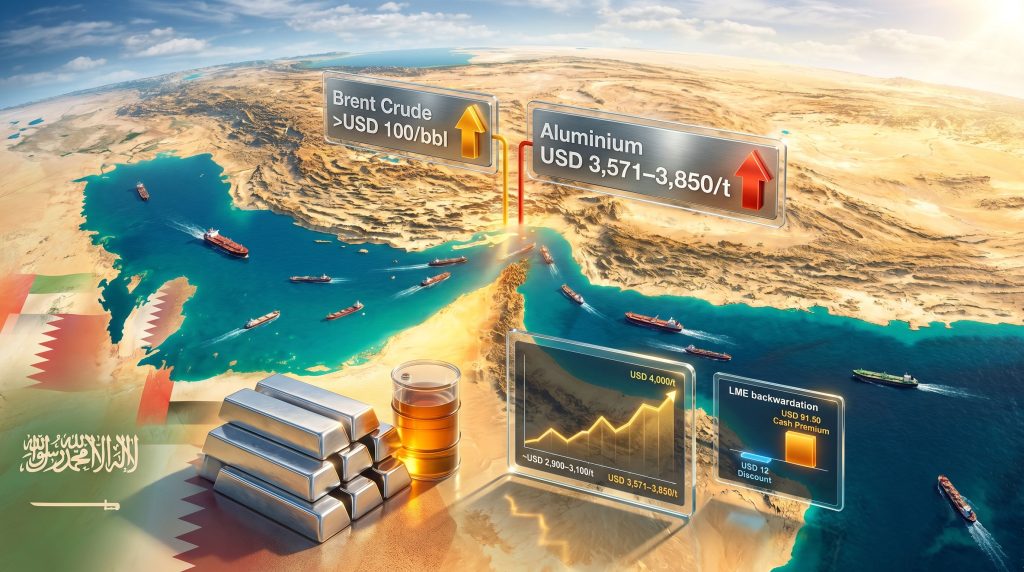
The aluminium price response to Hormuz disruption in 2026 has been among the most dramatic in recent memory. LME prices surged from a pre-conflict baseline of approximately USD 2,900 to 3,100 per tonne to a four-year high range of USD 3,571 to 3,850 per tonne during peak disruption conditions. Aluminium at a 4-year high as Hormuz disruption reprices the supply chain has become a defining headline for metals markets in 2026.
The price table below maps the current scenario structure:
| Aluminium Price Scenario | Price Level | Trigger Condition |
|---|---|---|
| Pre-conflict baseline | ~USD 2,900–3,100/t | Normal Strait operations |
| Four-year high (disruption peak) | USD 3,571–3,850/t | Strait closure + force majeure declarations |
| Projected ceiling | USD 4,000/t | Prolonged conflict escalation |
| Current consolidation range | USD 3,320–3,400/t | Partial diplomatic progress |
| Key support zone | USD 3,380–3,420/t | Demand absorption floor |
The USD 4,000 per tonne level represents a psychologically and technically significant ceiling. Reaching it would require a combination of prolonged Strait access restrictions, continued force majeure declarations from Gulf producers, failure of LME warehouse stocks to absorb demand, and evidence that non-Gulf producers cannot ramp output at sufficient speed to offset the deficit.
None of these conditions are implausible. What prevents them from being a base case is the partial diplomatic progress achieved in mid-June 2026, which has at minimum deferred the most extreme supply compression scenarios.
Force Majeure Declarations and the 19% Output Reduction Signal
One of the most technically significant developments during the June 2026 disruption was the invocation of force majeure clauses by Gulf aluminium producers. Force majeure declarations are not routine commercial communications. They represent formal acknowledgements by producers that contractual delivery obligations cannot be met due to circumstances beyond operational control.
A 19% reduction in Gulf aluminium output carries direct mathematical implications for the global supply balance. With Gulf producers accounting for 8 to 9% of world output, a 19% curtailment within that cohort removes approximately 1.5 to 1.7% of total global supply from the market simultaneously. When combined with the energy cost pressure on non-Gulf producers, the aggregate supply impact is substantially larger than the Gulf's production share alone would suggest.
Backwardation as a Scarcity Signal: The USD 91.50 Cash Premium
Perhaps the most technically revealing indicator of genuine physical scarcity in the June 2026 aluminium market was the dramatic swing in LME market structure from contango to backwardation.
In normal market conditions, spot aluminium prices trade at a discount to three-month forward contracts, reflecting storage costs and the time value of inventory. This is known as contango. When spot prices trade above forward prices, the market is said to be in backwardation, and this condition reliably signals that buyers are urgently competing for immediately available physical metal rather than future delivery.
The swing observed during the June 2026 disruption was extraordinary: from a USD 12 per tonne discount (contango) to a USD 91.50 per tonne cash premium over three-month futures (backwardation). This is not a signal generated by speculative positioning. A backwardation of this magnitude reflects real-world buyers bidding aggressively for metal that exists today, because they cannot rely on forward supply commitments from producers operating under force majeure.
For industrial consumers in the automotive, packaging, and aerospace sectors, this structure creates a genuine procurement crisis. Locking in forward contracts offers no protection when spot premiums reflect physical unavailability.
The next major ASX story will hit our subscribers first
The Projected 2-Million-Tonne Deficit: Stress-Testing the Supply Gap
Modelling the full supply shortfall requires accounting for several interacting variables:
-
Gulf export suspension duration: Every additional week of effective closure compounds the volume deficit, as Gulf producers cannot easily restart curtailed capacity instantaneously.
-
LME inventory buffers: Warehouse stocks entering the disruption period were already under pressure from prior demand cycles, limiting the market's capacity to absorb a sudden supply withdrawal.
-
Non-Gulf producer response times: Expanding output at smelters in China, Canada, Norway, or Australia requires lead times measured in weeks to months, not days.
-
Downstream inventory positioning: Manufacturers who rely on just-in-time procurement models are structurally more exposed than those maintaining strategic stockpiles.
If Gulf aluminium exports remain suspended for a full quarter and LME stocks fail to compensate adequately, downstream manufacturers across the automotive, aerospace, and packaging sectors face not just price escalation but genuine allocation constraints. The broader aluminium supply chain vulnerabilities exposed by this scenario have prompted renewed calls for strategic reserve policies in several importing nations.
The projected 2-million-tonne supply deficit through end-2026 represents the outer bound of this scenario analysis. It is not a certainty, but it is a credible risk envelope given the structural conditions currently in place.
Defence and Aerospace: The Strategic Dimension That Market Participants Underweight
Beyond commercial industrial users, the Hormuz aluminium disruption carries strategic implications that extend into national security considerations. U.S. military supply chains maintain significant dependencies on high-purity primary aluminium sourced from Gulf producers. Aerospace-grade and military-grade aluminium alloys require specific purity standards and metallurgical characteristics that cannot always be substituted from alternative sources on short notice.
This creates a strategic vulnerability that sits outside the typical commercial hedging framework. Defence procurement cycles operate on longer planning horizons than commodity spot markets, meaning that a prolonged Gulf supply disruption could create qualification and certification bottlenecks for aerospace-grade material, even if total global supply eventually recovers.
Allied nations that have oriented portions of their defence industrial base around Gulf-origin primary aluminium face a similar exposure. This dimension of Hormuz risk is rarely priced explicitly into commodity markets but represents a structural incentive for governments to maintain strategic stockpiles of critical metals.
Competing Narratives and the Mechanics of Risk Premium Pricing
The fundamental challenge facing commodity markets in late June 2026 is the simultaneous existence of two contradictory official accounts of the Strait's operational status. Washington maintains that commercial navigation continues uninterrupted. Tehran describes the waterway as effectively closed and subject to Iranian oversight, citing continued Israeli military operations in Lebanon and alleged ceasefire breaches.
Commodity markets operate on observable physical flows, not political statements. When two sovereign actors offer contradictory accounts of a waterway's operational status, traders default to the more conservative assumption and maintain elevated risk premiums accordingly.
This is not irrationality. It reflects the fundamental asymmetry of downside risk in physical commodity markets: the cost of being wrong about a supply disruption that materialises is catastrophically higher than the cost of maintaining a risk premium that proves unnecessary. Consequently, the mining geopolitical landscape has become an essential lens through which commodity strategists must evaluate any forward positioning.
The modest Brent crude recovery to USD 78.15 per barrel by June 23, 2026, and the aluminium consolidation in the USD 3,320 to 3,400 range, both reflect this cautious optimism framework. Neither market has fully unwound its disruption premium, because neither market has received unambiguous confirmation that the physical supply constraint has been resolved.
Scenario Modelling: Three Pathways for Oil and Aluminium Markets
The forward outlook for Strait of Hormuz oil and aluminium markets can be structured around three distinct scenarios, each carrying materially different commodity price implications:
| Scenario | Strait Status | Oil Price Outlook | Aluminium Price Outlook |
|---|---|---|---|
| Full normalisation | Unrestricted commercial navigation restored | Return toward USD 72–75/bbl | Gradual retreat toward USD 3,100–3,200/t |
| Partial resolution | Intermittent access, elevated risk premium maintained | USD 78–85/bbl range | USD 3,300–3,500/t consolidation |
| Renewed escalation | Effective closure maintained or deepened | >USD 100/bbl | Potential breach of USD 4,000/t |
A critical dynamic that scenario models often underweight is the asymmetry of recovery timelines. Even in the full normalisation scenario, aluminium supply chains do not snap back to pre-disruption conditions immediately. Restarting curtailed smelter capacity, rebuilding LME inventory buffers, re-establishing shipping insurance terms, and unwinding force majeure declarations all take time. The price recovery lag for aluminium typically extends several weeks beyond the geopolitical resolution event itself.
This asymmetry means that aluminium buyers who wait for confirmed diplomatic resolution before adjusting procurement strategies may find themselves paying elevated spot premiums even after the underlying geopolitical risk has technically subsided.
Frequently Asked Questions: Strait of Hormuz, Oil, and Aluminium Markets
Why does the Strait of Hormuz matter so much to aluminium prices?
The Strait connects two critical supply chain functions: it is the export corridor for Gulf aluminium producers representing 8 to 9% of global supply, and it is the transit route for the oil that powers alumina refineries worldwide. Disruptions simultaneously reduce supply and increase production costs, creating a compounding price pressure effect.
How much of the world's oil passes through the Strait of Hormuz?
According to the U.S. Energy Information Administration, approximately 20% of global oil supply and around one-third of all LNG exports transit the Strait annually, making it the single most consequential maritime chokepoint for global energy markets. SMM's analysis of a potential Hormuz blockade provides further detail on the structural dimensions of this risk.
What is market backwardation and why does it signal aluminium scarcity?
Backwardation occurs when spot prices trade above forward contract prices. In aluminium, a shift from a USD 12 discount to a USD 91.50 cash premium over three-month futures signals that buyers are competing urgently for immediately available metal, a reliable indicator of genuine physical scarcity rather than speculative activity.
Could the aluminium market reach USD 4,000 per tonne?
It is a credible tail risk rather than a base case. Reaching that level would require prolonged Strait closure, sustained force majeure conditions among Gulf producers, insufficient LME inventory buffers, and slow non-Gulf production ramp-up. None of these conditions are impossible under a renewed escalation scenario.
Which countries face the greatest exposure to a prolonged Strait closure?
Nations most exposed include those dependent on Gulf energy exports for domestic power generation, countries whose defence and aerospace sectors source high-purity primary aluminium from Gulf producers, and economies with limited strategic metal stockpiles. Japan, South Korea, India, and several European nations fall into overlapping categories of elevated exposure.
Key Takeaways for Market Participants
-
The Strait of Hormuz represents the intersection of global energy and metals supply chains, generating simultaneous price shocks across the Strait of Hormuz oil and aluminium markets when disrupted
-
Gulf aluminium producers account for 8 to 9% of global output, with a projected 2-million-tonne supply deficit emerging if disruptions persist through end-2026
-
Oil prices above USD 100 per barrel directly elevate aluminium refining costs across regions consuming tens of thousands of terajoules in energy-intensive alumina production
-
The LME backwardation swing from a USD 12 discount to a USD 91.50 cash premium signals genuine physical scarcity, not speculative trading
-
Current market pricing reflects unresolved ambiguity over Strait access, with Brent at USD 78.15/bbl and LME aluminium consolidating at USD 3,320 to 3,400/t
-
The USD 3,380 to 3,420/t aluminium support zone and the USD 4,000/t ceiling define the current risk corridor for buyers and producers
-
Recovery timelines for aluminium supply chains lag geopolitical resolutions by weeks, creating procurement risk for buyers who delay strategic responses
This article contains forward-looking scenario analysis and market projections based on conditions as of June 2026. Commodity price forecasts involve significant uncertainty, and actual market outcomes may differ materially from the scenarios described. This content does not constitute financial advice. Readers should conduct independent analysis before making any investment or procurement decisions.
For ongoing coverage of aluminium market developments and geopolitical supply chain analysis, AL Circle's SupplementAL series at alcircle.com provides regular reporting on the structural forces shaping global aluminium trade.
Want to Capitalise on the Next Major Commodity Discovery Before the Market Moves?
When geopolitical shocks like Hormuz disruptions reprice entire supply chains overnight, early identification of high-potential ASX mineral discoveries becomes critical — Discovery Alert's proprietary Discovery IQ model delivers real-time alerts on significant ASX discoveries across aluminium, energy, and 30+ other commodities, ensuring subscribers can act on actionable opportunities ahead of the broader market. Explore historic examples of exceptional discovery returns and start your 14-day free trial today.