June 23, 2026
Africa's Most Underleveraged Energy Asset Is Finally Closing the Gap
For decades, energy analysts have wrestled with one of the most persistent paradoxes in global commodity markets: a nation sitting atop the largest proven oil reserves on an entire continent, yet consistently producing at a fraction of its geological potential. The reserve-to-production dynamics of North African upstream oil have long told a story of chronic underperformance relative to endowment, shaped less by geology and more by the turbulent intersection of political fragmentation, infrastructure decay, and institutional instability.
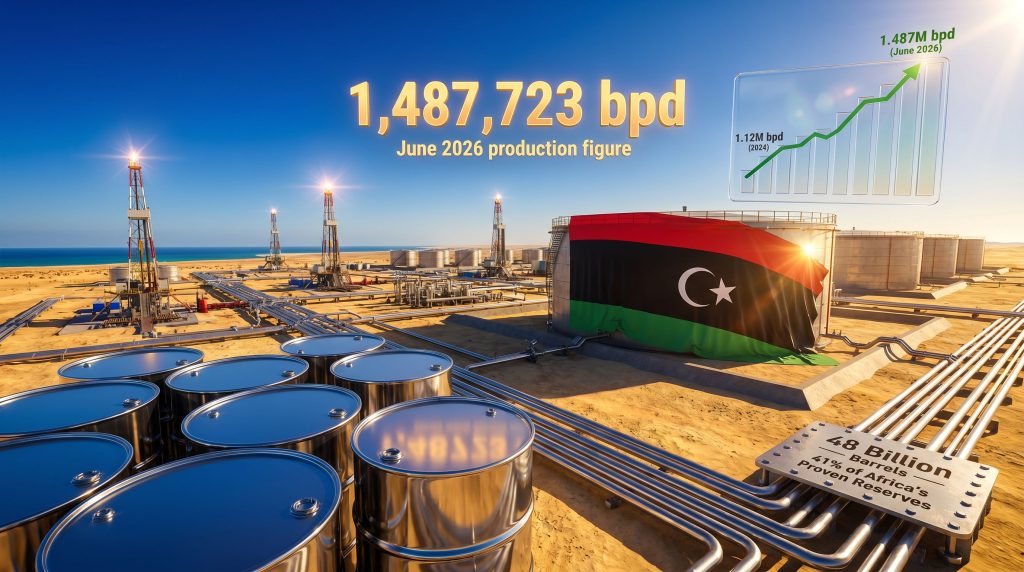
That narrative is shifting in measurable ways. Libya oil production hits a 12-year high in June 2026, with combined crude and condensate output reaching 1,487,723 barrels per day according to the National Oil Corporation. Of that figure, crude accounted for 1,438,560 bpd and condensate contributed 49,163 bpd, placing the country closer to its 1.5 million bpd near-term target than at any point since the early 2013 post-revolution recovery attempt.
Understanding why this milestone matters requires looking beyond the headline number to the structural forces, geological realities, and geopolitical risk variables that will determine whether this recovery becomes durable or dissolves in the next political crisis.
When big ASX news breaks, our subscribers know first
How Libya's Production History Explains the Significance of 1.49 Million Bpd
A Reserve Base That Dwarfs Its Output Record
Libya holds approximately 48 billion barrels of proven crude reserves, representing roughly 41% of Africa's total proven reserves, according to U.S. Energy Information Administration data. To contextualise the scale of this endowment: Libya's reserve base exceeds Nigeria's 37 billion barrels by nearly 30%, yet Nigeria has consistently outproduced Libya for most of the past decade.
This gap between reserve wealth and actual production output reflects what energy economists call the reserve-to-production underutilisation problem, a condition driven not by geological limitations but by above-ground risk factors including civil conflict, competing governmental authority, and infrastructure neglect spanning more than a decade.
The table below maps the trajectory of this underperformance across the key inflection points since Libya's pre-revolution peak:
| Period | Average Output (bpd) | Primary Driver |
|---|---|---|
| Pre-2011 | ~1.6 million | Stable centralised governance |
| 2011-2013 | Sharp multi-year decline | Political transition, security disruption |
| 2023 | ~1.18 million | Gradual recovery momentum |
| 2024 | ~1.12 million | Central Bank power struggle, field shutdowns |
| Q1 2025 | ~1.38 million | Highest quarterly output since 2013 |
| May 2025 | ~1.23 million | 12-year monthly high at the time |
| Full Year 2025 | ~1.37 million | 12-year annual high confirmed |
| June 2026 | 1.487 million | Closest approach to 1.5 million bpd target since 2013 |
The 2024 contraction deserves particular attention. A dispute over control of the Central Bank of Libya triggered coordinated field shutdowns that cut national output by roughly 50% at its worst point. The speed of both the collapse and the subsequent recovery illustrates the primary characteristic of Libyan oil supply: it is not constrained by geology but by governance, and it can swing violently in either direction within weeks.
What Is Driving the 2025-2026 Production Surge
The NOC's Operational Restructuring Under Massoud Sulaiman
The National Oil Corporation's internal management reforms have been central to the production recovery. Under NOC Chairman Massoud Sulaiman, the organisation has shifted toward a field-level operational model that prioritises obstacle removal, real-time technical monitoring, and direct workforce support at production sites rather than centralised administrative management.
The primary production activity is concentrated across two geological formations:
- The Sirte Basin, the most prolific hydrocarbon system in North Africa by historical yield, responsible for the majority of Libya's recoverable crude
- The Murzuq Basin, a secondary but substantial formation in the southwest that has attracted renewed international exploration interest
The NOC has communicated its intention to continue pushing output higher before the close of 2026, linking production volume directly to national revenue generation in an economy that remains almost entirely dependent on crude export receipts. Furthermore, crude oil price trends through this period have provided an additional incentive for the NOC to maximise volumes wherever operationally feasible.
The Mabruk Oilfield Restart: A Signal Beyond the Barrels
One of the more strategically significant operational developments of 2025 was the restart of the Mabruk oilfield after a 10-year suspension. The field contributes approximately 5,000 bpd to the national production base, a figure modest in isolation but symbolically important in a broader context.
The Mabruk restart demonstrates a proof-of-concept for Libyan upstream rehabilitation: dormant assets that have sat idle through years of conflict and neglect can be returned to production when security conditions stabilise and operational investment follows. Additional field rehabilitation programs across both the Sirte and Murzuq basins are expected to generate incremental volume gains through 2026 and into 2027.
The Return of International Capital: First Licensing Round Since 2007
Perhaps the most consequential structural development for Libya's long-term production trajectory was the February 2026 licensing round, the first since 2007. The NOC awarded exploration rights across five blocks from approximately 20 offered, covering onshore and offshore acreage in both major basin formations.
Award recipients included:
- Chevron (United States)
- Eni (Italy)
- QatarEnergy (Qatar)
- Repsol (Spain)
- Türkiye Petrolleri (Turkey)
- Aiteo (Nigeria), which secured the Murzuq M1 block
The inclusion of Aiteo represents an interesting dimension: an African-headquartered energy company competing successfully for Libyan upstream acreage alongside international majors. However, the partial take-up rate, with only five of roughly twenty blocks awarded, signals that the investor community has not fully repriced Libyan political risk downward despite the operational improvements.
The geological upside of Libyan acreage is well-established and not in dispute. The outstanding question for international operators is whether the institutional environment has stabilised sufficiently to support long-cycle capital commitments of ten years or more. The 2026 licensing round suggests that the largest global energy companies believe the risk-reward balance has shifted meaningfully, even if the broader market remains cautious.
Africa's Upstream Competitive Landscape: Where Libya Now Stands
Comparative Production and Reserve Positioning
Libya's current output trajectory positions it as a genuine competitor for second place among African producers, a ranking currently held by Algeria. According to S&P Global, Libya oil production hits a 12-year high even as political tensions in Tripoli continued to flare, underscoring the resilience of the current recovery. The reserve-per-barrel-produced ratio, however, already favours Libya by a substantial margin relative to all continental peers.
| Country | Approximate Output (2025-2026) | Proven Reserves | Continental Rank |
|---|---|---|---|
| Nigeria | ~1.5-1.6 million bpd | ~37 billion barrels | 1st |
| Algeria | ~1.2-1.3 million bpd | ~12 billion barrels | 2nd |
| Libya | ~1.49 million bpd | ~48 billion barrels | 3rd (rising) |
| Angola | ~1.1 million bpd | ~8 billion barrels | 4th |
Libya's reserve base is not merely larger than its peers in absolute terms; at 48 billion barrels against Algeria's 12 billion barrels, it represents a production runway of fundamentally different duration. In addition, if recovery rates from existing fields can be improved through enhanced oil recovery techniques as foreign capital returns, the long-term production ceiling for Libya's existing fields alone is substantially higher than current output suggests.
The Crude Quality Dimension: Why Libyan Barrels Command Attention
Libyan crude grades, particularly Es Sider and Sharara, are classified as light, sweet crudes with API gravity typically ranging between 37 and 43 degrees and sulphur content below 0.5%. These specifications place Libyan grades among the most refinery-friendly crude types available, commanding a quality premium over heavier, higher-sulphur alternatives from other OPEC producers.
European refineries, which are configured around light sweet crude processing, have a structural preference for Libyan grades that extends beyond simple geographic proximity. The combination of short maritime transit distances and premium crude quality creates a commercial advantage that is difficult for competing supply sources to fully replicate.
The European Import Dependency Structure
Italy's Position as Libya's Anchor Buyer
Five European nations collectively absorbed 71% of Libya's crude exports during the first nine months of the reporting period, according to U.S. Energy Information Administration data. This concentration is not a coincidence of trade flows but reflects long-standing infrastructure interdependencies and refinery configuration decisions made over decades.
Italy occupies the dominant position within this structure, receiving 13,434,662 tonnes of Libyan crude in 2025, representing approximately one quarter of Italy's total crude import volume. This level of dependency is partly explained by Eni's deep operational presence in Libya, creating commercial relationships that extend from upstream production through to downstream refinery processing.
Spain ranks as the second-largest European destination, reinforcing what energy trade specialists describe as the Mediterranean supply corridor: a structurally embedded trade route that serves the refining economies of southern Europe with North African light sweet crude.
Which country imports the most Libyan oil? Italy is the single largest importer of Libyan crude, receiving approximately 13.4 million tonnes in 2025, accounting for nearly 25% of Italy's total crude import volume. This positions Italy as the anchor buyer within Libya's Mediterranean export network.
The Risk Framework: What Could Derail the Recovery
Political Fragmentation as a Persistent Supply Variable
Libya has operated under competing administrative structures since 2014, with the Government of National Unity in Tripoli and the Government of National Stability in the east maintaining separate institutional claims over key state functions including the NOC and Central Bank. This dual-authority structure creates ongoing jurisdictional uncertainty that no production milestone eliminates. Consequently, the geopolitical trade tensions that characterise Libya's domestic political environment continue to weigh on investor confidence in long-cycle upstream projects.
The 2024 collapse serves as the most recent quantified example of how quickly political disputes translate into supply disruptions. International operators modelling Libyan project economics typically apply a political risk premium of 15-25% to upstream returns, reflecting the non-geological uncertainty that sits above the otherwise attractive reserve base.
Despite reported security incidents in Tripoli during mid-2026, production has maintained its upward trajectory, a resilience signal that energy markets are beginning to price more constructively. Whether this resilience reflects genuine institutional stabilisation or simply a temporary alignment of political interests remains an open question.
Infrastructure Vulnerabilities That Cap the Upside
Three infrastructure gaps present the most immediate constraints on achieving higher production levels:
- Export terminal reliability: Repeated disruptions at coastal terminals have historically amplified field-level production volatility, creating supply discontinuity that complicates refinery scheduling for European buyers
- Pipeline integrity: Ageing pipeline networks connecting interior fields to coastal export facilities require sustained maintenance investment that has been inconsistent during years of political instability
- The Ras Lanuf refinery: A 220,000 bpd facility that has remained idle since 2013, its restart targeted by the NOC within a 12-month window from May 2026
The Ras Lanuf restart, if achieved, would produce dual benefits. First, it would expand downstream processing capacity within Libya itself, capturing value-added margin currently foregone through crude-only exports. Second, it would reduce the country's dependence on refined product imports, an ongoing fiscal drain that partially offsets crude export revenues.
The next major ASX story will hit our subscribers first
Libya's 2030 Ambitions: What the Numbers Require
The Multi-Horizon Production Roadmap
The Libyan government's stated production objectives span multiple time horizons, each requiring a materially different level of investment and political stability:
| Target Period | Output Goal | Incremental Gain Required |
|---|---|---|
| End of 2026 | 1.5 million bpd | ~13,000 bpd from June 2026 baseline |
| 2030 | 2.0-3.0 million bpd | 34-100% increase from current levels |
Reaching 2-3 million bpd by 2030 would represent one of the most ambitious upstream expansions attempted by any OPEC member in recent history. Achieving it would require not just the conversion of the 2026 licensing round's early momentum into active drilling programs, but also sustained investment in pipeline rehabilitation, terminal upgrades, refinery restoration, and new enhanced oil recovery programs across existing field portfolios.
The gap between the near-term 1.5 million bpd target and the 2030 lower bound of 2 million bpd is smaller in volume terms than the gap to 3 million bpd, but both require a political stability environment that has not yet been consistently demonstrated across a multi-year period. Reporting from Global Finance Magazine highlights, however, that despite record production, revenues continue to trickle rather than flow freely into national development budgets, underscoring the fiscal complexity behind the output headline.
OPEC+ Dynamics and Global Market Implications
The Exemption Advantage: Unconstrained Supply Growth
Libya operates under a production exemption from OPEC+ quota agreements, a status granted due to its ongoing political instability. This exemption carries a significant implication for global crude market balancing: every barrel Libya produces is added to global supply without requiring group approval or triggering quota offset requirements from other members. Understanding how OPEC shapes markets is therefore essential context for appreciating how Libya's uncapped volumes interact with the broader production management framework.
As Libya approaches and potentially exceeds 1.5 million bpd, the cumulative supply contribution to the global crude balance becomes increasingly material. Energy market analysts tracking OPEC+ compliance calculations must account for Libyan volumes as a floating variable that can shift global supply balances by hundreds of thousands of barrels per day within a single quarter.
Historical analysis of Libyan supply disruptions shows that sudden outages of 200,000-400,000 bpd have generated Brent crude price spikes of $2-5 per barrel within 48-72 hours. The reverse dynamic, sustained production recoveries of the current magnitude, exerts measured downward pressure on Mediterranean crude differentials, particularly for light sweet grades competing directly with Es Sider and Sharara. Traders monitoring WTI and Brent futures will consequently be watching Libyan output levels closely as a key variable in forward pricing models.
For energy traders and portfolio managers, Libya functions as one of the few remaining large-scale swing variables in the global supply picture that operates entirely outside the OPEC+ coordination framework. Furthermore, the influence of sanctions on Russian oil has redirected European refinery sourcing decisions in ways that structurally increase demand for Libyan light sweet grades, making Libya's recovery timing particularly commercially significant. This makes it a critical factor in any serious crude oil price scenario analysis through 2026 and beyond.
Disclaimer: This article contains forward-looking statements, production targets, and market projections that are inherently subject to uncertainty. Past production trends do not guarantee future output levels. Readers should conduct their own independent research before making any investment or commercial decisions based on the information presented here.
Want to Stay Ahead of the Next Major Resource Discovery?
Discovery Alert's proprietary Discovery IQ model delivers real-time alerts on significant ASX mineral discoveries, instantly converting complex geological and commodity data into actionable investment insights — explore historic discoveries and their returns to understand the scale of opportunity, then begin your 14-day free trial at Discovery Alert to position yourself ahead of the broader market.