June 23, 2026
The Fiscal Architecture That's Quietly Rewriting Global Aluminium Trade
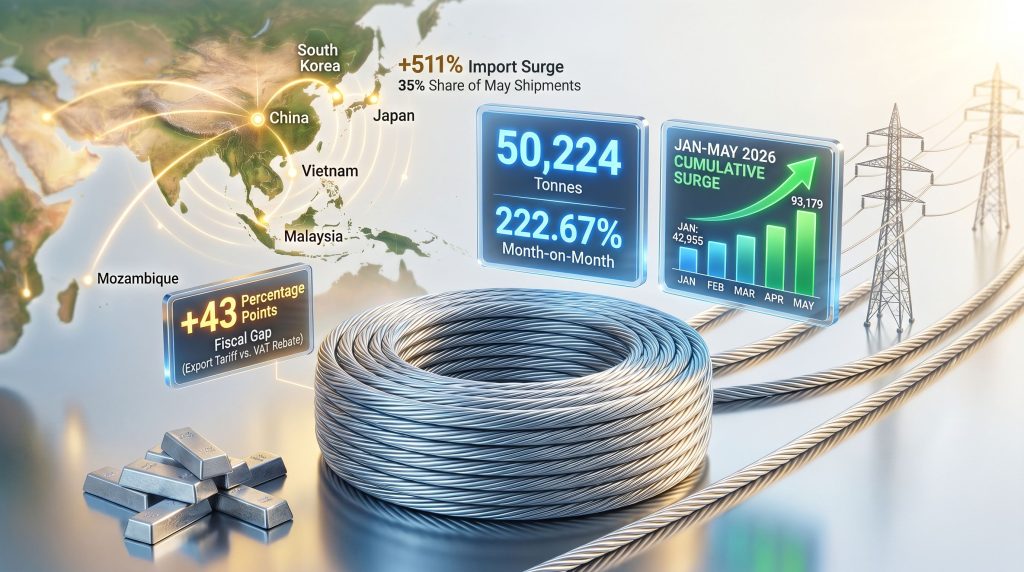
Few forces reshape commodity trade flows as decisively as a well-engineered tax differential. While most market observers focus on supply disruptions, production costs, or demand cycles, the mechanics of China aluminium wire exports tax incentives can redirect entire product categories across borders with surgical precision. China's aluminium sector is currently demonstrating exactly this phenomenon, as a 43-percentage-point fiscal gap between raw and processed metal exports has triggered one of the most dramatic single-month export surges the aluminium wire market has recorded in recent years.
Understanding why this is happening requires looking beneath the headline numbers and into the structural incentives that Chinese producers and traders have been quietly optimising around for months. Furthermore, the interplay between fiscal policy and global demand trends makes this a story with significant implications for aluminum and alumina markets worldwide.
When big ASX news breaks, our subscribers know first
China's Tiered Export Tax Framework: Raw vs. Processed Metal
China's approach to aluminium export taxation is deliberately asymmetric. The fiscal architecture distinguishes sharply between primary metal and downstream-processed products, with consequences that cascade through global supply chains.
Exports of unwrought aluminium ingots carry a 30% export tariff, a punitive rate designed to discourage the outflow of raw feedstock and preserve domestic material for value-added manufacturing. At the opposite end of the spectrum, aluminium stranded wire qualifies for a 13% VAT rebate on exports, effectively subsidising the outbound shipment of fabricated product.
The combined swing between these two policy positions creates a 43-percentage-point fiscal advantage for wire exporters over ingot exporters. In practical terms, this means a producer who converts domestic ingot into stranded wire before exporting transforms a tariff-burdened transaction into a rebate-eligible one — an outcome entirely within the framework of Chinese trade law and one that scales efficiently across large fabrication operations.
This type of fabrication arbitrage is not unique to aluminium globally, but the magnitude of China's differential is exceptional by international standards. No other major aluminium-producing nation, including Australia, Canada, or Gulf Cooperation Council producers, employs a comparable tiered structure that so aggressively incentivises downstream conversion as a precondition for competitive export economics.
Consequently, even the top aluminium producers globally have struggled to match the competitive dynamics created by this policy structure.
The December 2024 Policy Shift and Its Aftermath
What Changed and Why It Matters
The current export dynamics cannot be fully understood without examining a critical policy inflection point from late 2024. In December of that year, China ended tax incentives on aluminium exports for a broad category of general semi-fabricated products. This move sent an immediate signal through the industry, compressing margins for producers of standard semi-fabricates and prompting a reassessment of export strategies across the sector.
Critically, aluminium stranded wire was not included in this cancellation. Its 13% VAT rebate remained intact, creating an even sharper differentiation between wire and the broader semi-fabricate category in the post-December 2024 environment.
| Product Category | Export Policy Status | Fiscal Impact |
|---|---|---|
| Unwrought Aluminium Ingots | 30% export tariff applied | Severely limits export profitability |
| General Aluminium Semi-Fabricates | VAT rebate cancelled (December 2024) | Reduced margins; gradual recovery by Q1 2026 |
| Aluminium Stranded Wire | 13% VAT rebate retained | Strong and widening fiscal advantage |
The industry absorbed the December 2024 shock with a period of strategic reorientation. By Q1 2026, recovery had begun across the broader semi-fabricate sector, however, the wire segment had already established itself as the preferred vehicle for export-oriented production — a structural preference that was set to accelerate dramatically.
Breaking Down the May 2026 Export Surge
How Large Was the Surge?
The numbers that emerged from China's official customs data for May 2026 are striking by any measure. Aluminium wire exports reached 50,224 tonnes during the month, representing a 222.67% increase compared to April 2026. To contextualise the scale of that jump: May's single-month shipment volume exceeded the combined total of 42,955 tonnes exported across the entire January-to-April period.
Key export statistics at a glance:
- May 2026 exports: 50,224 tonnes
- January to April 2026 combined: 42,955 tonnes
- January to May 2026 cumulative: 93,179 tonnes
- First 11 months of 2025 total: 94,369 tonnes
- Year-on-year growth, January to February 2026: +37%
The cumulative January-to-May 2026 figure of 93,179 tonnes is particularly revealing. It has nearly equalled the entire first eleven months of 2025's export volume, suggesting the pace of shipments in 2026 is running at a fundamentally different trajectory than the prior year. If this rate is sustained, full-year 2026 exports could significantly exceed any comparable annual benchmark in recent history.
How Rising LME Prices Amplified the Export Incentive
The timing of the surge was not driven by China aluminium wire exports tax incentives alone. A concurrent rally in global aluminium prices created a compounding effect that made the economics of wire exports increasingly attractive through the spring of 2026.
The benchmark three-month aluminium contract on the London Metal Exchange gained 5.54% in May, extending a run of positive monthly performance for a third consecutive month. This price environment is significant for a less-obvious reason: the absolute dollar value of a percentage-based VAT rebate rises proportionally with the underlying commodity price.
When aluminium trades at elevated levels, a 13% rebate represents a larger nominal return per tonne exported than when prices are depressed. The incentive is therefore self-reinforcing during bull market conditions, with rising prices making wire exports progressively more attractive.
The May price rally was partly attributed to geopolitical uncertainty in the Middle East, which introduced a risk premium into energy and metal markets. This type of supply-risk sentiment tends to accelerate procurement decisions among industrial buyers, as purchasing managers seek to build inventory buffers ahead of potential disruption. In addition, US aluminium tariffs have further complicated global trade routing, adding pressure on buyers to secure supply from alternative origins.
Destination Markets: Who Is Buying China's Aluminium Wire
The geographic distribution of May 2026 wire shipments reveals both the scale and the breadth of demand that absorbed such a large single-month volume.
| Destination | April 2026 Imports (tonnes) | May 2026 Imports (tonnes) | Month-on-Month Change |
|---|---|---|---|
| South Korea | 2,911 | 17,797 | +511% |
| Mozambique | Low hundreds | 7,236 | Significant multi-fold increase |
| Vietnam | 2,288 | 7,254 | +217% |
| Japan | Low hundreds | 2,342 | Significant multi-fold increase |
| Malaysia | Modest volumes | Notable volumes | Broad-based increase |
| Thailand | Modest volumes | Notable volumes | Broad-based increase |
South Korea and the Re-Export Dynamic
South Korea's dominance is the most striking feature of the destination data. Its imports surged from 2,911 tonnes in April to 17,797 tonnes in May, accounting for approximately 35% of total Chinese wire exports during the month. South Korea's position as a major re-exporter and transformer of semi-fabricated metals means some of this volume likely feeds into downstream cable and conductor manufacturing before reaching end-use infrastructure markets.
Mozambique and African Infrastructure
Mozambique's emergence as a top-five destination is arguably the most structurally interesting development in the dataset. The country's electricity infrastructure remains significantly underdeveloped relative to its economic potential, and substantial investment in power generation and transmission capacity has been flowing into Sub-Saharan Africa. Aluminium wire is the foundational material for overhead transmission line construction, making Mozambique's purchasing surge a signal of active grid expansion rather than speculative stockpiling.
Vietnam and Japan both recorded sharp volume increases, reflecting regional grid modernisation programmes and the broader Southeast and Northeast Asian infrastructure investment cycle. These are not episodic buyers but structurally recurring import markets. Furthermore, China's industrial demand trends suggest that domestic policy decisions are increasingly shaping the destinations to which processed metals flow.
The next major ASX story will hit our subscribers first
The Fabrication Arbitrage Model: How Chinese Producers Optimise for the Rebate
A technically important aspect of this story that receives limited attention is the actual production pathway that enables the fiscal transformation. The process involves several deliberate steps:
- Domestic aluminium ingot is purchased at prevailing Chinese spot prices, which are decoupled from LME pricing by import tariffs and domestic market dynamics.
- The ingot is processed through rod breakdown and wire drawing equipment at fabrication facilities to produce stranded conductor wire meeting international specifications.
- The finished wire product is classified under the customs codes that qualify for the 13% VAT rebate, rather than the ingot codes subject to the 30% export tariff.
- Upon export and receipt of payment, the exporter files for VAT rebate reimbursement from Chinese tax authorities, recovering the embedded tax value.
This model is operationally straightforward for established fabricators with existing wire drawing capacity. The key constraint is not technology but throughput, and the May 2026 data suggests Chinese producers had been quietly scaling fabrication capacity during Q1 2026 in anticipation of capitalising on the combined price rally and rebate advantage.
The speed at which monthly volumes can ramp is a distinguishing feature of this trade structure. Unlike mining or smelting capacity, wire fabrication equipment has relatively short lead times for expansion, meaning the supply response to favourable incentives can be rapid and substantial.
Policy Sustainability and Forward Risk Scenarios
Will the Rebate Last?
A critical question for importers, competing producers, and investors is how durable the current policy configuration will prove to be. The December 2024 cancellation of general semi-fabricate rebates demonstrated that China's export tax rebate framework is actively managed and subject to revision when trade flows diverge too significantly from domestic policy objectives. Indeed, the tariff impacts on commodity trade more broadly illustrate how quickly fiscal measures can reshape global market dynamics.
Three distinct policy trajectories merit monitoring:
- Status quo continuation: The wire rebate remains intact, export volumes sustain their elevated trajectory through the remainder of 2026, and global wire markets continue absorbing Chinese supply at prevailing price levels.
- Partial restriction: The rebate is reduced in rate or capped by annual volume thresholds, prompting a recalibration of export economics and a potential shift toward other processed aluminium forms that retain rebate eligibility.
- Full cancellation: Wire is brought into alignment with the December 2024 semi-fabricate decision, eliminating the rebate entirely and triggering a significant contraction in export volumes.
The fact that wire survived the December 2024 policy tightening suggests it occupies a distinct position in China's industrial policy calculus, likely because wire production represents genuine downstream value addition and supports strategic sectors including grid infrastructure and electrification. However, the scale of the May 2026 surge may attract regulatory attention if volumes continue at this pace.
Competitive Implications for Non-Chinese Wire Producers
The volume and pricing dynamics flowing from China's export surge create material competitive pressure for wire and conductor manufacturers in South Korea, Japan, Southeast Asia, and beyond. When a single origin country can flood regional markets with competitively priced, rebate-subsidised product, domestic producers in importing nations face margin compression and potential market share erosion.
South Korea's dramatic volume increase in May 2026 could reflect two distinct dynamics that are not mutually exclusive: first, genuine end-use demand from grid expansion projects; and second, strategic stockpiling by Korean manufacturers seeking to lock in lower-cost Chinese wire as an input for downstream cable assembly, effectively importing the Chinese cost advantage into their own production economics.
Structural Demand Tailwinds Sustaining the Import Cycle
Beyond the near-term arbitrage dynamics, the global demand context for aluminium wire is genuinely robust on structural grounds. Several convergent infrastructure trends are sustaining long-term purchasing requirements across the primary import regions:
- Grid modernisation programmes across Southeast Asia, driven by ageing transmission infrastructure and growing peak demand loads from urbanisation and industrial expansion.
- Renewable energy integration requirements, where solar and wind generation capacity additions necessitate significant transmission network buildout to connect generation assets to load centres.
- Electrification of transport and industry across emerging markets, which requires both distribution network densification and high-capacity transmission corridor development.
- Sub-Saharan African infrastructure investment, where access electrification rates remain low and development financing continues to support transmission and distribution projects.
These are not cyclical demand drivers but multi-decade structural forces. The implication is that China aluminium wire exports tax incentives are helping position Chinese producers into markets with durable, long-horizon import requirements — a combination that could sustain elevated volumes even if the VAT rebate is eventually modified.
Frequently Asked Questions
What is the current export tax policy for aluminium wire from China?
Aluminium stranded wire currently qualifies for a 13% VAT rebate on exports, making it one of the most fiscally advantaged aluminium product categories in China's export framework. This stands in sharp contrast to unwrought ingot exports, which face a 30% export tariff.
Why did China cancel export rebates for general aluminium semi-fabricates in December 2024?
The cancellation reflected China's ongoing effort to discourage the export of lower-value-added processed products while managing domestic material supply. The policy sought to retain more aluminium value within the domestic manufacturing economy. Aluminium wire was exempted, likely because it represents a higher level of fabrication and serves strategic infrastructure end uses.
How does the 13% VAT rebate work in practice?
When a Chinese exporter sells aluminium wire to an overseas buyer, the transaction is zero-rated for VAT purposes on export. The exporter can then file a claim with Chinese tax authorities to recover 13% of the product's value as a rebate, effectively reducing the net cost of production and increasing the margin available on international sales.
Which countries import the most Chinese aluminium wire?
Based on May 2026 customs data, South Korea is the largest single destination, followed by Vietnam and Mozambique, with Japan, Malaysia, and Thailand also recording significant volumes.
Will China's aluminium wire export volumes remain elevated through 2026?
This represents a forward-looking assessment subject to uncertainty. If the VAT rebate remains in place and LME aluminium prices hold at or above current levels, the incentive structure supports continued elevated export volumes. However, policy revision, a significant aluminium price correction, or demand softening in key destination markets could each moderate the pace of shipments. Investors and market participants should monitor Chinese customs data on a monthly basis for early signals of trend change.
Key Takeaways for Market Participants
The 2026 aluminium wire export surge is not a random market anomaly. It is the logical output of a deliberately constructed fiscal architecture interacting with a favourable price environment and genuine structural demand from infrastructure-intensive markets. Several conclusions flow from a careful analysis of the available data:
- The 43-percentage-point differential between ingot tariffs and wire rebates is large enough to reshape production and export decisions at scale across China's fabrication sector.
- The self-reinforcing dynamic between rising LME prices and the absolute value of percentage-based rebates means the incentive intensifies precisely when global markets are most receptive to additional supply.
- Destination market diversification, particularly the emergence of African buyers alongside established Asian markets, signals that demand for Chinese wire is broadening beyond traditional trade corridors.
- Policy risk is real but currently manageable, given that wire survived the December 2024 tightening cycle. However, the scale of the May surge may accelerate the timeline for policy reassessment.
- For global wire and cable producers outside China, the competitive dynamics introduced by rebate-subsidised Chinese exports represent a persistent structural headwind that warrants strategic attention.
Disclaimer: This article contains forward-looking analysis and market projections based on publicly available trade data and policy information. It does not constitute financial or investment advice. Trade policy frameworks are subject to change, and historical export trends are not a reliable guide to future performance. Readers should conduct their own due diligence before making any commercial or investment decisions based on the information presented here.
Want to Capitalise on the Next Major Commodity Market Shift?
Discovery Alert's proprietary Discovery IQ model continuously monitors ASX announcements across 30+ commodities — including aluminium and related sectors — delivering real-time alerts that turn complex market signals into actionable investment opportunities the moment they emerge. Explore historic discoveries and their extraordinary returns to understand the scale of what's possible, then begin your 14-day free trial at Discovery Alert to position yourself ahead of the broader market.