August 21, 2026
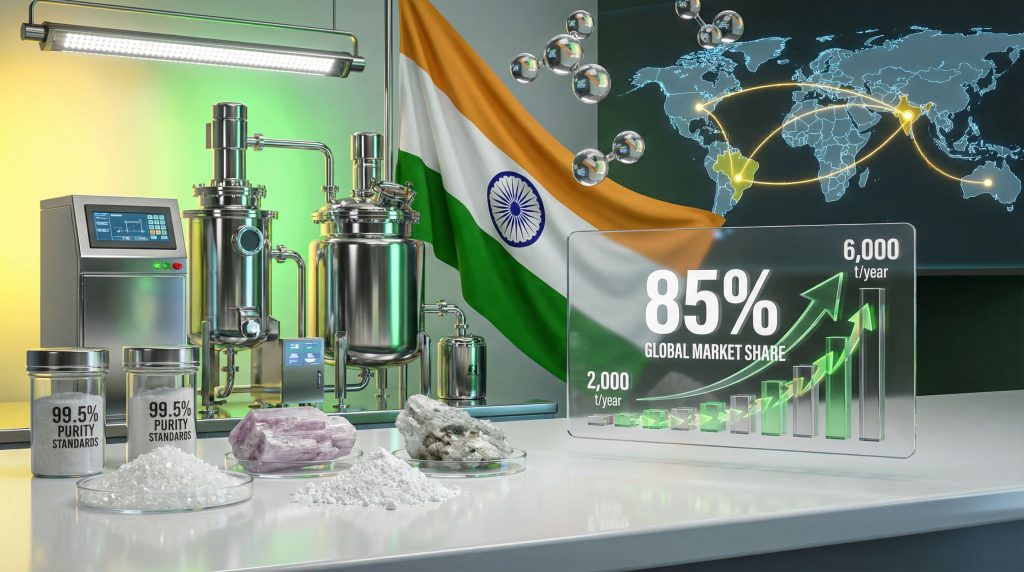
The global battery minerals sector faces structural vulnerabilities that extend far beyond raw material availability, encompassing technological know-how, processing capacity, and demand-side integration. Market participants increasingly recognise that sustainable lithium supply chains require geographically distributed processing capabilities. Furthermore, the recent parceria com a Índia para triplicar refino de lítio demonstrates concrete progress in establishing alternative processing corridors outside traditional market structures.
What Makes Brazil-India Lithium Partnerships Strategically Critical for Western Supply Chains?
Geopolitical Risk Mitigation Through Non-Chinese Processing Routes
The concentration of global lithium refining capacity within Chinese industrial infrastructure creates systemic vulnerabilities that extend throughout Western battery manufacturing supply chains. Current market structures demonstrate that approximately 85 percent of battery-grade lithium processing occurs within Chinese facilities. This concentration affects not merely commodity pricing but fundamental questions of supply security during periods of geopolitical tension.
The partnership between Companhia Brasileira de Lítio (CBL) and Indian firm Altmin represents a tangible mechanism for establishing alternative processing corridors outside Chinese control. CBL operates what industry analysis identifies as the only refinery outside China capable of processing spodumene ore to battery-grade chemical compounds meeting 99.5 percent purity specifications required for lithium-ion cathode production. However, this technological differentiation creates strategic value that transcends simple capacity considerations.
The parceria com a Índia para triplicar refino de lítio demonstrates concrete capital deployment rather than theoretical cooperation agreements. Altmin's US$40 million investment in exchange for a 33 percent equity stake in CBL Refinaria establishes aligned incentives for operational excellence. Consequently, the investment structure transforms CBL's current 2,000 tonnes per annum capacity to 6,000 tonnes annually within a 24-month implementation timeline.
Technology Transfer Mechanisms in Emerging Market Partnerships
Knowledge transfer between Brazilian spodumene processing expertise and Indian battery cathode manufacturing capabilities creates mutual technological advancement opportunities. CBL's refining methodology encompasses sequential chemical treatment of spodumene concentrates through solvent extraction and crystallization stages. This process engineering knowledge represents accumulated intellectual property developed through operational experience spanning multiple economic cycles.
Altmin's selection as CBL's strategic partner reflects specific technological complementarity beyond capital provision alone. The Indian company's focus on battery cathode production creates direct demand-side integration for CBL's refined lithium carbonate output. For instance, this vertical integration extends beyond simple customer-supplier relationships to encompass technology sharing protocols that leverage CBL's processing knowledge.
The 15-year offtake agreement embedded within the partnership structure transforms market exposure characteristics for both parties. CBL gains demand certainty that justifies processing capacity investment, while Altmin secures long-term supply access at predetermined pricing structures. Furthermore, this offtake mechanism addresses fundamental challenges in lithium refining economics, where mining operations typically generate superior returns compared to processing activities.
Joint venture governance structures establish knowledge codification protocols that enable systematic documentation and transfer of processing methodologies. In addition, the equity partnership creates incentive alignment for operational transparency and best practice sharing that extends beyond traditional commercial relationships.
When big ASX news breaks, our subscribers know first
How Do Investment Flows Shape Regional Lithium Processing Capacity?
Capital Deployment Patterns in Latin American Battery Minerals
Foreign direct investment patterns into South American lithium processing infrastructure demonstrate distinct characteristics compared to traditional mining exploration funding. The Altmin-CBL partnership illustrates equity-based capital deployment rather than debt financing. This investment structure creates aligned incentives for long-term capacity optimization and technological advancement.
The US$40 million capital commitment enables a threefold capacity expansion from 2,000 to 6,000 tonnes annually, yielding approximately US$10,000 per tonne of annual processing capacity. This capital intensity metric provides insight into processing facility development costs and establishes benchmarks for evaluating similar brownfield expansion projects. However, the investment represents only direct facility enhancement and excludes working capital requirements.
Regional processing capacity development faces profitability disparities between mining and refining operations that affect capital allocation decisions. Current market dynamics indicate mining operations generate superior returns on invested capital compared to downstream processing activities. Consequently, this return differential explains why standalone refineries struggle to attract capital without demand anchors and predetermined pricing structures.
CBL's mineral resource base provides context for potential future capital deployment beyond current expansion commitments. The company maintains audited resources sufficient for 200,000 tonnes annual production over 15 years, with current planning focused on achieving 115,000 tonnes per year capacity. Furthermore, this resource scale indicates that the 6,000-tonne processing expansion represents an intermediate development phase.
Market Positioning Through Vertical Integration Strategies
The separation between CBL's mining division and CBL Refinaria reflects operational optimisation strategies common in vertically integrated mining companies. This divisional structure enables distinct performance measurement and capital allocation frameworks for operations with different risk profiles. Moreover, mining operations involve long-cycle commodity production dependent on global price movements, while refining requires stable throughput.
Processing Capacity Expansion Scenarios
| Facility Type | Current Output | Projected Capacity | Investment Required | Timeline |
|---|---|---|---|---|
| Spodumene Processing | 2,000 t/year | 6,000 t/year | $40M | 24 months |
| Battery-Grade Refinement | Limited | Industrial Scale | Additional $60M | 36 months |
Brownfield expansion projects offer accelerated development timelines compared to greenfield facilities due to existing infrastructure and regulatory clearances. CBL's refinery expansion operates under fast-track development classification that leverages pre-approved environmental permits. In addition, this regulatory foundation compresses implementation schedules and reduces execution risk compared to new facility development.
Market positioning through vertical integration creates competitive advantages that extend beyond cost optimisation to encompass supply chain control. The CBL-Altmin partnership establishes direct linkages between raw material processing and end-use manufacturing that eliminate intermediary margin compression.
What Are the Long-Term Supply Chain Implications of South-South Cooperation?
Demand Forecasting for Battery-Grade Lithium Compounds
India's state-level commitment to integrated lithium supply chain development creates demand-side anchors essential for justifying new processing investments in partner countries. Government policy frameworks supporting battery cathode manufacturing establish demand certainty that transcends purely market-driven purchasing decisions. Furthermore, this policy alignment distinguishes India from typical commercial customers and indicates governmental support for Western supply chain diversification objectives.
Electric vehicle adoption trajectories across emerging markets create expanding demand bases for battery-grade lithium compounds beyond traditional automotive manufacturing centres. India's domestic EV policy implementation establishes demand forecasting foundations that support long-term supply planning. However, this demand anchor reduces market exposure for processing facility operators and enables strategic planning beyond short-term commodity price cycles.
Battery cathode production requirements establish specific quality parameters that differentiate CBL's processing capabilities from lower-purity alternatives. Battery-grade lithium carbonate achieving 99.5 percent purity standards requires specialised refining expertise and consistent quality control systems. Consequently, this specification requirement justifies premium pricing relative to technical-grade compounds used in non-battery applications.
Energy storage deployment scenarios across BRICS economies create additional demand streams beyond automotive applications. Grid-scale storage systems, residential battery installations, and industrial energy management applications diversify end-use markets. In addition, this diversification enhances demand stability for processing facilities and supports capacity utilisation optimisation across economic cycles.
Competitive Dynamics Against Established Processing Hubs
Chinese processing operations maintain competitive advantages derived from accumulated capital investment and operational experience spanning 15 years of market development. This historical investment created what industry analysis characterises as dumping conditions through overcapacity relative to immediate market demand. Furthermore, Chinese facilities benefit from integrated supply chains, optimised logistics networks, and established customer relationships.
Alternative processing corridors must achieve sufficient scale to compete effectively with Chinese operations while maintaining quality standards required for battery applications. The Brazil-India partnership addresses scale requirements through capacity expansion combined with demand certainty. Moreover, the 15-year offtake agreement provides market guarantees essential for competing against established Chinese suppliers.
Cost structure analysis indicates that sustainable lithium carbonate pricing requires levels between US$15,000 and US$20,000 per tonne to justify new project development while maintaining healthy supply chain margins. However, current market pricing exhibits volatility that affects investment decision-making and capacity utilisation planning for emerging processing operations.
Industry analysis suggests sustainable lithium carbonate pricing requires $15,000-$20,000 per tonne to justify new project development while maintaining healthy supply chain margins across extraction, processing, and manufacturing stages.
Logistics optimisation becomes critical for intercontinental supply arrangements between Brazil and India, requiring efficient transportation networks and inventory management systems. Processing facilities must balance production scheduling with shipping logistics to maintain cost competitiveness. Furthermore, supply chain coordination encompasses raw material sourcing, production planning, and delivery scheduling across multiple time zones.
How Do Regulatory Frameworks Influence Cross-Border Mineral Partnerships?
Bilateral Trade Agreement Structures for Critical Minerals
Brazil-India mineral cooperation operates within broader bilateral trade frameworks that facilitate strategic resource partnerships beyond purely commercial arrangements. Government-to-government cooperation protocols establish policy foundations that support private sector investment while addressing national security considerations. However, these frameworks provide political risk mitigation and regulatory certainty for long-term partnership development.
Strategic mineral classifications affect export licensing requirements and investment approval processes for cross-border partnerships. Brazil's regulatory framework for lithium mining and processing includes specific provisions for foreign investment that balance economic development objectives with resource sovereignty considerations. Furthermore, these regulations establish transparent approval processes while maintaining governmental oversight of strategic resource development.
Environmental compliance standards across jurisdictions require harmonisation of operational protocols and reporting requirements. Processing facilities must meet both Brazilian environmental regulations and Indian import specifications for battery-grade compounds. Consequently, this dual compliance framework necessitates integrated quality management systems and documentation protocols that satisfy regulatory requirements in both countries.
Trade financing mechanisms for critical mineral partnerships often involve development finance institutions and export credit agencies that support strategic supply chain diversification initiatives. These financing structures provide additional risk mitigation and favourable terms compared to purely commercial funding sources. Moreover, they reflect governmental recognition of supply chain security benefits.
Investment Protection Mechanisms in Emerging Market Joint Ventures
Political risk assessment becomes essential for evaluating long-term mining partnerships, particularly given the 15-year timeline for supply agreements and operational commitments. Investment protection mechanisms include bilateral investment treaties, political risk insurance, and dispute resolution protocols. Furthermore, these provide recourse for foreign investors in case of regulatory changes or contract modifications.
Currency hedging considerations affect partnership economics due to commodity pricing typically denominated in US dollars while operational costs occur in local currencies. Exchange rate volatility can significantly impact project returns and requires sophisticated financial risk management strategies. However, maintaining economic viability throughout long-term supply arrangements remains crucial.
Joint venture governance structures must accommodate different legal frameworks and business practices while maintaining operational efficiency. The CBL-Altmin partnership establishes governance protocols that balance Brazilian mining expertise with Indian manufacturing knowledge. In addition, clear authority structures for operational and strategic decisions ensure effective decision-making.
Contract enforcement mechanisms require careful consideration of jurisdictional issues and dispute resolution procedures given the international nature of the partnership. Supply agreements must specify governing law, arbitration procedures, and enforcement mechanisms that protect both parties' interests. Furthermore, practical resolution processes for operational disputes maintain partnership effectiveness.
What Market Forces Drive Pricing Volatility in Lithium Processing?
Price Discovery Mechanisms in Concentrated Markets
Lithium carbonate pricing exhibits significant volatility due to market concentration and limited transparent price discovery mechanisms outside Chinese trading platforms. Current pricing levels reflect supply-demand imbalances exacerbated by geopolitical tensions and supply chain disruption concerns. However, this volatility affects investment planning and capacity utilisation strategies for processing facilities worldwide.
The premium for battery-grade lithium carbonate over technical-grade compounds historically averages approximately 10 percent, reflecting additional processing requirements and quality control costs necessary to achieve 99.5 percent purity specifications. This premium structure provides economic incentives for processing facility upgrades. Furthermore, it requires consistent demand from battery cathode manufacturers to maintain pricing differentials.
Chinese market influence on global lithium pricing extends beyond processing capacity to encompass strategic inventory management and export allocation decisions. Chinese producers can manipulate global price levels through production adjustments and inventory release timing. Consequently, this creates challenges for non-Chinese processors attempting to compete in open markets without similar scale advantages.
Market equilibrium analysis indicates that prices above current levels may be necessary to incentivise sufficient new processing capacity development outside China. The investment-to-capacity ratios demonstrated in the CBL-Altmin partnership suggest that current pricing levels provide adequate returns. However, this requires combination with demand certainty through long-term offtake agreements.
Strategic Inventory Management Across Supply Chain Tiers
Buffer stock policies for processing facilities require careful balance between operational efficiency and market risk mitigation. Processing operations must maintain sufficient inventory to accommodate production scheduling flexibility while minimising working capital requirements. Furthermore, strategic inventory levels become more critical for facilities serving intercontinental markets with extended logistics timelines.
Demand smoothing strategies during market volatility periods enable processing facilities to maintain consistent production schedules despite fluctuating commodity prices. The CBL-Altmin partnership's 15-year offtake agreement provides demand stability that allows operational optimisation. Moreover, capacity utilisation planning operates independently of short-term market fluctuations.
Contract structure optimisation becomes essential for managing price risk while maintaining competitive positioning. Processing facilities must balance fixed-price commitments with cost-plus arrangements to protect margins during input cost volatility. However, providing customers with pricing predictability necessary for downstream manufacturing planning remains crucial.
Working capital management requires sophisticated financial planning due to the extended processing cycles and quality testing requirements for battery-grade compounds. Processing facilities must finance raw material purchases, production operations, and finished goods inventory. Furthermore, awaiting customer payments and quality approvals can extend settlement timelines significantly.
How Do Processing Partnerships Impact Regional Industrial Development?
Value-Added Manufacturing Ecosystem Development
Processing capacity expansion creates foundations for broader industrial ecosystem development through skills development and infrastructure investment that support additional manufacturing activities. The CBL refinery expansion generates employment opportunities requiring specialised chemical processing expertise. However, it also establishes supplier networks for maintenance, logistics, and technical services that benefit regional industrial development.
Technology transfer embedded within the Brazil-India partnership contributes to knowledge accumulation and technical capability development that extends beyond lithium processing. This knowledge base creates potential for industrial diversification and additional value-added manufacturing opportunities. Furthermore, these developments strengthen the regional economy through enhanced technical capabilities.
Infrastructure investment catalysts arise from processing facility development through requirements for transportation networks, power supply systems, and environmental management capabilities. These infrastructure improvements benefit broader industrial development and create foundations for additional manufacturing investments. Moreover, leveraging existing infrastructure investments enhances overall economic efficiency.
Skills development requirements for advanced chemical processing create educational and training opportunities that enhance regional human capital development. Processing facilities require specialised expertise in chemical engineering, quality control, environmental management, and process optimisation. Furthermore, these contribute to broader technical capability development within regional labour markets.
Comparative Regional Advantages in Global Lithium Markets
Brazil's established mining regulatory framework provides competitive advantages for processing facility development through transparent permitting processes and predictable regulatory environments. This regulatory maturity contrasts with jurisdictions experiencing regulatory uncertainty or frequent policy changes. However, transparent frameworks reduce investment risk and development timelines for processing projects.
Strategic Positioning Factors
- Proximity to raw material sources reduces transportation costs and supply chain complexity
- Established mining regulatory frameworks accelerate project development timelines
- Growing domestic EV markets provide demand anchors for processing facility justification
- Non-aligned geopolitical positioning appeals to diversification-focused Western buyers
- Existing industrial infrastructure supports processing facility development and operations
Geographic positioning between major spodumene mining districts and international shipping infrastructure creates logistics advantages for processing facilities serving global markets. Brazil's Atlantic coast location enables efficient shipping to both North American and European battery manufacturing centres. Furthermore, this maintains access to domestic raw material sources, particularly through partnerships focusing on lithium industry innovations.
Energy infrastructure availability affects processing economics due to significant electricity requirements for chemical refining operations. Brazil's hydroelectric generating capacity provides cost-competitive and environmentally favourable power sources that enhance processing facility economics. Moreover, this supports sustainability objectives increasingly important to battery supply chain participants considering broader energy transition and security requirements.
The next major ASX story will hit our subscribers first
What Are the Technical Challenges in Scaling Lithium Refining Operations?
Process Engineering Requirements for Battery-Grade Production
Chemical purity specifications for automotive applications require sophisticated process control systems and quality assurance protocols that exceed requirements for other lithium applications. Battery-grade lithium carbonate must achieve 99.5 percent purity with strict limitations on metallic contaminants that could degrade battery performance. Furthermore, this specification requirement necessitates advanced analytical capabilities and contamination control procedures throughout the refining process.
Quality control systems for consistent output standards require automated monitoring and process adjustment capabilities that ensure specification compliance despite variations in input ore characteristics. Processing facilities must implement statistical process control methodologies and real-time analytical feedback systems. However, maintaining quality consistency while optimising production throughput and efficiency remains challenging.
Environmental management for chemical processing operations encompasses wastewater treatment, air emission control, and solid waste disposal that comply with environmental regulations while minimising operational costs. Processing facility design must incorporate environmental management systems from initial planning stages. Furthermore, ensuring sustainable operations and regulatory compliance throughout facility lifetime becomes increasingly important.
Process optimisation requires continuous improvement methodologies and technical expertise that maximise yield rates while minimising energy consumption and chemical reagent usage. These optimisation efforts become more critical as processing facilities scale capacity. Moreover, seeking to maintain cost competitiveness against established international producers drives continuous improvement initiatives.
Technology Adaptation Strategies for Emerging Market Conditions
Equipment sourcing considerations for processing facility expansion must balance cost optimisation with technical performance requirements and supplier support capabilities. Processing facilities in emerging markets may face longer equipment delivery timelines and higher maintenance costs compared to operations in established industrial regions. However, careful supplier selection and inventory management strategies mitigate these challenges.
Local supplier development for maintenance and operations support creates opportunities for regional industrial capability development while reducing operational dependencies on international technical services. Processing facilities must invest in supplier training and capability development to establish reliable local support networks. Furthermore, ongoing operations and maintenance requirements drive local industrial development.
Knowledge transfer protocols ensure operational excellence through systematic documentation of processing procedures and technical expertise that enable consistent performance despite personnel changes or operational scaling. These protocols become particularly important for joint venture partnerships where technical knowledge must be shared. Moreover, different operational cultures and technical approaches require systematic knowledge codification.
Operational training programs require comprehensive technical education covering process chemistry, quality control procedures, safety protocols, and environmental management that enable local workforce development while maintaining international performance standards. These training investments create regional technical capabilities that support broader industrial development. Furthermore, specific processing operations benefit from enhanced local technical expertise.
How Do These Partnerships Influence Global Lithium Market Structure?
Market Share Redistribution Scenarios
Alternative processing capacity development outside China creates potential for gradual market share redistribution over extended timeframes, though Chinese dominance will likely persist due to existing scale advantages. The Brazil-India partnership represents one component of broader diversification efforts that collectively could reduce Chinese market control. However, this requires development of multiple alternative processing corridors, similar to developments at the Thacker Pass lithium mine.
Western supply chain diversification initiatives require coordinated development of multiple processing facilities and supporting infrastructure to achieve meaningful impact on global market structure. Individual partnerships like CBL-Altmin provide important precedents and technological foundations. Furthermore, replication across multiple countries and partnerships becomes necessary to substantially alter global processing capacity distribution, following insights from lithium market insights.
Timeline assumptions for meaningful market share redistribution span decades rather than years due to capital intensity and development complexity of processing facility projects. Current expansion commitments by CBL and similar operations represent initial steps in longer-term diversification strategies. Moreover, sustained investment and policy support become essential to achieve strategic objectives within broader mining industry evolution trends.
Investment requirements for establishing competitive alternative processing capacity exceed individual partnership capabilities and necessitate coordinated support from development finance institutions. The scale of required investment suggests need for systematic policy frameworks supporting strategic mineral processing development. Furthermore, government agencies and private investors committed to supply chain diversification objectives must coordinate efforts.
Investment Attraction Strategies for Similar Partnerships
Success metrics for evaluating partnership effectiveness encompass operational performance, financial returns, and strategic supply chain diversification contributions that demonstrate value creation for all stakeholders. These metrics must balance commercial objectives with broader strategic goals related to supply chain security. However, geopolitical risk mitigation considerations become increasingly important in partnership evaluation.
Replication potential across other critical mineral supply chains depends on identification of similar technological capabilities, demand anchors, and financing structures that enable partnership development. The CBL-Altmin model provides frameworks for joint venture structuring, technology transfer protocols, and risk mitigation mechanisms. Furthermore, these frameworks prove applicable to other strategic mineral partnerships across different commodities and regions.
Policy recommendations for encouraging strategic mineral cooperation include investment incentives, regulatory streamlining, and bilateral trade agreement provisions that reduce barriers to cross-border partnership development. These policy frameworks should balance economic development objectives with strategic supply chain security considerations. Moreover, maintaining transparent and predictable regulatory environments supports long-term partnership development, as demonstrated by recent empresa indiana investimentos.
International cooperation mechanisms through multilateral organisations and bilateral agreements can facilitate additional partnerships by providing political risk mitigation, financing support, and technical assistance. These mechanisms become increasingly important as geopolitical tensions highlight supply chain vulnerability concerns. Furthermore, developing alternative supply chain corridors requires sustained international cooperation and coordination among multiple stakeholders, as highlighted by recent negociações para acordos de minerais críticos.
Disclaimer: This analysis contains forward-looking statements and projections based on current market conditions and partnership announcements. Actual results may vary significantly due to commodity price volatility, regulatory changes, technological developments, and geopolitical factors affecting global lithium markets. Investment decisions should consider comprehensive due diligence and professional financial advice.
Looking to Navigate the Complex World of Critical Mineral Investments?
Discovery Alert's proprietary Discovery IQ model delivers instant notifications on significant ASX mineral discoveries, transforming complex geological data into actionable investment insights for both short-term traders and strategic investors. Stay ahead of market movements by exploring Discovery Alert's proven track record of identifying major discoveries before they gain widespread attention, then begin your 14-day free trial to position yourself at the forefront of Australia's dynamic critical minerals sector.