July 19, 2026
The Iron Ore Quality Divide: Why Brazil's Structural Advantage Is Widening at the Right Moment
Commodity markets rarely reward patience, but the iron ore sector in 2026 is proving an exception. Decades of volume-driven competition are giving way to a fundamentally different competitive environment, one where the chemical composition of ore in the ground matters as much as the cost of getting it out. The global steel industry is undergoing what analysts at Shanghai Metals Market (SMM) describe in their Steel Industry Analysis and Outlook – July 2026 report as a qualitative transformation, a structural repricing of what iron ore is actually worth based on grade, carbon intensity, and supply chain reliability rather than raw tonnage.
For Brazil, the world's second-largest iron ore exporter, this transition represents something rare in commodity cycles: a convergence of geological endowment, energy infrastructure, and shifting end-market demand that creates a genuine, durable Brazil iron ore strategic opportunity.
When big ASX news breaks, our subscribers know first
Understanding the Structural Surplus and What It Actually Means for Producers
The SMM's July 2026 report projects a cumulative global iron ore surplus approaching 400 million tonnes over the next five years. Three forces are driving this: ongoing capacity expansion by major Australian miners, continued growth from Brazilian operations, and the impending production ramp-up from the Simandou megaproject in Guinea, West Africa, one of the largest undeveloped iron ore deposits ever brought into production.
On the demand side, the picture is equally challenging. China's property sector contraction, combined with government-enforced steel output restrictions, has permanently altered the trajectory of Chinese iron ore imports. The China steel and iron ore market has, for more than two decades, functioned as an almost reliable price floor, absorbing supply surpluses and supporting elevated price levels. That dynamic has fundamentally changed.
Furthermore, the iron ore surplus outlook suggests that in a cost-curve pricing environment, where prices settle near the marginal cost of the highest-cost producers, the market bifurcates sharply:
- Low-grade, high-cost ore becomes uneconomic first
- Mid-grade operations face margin compression
- High-grade, low-cost producers retain profitability and gain market share
- Premium pricing shifts from being cyclical to being structural
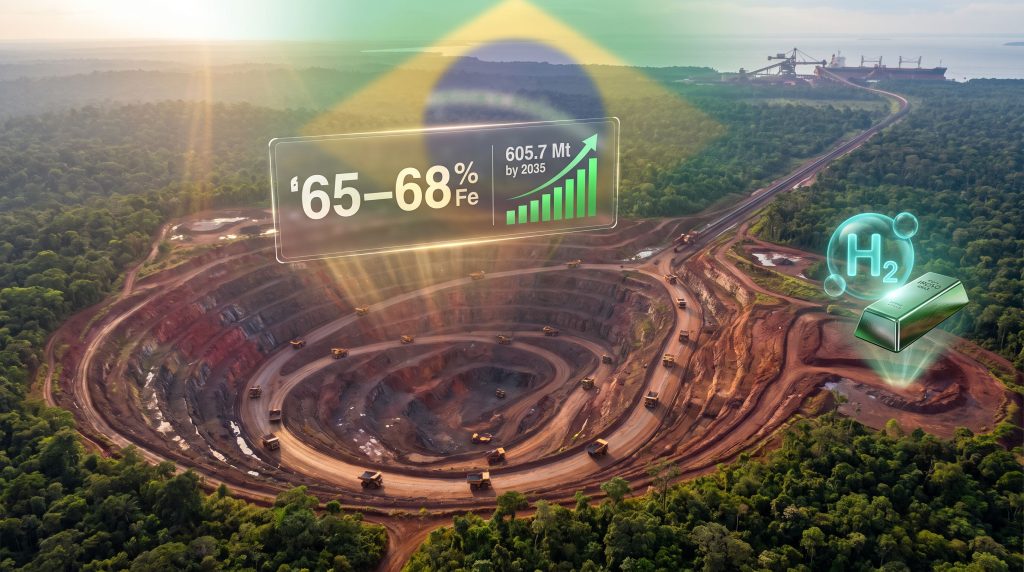
This is precisely the environment where Brazil's Carajás deposits, producing ore averaging 65–68% Fe content, become systemically more valuable rather than simply more desirable.
The Blast Furnace Efficiency Factor: A Technically Underappreciated Driver
One aspect of this dynamic that receives insufficient attention outside specialist circles is the operational impact of ore grade on blast furnace efficiency. As steelmakers face compressed margins, they increasingly model the total cost per tonne of steel produced, not merely the price paid for raw ore. Higher-grade ore reduces the quantity of coke required per unit of hot metal output, lowers slag volumes, and improves furnace productivity rates.
In practical terms, a steel mill feeding 65%+ Fe content Brazilian ore achieves meaningfully lower operating costs than one running 58–60% Fe content ore from certain Australian Pilbara operations, even if the nominal price differential appears modest. This grade-driven operational advantage becomes self-reinforcing in a low-margin environment, accelerating the market share gains of premium ore suppliers. The interplay between grade versus permitting decisions is consequently a critical factor for new project developers navigating this environment.
Brazil's Renewable Energy Matrix: The Competitive Dimension Most Analysts Underweight
Brazil's electricity grid, drawing on hydropower, wind, and solar for approximately 85% or more of its generation capacity, creates a secondary advantage that goes beyond iron ore mining itself. The country's clean energy base enables the production of green hydrogen at costs estimated to be substantially lower than competing iron ore-producing nations, with some projections suggesting a cost advantage of up to 65% compared to peers such as Australia or European producers.
This matters because the global steel industry's decarbonisation trajectory runs directly through hydrogen-based direct reduction (H₂-DRI) technology. Hydrogen iron ore reduction uses hydrogen rather than metallurgical coal as the reducing agent, dramatically cutting carbon emissions per tonne of steel. Critically, H₂-DRI requires iron ore feedstock exceeding 67% Fe content to function efficiently. Lower-grade ores introduce processing inefficiencies that undermine the carbon reduction economics.
Brazil sits at the intersection of both requirements: it possesses the ore grade and the energy cost structure to produce what the industry is increasingly calling green iron production, reduced iron produced via hydrogen-based processes powered by renewable electricity.
| Competitive Dimension | Brazil | Australia | Simandou (Guinea) |
|---|---|---|---|
| Average Ore Grade (Fe%) | 65–68% | 57–62% | 65%+ |
| Renewable Energy Cost | Very Low | Moderate–High | Very High |
| Green H₂ Production Cost | Among lowest globally | Moderate | Very High |
| Logistics Maturity | High | Very High | Low (developing) |
| Green Iron Production Potential | Very High | Moderate | Low (near-term) |
| Political/Regulatory Risk | Moderate | Low | High |
The Value Chain Pivot: From Exporting Tonnes to Exporting Value
The SMM analysis published in July 2026 makes explicit what Brazilian industry strategists have been debating for years: the country's most significant economic opportunity lies not in exporting more raw ore, but in capturing processing margin through domestic value-added production.
The numbers behind this thesis are striking. If Brazil were to produce 10 million tonnes of green iron annually by 2040, the downstream economic impact would include:
- Approximately 35,500 new jobs created across the value chain
- An estimated 12.8 million tonnes of CO₂ emissions avoided annually
- Export revenues that could potentially more than double compared to equivalent volumes of raw ore
The revenue uplift potential is the critical insight here. Processed green iron and direct reduced iron (DRI) pellets command significantly higher prices per tonne than raw ore, with some industry modelling suggesting a premium of US$80–120 per tonne over raw ore equivalents once carbon certification and market positioning are factored in. For a country exporting hundreds of millions of tonnes per year, even a partial conversion of export volumes to processed product fundamentally transforms the sector's contribution to national GDP.
The regulatory environment for this transition shifted meaningfully in December 2025, when Brazil's Senate passed a National Policy for Critical and Strategic Minerals, designed specifically to incentivise domestic mineral processing and strengthen supply chain integration. Brazil's green iron opportunity could consequently drive substantial jobs growth, trade expansion, and a broader global steel transformation in the decades ahead.
Understanding DRI and Why It Matters for Non-Specialist Investors
Direct Reduced Iron (DRI) is produced by removing oxygen from iron ore using a reducing gas, historically natural gas, but increasingly hydrogen. The resulting product, sometimes called sponge iron, is a highly metallised iron product used as a premium feedstock in electric arc furnaces (EAF). Because EAF steelmaking generates far lower carbon emissions than traditional blast furnace routes, demand for DRI as an EAF input is growing rapidly across European, North American, and Japanese steel industries.
Brazil's strategic positioning in this emerging DRI supply chain depends on maintaining consistent access to:
- High-grade ore concentrates above 67% Fe content
- Competitively priced green hydrogen from renewable energy sources
- Processing infrastructure capable of producing certified low-carbon DRI at scale
- Off-take agreements with downstream steelmakers in Europe, Japan, and South Korea
The Amapá Project, which recently cleared regulatory review, illustrates this model. It targets 67.5% Fe DR-grade concentrate and includes a 194-kilometre dedicated railway connecting mining operations to export logistics, directly aligned with the specifications required by green steel producers.
Geographic Diversification: The Urgency Beneath the Strategy
Brazil's historical reliance on China as the primary destination for iron ore exports has created a concentration risk that the current demand contraction makes difficult to ignore. The SMM's July 2026 outlook identifies the shift in global steel demand toward India, Southeast Asia, and the Middle East as one of the defining structural trends of the coming decade.
India stands out as the most compelling near-term target. The country is in an aggressive steelmaking capacity expansion cycle, with domestic consumption growth running well above global averages and a genuine shortage of domestically available high-quality iron ore feedstock in certain regions.
The Gulf Cooperation Council (GCC) nations present a complementary opportunity. Several Gulf states are scaling up steel production capacity using EAF and DRI-based plants, which require premium-grade ore concentrates of exactly the type Brazil produces. Brazil's maritime routes via the Cape of Good Hope provide cost-competitive access to both Indian Ocean and Gulf market destinations.
Geopolitical volatility, including factors such as the US-Iran tensions referenced in the SMM report, periodic disruptions to coal supply chains, and ongoing trade fragmentation through anti-dumping mechanisms, creates episodic price spikes that reward producers with diversified customer bases and reliable supply track records.
Key Brazilian Projects Driving the Investment Cycle
Brazil's production growth trajectory, targeting 605.7 million tonnes per year by 2035 at a 3.0% compound annual growth rate, rests on a combination of established expansions and emerging project pipelines. Vale's expansion plans to feed Chinese demand further underscore the scale of capital commitment underpinning this growth phase.
Vale's S11D Phase 2 remains the centrepiece, representing one of the most cost-efficient iron ore capacity additions globally. S11D's autonomous mining technology and consistent ore quality set the benchmark for low-cost, high-grade production.
Bahia Mineração (Bamin) has attracted significant international attention, featuring ore body characteristics averaging 68% Fe content and integrated rail and port logistics targeting 26 million tonnes of annual production capacity.
Emerging developments including Block 8, Jambeiro, and the Bamin restart collectively underpin the production growth pipeline, with US$19.6 billion in total sector investment committed for 2025–2029, centred on Minas Gerais as the primary investment hub.
The next major ASX story will hit our subscribers first
Navigating the Risks: Challenges That Require Clear-Eyed Assessment
The Brazil iron ore strategic opportunity carries genuine risks that investors and industry participants should evaluate carefully.
Logistics bottlenecks remain a material constraint. Despite world-class export infrastructure at the Ponta da Madeira terminal in Maranhão, Brazil's inland rail and multimodal logistics networks face capacity limitations that can add cost and reduce supply chain predictability for new mining districts in Pará, Minas Gerais, and Bahia.
Environmental licensing complexity is perhaps the most frequently underestimated risk in project development timelines. Brazil operates one of the world's most comprehensive environmental regulatory frameworks. However, while important for long-term social licence and ecosystem protection, the licensing process can extend project development timelines significantly, introducing scheduling uncertainty for capital commitments.
Green iron scaling represents the most capital-intensive challenge. Building the H₂-DRI infrastructure, securing green hydrogen supply chains at sufficient volume, and attracting long-term off-take commitments from European or Asian steelmakers requires coordination across multiple parties over extended timeframes. The capital intensity is substantial, and the technology transfer requirements from more advanced hydrogen economies are non-trivial.
It is worth noting that the very capital intensity that makes green iron scaling difficult also creates a durable competitive moat. Nations that successfully build this infrastructure in the 2025–2035 window will capture decades of premium pricing in low-carbon steel supply chains. Late movers risk being structurally locked into the commoditised raw ore segment as carbon border adjustment mechanisms progressively reshape trade economics.
The Macro Intelligence Imperative
One insight from the SMM's July 2026 analysis deserves particular emphasis for practitioners across the Brazilian mining sector. The global steel market in the current period is operating with an unusually high sensitivity to geopolitical and supply disruption events. Accidents at Chinese coal mines, trade policy shifts, and regional conflicts can generate short-term price spikes that create decision windows of limited duration.
In this environment, the ability to rapidly interpret market signals, including granular cost curve data, trade route mapping, and margin analysis for Chinese steel mills, has consequently shifted from a strategic advantage to an operational necessity for miners, traders, and investors operating in or around the Brazilian iron ore sector.
The SMM report frames this directly, noting that decisions based on intuition rather than data-driven market intelligence carry unacceptable risk in a market operating at such a sensitive equilibrium point.
Frequently Asked Questions
Why does iron ore grade matter so much in the current market?
In a cost-curve pricing environment where margins are compressed, steelmakers optimise every cost variable. Higher-grade ore reduces coke consumption per tonne of hot metal, lowers slag volumes, and improves blast furnace productivity. Brazilian ore at 65–68% Fe provides measurable operating cost advantages that become more valuable as steel margins compress.
What is the significance of Brazil's December 2025 mineral policy?
Brazil's Senate approved a National Policy for Critical and Strategic Minerals in December 2025, creating a regulatory framework specifically designed to incentivise domestic mineral processing. This provides a clearer policy environment for investment decisions in green iron and DRI production infrastructure, though specific project approvals depend on individual regulatory processes.
How does green hydrogen production cost affect Brazil's green iron competitiveness?
Green hydrogen is produced using renewable electricity through electrolysis. Because Brazil generates approximately 85% or more of its electricity from renewable sources, the input cost of green hydrogen production is structurally lower than in countries reliant on fossil fuel generation. This cost advantage flows directly into the economics of H₂-DRI green iron production.
What is the production outlook for Brazilian iron ore through 2035?
Brazil's iron ore production is projected to grow at approximately 3.0% CAGR from 2026 to 2035, reaching an estimated 605.7 million tonnes per year by 2035, underpinned by S11D Phase 2, Bamin, Block 8, Jambeiro, and other pipeline projects backed by US$19.6 billion in committed investment for 2025–2029.
Disclaimer: This article contains forward-looking statements, production forecasts, price projections, and market analyses sourced from third-party industry reports including SMM's Steel Industry Analysis and Outlook (July 2026). These projections involve assumptions and uncertainties that may cause actual outcomes to differ materially. This content is provided for informational purposes only and does not constitute financial or investment advice. Readers should conduct independent due diligence before making any investment decisions.
Want to Track the Next Major Mineral Discovery Before the Broader Market Does?
Discovery Alert's proprietary Discovery IQ model delivers real-time alerts on significant ASX mineral discoveries — turning complex geological and commodity data into actionable investment insights for both short-term traders and long-term investors. Explore how historic discoveries have generated extraordinary returns on Discovery Alert's dedicated discoveries page, and begin your 14-day free trial today to position yourself ahead of the market.