August 26, 2026
Understanding Brazil's Marine Fuel Export Tax Framework
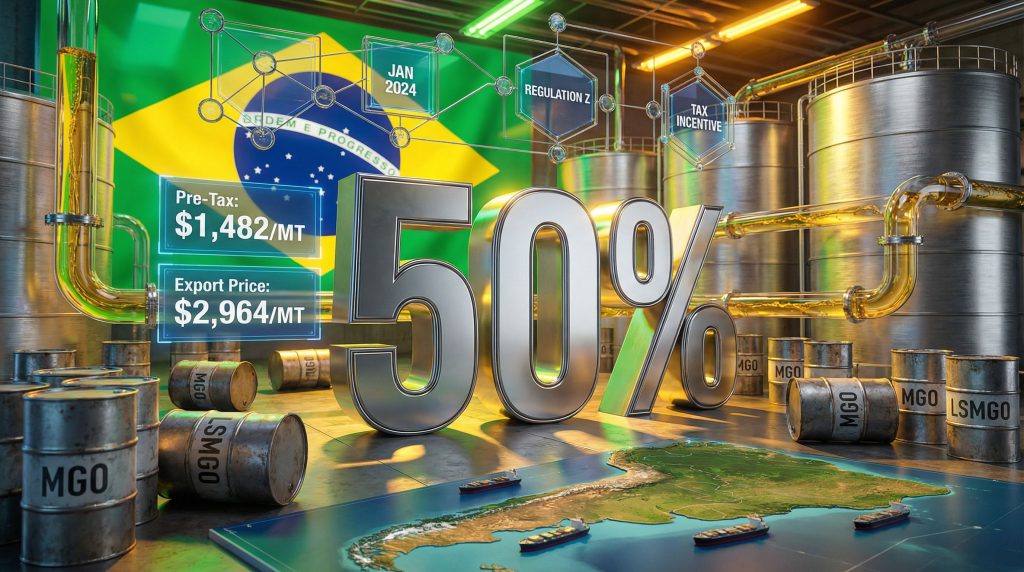
Brazil's implementation of a 50% export tax on marine gasoil (MGO) represents a dramatic shift in the global marine fuel landscape. Brazil's MGO demand slumps due to export tax policies have created unprecedented disruptions, fundamentally altering pricing dynamics and supply chain relationships that have operated unchanged for decades. This regulatory intervention, which became effective on March 12, 2026, targets diesel derivatives exported from Brazilian ports.
The tax mechanism operates through a straightforward but economically devastating formula. When MGO was assessed at $1,482 per metric tonne in Santos and $1,541 per metric tonne in Rio de Janeiro on March 18, 2026, the 50% levy effectively doubled these prices to $2,964 and $3,082 respectively. This mathematical reality transforms Brazil from a competitive supplier into a premium-priced option that most international buyers cannot economically justify.
Market participants have responded with unprecedented speed and decisiveness. Industry sources describe Brazil's MGO demand slumps due to export tax effects as having become completely absent, with buyers shifting wholesale to very-low-sulfur fuel oil (VLSFO) as their primary marine fuel choice. Even domestically flagged vessels operating under cabotage rules, which theoretically exempt them from the tax, have prioritised VLSFO purchases due to MGO's inflated domestic pricing structure.
Key Policy Parameters:
• Tax Rate: 50% ad valorem charge on export transactions
• Coverage: Marine gasoil exports and sales to internationally flagged vessels in Brazilian ports
• Exemptions: Cabotage voyages for domestic-flagged vessels
• Implementation: March 12, 2026
• Price Impact: 100% increase in final invoice pricing
When big ASX news breaks, our subscribers know first
Geopolitical Catalyst Behind Export Restrictions
The timing of Brazil's export tax coincides with significant disruptions to global energy supply chains. Furthermore, the oil price rally has created additional pressures on international markets. The Strait of Hormuz, through which approximately 20% of the world's oil typically flows, has experienced substantial interference from regional conflicts.
This critical maritime chokepoint's vulnerability has created ripple effects throughout international fuel markets, prompting various nations to reassess their energy security strategies. Consequently, oil price movements have become increasingly volatile as supply chain uncertainties mount.
Brazil's domestic market faces acute shortages of diesel derivatives, creating the political and economic justification for export restrictions. The government's stated objective involves retaining petroleum products within domestic markets while containing price increases that would otherwise result from global supply constraints. This policy framework prioritises domestic fuel affordability over export revenue generation, reflecting a fundamental shift toward energy nationalism.
Global Supply Chain Context:
• Strait of Hormuz Impact: 20% of global oil flows disrupted
• Brazilian Market Pressure: Domestic diesel derivative shortages
• European Exposure: 20% of EU and UK imports transit through affected regions
• Middle East Infrastructure: Refineries in Kuwait and Saudi Arabia sustaining direct attacks
The broader economic environment adds complexity to this policy implementation. Brazil's Central Bank reduced its target interest rate to 14.75% in March 2026, following an extended period at 15% from June 2025. Headline inflation decelerated to 3.81% annually in February 2026, though inflation expectations remained above central bank targets at 4.1% for 2026 and 3.8% for 2027.
In addition, the US oil production decline has contributed to global supply tightness, while tariff economic pressures continue to influence international trade dynamics. GDP growth slowed to 2.3% for full-year 2025, down from 3.4% in 2024, indicating economic pressures that influence energy policy decisions.
Recent attacks on regional energy infrastructure underscore the geopolitical risks driving Brazilian policy. Iranian drone strikes targeted refineries in Kuwait and Saudi Arabia, including the 400,000 barrel-per-day Samref refinery at Yanbu on the Red Sea. These facilities represent critical components of global refining capacity, with disruptions creating immediate upward pressure on international fuel prices and reinforcing the rationale for domestic protection measures.
Tax Implementation Mechanics and Compliance Structure
The 50% export tax operates as an ad valorem mechanism that fundamentally alters invoice structures for Brazilian marine fuel transactions. Exporters must adjust their pricing documentation to reflect the tax obligation, creating administrative complexities and compliance requirements that extend beyond simple percentage calculations.
Calculation Framework:
| Port Location | Base MGO Price | Tax Amount (50%) | Final Export Price | Price Impact |
|---|---|---|---|---|
| Santos | $1,482/MT | $741/MT | $2,964/MT | +100% |
| Rio de Janeiro | $1,541/MT | $771/MT | $3,082/MT | +100% |
The exemption structure creates a two-tiered system based on vessel flagging and operational characteristics. Domestic-flagged vessels engaged in cabotage operations can access MGO without tax obligations, theoretically maintaining competitive pricing for internal Brazilian maritime trade. However, market evidence indicates that even exempted vessels have shifted toward VLSFO purchases due to overall price pressures within the Brazilian fuel system.
Compliance Requirements:
• Invoice Modification: Export documentation must reflect tax-inclusive pricing
• Vessel Classification: Distinction between domestic and international flagging
• Transaction Recording: Administrative burden on exporters for compliance documentation
• Payment Timing: Tax remittance procedures aligned with export transaction completion
Contract modification procedures have become critical for existing supply agreements established before the March 12 implementation date. Brazilian suppliers report widespread volume cancellations from African and European buyers who cannot absorb the doubled pricing structure. These cancellations represent immediate disruption to established trade relationships and cash flow projections for Brazilian exporters.
The force majeure implications of this policy change create legal uncertainties for existing contractual obligations. Suppliers must navigate between fulfilling pre-existing agreements and managing the economic impossibility of honouring contracted prices under the new tax regime. This tension has prompted industry-wide contract renegotiations and, in many cases, complete termination of supply relationships.
Market Response and Adaptation Strategies
The immediate aftermath of the tax implementation reveals the speed at which global fuel markets can reconfigure supply relationships. Petrobras, Brazil's state-owned oil company, suspended MGO exports entirely, representing a complete withdrawal from international markets rather than attempting to compete at tax-inflated prices.
Buyer behaviour has shifted dramatically across all vessel categories. International-flagged vessels calling at Brazilian ports have eliminated MGO purchases, while domestic-flagged vessels have reduced their MGO consumption despite exemption availability. This universal shift toward VLSFO indicates that the tax has created broader pricing distortions within Brazil's domestic fuel market structure.
Industry Adaptation Patterns:
• Volume Cancellations: African and European buyers terminating scheduled deliveries
• Fuel Substitution: Universal shift from MGO to VLSFO across vessel categories
• Contract Modifications: Wholesale renegotiation of existing supply agreements
• Export Suspension: Major suppliers withdrawing from international markets completely
Alternative sourcing strategies have emerged as buyers seek replacement supplies outside Brazilian markets. Argentina and Trinidad represent potential substitution sources, though their capacity to absorb displaced Brazilian volumes remains uncertain. The geographic redistribution of buying patterns creates new logistical challenges and potentially higher transportation costs for end users.
Supply Chain Reconfiguration Challenges
Regional competitive positioning has shifted substantially, with Brazil's traditional export markets now served by alternative suppliers. This geographic reallocation creates both opportunities and constraints across South American fuel markets. Suppliers in neighbouring countries may benefit from increased demand, while Brazilian exporters face permanent market share erosion.
The speed of market adaptation demonstrates the elasticity of marine fuel demand when price differentials become extreme. Rather than absorbing cost increases, buyers have demonstrated willingness to modify fuel specifications, alter purchasing locations, and restructure supply relationships entirely.
Furthermore, global trade disruptions have created additional complexity as buyers navigate multiple supply chain challenges simultaneously.
Economic Impact Analysis and Revenue Implications
The export tax generates government revenue through a mechanism that simultaneously destroys the underlying tax base. While each transaction subject to the 50% levy produces substantial tax collection, the elimination of export volumes reduces total revenue potential. This paradox illustrates the tension between short-term revenue generation and long-term export competitiveness.
Revenue Impact Assessment:
• Tax Collection: Substantial per-transaction revenue from remaining exports
• Volume Collapse: Dramatic reduction in taxable transaction frequency
• Net Revenue: Uncertain outcome due to competing effects
• Export Earnings: Permanent loss of foreign exchange generation
Brazilian suppliers face immediate cash flow disruptions as established export contracts become economically unviable. The cancellation of scheduled deliveries represents not only lost revenue but also stranded inventory and unutilised refining capacity. These operational challenges compound the direct tax burden by creating secondary economic inefficiencies.
Trade balance effects extend beyond immediate transaction impacts. However, Brazil's MGO demand slumps due to export tax policies have fundamentally altered the country's petroleum product export profile. The reduction in marine fuel exports, even if partially offset by increased tax revenue, represents a fundamental shift in the country's international trade position.
Competitive Positioning Consequences
Brazil's market share in African and European marine fuel markets faces permanent erosion. Alternative suppliers from Argentina, Trinidad, and other regional producers can capture displaced volumes, potentially establishing long-term customer relationships that persist even if Brazilian export taxes are subsequently reduced or eliminated.
The preservation of customer relationships becomes critical for Brazilian suppliers contemplating future market re-entry. Current volume cancellations and contract terminations may create lasting damage to commercial relationships that took years to establish, representing intangible asset destruction beyond immediate revenue impacts.
Regional Policy Context and Strategic Implications
Brazil's export tax represents part of a broader trend toward energy nationalism across Latin America and other major commodity-producing regions. Governments increasingly prioritise domestic energy security over export revenue optimisation, particularly during periods of global supply instability.
This policy approach parallels historical precedents in other commodity sectors. Brazil has previously implemented export restrictions on soybeans and iron ore during periods of domestic scarcity or price volatility. These experiences provide guidance regarding potential duration, modification procedures, and eventual policy reversal mechanisms.
Historical Policy Framework
The integration with broader economic policy objectives becomes evident when examining concurrent monetary and fiscal measures. The Central Bank's interest rate reduction to 14.75% occurs simultaneously with export restrictions, suggesting coordinated policy implementation designed to balance domestic economic stimulus with energy security objectives.
International Trade Implications:
WTO compliance considerations surrounding export restrictions create potential legal challenges for Brazil's policy implementation. While governments maintain sovereign authority over natural resource exports during supply emergencies, the duration and scope of such measures face international trade law scrutiny.
Diplomatic consequences with traditional importing partners may extend beyond immediate commercial relationships. African and European buyers who relied on Brazilian supply relationships may seek alternative arrangements that reduce future dependence on Brazilian exports, potentially creating lasting shifts in international energy partnerships.
The next major ASX story will hit our subscribers first
Future Policy Evolution and Market Adaptation
The sustainability of Brazil's export tax depends largely on domestic supply conditions and global market developments. If Strait of Hormuz disruptions resolve and international prices stabilise, the economic justification for maintaining export restrictions may diminish. Conversely, prolonged global supply instability could reinforce the policy framework and potentially expand its scope to additional petroleum products.
Policy Modification Scenarios:
• Tax Rate Adjustments: Potential reduction from 50% to more moderate levels
• Product Scope Changes: Extension to additional marine fuel categories
• Duration Specifications: Temporary implementation with defined sunset provisions
• Trigger Mechanisms: Automatic policy reversal based on supply conditions
Market structure evolution appears inevitable regardless of policy duration. The demonstrated willingness of buyers to substitute fuel types and modify supply chains suggests that even temporary disruptions create permanent behavioural changes. Brazilian suppliers may find that market re-entry requires substantial relationship rebuilding and competitive pricing to overcome established alternative arrangements.
Long-term Strategic Assessment
Investment implications for Brazilian refining capacity may favour domestic distribution infrastructure over export-oriented facilities. The policy signal regarding government priorities could influence capital allocation decisions and strategic planning for major petroleum companies operating in Brazilian markets.
Regional policy coordination with neighbouring producers becomes increasingly important as Brazil's export reduction creates opportunities for alternative suppliers. Argentina, Trinidad, and other regional producers may coordinate their responses to capture displaced demand while managing their own domestic supply requirements.
Policy Effectiveness and Market Resilience
The immediate success of Brazil's export tax in retaining domestic fuel supplies remains unclear given the wholesale shift toward VLSFO across all market segments. While the policy effectively eliminated MGO exports, it also appears to have reduced domestic MGO consumption, potentially undermining the original supply retention objective.
Effectiveness Metrics:
• Supply Retention: Unclear due to reduced domestic consumption
• Price Stabilisation: Mixed results with continued market volatility
• Revenue Generation: Limited by volume collapse
• Market Disruption: Complete transformation of buyer behaviour
The resilience of global marine fuel markets demonstrates the limitations of unilateral export restrictions when substitute products remain available. The rapid shift toward VLSFO indicates that buyers possess sufficient flexibility to avoid tax-inflated pricing, reducing the policy's effectiveness in generating sustainable revenue or maintaining export relationships.
In particular, diesel shortage concerns have created additional complexity as Brazil attempts to balance domestic supply requirements with export market participation.
Brazil's MGO demand slumps due to export tax effects will likely persist as long as the current policy framework remains in place. Future monitoring requirements must consider both intended and unintended policy consequences. While the export tax successfully restricts MGO exports, its broader impact on domestic fuel markets, refining economics, and international trade relationships creates complexities that extend far beyond the original policy objectives.
Investment Disclaimer: This analysis contains forward-looking statements and market projections that involve inherent risks and uncertainties. Commodity markets, particularly during periods of geopolitical instability, can experience rapid and unpredictable changes. Readers should conduct independent research and consult qualified professionals before making investment or business decisions based on this information.
Are You Tracking Marine Fuel Market Disruptions for Investment Opportunities?
Brazil's dramatic export tax implementation demonstrates how quickly regulatory changes can reshape entire commodity sectors, creating both risks and opportunities for investors. Discovery Alert's proprietary Discovery IQ model provides real-time insights into ASX-listed companies exposed to marine fuel markets and energy sector developments, helping subscribers identify actionable opportunities before broader market awareness develops. Begin your 14-day free trial today to stay ahead of rapidly evolving commodity market dynamics.