June 13, 2026
The Ocean as a Resource Frontier: Why Brazil Is Looking Beyond Its Landmass
The global race to secure critical minerals is reshaping how nations define their resource boundaries. For most of the twentieth century, a country's mineral wealth was measured by what lay beneath its soil. That calculus is changing. Advances in subsea mapping technology, growing pressure on land-based reserves, and the surging demand for battery-critical materials have collectively pushed governments and state-owned enterprises toward an entirely different domain: the ocean floor.
Brazil sits at a fascinating intersection of these forces. Already one of the world's foremost mining nations, it commands the largest known reserves of niobium on the planet, ranks among the top producers of iron ore, and is rapidly developing its land-based lithium and rare earth sectors. Yet Brazilian policymakers and industrial strategists are increasingly asking whether the country's resource identity needs to extend several hundred kilometres further, beneath the Atlantic waters of its exclusive economic zone (EEZ).
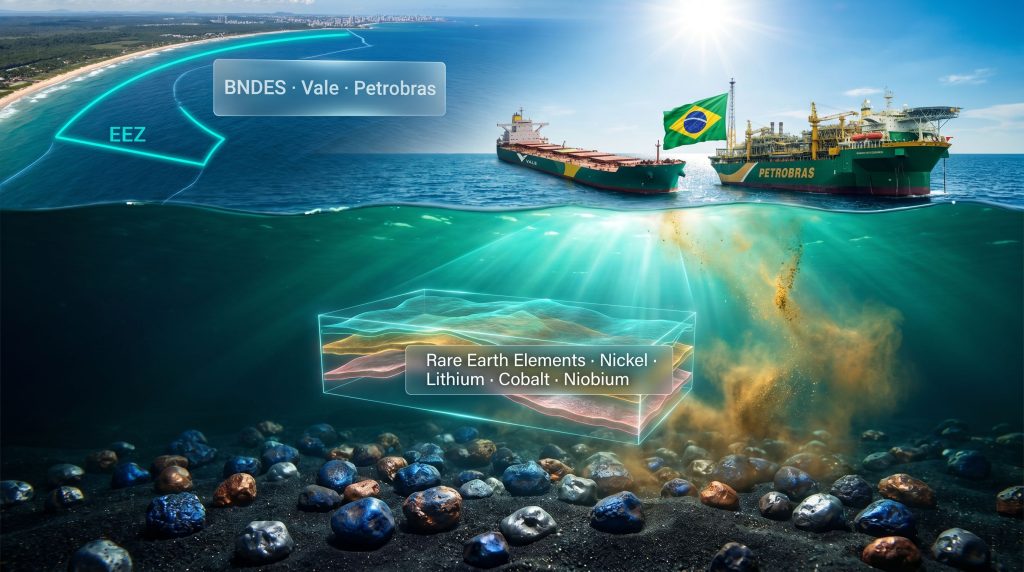
The institutional architecture now taking shape around Brazil marine mining with Vale and Petrobras offers a revealing window into how resource-rich emerging economies are approaching the seabed question: not through speculative new entrants, but by leveraging the deepwater technical expertise and financial firepower of existing national champions.
When big ASX news breaks, our subscribers know first
An Offshore Economy Already Running at Scale
Before examining what lies ahead, it is worth appreciating what Brazil has already built beneath its coastal waters. The country's offshore oil and gas sector is not a nascent industry. It is a mature, technically sophisticated operation that generates a substantial share of national energy output.
Approximately 10% of Brazil's total oil production and a striking 80% of its natural gas output originates from offshore operations, according to reporting by BNamericas. This is not incidental infrastructure. It represents decades of accumulated engineering knowledge, subsea robotics capability, remotely operated vehicle (ROV) expertise, and deepwater logistics systems. The Brazilian Navy has also been an active participant in federal marine mapping programmes, contributing hydrographic and bathymetric data that is now being assessed for mineral prospecting relevance.
This pre-existing offshore industrial base is critical context for understanding why the marine mining conversation in Brazil is qualitatively different from equivalent discussions in countries without such foundations. The question is not whether Brazil can develop offshore resource capability — it already has one. The question is whether that capability can be intelligently redirected toward mineral extraction.
What the Seabed Actually Holds: Target Minerals and Strategic Relevance
Brazil's marine mineral mapping programme is not a single-commodity exercise. The federal government's assessment, conducted in partnership with the Navy and financed through BNDES, is identifying prospective zones across a range of mineral categories with direct relevance to clean energy technology supply chains. Furthermore, the critical minerals energy transition agenda has lent additional urgency to these mapping efforts.
| Mineral | Land-Based Status | Offshore Potential | Strategic Relevance |
|---|---|---|---|
| Iron Ore | Global top producer | Limited offshore data | Established export commodity |
| Rare Earth Elements | Emerging producer | Under active survey | EV supply chains, defence |
| Nickel | Moderate reserves | Prospective deepwater | Battery manufacturing |
| Niobium | World's largest reserves | Unexplored offshore | Steel alloys, aerospace |
| Lithium | Growing land production | Early-stage mapping | Energy storage, EVs |
| Copper | Moderate land base | Prospective shallow zones | Grid infrastructure |
The marine plan currently identifies areas requiring what Brazilian authorities describe as more rigorous analysis — a term that signals the transition from broad geological reconnaissance to targeted feasibility assessment. Polymetallic nodules, cobalt-rich ferromanganese crusts, and seafloor massive sulphides are among the deposit types that have attracted attention in Brazil's Atlantic maritime zones, though detailed grade data from offshore surveys has not yet been made public.
One underappreciated dimension of Brazil's seabed mineral story is the country's niobium position. Brazil already controls an estimated 90% of global niobium production through its land-based operations in Minas Gerais. Whether economically significant niobium mineralisation extends into offshore environments remains largely unexplored, representing one of the more intriguing open questions in the Brazilian marine mineral programme.
The BNDES, Vale, and Petrobras Framework: How the Tripod Works
The institutional design of Brazil's marine mining initiative is arguably as important as the mineral targets themselves. Rather than creating a new agency or issuing exploration licences to private foreign operators, Brazil's approach centres on a three-entity framework anchored by BNDES, Vale, and Petrobras.
BNDES, the national development bank, functions as both the financial architect and the coordinating institution. It has an existing research partnership with Vale on marine mineral topics and has publicly stated its intention to formalise Petrobras's participation in the framework. Significantly, BNDES signed a memorandum of understanding with the Institutional Security Office of the Presidency of the Republic (GSI), framing the marine mining initiative within Brazil's broader national border protection and sovereignty strategy. This framing elevates the programme beyond a commercial proposition into a matter of national strategic interest.
Vale contributes capabilities that neither BNDES nor Petrobras can replicate:
- World-class expertise in mineral processing and large-scale extraction logistics
- An extensive port and maritime infrastructure network built around its iron ore and base metals operations
- Ongoing decarbonisation research, including the testing of biofuel blends incorporating up to 24% second-generation biodiesel on bulk carrier vessels — a programme with direct relevance to future marine mining vessel operations
- Deep institutional knowledge of how to manage environmental and community obligations at large resource projects
Petrobras brings an entirely different but equally essential set of capabilities:
- Proven ultra-deepwater engineering expertise developed across decades of pre-salt oil and gas exploration in the Santos and Campos basins
- A safety record in offshore operations that is directly relevant to risk management in marine mineral extraction
- Subsea robotics and ROV capability that can be adapted from hydrocarbon extraction to mineral sampling and eventually extraction
- Established relationships with international subsea technology vendors and contractors
The complementarity of these three institutions is deliberate. BNDES provides capital allocation and strategic coordination. Vale provides the mining methodology. Petrobras provides the deepwater operational template. Together, they constitute a vertically integrated knowledge base that few nations could assemble from domestic entities alone. In addition, critical minerals demand surge globally means that this framework is being constructed at precisely the right moment.
Global Context: Where Brazil Sits in the Seabed Mining Hierarchy
Brazil's marine mining initiative does not exist in a vacuum. Governments across multiple continents are assessing their offshore mineral endowments with renewed urgency, driven by the energy transition's voracious demand for battery metals and rare earth elements.
| Country/Region | Lead Entities | Target Minerals | Development Stage | Environmental Framework |
|---|---|---|---|---|
| Brazil | BNDES, Vale, Petrobras | REE, Ni, Li, Cu, Nb | Research and mapping | National marine plan plus Navy |
| Norway | Equinor, government | Polymetallic nodules | Regulatory approval stage | EEA environmental standards |
| Japan | JOGMEC | Cobalt-rich crusts | Pilot extraction | National strategic reserve policy |
| Cook Islands/Pacific | ISA contractors | Mn nodules, Co, Ni | Exploration licences | ISA Mining Code (pending) |
| China | State-owned entities | REE, polymetallic | Advanced exploration | Bilateral ISA agreements |
What distinguishes Brazil's model from Pacific-focused programmes is its deliberate reliance on nationally embedded institutions rather than internationally contracted exploration companies. Where many Pacific seabed mining ventures are being driven by relatively small specialist companies operating under International Seabed Authority (ISA) licences, Brazil is constructing its programme around entities with deep domestic roots and existing infrastructure. This approach trades speed for strategic control — a trade-off that is consistent with Brazil's broader posture on resource sovereignty.
Environmental Governance: The Variable That Will Define the Programme's Pace
No assessment of Brazil's marine mining ambitions can be complete without confronting the environmental dimension directly. Deep-sea mining concerns remain significant, as these ecosystems are among the least understood and most fragile environments on the planet. Extraction activities at significant ocean depths generate sediment plumes that can travel hundreds of kilometres, potentially disrupting filter-feeding organisms, altering nutrient cycles, and affecting fish populations in ways that surface-level ecological assessments may not capture.
Brazilian authorities have been explicit that the programme will advance only with full respect for ocean biodiversity and sustainability principles. This is not merely rhetorical. Brazil's EEZ encompasses ecologically sensitive zones including seamounts, cold-water coral communities, and areas of high endemic species diversity that would require careful baseline characterisation before any extraction activity could be permitted.
The regulatory challenge is substantial. Brazil's existing mining code was designed entirely around terrestrial operations. Adapting it for offshore mineral concessions will require new frameworks covering:
- Environmental bonding requirements calibrated to deepwater remediation costs
- Sediment plume modelling standards specific to Brazilian Atlantic conditions
- Coastal community and fisheries impact assessment protocols
- Revenue-sharing mechanisms between federal and state jurisdictions in maritime zones
- Coordination mechanisms between the mining regulator (ANM), the oil and gas regulator (ANP), and environmental agency IBAMA
However, the broader deep-sea mining regulations picture internationally suggests that Brazil will need to develop uniquely tailored frameworks rather than simply adopting models from other jurisdictions.
Brazil's critical minerals legislative agenda is already generating significant debate over the appropriate threshold of state intervention in the sector. Any offshore extraction framework will need to navigate these same political fault lines, potentially making regulatory development for marine mining a more contested process than the technical challenges alone would suggest.
The next major ASX story will hit our subscribers first
From Mapping to Extraction: A Realistic Phased Pathway
It is important that observers calibrate expectations correctly. Brazil marine mining with Vale and Petrobras is emphatically a long-horizon initiative. The institutional commitments made to date represent the foundational architecture of a programme that will unfold across multiple decades, not a near-term commercial venture.
A realistic progression looks something like this:
- Geological mapping and survey — Federal agencies, the Navy, and BNDES-financed research teams continue identifying and characterising prospective marine mineral zones within Brazil's EEZ
- Research consortium formalisation — BNDES formally extends the existing Vale partnership to include Petrobras, establishing data-sharing protocols and joint technical research mandates
- Technology assessment — Petrobras's deepwater engineering systems are evaluated for mineral extraction applicability; Vale contributes processing and logistics methodology from its terrestrial operations
- Environmental baseline studies — Comprehensive marine ecological assessments conducted across prospective zones, establishing pre-disturbance baselines required for future impact assessment
- Regulatory framework development — Brazil's mining code is adapted or supplemented to accommodate offshore mineral concessions, environmental bonding, and revenue frameworks
- Pilot extraction — Small-scale proof-of-concept operations, subject to full regulatory approval and environmental clearance, likely representing a multi-decade horizon from current activities
The Industrial Policy Dimension: Minerals, Mobility, and Market Positioning
One of the more strategically significant aspects of Brazil's marine mining framework is BNDES's explicit connection of the programme to the country's hybrid and electric vehicle mobility agenda. This linkage is not incidental. It reflects a deliberate industrial policy logic: if Brazil can secure domestic supplies of battery-critical minerals from its offshore zones, it can potentially build out a vertically integrated clean energy manufacturing base — from raw material extraction through to vehicle component production.
The geopolitical dimension compounds the strategic logic. Brazil finds itself in a position of significant leverage in the global critical minerals conversation. The United States, European Union, and China are all seeking to diversify and secure battery mineral supply chains. A Brazil that controls not only its substantial land-based critical mineral endowment but also a mapped and commercially accessible offshore mineral estate would occupy a materially stronger position in bilateral trade negotiations with all three blocs simultaneously.
For investors and industry observers, the key signals to monitor are not the geological survey results in isolation, but the pace at which Brazil's legislative framework for offshore mineral concessions develops, the degree to which BNDES deploys financing instruments to accelerate the research phase, and whether the Vale and Petrobras partnership formed around decarbonised marine fuels evolves into a deeper joint venture structure.
Key Considerations for Industry Observers
- The programme is institutionally anchored and driven by national industrial policy, giving it durability through political cycles that purely commercial ventures would not enjoy
- Petrobras's ultra-deepwater track record in the pre-salt Santos Basin represents a genuinely differentiated technical asset for any mineral extraction application at depth
- Environmental governance will be the decisive constraint on programme velocity, not geological or financial factors
- The Brazil marine mining with Vale and Petrobras initiative's connection to the EV supply chain gives it strong long-term policy momentum within Brazil's industrial strategy framework
- Brazil's offshore mineral estate remains largely uncharacterised, meaning the programme carries both significant upside potential and material geological uncertainty
- The framing of marine mining within a national sovereignty and border protection memorandum signals that Brazil treats offshore resource control as a strategic priority, not merely a commercial opportunity
This article contains forward-looking assessments regarding Brazil's marine mining program, institutional timelines, and mineral potential. These assessments are based on publicly available information and analytical frameworks and should not be interpreted as investment advice. Geological and regulatory outcomes may differ materially from projections presented here.
Want to Track the Next Major Mineral Discovery Before the Market Moves?
Discovery Alert's proprietary Discovery IQ model delivers real-time alerts on significant ASX mineral discoveries — cutting through the noise across 30+ commodities to surface actionable opportunities the moment they hit the exchange. Explore how historic discoveries have generated extraordinary returns on Discovery Alert's dedicated discoveries page, and begin your 14-day free trial today to position yourself ahead of the broader market.