June 22, 2026
The Geography of Constraint: Understanding Brazil's Mining Logistics Crisis
Transport infrastructure rarely makes headlines until it fails. In mining-dependent economies, however, the gap between what the ground holds and what can actually reach a ship's hold is one of the most consequential variables in the entire investment thesis. Brazil presents this tension in particularly sharp relief. As one of the top two or three iron ore exporters on the planet, Brazil mining logistics has become a critical subject, with the country moving hundreds of millions of tonnes annually and having built world-class systems for a specific commodity profile.
What it has not built, at least not yet, is the infrastructure required to serve a rapidly diversifying mineral landscape.
The global energy transition is redirecting capital toward lithium, nickel, copper, bauxite, and rare earth elements. Brazil holds significant reserves of all of them. However, many of these deposits sit in regions that the existing rail and port network was never designed to reach. The result is a structural tension between geological abundance and logistical reach that is now becoming a material constraint on production growth.
When big ASX news breaks, our subscribers know first
How Brazil's Mining Logistics System Actually Works
A Multi-Modal Network Engineered for Iron Ore at Scale
Brazil's mineral supply chain operates across three primary transport modes, each serving distinct geographic zones and commodity types. Rail dominates the high-volume corridors of the north and southeast. River barge systems serve the landlocked interior and border regions. Maritime port terminals act as the final conversion point between domestic transport and global shipping lanes.
| Transport Mode | Primary Commodities | Key Regions Served | Throughput Reliability |
|---|---|---|---|
| Freight Rail | Iron ore, bauxite | Pará, Minas Gerais, Espírito Santo | High (weather-independent) |
| River Barge / Waterways | Iron ore, manganese, emerging critical minerals | Mato Grosso do Sul, Amazonas | Low-Medium (drought-sensitive) |
| Maritime Port Export | All bulk commodities | Espírito Santo, Maranhão, São Paulo, Rio de Janeiro | High (infrastructure-dependent) |
Rail freight accounts for roughly 20% of all national cargo movement in Brazil, but its share of mining-specific logistics is far higher, particularly for iron ore. Three corridors define the architecture of the country's iron ore export capability:
-
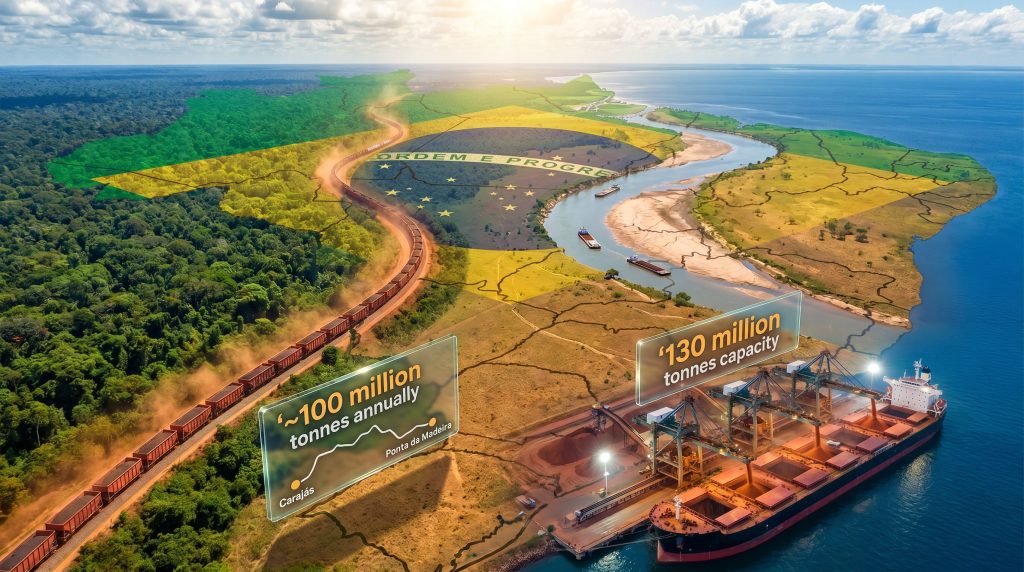
The Carajás Railway connects the Carajás mineral complex in Pará to the Ponta da Madeira marine terminal in São Luís, Maranhão, moving approximately 100 million tonnes of iron ore annually, primarily destined for Asian steel markets.
-
The MRS Logística Network links the Minas Gerais mining heartland to the Port of Santos in São Paulo and the Port of Itaguaí in Rio de Janeiro, two of Brazil's most commercially active maritime gateways.
-
The Vitória-Minas Railway, spanning over 905 kilometres, connects Minas Gerais to the Port of Tubarão in Espírito Santo, one of the highest-capacity iron ore export terminals in the world.
These corridors were engineered specifically for bulk iron ore transport at massive scale. As Brazil's commodity mix shifts toward critical minerals originating from geologically distinct and more remote regions, the geographic footprint of this rail network becomes an increasingly significant constraint.
What Role Do Waterways Play in Brazil Mining Logistics?
The Paraguay Corridor: Indispensable and Exposed
In Brazil's southwest interior, particularly across Mato Grosso do Sul and areas bordering Bolivia, the absence of rail density means that river barge transport via the Paraguay-Paraná waterway system is not a supplementary logistics option — it is the primary one. Under this model, ore travels approximately 2,500 kilometres along river corridors before reaching shallow-water transshipment ports in Uruguay, notably Nueva Palmira, where ocean-going vessels complete the export journey.
This route exists because the region's geography makes it the most cost-competitive solution under normal hydrological conditions. However, normal conditions are becoming harder to count on.
Why This Corridor Is Structurally Fragile
-
Geographic isolation means there are few cost-effective alternatives when waterway transport fails.
-
Seasonal variability creates recurring disruptions to loading schedules and vessel drafts at inland ports including Corumbá.
-
Multi-year drought cycles transform what was once a manageable seasonal inconvenience into a prolonged operational crisis.
-
Shallow-water port limitations at key loading points restrict vessel size and loading efficiency even during periods of adequate water levels.
The drought conditions affecting this waterway system between 2024 and 2026 have demonstrated how exposed the corridor genuinely is. Mining operators in the region have been forced to limit production rates, absorb significantly higher per-tonne logistics costs as road transport substitutes for barge operations, and defer capacity expansion projects that were contingent on reliable waterway access.
Climate modelling increasingly suggests that drought frequency and severity in central-western Brazil will intensify through the remainder of this decade, reframing what was previously viewed as a cyclical risk into a structural one.
| Feature | Rail Corridor System | Paraguay Waterway System |
|---|---|---|
| Primary commodity | Iron ore, bauxite | Iron ore, manganese, emerging critical minerals |
| Geographic coverage | Southeast and North Brazil | Southwest Brazil / Bolivia border region |
| Annual throughput reliability | High | Low-Medium |
| Infrastructure maturity | Established, high-capacity | Underdeveloped, climate-exposed |
| Expansion potential | Moderate (brownfield upgrades) | High (if water security addressed) |
The Three Bottlenecks Limiting Export Throughput
1. Climate-Driven Waterway Disruption
The 2024–2026 drought cycle across central-western Brazil has become the most immediately disruptive force in the Paraguay waterway corridor. Its effects cascade through the entire supply chain:
-
Production rates are capped at volumes that can be stored or moved via expensive road alternatives.
-
Capital expansion decisions are deferred when waterway availability cannot be reliably forecast.
-
Per-tonne logistics costs escalate sharply as operators shift to trucking, which is far less efficient for bulk commodities across long distances.
What makes this particularly significant from an investment perspective is that the river system's navigability is determined not just by local rainfall but by upstream hydrological conditions across a vast catchment area. A mine operator cannot fully control or hedge this variable through on-site infrastructure investment alone.
2. Remote Border Region Logistics
Operations near the Brazil-Bolivia frontier face a compounding set of challenges beyond simple distance. Furthermore, cross-border coordination requirements introduce regulatory complexity that extends planning timelines. Shallow-water port constraints at inland loading points limit vessel capacity and turnaround efficiency.
The absence of viable rail alternatives means that when waterways fail, there is no comparable fallback option available at comparable cost.
3. Environmental and Indigenous Land Access
In the Amazonas region, several mining corridors sit adjacent to biological reserves and Indigenous community territories. Securing and maintaining long-term access agreements requires a level of social and regulatory engagement that extends planning horizons well beyond those typical in more established mining jurisdictions.
For project developers and investors, these constraints are not peripheral footnotes in a feasibility study. They represent material risks capable of delaying production ramp-up by years and inflating capital expenditure estimates significantly beyond initial projections.
Brazil's Port Network: The Four Export Hubs
Where Domestic Transport Meets Global Shipping
Brazil's mineral export capability ultimately converges on a small number of high-capacity maritime terminals. Each plays a distinct role in the national logistics architecture:
-
Port of Tubarão (Espírito Santo): Operated by Vale, this facility is among the world's largest iron ore export terminals, with annual handling capacity exceeding 130 million tonnes. It serves as the primary outlet for ore arriving via the Vitória-Minas Railway.
-
Ponta da Madeira Terminal (São Luís, Maranhão): The dedicated maritime gateway for the Carajás Railway system, routing enormous iron ore volumes primarily to Asian buyers.
-
Port of Santos (São Paulo): Brazil's largest general-purpose port, handling a broad mix of mining exports alongside equipment imports from North America and Canada that support the sector's operational needs.
-
Port of Itaguaí (Rio de Janeiro): A key secondary hub for MRS Logística's ore flows, with growing strategic importance as southeastern mining output expands.
A characteristic that is less widely appreciated outside specialist logistics circles is the degree to which these terminals were engineered around Valemax and Capesize vessel classes, specifically designed for the economics of iron ore. As critical mineral exports grow, and many involve smaller, more irregular shipment volumes, the operational fit between existing terminal infrastructure and new commodity flows becomes a nuanced challenge requiring targeted adaptation rather than wholesale replacement.
How the Critical Minerals Boom Is Stressing Legacy Infrastructure
A Mismatch Between New Deposit Geographies and Old Transport Networks
The critical minerals demand surge driven by the global energy transition has elevated demand for commodities that Brazil holds in significant quantities. However, these deposits are often located far outside the corridors the existing logistics network was built to serve. This creates a structural mismatch that is now becoming a tangible constraint on project development timelines.
| Factor | Iron Ore (Established) | Critical Minerals (Emerging) |
|---|---|---|
| Mine locations | Concentrated in known corridors | Dispersed, often remote |
| Logistics infrastructure | Purpose-built, high-capacity | Largely absent or repurposed |
| Export volumes | Hundreds of millions of tonnes | Tens of thousands to low millions of tonnes |
| Value per tonne | Lower (bulk commodity) | Higher (specialty or processed) |
| Logistics cost sensitivity | Moderate | High |
The bauxite sector illustrates this dynamic well. Considering global bauxite production trends, Mineração Rio do Norte, Brazil's largest bauxite producer, is currently extending its East Zone operations while simultaneously developing its West Zone project in Pará, with production expected to commence around 2028.
The West Zone represents a geographically distinct deposit that will require dedicated logistics solutions, including river port upgrades and potentially new rail connections, to move material into existing export infrastructure. This is not an isolated case but a template for what the broader critical minerals build-out in Brazil will require.
A less commonly discussed dimension of the critical minerals logistics challenge involves mineral processing location decisions. Unlike iron ore, which is typically exported with relatively limited processing, commodities such as lithium are increasingly being exported in partially or fully processed form — as lithium carbonate or lithium hydroxide rather than raw spodumene.
This changes the logistics calculus considerably: processed product volumes are smaller, value per tonne is higher, and the transport mode requirements shift away from bulk rail toward containerised or specialised cargo handling — infrastructure that Brazil's mining regions currently lack in meaningful quantity.
The next major ASX story will hit our subscribers first
Strategic Investments Reshaping Brazil's Transport Network
Infrastructure Modernisation as a Competitive Necessity
Several converging pressures are now driving a new wave of logistics investment across Brazil's mining sector. The resource export challenges seen in comparable resource economies offer a useful parallel, as the demonstrated fragility of waterway-dependent systems and the need to connect newly identified deposits to export-capable ports are themes shared across major mining nations. Key investment themes currently reshaping the network include:
-
Freight rail expansion and rehabilitation, including feasibility studies for new rail links into underserved mining regions, though no major new corridors specifically targeting critical mineral zones have yet reached final investment decision stage as of mid-2026.
-
River port infrastructure investment, particularly focused on improving loading capacity and navigational reliability at inland ports including Corumbá, where the Paraguay waterway bottleneck is most acute.
-
Bulk commodity terminal upgrades at Santos, Itaguaí, and secondary ports to accommodate growing critical mineral export volumes alongside existing iron ore flows.
-
Vertically integrated logistics development, where operators in remote regions are building unified control over barge, road, and port assets to reduce dependency on public infrastructure that cannot be relied upon to expand at the pace the sector requires.
From an investor standpoint, Brazil's logistics infrastructure gap is simultaneously an operational risk and an opportunity. Companies capable of delivering reliable, cost-efficient transport solutions in underserved mining corridors are positioned to capture significant value as critical mineral production scales through the late 2020s.
Three Scenarios for the Next Decade
How Brazil's Logistics Future Could Unfold
Scenario 1: Incremental Adaptation. Existing infrastructure is upgraded at the margins. Waterway disruptions continue to constrain southwest production. Brazil's critical mineral export growth underperforms its geological potential as logistics bottlenecks suppress project economics.
Scenario 2: Targeted Investment Unlocks New Corridors. Strategic public-private investment in rail extensions, river port upgrades, and terminal capacity allows Brazil to progressively close the logistics gap. Consequently, critical mineral production scales in line with iron ore demand prospects and global demand through the 2030s.
Scenario 3: Climate Disruption Accelerates Structural Reform. Repeated severe droughts force a fundamental rethinking of the waterway-dependent logistics model in southwest Brazil. Accelerated investment in rail alternatives reshapes the competitive economics of the region's mining sector, ultimately producing a more resilient but more capital-intensive transport architecture.
Which scenario materialises will depend on three variables that no single actor controls: the pace of climate deterioration in the Paraguay catchment, the willingness of private capital to commit to long-dated infrastructure assets in the absence of guaranteed volume contracts, and the regulatory environment governing rail concession expansion.
The interaction between these variables — rather than any one of them in isolation — will determine whether Brazil's mineral endowment translates into export performance at the scale the global energy transition demands. Furthermore, the China steel and iron ore market will continue to exert significant influence over which investment scenarios attract the capital needed to proceed.
Brazil's geological wealth is not the constraint. What is being tested, urgently and visibly, is whether the country's Brazil mining logistics infrastructure can evolve fast enough to serve a mining sector that is rapidly outgrowing the iron ore corridors it was originally built around.
This article is intended for informational purposes only and does not constitute financial or investment advice. Forward-looking statements, scenario projections, and infrastructure timelines involve uncertainty and should not be relied upon as guarantees of future outcomes. Readers should conduct their own due diligence and consult qualified advisers before making investment decisions.
Want to Stay Ahead of the Next Major Mineral Discovery?
While Brazil's logistics constraints shape the broader commodities landscape, significant mineral discoveries continue to emerge across the ASX — and timing is everything. Discovery Alert's proprietary Discovery IQ model delivers real-time alerts the moment a significant ASX mineral discovery is announced, transforming complex data across 30-plus commodities into clear, actionable insights for investors at every level. Explore historic discoveries and their returns, then begin your 14-day free trial at Discovery Alert to position yourself ahead of the market.