July 22, 2026
When the World's Most Important Shipping Lane Becomes a Liability
For decades, the Strait of Hormuz has functioned as the circulatory system of global energy trade, a narrow 33-kilometre-wide passage through which roughly one-fifth of the world's hydrocarbon supply moves every single day. Oil strategists, naval planners, and refinery procurement teams have always understood the theoretical risk it represents. What they are now confronting in 2026 is that theoretical risk becoming an operational reality, with cascading consequences that are reshaping crude oil trade flows across the entire Indo-Pacific region.
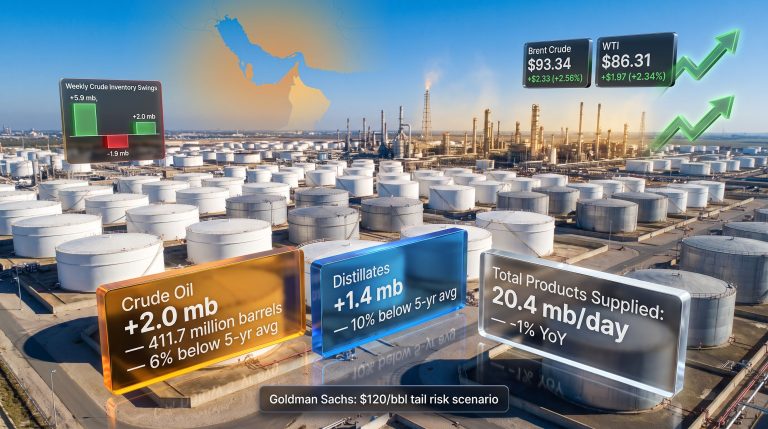
The intensification of U.S.-Iran hostilities has transformed the Strait from a monitored vulnerability into an active chokepoint crisis. Tanker seizures, elevated war-risk insurance surcharges, and shipping companies rerouting vessels away from the Persian Gulf have disrupted the supply chains that Asian refiners have relied upon for generations. Goldman Sachs has warned that if the conflict continues without resolution, oil prices could reach $120 per barrel, a projection that has focused the minds of procurement executives from Beijing to Mumbai. Brent Crude has already surged past $93 per barrel, while Murban Crude has climbed above $89 per barrel as risk premiums widen across benchmarks.
Against this backdrop, a fundamental re-evaluation of crude sourcing strategy is now underway among Asian buyers, and Brazil stands positioned to be among the primary beneficiaries of this structural shift. The Brazil oil boom as Asian buyers flee the Middle East is not a temporary market fluctuation — it represents a durable realignment with consequences that will outlast any ceasefire. Furthermore, understanding crude oil volatility is essential context for grasping why this shift carries such long-term weight.
When big ASX news breaks, our subscribers know first
The Commercial Logic Driving Asian Refiners Away From Gulf Crude
Asia collectively represents the world's largest concentration of crude oil demand, with China, India, Japan, and South Korea consuming enormous volumes of Middle Eastern petroleum. For years, the Gulf's cost advantage, driven by proximity to large reserves and established tanker routes, made it the default sourcing region for Asian refiners.
That calculus has been fundamentally disrupted. When war-risk insurance surcharges, spot freight volatility, and supply reliability uncertainty are factored into total landed cost, the price advantage of Gulf crude narrows dramatically or disappears entirely. India's crude import bill has surged by 60% as Iran-linked price spikes flow through to refinery gate costs, according to reporting from Oilprice.com. The United States has indicated that China has reduced Iranian oil purchases by approximately 40% amid escalating conflict risk. Pakistan is scrambling to secure spot LNG alternatives as Qatar supply routes face disruption pressure.
The shift in procurement philosophy is significant. Asian national oil companies and private refiners have moved from optimising for marginal cost savings to prioritising supply security above all else. Once that psychological threshold is crossed at the institutional level, procurement decisions tend to lock in for extended periods. Consequently, this oil market disruption is proving far more consequential than a simple temporary price shock.
"Supply chain resilience has become a board-level priority for Asian energy companies, and that shift in risk appetite tends to persist well beyond the immediate crisis that triggered it."
India is simultaneously maintaining near-record Russian oil purchases, demonstrating a deliberate multi-vector procurement strategy designed to avoid dependence on any single corridor. South Korea and Japan, both heavily exposed to Hormuz-dependent crude, are watching developments closely as Middle East risk premiums persist. The broader picture of oil's global importance has rarely been more visible than in this moment.
Why Tupi Crude Is Almost Perfectly Engineered for Asian Refineries
Brazil's flagship export grade possesses a petrochemical profile that reads almost as if it were designed for the refinery configurations prevalent across East and Southeast Asia. Understanding why requires a brief look at what refineries actually want from their feedstock.
What Makes Tupi Crude Stand Out?
Tupi crude carries:
- An API gravity of approximately 29 degrees, classifying it as a medium crude
- A sulfur content of just 0.31%, qualifying it as a sweet crude requiring minimal downstream desulfurisation
- Exceptionally low concentrations of paraffin and heavy metals compared to most competing grades
- Consistent quality characteristics across the reservoir, reducing processing variability
Lower sulfur content directly translates into reduced operating costs at the refinery. Desulfurisation units are expensive to run, and sweet crude bypasses much of that cost burden. The low paraffin content also reduces maintenance cycles and processing complexity, meaning Tupi delivers economic advantages that extend well beyond the headline price per barrel.
The table below illustrates how Tupi compares with key Middle Eastern grades on metrics that matter to refinery operators:
| Crude Grade | API Gravity | Sulfur Content | Hormuz Exposure | Refinery Cost Profile |
|---|---|---|---|---|
| Tupi (Brazil) | ~29° | ~0.31% | None | Low desulfurisation cost |
| Arab Light (Saudi Arabia) | ~32° | ~1.8% | High | Moderate processing cost |
| Basra Light (Iraq) | ~29° | ~2.1% | High | Higher desulfurisation cost |
| Iranian Heavy | ~30° | ~1.7% | Very High (sanctioned) | Moderate processing cost |
| Murban (UAE) | ~40° | ~0.8% | High | Lower desulfurisation cost |
The comparison highlights a critical insight that is not always obvious from headline price data: Tupi's sweet, medium profile delivers comparable or superior refinery economics to many Gulf grades, without any of the geopolitical transit risk.
Brazil's pre-salt crude shipments reach Asian ports via entirely open ocean routes, travelling through the Atlantic and Indian Oceans without transiting the Persian Gulf, the Red Sea, or the Strait of Hormuz. As Houthi naval blockade threats against Saudi Arabia compound Hormuz disruptions, that routing advantage becomes a structural commercial differentiator, not merely a theoretical one.
Brazil's Production Machine: Record After Record
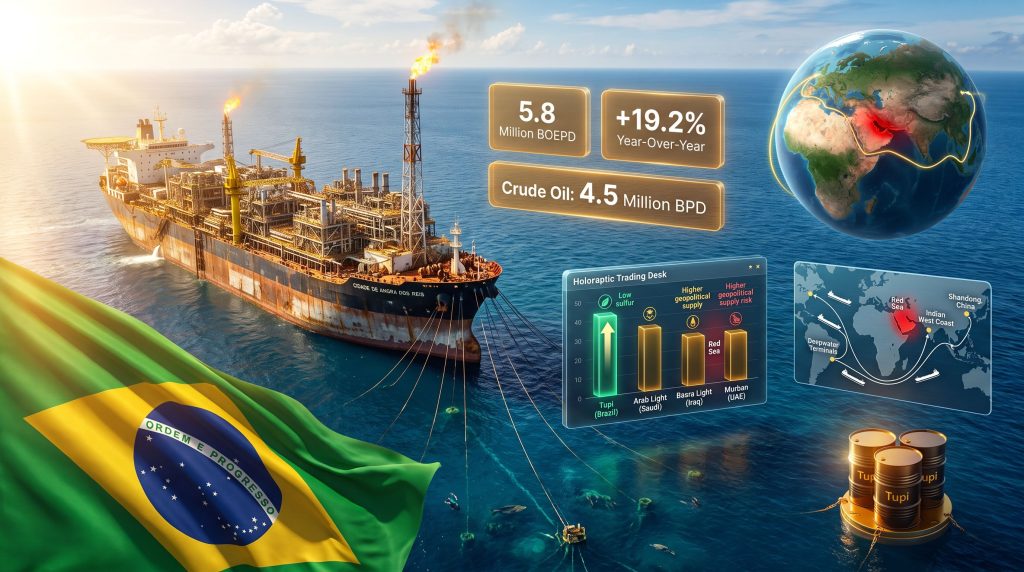
The scale of Brazil's hydrocarbon output expansion is difficult to overstate. Government data confirms that total hydrocarbon production for June 2026 reached a fresh national record of 5.8 million barrels of oil equivalent per day (boepd), representing a 4.2% month-over-month increase and a remarkable 19.2% year-over-year surge compared to June 2025. Notably, April 2026 had itself set a prior record at 5.64 million boepd, meaning Brazil broke its own benchmark within just two months.
June 2026 Production Breakdown
The June 2026 production breakdown:
- Total hydrocarbon output: 5.8 million boepd (+19.2% year-on-year)
- Crude oil production: 4.5 million barrels per day (+4% month-on-month, +19% year-on-year)
- Natural gas output: 7.7 billion cubic feet per day (+5.5% month-on-month, +19.6% year-on-year)
- Pre-salt share of crude production: approximately 77%
- Santos Basin share of total petroleum output: approximately 74%
The offshore ultra-deepwater pre-salt geological layer is the engine behind these numbers. The Santos Basin, site of the landmark Tupi oilfield discovery in 2006, has evolved from a pioneering deepwater exploration success into the backbone of Brazil's entire petroleum sector. Pre-salt reservoirs sit beneath several kilometres of ocean water, rock strata, and a thick salt layer — a technically demanding extraction environment that rewards scale operators with high flow rates per well, long field lifespans, and consistent crude quality throughout the reservoir.
The natural gas figures carry particular regional significance. South American gas demand is accelerating while regional alternatives are contracting sharply. Colombia faces a deepening gas supply crisis. Trinidad and Tobago's domestic hydrocarbon sector confronts significant structural headwinds. Ecuador and Peru are experiencing declining reserves. Brazil's surging gas output arrives precisely when the regional supply gap is widening most rapidly.
The Capital Architecture Behind Brazil's Expansion
Production records do not emerge from geological fortune alone. They require sustained, large-scale capital commitment, and Brazil's investment landscape reflects exactly that.
Petrobras has committed to $109 billion in total capital expenditure across the 2026 to 2030 planning horizon, with $69.2 billion directed exclusively to upstream exploration and production. The internal allocation within that upstream budget reveals where the company sees its highest-returning opportunities:
- 62% allocated to pre-salt asset development
- 24% directed to post-salt operations
- 10% earmarked for frontier exploration activities
- Remaining balance directed toward onshore infrastructure
Petrobras expects this investment programme to lift its own production to 3.4 million boepd, with 82% of that output sourced from pre-salt operations. Across all operators active in Brazil, total upstream investment during 2026 is projected to reach $21.3 billion, according to estimates from the Brazilian Petroleum Institute (IBP).
How Supermajors Are Responding
What is particularly notable from an investor psychology standpoint is that this capital deployment has continued despite the Lula government extending a 12% oil export tax for an additional 60 days — a policy decision that has generated friction within the investment community. The fact that international supermajors have maintained and expanded their Brazilian commitments despite this fiscal headwind signals that the geological and commercial fundamentals outweigh near-term policy uncertainty in their risk-return assessments.
Shell provides the most striking illustration of this supermajor conviction. The company has nearly doubled its Brazilian asset portfolio since 2022, expanding from approximately 30 working interests in oil blocks to close to 70 blocks by mid-2026. Brazil has become Shell's single largest oil-producing country globally, and the company accounts for approximately 12% of all petroleum extracted in Brazil during June 2026, positioning it as the country's second-largest producer behind Petrobras.
Equinor, TotalEnergies, ExxonMobil, and Chevron all maintain active deepwater pre-salt positions, creating a competitive capital deployment environment that accelerates field development timelines and brings world-class deepwater expertise to bear on Brazil's reservoirs.
The Asian Trade Flow Transformation: China, India, and Beyond
The demand signal from Asia is unambiguous. In March 2026, China imported a record 1.6 million barrels per day of Brazilian crude, according to Reuters, representing the highest single-origin import volume ever recorded for the world's largest oil buyer. Brazil's first-quarter 2026 oil export revenues reached $12.56 billion, reflecting a 31% year-over-year increase in export volumes.
India has emerged as the second-largest destination for Brazilian crude shipments, receiving approximately 15% of total Brazilian oil exports in early 2026. This positions India as a strategically important and growing market, even as the country simultaneously maintains near-record Russian oil purchases, demonstrating a deliberate diversification architecture rather than a simple substitution strategy.
"A less widely appreciated dynamic is Brazil's position within South America's own energy rebalancing. As the continent's traditional gas and oil suppliers lose production capacity, Brazilian crude and gas are beginning to fill a regional gap that extends well beyond the Asian trade story."
South Korea and Japan represent the next logical frontier for Brazilian crude market penetration. Both economies are heavily dependent on Hormuz-transiting crude, and both face mounting pressure from elevated energy import costs. Japan's power prices have recently soared to multi-year highs, and surging oil prices have pushed Japan's import bill to unprecedented levels, as reported by Oilprice.com. Brazilian crude's Hormuz-free routing offers these markets a structural solution, not just a spot-market alternative.
Oil became Brazil's single largest export category in 2024, surpassing soybeans for the first time in the country's history. That structural shift in Brazil's export economy carries long-term fiscal implications, increasing the country's leverage in international trade negotiations and deepening its alignment with Asian economic growth trajectories. Monitoring current crude oil prices remains critical for assessing how these trade flows will evolve.
The next major ASX story will hit our subscribers first
Forward Scenarios: What Comes Next for Brazil's Oil Boom
Three distinct forward pathways are worth examining, each with different implications for Brazil's trajectory.
Scenario 1: Sustained Middle East Conflict
If U.S.-Iran hostilities remain unresolved for 12 to 36 months, Hormuz disruptions become structurally embedded in global trade flows. Asian refiners accelerate long-term supply agreements with Brazilian producers, and Petrobras's 3.4 million boepd production target becomes achievable ahead of schedule. Under this scenario, Brazil crosses the threshold to become a confirmed top-5 global hydrocarbon producer and exporter, reshaping OPEC+ market dynamics in the process.
Scenario 2: Diplomatic Resolution With Sticky Market Share
Even if a ceasefire reduces immediate Hormuz risk, Asian buyers who have diversified toward Brazilian crude are unlikely to fully revert to prior procurement patterns. Supply chain resilience has become institutionalised in procurement strategy, and long-term offtake agreements already signed will anchor Brazilian crude volumes into Asian refineries regardless of short-term geopolitical improvements.
Scenario 3: Climate Policy and Domestic Friction
Brazil's planned expansion into frontier exploration areas, including near-Amazon offshore zones, faces mounting international climate scrutiny. The tension between Brazil's COP hosting ambitions and its aggressive fossil fuel expansion represents a reputational and regulatory risk that could affect investor sentiment over a longer horizon, even if it has not yet materially slowed capital deployment. In addition, geopolitical trade tensions beyond the Middle East could introduce further complexity to Brazil's export strategy.
The Competitive Landscape: Brazil Among Non-OPEC Growth Producers
Brazil does not compete in isolation. Guyana has emerged as a significant Atlantic Basin producer, with ExxonMobil-led output approaching 700,000 barrels per day. Argentina's Vaca Muerta shale play is gathering momentum under President Milei's reform agenda. Norway's output continues to beat forecasts. Yet none of these alternatives matches Brazil's combination of scale, quality, investment depth, and Asian market penetration.
| Producer | 2026 Output Level | Key Differentiator | Primary Asian Buyer Exposure |
|---|---|---|---|
| Brazil | ~4.5 million bpd (crude) | Pre-salt quality and scale | China, India (very high) |
| Guyana | ~700,000 bpd | Low-cost deepwater | Growing |
| Argentina (Vaca Muerta) | ~700,000 bpd | Shale scalability | Emerging |
| Norway | Beating forecasts | Regulatory stability | Limited |
| Canada | ~5 million bpd (total) | Oil sands volume | Moderate |
Brazil's pre-salt output alone dwarfs any single competing Atlantic Basin producer. Its logistical infrastructure for VLCC tanker shipments to Chinese and Indian ports is more developed than any comparable alternative. Furthermore, the supermajor convergence on the Brazil oil boom as Asian buyers flee the Middle East creates a self-reinforcing capital cycle that smaller competing basins simply cannot replicate.
Disclaimer: This article is provided for informational and educational purposes only and does not constitute financial, investment, or trading advice. Projections, forecasts, and scenario analyses involve inherent uncertainty and should not be relied upon as predictions of future outcomes. Readers should conduct their own independent research and consult qualified financial advisers before making any investment decisions. All production, price, and investment figures cited are sourced from publicly available data and government reports as of the publication date.
Want to Stay Ahead of the Next Major Resource Discovery Driving These Global Shifts?
Discovery Alert's proprietary Discovery IQ model delivers real-time alerts on significant ASX mineral discoveries, transforming complex geological and commodity data into actionable investment insights — explore historic examples of major discoveries and their returns to understand the scale of opportunity, then begin your 14-day free trial to position yourself ahead of the broader market.