June 11, 2026
Understanding Brazil's Strategic Position in Global Energy Security
Brazil's petroleum sector transformation represents one of the most significant shifts in global energy dynamics over the past decade. As traditional supply routes face increasing volatility, the South American giant has emerged as a critical stabilising force, offering energy-importing nations an alternative to geopolitically unstable regions. This strategic repositioning stems from Brazil's unique combination of technological advancement, geological advantages, and substantial capital investment in offshore hydrocarbon development.
The country's production capabilities have undergone remarkable expansion, fundamentally altering its position within global energy markets. From a regional producer with limited international influence, Brazil has evolved into a major non-OPEC supplier capable of responding to international supply disruptions with increased output. This transformation carries profound implications for energy security across the Americas and beyond, particularly as the Brazil oil production surge continues to reshape regional supply dynamics.
When big ASX news breaks, our subscribers know first
Production Metrics and Growth Trajectory Analysis
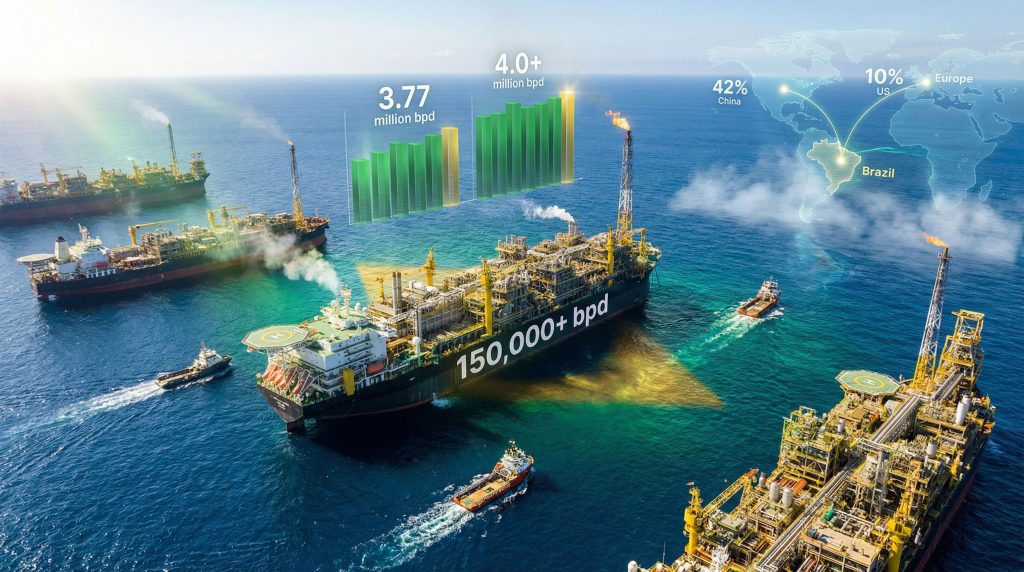
Brazil's crude oil production achieved unprecedented levels in February 2026, reaching just under 4.1 million barrels per day. This figure represents a substantial 16.4% increase compared to the same period in the previous year, demonstrating the country's capacity for sustained output growth even during periods of global market turbulence.
The decade-long trajectory reveals even more impressive gains. Production volumes have increased by 1.7 times since February 2016, when daily output averaged just over 2.3 million barrels. This growth pattern positions Brazil among the fastest-expanding petroleum producers globally, with much of the increase attributed to technological breakthroughs in ultra-deepwater extraction.
Key Production Indicators:
- Current Production Level: 4.1 million barrels per day (February 2026)
- Annual Growth Rate: 16.4% year-over-year increase
- Decade Expansion: 78% increase from 2016 baseline
- Pre-salt Contribution: 76% of total petroleum output
- Natural Gas Production: Nearly 7 million cubic feet per day
Natural gas production has experienced even more dramatic expansion, with output rising 24.5% year-over-year to reach nearly 7 million cubic feet per day. This growth rate significantly exceeds oil production increases, reflecting Brazil's commitment to developing integrated hydrocarbon resources rather than focusing exclusively on crude oil extraction.
What Makes Brazil's Pre-Salt Fields a Game-Changer for Energy Independence?
Technical Innovation and Resource Quality
The pre-salt geological formations beneath Brazil's offshore basins represent a technological and geological breakthrough that has redefined the country's energy potential. These reservoirs, located beneath thick salt layers in the Santos and Campos basins, contain exceptionally high-quality crude oil that commands premium pricing in international markets due to its low sulphur content and optimal API gravity.
Investment in pre-salt development has exceeded $200 billion since 2010, with this massive capital commitment enabling the deployment of advanced floating production, storage, and offloading (FPSO) technology. Each platform can process over 150,000 barrels per day, with some installations achieving significantly higher throughput rates depending on reservoir characteristics and operational optimisation.
Technical Specifications:
- API Gravity Range: 28-31 degrees (light, low-sulphur crude)
- Platform Capacity: 150,000+ barrels per day per installation
- Reserve Longevity: Estimated 30+ year production life for major fields
- Water Depth: Ultra-deepwater formations requiring specialised technology
- Recovery Rates: Enhanced through advanced subsea infrastructure
The quality characteristics of pre-salt crude make it particularly attractive to international refiners. Low sulphur content reduces processing costs while the light gravity specification ensures compatibility with existing refinery configurations across major consuming markets. This quality premium translates into higher netback revenues for Brazilian producers compared to heavier, higher-sulphur crude grades from other regions.
Investment Flow and Infrastructure Development
International consortium participation has been crucial to pre-salt development success. Major integrated oil companies including Equinor, Shell, and TotalEnergies have committed substantial resources to Brazilian offshore projects, bringing advanced technology and operational expertise alongside financial capacity.
Petrobras operates as the primary developer whilst international partners contribute specialised knowledge in ultra-deepwater operations. This collaborative approach has accelerated development timelines whilst sharing both costs and risks associated with complex offshore projects. The proven ability to develop multiple fields simultaneously demonstrates the scalability of Brazil's offshore infrastructure.
Furthermore, the oil price movements analysis shows how Brazil's production surge has influenced global pricing dynamics, particularly during periods of geopolitical uncertainty.
How Does Brazil's Production Growth Impact Regional Energy Security?
Americas Energy Integration Strategy
Brazil's expanding production capacity serves as a cornerstone for Western Hemisphere energy security, fundamentally altering supply dynamics across the Americas. The country's strategic geographic position enables efficient distribution to both North American and South American markets whilst maintaining competitive export routes to Asia and Europe.
Recent export data illustrates Brazil's growing importance as a reliable supplier. In 2025, the country exported a record 1.92 million barrels per day, generating nearly $45 billion in export revenue. This export capacity provides crucial supply diversity for importing nations seeking to reduce dependency on traditional Middle Eastern sources.
Moreover, whilst global markets face energy transition challenges, Brazil's production surge provides stability during this transitional period.
Export Destination Analysis and Market Dynamics
| Destination Market | 2024 Share | 2025 Share | Strategic Significance |
|---|---|---|---|
| China | 42% | 45% | Primary growth market, replacing Middle East supplies |
| United States | 8% | 10% | Energy security partnership, Gulf Coast refineries |
| Europe | 15% | 12% | Premium pricing destination, reduced Middle East dependency |
| Other Americas | 20% | 18% | Regional integration, shorter transport routes |
| Rest of World | 15% | 15% | Market diversification, risk distribution |
China's increasing reliance on Brazilian crude reflects broader geopolitical shifts in global energy trade. With approximately 42% of China's petroleum imports traditionally sourced from the Middle East, Brazilian oil production keeps growing to offer crucial diversification during periods of regional instability. Recent supply disruptions have accelerated this trend, with Brazil capturing an even larger share of Chinese import demand.
United States imports from Brazil have shown consistent growth, reaching 236,000 barrels per day in January 2026. This represents a 23.6% month-over-month increase and demonstrates the flexibility of Brazil's export infrastructure to respond rapidly to changing market conditions. The compatibility of Brazilian crude grades with U.S. Gulf Coast refinery specifications ensures continued demand growth potential.
Market Response Mechanisms During Supply Disruptions
Brazil's role as a swing producer became particularly evident during recent Middle Eastern supply disruptions. The country's spare production capacity and flexible export infrastructure enabled rapid increases in shipments to markets experiencing supply shortfalls. This response capacity provides crucial market stabilisation during periods of geopolitical uncertainty.
The Brazilian government has implemented export tax adjustments to balance domestic supply requirements with international market opportunities. A 12% levy on oil exports, introduced in response to recent price volatility, demonstrates the policy tools available to optimise revenue whilst ensuring domestic energy security.
However, the tariff economic implications of global trade policies continue to influence Brazil's export strategies and pricing mechanisms.
What Role Does Petrobras Play in Brazil's Energy Expansion Strategy?
Corporate Investment Framework and Strategic Planning
Petrobras operates under a unique hybrid model that balances state strategic objectives with commercial efficiency requirements. With the Brazilian government controlling 37% of the company, Petrobras serves as the primary vehicle for implementing national energy policy whilst maintaining competitive operational standards.
The company's 2026-2030 investment plan allocates $69.2 billion across upstream development activities. The strategic focus on pre-salt operations, receiving 62% of total investment or $43 billion, demonstrates the priority placed on maximising returns from Brazil's most productive assets. Post-salt assets receive 24% of investment whilst exploration activities account for 7%.
Petrobras Investment Allocation (2026-2030):
- Total Capital Expenditure: $69.2 billion
- Pre-Salt Operations: $43 billion (62% of total)
- Post-Salt Assets: $16.6 billion (24% of total)
- Exploration Activities: $4.8 billion (7% of total)
- Other Operations: $4.8 billion (7% of total)
Production Targets and Capacity Planning
Petrobras has established ambitious production targets aligned with national energy strategy objectives. The company anticipates lifting 2.6 million barrels per day by 2030, with combined oil and natural gas output reaching 2.9 million barrels of oil equivalent daily. These targets represent substantial increases from current production levels and require sustained investment in both existing field optimisation and new field development.
The public-private partnership model employed by Brazil has attracted sustained foreign investment whilst preserving national control over strategic energy assets. This approach enables access to international capital and technology whilst maintaining sovereignty over resource development decisions.
In addition, investors seeking to understand the broader implications can reference our comprehensive investment strategy guide which addresses energy sector opportunities amidst global market changes.
How Do Global Supply Disruptions Affect Brazil's Market Position?
Scenario Analysis and Market Response Capacity
Recent geopolitical tensions have highlighted Brazil's strategic importance as a reliable energy supplier during periods of global market disruption. The closure of the Strait of Hormuz, preventing passage of approximately one-fifth of global oil supply, created immediate demand for alternative sources. Brazil's spare capacity and established export infrastructure positioned the country to respond rapidly to this supply gap.
Iran's attacks on Qatar's liquefied natural gas infrastructure, eliminating 17% of export capacity, further emphasised the importance of diversified supply sources. Whilst Brazil remains a net natural gas importer, rapidly growing domestic production reduces import dependency and provides additional supply security for the broader region.
The trade war market impact continues to influence global energy flows, with Brazil benefiting from supply chain diversification trends.
Competitive Positioning Against Traditional Suppliers
Brazil's production costs, whilst higher than some Middle Eastern sources, remain competitive when quality premiums and reduced geopolitical risk are factored into pricing decisions. The consistent availability of Brazilian supplies during regional conflicts provides additional value to importing nations seeking supply reliability over lowest-cost sourcing.
The country's ability to maintain production growth during periods of global market volatility demonstrates operational resilience. Advanced offshore technology and experienced operational teams enable continued development even when other regions experience disruptions or capacity constraints.
According to Oil Price analysis, Brazil's role in regional energy security has become increasingly vital as traditional supply sources face mounting pressures.
The next major ASX story will hit our subscribers first
What Are the Long-Term Implications for Global Energy Markets?
2030 Production Scenarios and Market Impact
Conservative projections suggest Brazil could achieve 5.3 million barrels per day crude production by 2030, potentially ranking as the world's fourth-largest producer. This represents a 40.6% increase over 2025 levels and would position Brazil ahead of Canada in global production rankings. Such expansion would fundamentally alter global supply dynamics and reduce OPEC's market influence.
The anticipated production growth reflects both continued pre-salt development and expanded participation from international oil companies. Brazil's favourable regulatory framework and transparent licensing processes continue to attract investment from global energy firms seeking stable, long-term development opportunities.
Environmental and Regulatory Framework Evolution
Brazil's production expansion occurs within an evolving environmental regulatory framework that balances economic development with climate commitments. The country's approach to sustainable petroleum development, including carbon capture initiatives and reduced flaring programmes, may serve as a model for other emerging producers.
Investment in advanced recovery techniques and digitalisation initiatives aims to maximise resource extraction whilst minimising environmental impact. These technological advances position Brazil's petroleum sector for long-term competitiveness even as global energy markets transition toward lower-carbon alternatives.
How Does Brazil's Natural Gas Production Support Industrial Development?
Domestic Market Integration and Value-Added Processing
Whilst Brazil remains a net natural gas importer, rapidly growing domestic production is reducing import dependency and supporting industrial expansion across multiple sectors. The development of integrated gas-to-power projects and petrochemical facilities creates additional value from hydrocarbon resources beyond simple export sales.
Natural gas production growth of 24.5% year-over-year demonstrates the rapid expansion of domestic supply capabilities. This growth supports energy-intensive industries whilst providing feedstock for chemical production and power generation applications.
Industrial Applications and Market Development:
- Power Generation: Natural gas-fired plants providing grid flexibility and backup capacity
- Petrochemicals: Feedstock for domestic chemical industry reducing import dependency
- Industrial Heat: Direct applications reducing reliance on imported fuel sources
- Transportation: Compressed natural gas infrastructure development for commercial vehicles
The integrated approach to hydrocarbon development creates synergies between oil and gas operations whilst maximising economic returns from offshore investments. Co-production of oil and natural gas from pre-salt fields enables cost optimisation across both commodity streams.
What Investment Opportunities Emerge from Brazil's Energy Expansion?
Sector Investment Themes and Market Opportunities
The Brazil oil production surge presents multiple investment opportunities across the entire value chain. From upstream exploration and production to downstream processing and export infrastructure, sustained growth creates demand for specialised services and equipment.
The Brazilian Institute of Oil, Gas and Biofuels anticipates record upstream investment of $21.3 billion during 2026. This investment flow supports domestic service companies whilst creating opportunities for international firms specialising in offshore operations.
Key Investment Areas:
- Offshore Services: Specialised vessels, drilling equipment, and subsea infrastructure
- Refining Capacity: Upgrading facilities to process increased crude volumes
- Export Infrastructure: Terminal expansion, pipeline development, and storage capacity
- Technology Services: Digital solutions, advanced recovery techniques, and operational optimisation
- Environmental Solutions: Carbon management, emissions reduction, and sustainable development technologies
The combination of sustained production growth, technological advancement, and regulatory stability positions Brazil's energy sector as an attractive destination for long-term capital investment. Continued development of pre-salt resources ensures decades of growth potential whilst evolving market dynamics create new opportunities for innovative companies and technologies.
Investment decisions should consider individual risk tolerance and market conditions. This analysis does not constitute financial advice and readers should conduct independent research before making investment decisions.
Interested in Capitalising on Brazil's Energy Boom?
Discovery Alert's proprietary Discovery IQ model delivers real-time alerts on significant ASX mining and energy discoveries, empowering subscribers to identify actionable opportunities ahead of the broader market. Start your 14-day free trial today and gain instant access to discoveries that have historically generated exceptional returns for early investors.