June 20, 2026

Understanding Brazil's Rare Earth Independence Strategy
The global critical minerals landscape increasingly reflects a shift from market-driven commodity trading toward strategic resource sovereignty, as nations recognise that control over rare earth supply chains determines technological independence. This transformation has accelerated as Western economies confront their overwhelming dependence on Chinese processing capabilities, which currently handle approximately 85% of global rare earth production despite China controlling only 44% of proven reserves.
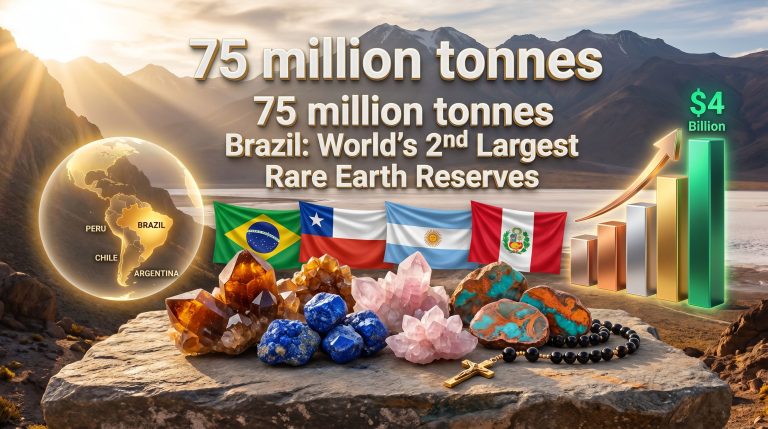
Brazil's emergence as a potential challenger to this dynamic represents more than an economic opportunity. With 23% of the world's rare earth reserves concentrated in its Goiás and Minas Gerais regions, the South American nation sits on largely untapped mineral wealth that could reshape global supply chains. However, the path from geological potential to operational reality requires navigating complex political, technical, and investment challenges that will determine whether Brazil becomes a genuine alternative to Chinese dominance or remains a resource exporter feeding into existing Asian supply chains.
When big ASX news breaks, our subscribers know first
What Does Brazil's Proposed State-Owned Rare Earths Company Mean for Global Markets?
Understanding Terrabras: Brazil's Answer to China's Dominance
The proposed Terras Raras Brasileiras SA (Terrabras) represents Brazil's strategic response to what lawmakers characterise as excessive foreign influence in the nation's critical mineral sector. Modeled after the successful Petrobras framework, this Brazil state-run rare earths company would maintain federal government control while accommodating private sector participation through a hybrid capital structure.
The Terrabras framework envisions participation from private companies, development banks, and sovereign funds, with the federal government retaining minimum shareholding necessary for strategic control. This structure mirrors successful state-controlled resource companies globally, balancing commercial efficiency with national security considerations.
Key structural elements include:
- Federal government maintaining controlling interest for strategic oversight
- Private investment flexibility to attract capital and expertise
- Development bank participation for long-term financing stability
- Sovereign fund integration for international partnership opportunities
- Professional management structure separating operational decisions from political interference
Key Legislative Proposals and Timeline Analysis
Congressional momentum behind rare earth nationalisation reflects bipartisan recognition of Brazil's strategic mineral potential. Congressman Rodrigo Rollemberg's primary legislation establishes the Terrabras framework with broad stakeholder participation, while the Workers' Party alternative proposes more prescriptive state control through production-sharing arrangements.
The Workers' Party proposal mandates minimum 50% allocation of critical mineral mining rights to Terrabras, creating a more centralised control mechanism compared to Rollemberg's equity participation model. This difference highlights competing philosophies regarding optimal balance between state oversight and market efficiency.
Legislative timeline considerations:
- October 2026 electoral calendar creating compressed approval window
- Political consensus requirements across competing party priorities
- Implementation complexity requiring regulatory framework development
- International stakeholder coordination affecting approval dynamics
Why Is Brazil Positioning Itself as the Western Alternative to Chinese Rare Earth Supply?
Brazil's Strategic Resource Advantage
Brazil's geological endowment positions it uniquely among Western-aligned nations seeking supply chain diversification. The country's 23% share of global rare earth reserves, concentrated primarily in Goiás and Minas Gerais states, represents the largest known deposits outside Chinese territory.
However, geological potential alone insufficient explains Brazil's strategic positioning. The country's current production represents less than 2% of global output, revealing massive scaling opportunity constrained primarily by processing infrastructure rather than resource availability. Furthermore, this disparity between reserves and production demonstrates the critical minerals strategy challenges facing developing economies.
| Metric | Brazil | China | Strategic Implications |
|---|---|---|---|
| Proven Reserves | 23% global share | 44% global share | Brazil's untapped potential |
| Current Production | <2% global output | 85% global output | Massive scaling opportunity |
| Processing Capacity | Minimal | Dominant | Critical bottleneck for Brazil |
| Export Markets | Primarily China | Global | Supply chain vulnerability |
Geopolitical Drivers Behind State Intervention
Western nations have actively courted Brazil as part of broader critical minerals partnerships aimed at reducing Chinese supply dependence. However, this engagement has created political tensions within Brazil regarding sovereignty over strategic resources.
The $565 million US Development Finance Corporation loan to Serra Verde, Brazil's only operational rare earth producer, includes provisions allowing US equity stake acquisition. Congressional critics cite this arrangement as evidence of foreign intervention requiring state-owned counterbalancing. This tension reflects broader implications from the US-China trade war impact on global supply chain strategies.
Geopolitical friction points include:
- US-Goiás state memorandum of understanding on critical minerals cooperation
- Former Governor Ronaldo Caiado's departure to contest presidential election against Lula
- Brazil's preference for multilateral versus bilateral critical minerals arrangements
- Tensions between US partnership expectations and Brazilian sovereignty priorities
How Would a State-Owned Model Impact Brazil's Current Private Sector Players?
Existing Market Landscape Analysis
Brazil's current rare earth sector features diverse private operators at various development stages, from Serra Verde's commercial production to Meteoric Resources' $450 million development project. This established private sector presence complicates Brazil state-run rare earths company implementation, requiring careful integration rather than displacement strategies.
Current private sector participants:
- Serra Verde Group: Brazil's only commercial rare earth producer, recipient of $565M US DFC loan
- Aclara Resources: Development-stage company emphasising environmental sustainability
- Viridis Mining: Operational focus on refining and recycling technologies
- Meteoric Resources: Advanced development project requiring substantial capital investment
Public-Private Partnership Scenarios
The legislative framework suggests collaboration rather than competition between Terrabras and existing private operators. Potential integration mechanisms include equity participation, production-sharing arrangements, or hybrid models combining both approaches.
Integration scenarios under consideration:
- Equity participation model: Terrabras acquires minority or majority stakes in existing projects while maintaining operational autonomy
- Production-sharing regime: Private operators retain mining rights while allocating fixed percentages to Terrabras
- Technology partnership framework: State company focuses on processing while private sector handles extraction
- Infrastructure coordination: Terrabras develops shared processing facilities serving multiple private producers
The Workers' Party alternative emphasises production-sharing with minimum 50% allocation requirements, creating more prescriptive state involvement compared to flexible equity participation approaches. This reflects broader mining industry evolution trends towards state involvement in strategic mineral sectors.
What Are the Economic and Strategic Implications for Global Rare Earth Supply?
Supply Chain Diversification Benefits
Brazil's entry as a major rare earth supplier could fundamentally alter global supply chain dynamics currently dominated by Chinese processing capabilities. Western economies seeking supply security would benefit from genuine alternatives to Chinese rare earth sources, particularly for critical defence and technology applications.
Potential market impacts include:
- Enhanced supply security reducing Chinese leverage over Western technology sectors
- Price stabilisation through increased competition and alternative sourcing
- Technology transfer acceleration as Western companies seek processing partnerships
- Regional supply chain development reducing transportation vulnerabilities
Investment and Infrastructure Requirements
Transforming Brazil's geological potential into operational capacity requires substantial infrastructure investment spanning the entire rare earth value chain. Processing capability represents the most critical bottleneck, as Brazil currently lacks facilities for converting raw ore into refined products demanded by international markets.
Critical infrastructure gaps include:
- Processing facilities for rare earth separation and refinement
- Quality control and certification systems meeting international standards
- Transportation infrastructure connecting mining regions to export terminals
- Environmental management systems for sustainable processing operations
- Workforce training programmes for specialised technical operations
In addition, Brazil could benefit from studying the European CRM facility models that integrate processing with energy transition security objectives.
"Brazil's move toward state ownership reflects a broader global trend where nations are treating rare earths as strategic assets rather than purely commercial commodities, fundamentally altering how these critical materials are controlled and distributed."
Technology transfer represents a particular challenge, as rare earth processing involves proprietary technologies primarily controlled by Chinese companies and select international specialists. Brazil must either develop domestic capabilities or negotiate technology licensing agreements with non-Chinese sources.
Which Scenarios Could Emerge from Brazil's State-Owned Rare Earths Initiative?
Scenario 1: Rapid Implementation and Market Disruption
This optimistic scenario assumes swift legislative approval and accelerated implementation creating meaningful market disruption by 2030. Success would require political consensus surviving electoral transitions, adequate funding commitment, and rapid technology acquisition.
Key assumptions for rapid implementation:
- Congressional approval before October 2026 elections
- Sustained political support across administration changes
- International technology partnerships facilitating rapid capacity building
- Private sector cooperation rather than opposition to state involvement
Potential outcomes include:
- Brazil capturing 15-20% of global rare earth processing capacity by 2030
- Western procurement diversification reducing Chinese market share
- Accelerated investment in Brazilian mining infrastructure
- Enhanced bargaining power for rare earth consuming nations
Scenario 2: Gradual Development with Private Sector Integration
A more moderate scenario emphasises sustainable capacity building through hybrid public-private partnerships, prioritising long-term viability over rapid market capture. This approach balances state strategic control with private sector efficiency and expertise.
Implementation characteristics:
- Phased capacity development aligned with market demand growth
- Technology partnerships with established international rare earth processors
- Gradual scale-up minimising market disruption and political opposition
- Focus on high-value applications rather than commodity market competition
Scenario 3: Political Obstacles and Delayed Implementation
The challenging scenario recognises significant obstacles that could delay or derail implementation, including electoral complications, private sector resistance, and international diplomatic pressure.
Risk factors include:
- Election year complications: October 2026 electoral calendar creating compressed legislative timeline
- Policy continuity risks: Potential leadership changes affecting long-term commitment
- Private sector opposition: Legal challenges or investment withdrawal from existing operators
- International pressure: US or other Western partner concerns about state-owned resource control
Mitigation strategies might include:
- Building cross-party consensus on rare earth strategic importance
- Negotiating private sector integration rather than displacement
- Coordinating with Western allies on supply chain cooperation frameworks
- Establishing legal protections for long-term policy continuity
The next major ASX story will hit our subscribers first
What Does This Mean for Investors and Industry Stakeholders?
Investment Opportunities and Risks
Brazil's state-owned rare earth initiative creates diverse investment opportunities across the value chain, from direct equity participation in Terrabras to support service contracts for infrastructure development. However, investors must carefully evaluate political, currency, and operational risks specific to Brazil's institutional environment.
Investment opportunity categories:
- Direct equity participation in Terrabras through private investor allocation
- Infrastructure development contracts for processing facility construction
- Technology licensing agreements for rare earth separation capabilities
- Logistics and transportation services supporting expanded operations
- Environmental management and sustainability consulting services
Risk considerations include:
- Brazilian real currency volatility affecting investment returns
- Political risk from potential policy changes across electoral cycles
- Operational complexity of rare earth processing technology transfer
- Competition with existing private sector operators for market share
- Regulatory uncertainty during implementation phase
Supply Chain Strategy Implications
Manufacturing companies dependent on rare earth inputs should evaluate Brazil's potential as a strategic supplier, particularly for applications requiring supply chain security and sustainability credentials. Long-term contract negotiations may become increasingly important as Brazil develops operational capacity.
Strategic procurement considerations:
- Diversification benefits of Brazilian sourcing reducing Chinese dependence
- Quality and consistency requirements for Brazilian rare earth products
- Pricing dynamics as Brazilian capacity scales relative to Chinese suppliers
- Sustainability and environmental standards comparison between suppliers
- Contract terms balancing supply security with price competitiveness
Frequently Asked Questions
When will Brazil's state-owned rare earths company become operational?
Legislative approval faces October 2026 electoral calendar constraints, with operational launch likely occurring between 2027-2028 assuming successful implementation of enabling legislation and infrastructure development. According to recent reports, Brazil proposes forming state-run rare earths firm to strengthen its position in the global market.
How would Terrabras compete with existing Brazilian rare earth producers?
The proposed framework emphasises collaboration through equity participation or production-sharing rather than direct competition, suggesting existing producers would integrate with rather than compete against the state company.
What impact would this have on rare earth prices globally?
Meaningful price impacts require 3-5 years given infrastructure development timelines, but increased supply diversity could gradually moderate Chinese pricing influence and provide greater price stability for consumers. Additionally, developments in Brazil's rare earth sector contribute to broader discussions about Latin America's rare earth potential in global markets.
Conclusion: Brazil's Strategic Positioning in the Global Rare Earths Race
Long-term Market Transformation Potential
Brazil's Brazil state-run rare earths company initiative represents more than domestic policy implementation. Success could fundamentally alter global supply chain architecture, shifting from Chinese processing monopoly toward bipolar supply structure offering genuine alternatives for Western consumers.
The transformation potential extends beyond simple supply diversification. Brazilian capacity development could accelerate rare earth technology innovation outside Chinese control, enhance Western negotiating power with Chinese suppliers, and create competitive pressure driving efficiency improvements across the entire industry.
Critical Success Factors for Implementation
Implementation success depends on several interconnected factors requiring sustained coordination across political, technical, and financial domains. Political consensus must survive electoral transitions while technical capabilities develop through international partnerships and domestic expertise building.
Essential success requirements include:
- Political stability: Cross-party consensus on rare earth strategic importance
- Financial adequacy: Sustained funding commitment through development phase
- Technical capability: Technology transfer agreements or domestic innovation programmes
- Private sector integration: Collaborative rather than competitive relationships with existing operators
- International coordination: Western partnership frameworks supporting Brazilian capacity development
Brazil's rare earth ambitions ultimately reflect broader questions about resource sovereignty in an interconnected global economy. The country's success in developing independent processing capabilities while maintaining international partnerships could establish templates for other nations seeking strategic mineral independence. The next several years will determine whether Brazil emerges as a genuine alternative to Chinese rare earth dominance or remains primarily a raw material supplier feeding into existing supply chains.
This analysis is for informational purposes only and should not be considered investment advice. Rare earth investments involve significant geological, political, and market risks. Potential investors should conduct thorough due diligence and consult qualified financial advisors before making investment decisions.
Looking to Capitalise on Critical Minerals Opportunities?
Discovery Alert's proprietary Discovery IQ model provides instant notifications on significant ASX mineral discoveries, transforming complex geological announcements into actionable insights for traders and investors. With Brazil's strategic positioning highlighting the growing importance of critical minerals globally, understanding major discovery potential becomes essential for capturing market opportunities before they become mainstream investment themes.