June 22, 2026
The Supply Chain Calculus Behind Brazil's Rare Earth Ambitions
Rare earth elements occupy a peculiar position in the global economy. They are not especially rare in terms of crustal abundance, yet the concentration of their processing and refining capacity within a single country has created one of the most structurally vulnerable supply chains in modern industrial history. China controls an estimated 85–90% of global rare earth processing capacity, and that dominance has proven extraordinarily difficult to replicate elsewhere — not because of geology, but because of decades of accumulated technical expertise, infrastructure investment, and vertically integrated industrial policy.
Against this backdrop, the question of where the next credible, scaled, non-Chinese rare earth production story comes from has become one of the defining supply chain puzzles of the energy transition era. Brazil rare earth sector development is increasingly providing a compelling answer, though the path from geological endowment to industrial maturity is neither linear nor guaranteed. Furthermore, understanding the broader context of rare earth supply chains helps illustrate just how significant Brazil's emergence truly is.
When big ASX news breaks, our subscribers know first
Why Brazil's Geology Sets It Apart
Brazil's rare earth credentials begin underground. The country holds some of the world's largest known rare earth oxide (TREO) reserves, and recent exploration activity suggests the full endowment may be substantially larger than what current resource estimates capture.
Two deposit types define Brazil's REE landscape, each with distinct strategic characteristics:
- Carbonatite-hosted deposits (primarily in Minas Gerais and parts of Goiás): These are hard-rock systems with high total rare earth grades but typically dominated by light rare earth elements (LREEs) such as cerium and lanthanum, which carry lower market premiums.
- Ion adsorption clay deposits (concentrated in Goiás): These are the more strategically valuable system type. Soft, weathered clays host rare earth ions that can be recovered at relatively low temperatures using simple leaching chemistry, without the energy-intensive cracking circuits required for hard-rock processing. Critically, these deposits tend to carry elevated proportions of heavy rare earth elements (HREEs) including dysprosium and terbium.
The distinction matters enormously. HREEs are the elements most constrained in global supply and most critical for high-performance permanent magnets used in electric vehicle motors and offshore wind turbine generators. The Jiangxi Province ionic clay deposits in southern China have served as the global benchmark for this deposit type for decades, effectively giving China a near-monopoly on HREE supply. Brazil's ion adsorption clay systems in Goiás represent one of the few geologically credible analogues to Jiangxi outside China.
In Bahia state, exploration programmes have delineated district-scale targets in the range of 12 to 18 million tonnes grading 4 to 6% TREO — figures that, if confirmed through resource definition drilling, would represent a world-class rare earth province by any global measure.
Brazil's Regional REE Landscape at a Glance
| Region | Deposit Type | Development Stage | Strategic Strength |
|---|---|---|---|
| Goiás State | Ion adsorption clay | Advanced / Production | HREE-rich; low processing complexity |
| Bahia State | Ion adsorption clay | Exploration / Resource definition | District-scale land positions; multiple discoveries |
| Minas Gerais | Carbonatite hard-rock | Historical / Early reassessment | High TREO tonnage; LREE-dominant |
Serra Verde and the Proof-of-Concept Moment
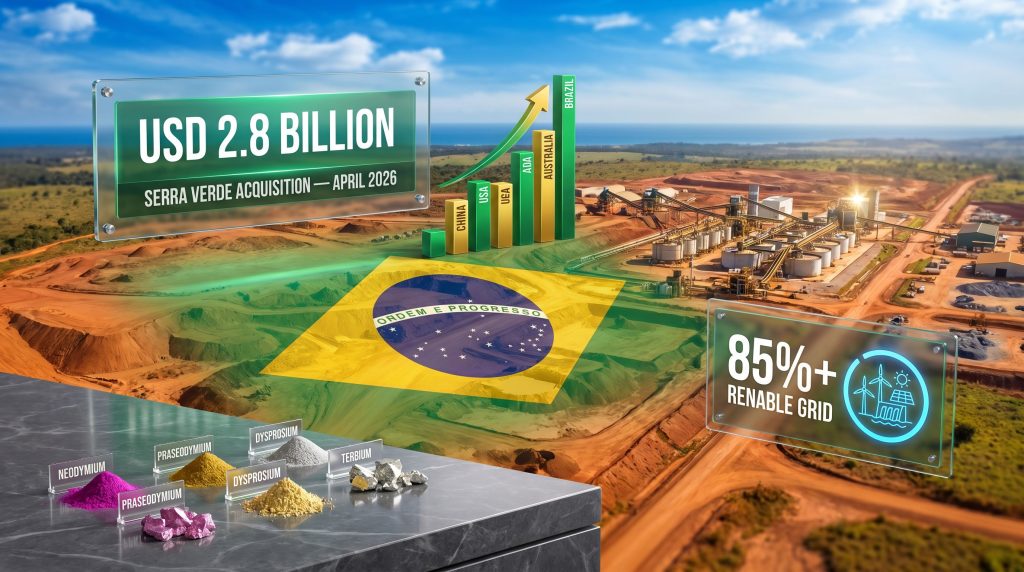
For years, Brazil's rare earth potential remained largely theoretical. Serra Verde changed that calculation in a fundamental way. The operation, located in Goiás, commenced commercial production in 2024 following a development programme that absorbed more than USD 1.1 billion in capital investment. It now stands as the only rare earth operation outside Asia producing all four key magnetic rare earth elements at commercial scale: neodymium, praseodymium, dysprosium, and terbium.
That distinction carries significant weight. Most non-Chinese REE projects produce mixed rare earth carbonate or concentrate that must be further processed, with HREE fractions often present in quantities too small for reliable commercial extraction. Serra Verde's ability to deliver separated product across all four magnet elements from a single ionic clay operation is a technical and commercial achievement that took years to validate.
The market's response to Serra Verde's production track record was swift and decisive. In April 2026, USA Rare Earth agreed to acquire the operation in a transaction valued at approximately USD 2.8 billion — one of the largest single-asset critical minerals deals recorded outside of lithium. The strategic logic was transparent: acquiring a production-ready, HREE-capable asset with Atlantic logistics access and a low-carbon energy profile at a time when Western magnet manufacturers are under intense pressure to diversify away from Chinese supply.
This transaction effectively set a valuation anchor for production-stage Brazilian REE assets and signalled to the broader investment community that Brazil had crossed from speculative jurisdiction to verified Tier-1 territory.
Transaction Benchmark Data
| Transaction | Year | Value | Strategic Signal |
|---|---|---|---|
| Serra Verde acquisition by USA Rare Earth | 2026 | ~USD 2.8 billion | Validates Brazil as a production-credible REE jurisdiction |
| Brazilian Rare Earths land expansion (Bahia) | 2023–2025 | Undisclosed | Land position grew from ~400 km² to 4,000+ km² |
The Structural Barriers That Still Define Brazil's Ceiling
Despite Serra Verde's milestone status, the Brazil rare earth sector development story faces three structural constraints that limit its near-term competitiveness as a fully integrated REE supplier.
The processing gap is the most consequential. Brazil currently lacks large-scale rare earth separation and refining infrastructure. These processing challenges mean that even where concentrate production exists, value-added processing occurs elsewhere — primarily in China and, to a lesser extent, in Malaysia via Lynas Corporation's separation facilities. The economic cost of this gap is not trivial; downstream separation and refining captures a disproportionate share of total REE value chain margins.
A country that exports mixed concentrate but imports separated oxides, alloys, and magnets is systematically leaking economic value at every processing stage.
The financing architecture presents a second structural challenge specific to Brazil's legal and regulatory environment. Under existing domestic frameworks, mineral rights and future offtake agreements are reportedly difficult to deploy as collateral for project financing. This constraint pushes Brazilian REE developers toward foreign capital markets, royalty streaming structures, and offtake-linked credit facilities — all of which increase the effective cost of capital relative to comparable projects in Australia or Canada.
The policy coordination deficit rounds out the structural picture. Brazil's REE sector currently operates without a unified national industrial strategy that links exploration incentives to processing investment and downstream manufacturing targets. The proposed National Policy on Critical and Strategic Minerals (PNMCE) is designed to address this gap, but governance mechanisms, financing windows, and implementation timelines remain works in progress.
Without a deliberate policy framework connecting mineral extraction to downstream processing, Brazil risks following a pattern seen repeatedly across resource-rich economies: abundant reserves generating limited domestic industrial value.
Brazil's Energy Advantage: An Underappreciated Differentiator
One dimension of Brazil's REE competitiveness that rarely receives adequate attention is the country's electricity grid composition. Brazil generates approximately 85% or more of its electricity from renewable sources, predominantly hydropower, supplemented by growing wind and solar capacity — among the highest renewable electricity proportions of any major economy globally.
For rare earth processing, this matters in a concrete and quantifiable way. Rare earth separation and refining are energy-intensive processes. Solvent extraction circuits, precipitation stages, and calcination operations consume substantial electricity and thermal energy. As carbon border adjustment mechanisms expand and as Western manufacturers apply increasing ESG scrutiny to their supply chains, the carbon intensity of upstream REE processing will become a differentiating factor in offtake negotiations.
A Brazilian separation facility powered predominantly by renewable hydroelectricity would carry a materially lower Scope 2 emissions profile than equivalent facilities in China or even Australia. For European automotive manufacturers operating under increasingly stringent supply chain decarbonisation mandates, and given the broader context of European critical raw materials sourcing pressures, this could prove a decisive procurement criterion.
Competitive Positioning: How Brazil Stacks Up Against Global Peers
| Dimension | Brazil | Australia | USA | Canada |
|---|---|---|---|---|
| Reserve Scale | Very Large | Large | Moderate | Large |
| Current Production | Early-Stage (Serra Verde) | Established (Lynas) | Emerging (MP Materials) | Pre-Production |
| Processing Infrastructure | Minimal | Moderate (Malaysia plant) | Growing | Minimal |
| Policy Framework | Developing (PNMCE) | Advanced | Advanced (IRA-linked) | Advanced |
| Renewable Energy Advantage | High (85%+ renewable grid) | Moderate | Moderate | Moderate |
| Financing Market Depth | Constrained | Mature | Mature | Mature |
Brazil's principal competitive advantages over peer jurisdictions are geological diversity, energy cost and carbon profile, and Atlantic logistics positioning for European and North American markets. However, its primary deficits remain processing infrastructure, financing market depth, and the policy framework maturity needed to attract capital at scale. Consequently, the rare earth geopolitics surrounding Brazil's rise will be just as important as its geology in determining long-term outcomes.
The next major ASX story will hit our subscribers first
Three Scenarios for Brazil's REE Sector to 2035
The range of outcomes for Brazil's rare earth ambitions over the next decade is genuinely wide, and the determining variables are more policy and capital market driven than geological.
Scenario 1: Accelerated Integration (Best Case)
- PNMCE enacted with substantive financing mechanisms by 2027
- Multiple pilot-scale separation plants operational by 2028–2029, transitioning to commercial scale by 2031
- Brazil captures 10 to 15% of global ex-China REE supply by 2035
- Total foreign direct investment across exploration, processing, and downstream manufacturing exceeds USD 5 billion
Scenario 2: Managed Growth (Base Case)
- Incremental policy progress; Serra Verde expands production; one or two additional ionic clay projects reach production stage
- Brazil remains primarily a concentrate exporter through 2030, with processing capacity emerging post-2030
- Sector grows in volume terms but value capture remains constrained to upstream activities
Scenario 3: Policy Stagnation (Downside Case)
- Financing constraints and regulatory uncertainty delay the next wave of project development beyond 2030
- Brazilian REE assets are progressively acquired by offshore entities with processing occurring entirely outside Brazil
- Resource endowment is monetised through foreign capital, but domestic industrial development remains minimal
The critical variable separating these scenarios is almost entirely determined by whether Brazil builds domestic processing capacity and a fit-for-purpose financing framework within the next five years. The geological endowment is not the constraint; the institutional architecture is.
What the Investment Landscape Reveals About Risk Appetite
The Serra Verde acquisition at USD 2.8 billion establishes a concrete valuation reference point for production-stage Brazilian REE assets. However, the more instructive signal for early-stage investors may be the land banking activity occurring in Bahia, where Brazilian Rare Earths expanded its tenement position from roughly 400 km² to over 4,000 km² between 2023 and 2025 — a tenfold increase reflecting a strategic land grab logic before resource definition drilling confirms the scale of the endowment.
Institutional investors and strategic buyers evaluating Brazilian REE exposure are tracking several key variables:
- Serra Verde's production ramp and product quality consistency as a proof-of-concept benchmark
- The PNMCE policy trajectory and whether financing window structures materialise
- Infrastructure development in frontier regions, particularly road access, water availability, and grid connectivity in Bahia
- ESG compliance frameworks, particularly with respect to indigenous land consultation requirements, which are legally robust in Brazil and carry real project development implications
Offtake agreements with Western magnet manufacturers or automotive OEMs represent the most effective risk mitigation tool available to Brazilian REE developers seeking project financing. These arrangements de-risk revenue assumptions sufficiently to open access to development bank financing, including potential participation from institutions such as BNDES and CAF.
The Policy Window That Defines the Decade
Brazil rare earth sector development stands at an inflection point that is time-sensitive in a way that geological endowments rarely are. The global supply chain restructuring underway in response to China's REE export controls and growing Western industrial policy is generating a window of opportunity for credible alternative suppliers. That window will not remain open indefinitely; Western manufacturers and governments are actively committing capital and offtake frameworks to the projects that can demonstrate execution capability now.
Serra Verde has demonstrated that Brazilian ionic clay deposits can be developed into commercially viable, multi-element magnetic rare earth operations. The USD 2.8 billion acquisition has demonstrated that Western strategic buyers will pay premium valuations for that capability. Furthermore, the surge in critical minerals demand globally only amplifies the urgency of Brazil's next move.
What remains unresolved is whether Brazil's policy environment and financing architecture can evolve quickly enough to convert geological potential into vertically integrated industrial capacity — making Brazil a genuine peer to China in the global REE supply chain, rather than simply its most geologically endowed raw material supplier. As analysts at the Peterson Institute for International Economics have noted, geology alone is not destiny; infrastructure and institutional frameworks are what ultimately determine whether a resource-rich nation captures enduring economic value.
The processing infrastructure investment decision is the single highest-leverage policy intervention available. Without domestic separation and refining capacity, Brazil exports strategic resources and imports the economic value they generate. With it, Brazil could position itself as the anchor of a non-Chinese rare earth supply chain spanning extraction, separation, alloying, and potentially magnet manufacturing — a supply chain the rest of the world currently does not have and urgently needs.
Disclaimer: This article contains forward-looking scenario analysis and market projections that involve inherent uncertainty. Readers should conduct independent due diligence before making any investment decisions. Transaction figures and geological data referenced are sourced from publicly available industry reporting and may be subject to revision.
Want to Track the Next Major Critical Minerals Discovery Before the Market Does?
Discovery Alert's proprietary Discovery IQ model delivers real-time alerts on significant ASX mineral discoveries — instantly converting complex mineral data into actionable investment insights for both short-term traders and long-term investors. Explore historic discovery returns on Discovery Alert's dedicated discoveries page and begin your 14-day free trial today to position yourself ahead of the market.