June 22, 2026
The Invisible Bottleneck Reshaping Industrial Strategy
Most discussions about energy transition and defence readiness focus on technology, finance, or workforce. Far less attention goes to the foundational layer beneath all of it: the physical materials that make advanced manufacturing possible. Rare earth elements and critical minerals are not niche commodities. They are the enabling inputs for electric vehicle drivetrains, offshore wind generators, precision defence electronics, and the semiconductor supply chain. Without reliable access to them, industrial ambitions stall regardless of how sophisticated the downstream technology becomes.
This reality is now driving a fundamental recalibration of UK industrial policy, with UK critical minerals supply chain investment emerging as one of the most consequential strategic priorities of the decade.
When big ASX news breaks, our subscribers know first
Why Concentration Risk Has Become Impossible to Ignore
The structural vulnerability is stark. According to the International Energy Agency, China accounts for roughly 70% of global rare earth extraction and approximately 90% of worldwide processing capacity. That degree of concentration in a single non-allied nation creates a category of risk that sits somewhere between trade exposure and national security concern.
What makes this different from oil dependency is the absence of mature financial instruments to manage it. Oil markets have deep spot trading, futures contracts, and sophisticated hedging mechanisms built over decades. Rare earth supply chains have none of that infrastructure. Prices are opaque, supply agreements are often long-term bilateral contracts, and there is no equivalent of the Brent benchmark to provide transparent price discovery for neodymium or dysprosium.
The practical consequences for UK industry are significant. Furthermore, the critical minerals demand driven by the energy transition compounds these vulnerabilities considerably:
- Procurement teams cannot hedge against rare earth price volatility the way they can with base metals or energy inputs
- Smaller manufacturers lack the purchasing scale to negotiate meaningful supply contracts with overseas producers
- A disruption to Chinese rare earth exports, whether from export controls, geopolitical friction, or logistical failures, would immediately impair the UK's capacity to manufacture EV drivetrains and commission offshore wind turbines
- The defence sector, which relies on rare earth permanent magnets for guidance systems, radar, and communications equipment, faces equivalent exposure
The core problem is not that the UK lacks awareness of this risk. It is that converting awareness into physical supply chain infrastructure takes years, requires coordinated public and private capital, and must overcome a long period during which domestic production cannot yet compete on cost with established Chinese supply.
Decoding the £50 Million Package: Three Distinct Market Failures Addressed
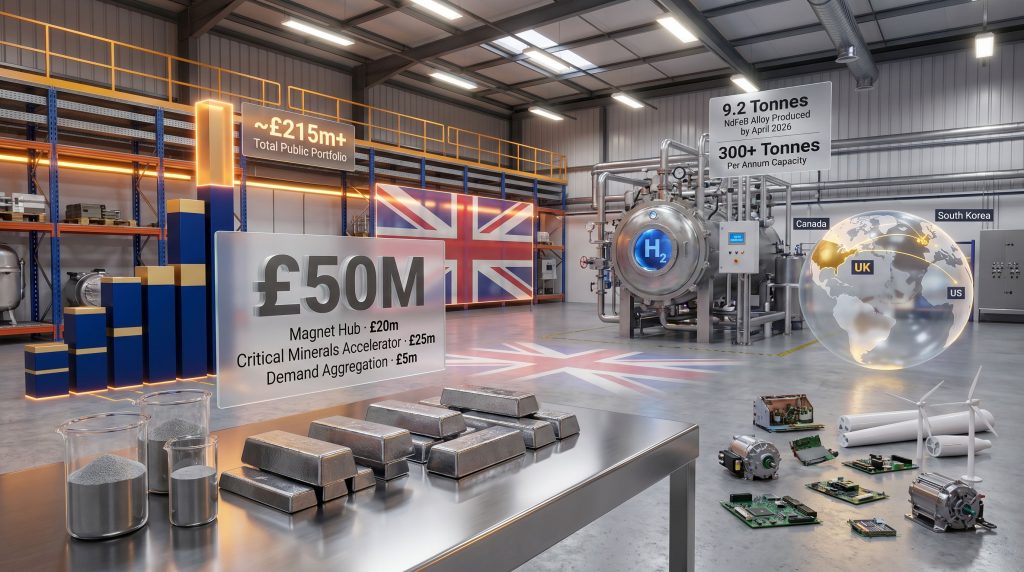
The UK government's £50 million commitment, announced in June 2026 by Industry Minister Chris McDonald, is not a single intervention. It is structured as three targeted pillars, each addressing a different point of market failure across the supply chain.
| Pillar | Name | Allocation | Core Problem Solved |
|---|---|---|---|
| 1 | Magnet Hub | £20m (US$26m) | Absence of domestic rare earth magnet manufacturing |
| 2 | Critical Minerals Accelerator | £25m (US$33m) | Early-stage project de-risking across extraction, processing, and recycling |
| 3 | Demand Aggregation Platform | £5m (US$6.6m) | Buyer-side fragmentation preventing competitive procurement |
Pillar One: Rebuilding Manufacturing Capability
The £20 million Magnet Hub targets a capability that the UK lost more than a quarter century ago. Domestic rare earth magnet manufacturing at commercial scale has been absent from Britain for over 25 years, a gap that leaves the entire clean energy and defence industrial base dependent on imported components. The Magnet Hub is designed to provide shared testing and development infrastructure, reducing the capital burden that would otherwise deter individual companies from re-entering this space.
Pillar Two: Catalytic Capital for the Full Value Chain
The £25 million Critical Minerals Accelerator is structured as public capital deployed specifically to de-risk projects that private investors would avoid at early stage. It covers extraction, processing, refining, and recycling, and is designed to encourage multi-party collaboration rather than isolated company-level projects. This is an important design choice. Isolated R&D investments tend to produce proprietary outputs that cannot scale. Collaborative structures create shared infrastructure and knowledge that benefits the sector broadly.
Pillar Three: Solving the Buyer Fragmentation Problem
The £5 million Demand Aggregation Platform addresses something that rarely features in critical minerals discussions: the buyer side. UK manufacturers individually lack the purchasing volume to negotiate competitive supply contracts. The collective buying group model enables smaller businesses to access pricing and contract terms typically available only to large industrial buyers. It also improves the commercial case for domestic and allied-nation suppliers, since aggregated demand reduces the offtake risk that makes smaller supply projects uneconomic.
The Broader Public Investment Architecture
The £50 million package does not exist in isolation. It is the most recent addition to a cumulative public investment framework that now totals approximately £215 million directed at the UK critical minerals sector. The UK Vision 2035 critical minerals strategy provides the overarching policy framework within which these investments are deployed.
| Programme | Scale | Primary Function |
|---|---|---|
| Prior sector commitments | £200m+ | Broad mining and minerals sector support |
| June 2026 package | £50m | Extraction, processing, recycling |
| CLIMATES Programme | £15m | Rare earth and magnet supply chain R&D |
| National Wealth Fund | Varies (loans, equity, guarantees) | Project-level de-risking |
| UK Export Finance | Varies | Overseas supply chain finance for UK exporters |
| Total estimated portfolio | ~£215m+ | Full value chain from extraction to recycling |
The National Wealth Fund has already deployed capital into domestic projects, with confirmed investments in Cornish Lithium and Cornish Metals, and a further commitment to Cornish Lithium in 2025. The UK Export Finance Critical Minerals Supply Finance tool extends this reach overseas, supporting projects in partner nations that supply UK industry under long-term contracts.
The CLIMATES Programme, a separately funded £15 million initiative, focuses specifically on rare earth and magnet supply chain resilience through feasibility studies, R&D funding, and industry collaboration structures. Together, these instruments provide coverage across the entire value chain rather than concentrating public capital at a single point.
HyProMag: The Factory That Proves Domestic Recycling Is Viable
Abstract policy commitments carry limited weight without physical proof points. The most compelling evidence that the UK's critical minerals ambition is grounded in technical reality came in January 2026, when Britain's first commercial rare earth magnet manufacturing facility in over two decades opened at Tyseley Energy Park in Birmingham.
The facility is operated by HyProMag, a company owned by Maginito Limited, which itself is 79.4% owned by Mkango Resources and 20.6% by CoTec Holdings. The technology at its core, known as Hydrogen Processing of Magnet Scrap (HPMS), was developed by the University of Birmingham's Magnetic Materials Group and represents one of the more significant process innovations in rare earth recovery to emerge from UK academia.
How HPMS Works and Why It Matters
The HPMS process uses hydrogen gas to selectively degrade the microstructure of neodymium-iron-boron (NdFeB) permanent magnets recovered from end-of-life equipment. This causes the magnet material to fracture along grain boundaries and break down into a fine alloy powder that retains the rare earth composition of the original magnet. The recovered powder can then be reprocessed into new magnets without the energy-intensive steps required to smelt and refine virgin rare earth ore.
The implications are commercially and environmentally significant. However, the rare earth processing challenges that have historically constrained this sector should not be underestimated:
- The process avoids the highly polluting separation chemistry associated with conventional rare earth processing from primary ore
- Production cost structures are meaningfully lower than virgin rare earth magnet production, according to Mkango Resources CEO William Dawes, who has described the facility as transformational for rare earth supply chains after a 25-year absence of domestic magnet manufacturing in Britain
- The feedstock, end-of-life magnets recovered from industrial equipment, consumer electronics, and EV components, is generated domestically, reducing geopolitical supply exposure
Production Performance by April 2026
| Metric | Recorded Figure |
|---|---|
| NdFeB alloy powder produced | 9.2 tonnes |
| Recovery per batch | 400kg+ of rare earth alloy |
| Annual capacity (single shift) | 100 tonnes per annum |
| Annual capacity (multiple shifts) | 300+ tonnes per annum |
| Target under evaluation | 1,000 tonnes per annum |
Early-stage customer engagement with Siemens provides commercial validation that the recovered alloy powder meets the quality requirements of industrial end users. This is a critical threshold. Recycled rare earth materials have historically faced scepticism about consistency and magnetic performance relative to virgin-source alloys. Siemens engagement signals that HPMS output is clearing that bar.
Urban Mining: Redefining Waste as a Domestic Mineral Resource
HyProMag is not the only UK company pursuing a recycling-led approach to critical minerals security. DEScycle, a Teesside-based startup, is applying a different technology pathway: chemical solvent extraction from waste electronics, a process that falls under the broader classification of urban mining.
The company is approaching completion of what it describes as a world-first demonstration facility at Teesside, with key equipment installed ahead of commissioning. The Wilton Centre, one of Europe's largest R&D campuses and the location where Industry Minister Chris McDonald launched the £50 million programme, is central to this industrial cluster.
Teesside's strategic value for this kind of operation is not accidental. The region combines:
- A deep industrial heritage in chemical processing
- An existing skilled technical workforce with experience in complex manufacturing environments
- Proximity to the Wilton Centre, which provides access to shared R&D infrastructure
- Established logistics and supply chain connections relevant to industrial-scale materials processing
The urban mining model carries a distinctly different risk profile than primary extraction. Feedstock generation is continuous and domestic. As the volume of end-of-life electronics, EV batteries, and industrial equipment grows alongside the energy transition, the material available for recovery increases in parallel. This creates a supply chain that expands with the very industries it is designed to support.
One underappreciated aspect of urban mining is that electronic waste contains rare earth concentrations that can exceed those found in conventional ore deposits on a per-kilogram basis. The challenge has historically been economic extraction rather than material availability.
The next major ASX story will hit our subscribers first
Vision 2035: What the Targets Actually Require
The UK's Vision 2035 strategy sets two headline targets:
- 10% of annual domestic critical mineral demand met through UK-based production by 2035
- 20% of annual demand met through domestic recycling by the same date
These figures may appear modest, but the baseline from which the UK is starting makes them ambitious in practice. Domestic primary extraction of rare earths and associated critical minerals is currently negligible at commercial scale. Recycling infrastructure capable of meeting 20% of demand does not yet exist. Achieving both targets requires parallel progress across technology development, infrastructure investment, private capital mobilisation, and international partnership.
The international dimension is substantive. The UK is pursuing bilateral supply chain collaboration with the United States and South Korea, focused on processing capacity development, investment frameworks, and shared resilience planning. In addition, a dedicated UK-Canada collaboration covers supply chain mapping, circular economy integration, and modelling for geopolitical disruption scenarios.
These partnerships align with commitments made at the G7 Évian summit, where member nations agreed to reduce dependence on any single non-G7 supplier of rare earths and permanent magnets to below 60% by 2030. That deadline is approximately four years away and represents a measurable geopolitical benchmark against which UK progress can be assessed.
How the UK Model Compares Across G7 Nations
| Country | Primary Mechanism | Strategic Focus |
|---|---|---|
| United Kingdom | £50m package + NWF + UKEF + CLIMATES | Processing, recycling, magnet manufacturing |
| United States | Pentagon-backed processing investments | Domestic rare earth refining |
| Canada | UK-Canada collaboration; domestic extraction focus | Supply chain mapping, circular economy |
| South Korea | Bilateral partnership with UK | Processing capacity, investment flows |
| G7 Collective | Évian summit commitments | Sub-60% single-supplier dependency by 2030 |
The UK's model is distinctive in its emphasis on catalytic public capital rather than direct state ownership. Rather than acquiring equity stakes in mining operations, the approach deploys public funding to reduce the risk profile of projects sufficiently to attract private investment. This preserves market efficiency while lowering entry barriers for companies that would otherwise find early-stage development uneconomic. Furthermore, the role of critical raw materials in the broader green transition reinforces why this investment architecture matters beyond simply domestic industrial policy.
Structural strengths of the UK approach include:
- Full value chain coverage from extraction through to recycling and supply chain finance, rather than concentration at a single point
- Strong university-industry linkages, as demonstrated by the HPMS technology transfer from the University of Birmingham to HyProMag
- Geographic clustering of capability at innovation hubs in Birmingham and Teesside, which creates agglomeration benefits and shared infrastructure efficiencies
- Use of public capital to de-risk rather than substitute for private investment
Areas where further development is needed:
- Domestic primary extraction remains very limited relative to peer nations such as Australia, Canada, and the United States
- Even at its 1,000 tonne per annum expansion target, HyProMag's Birmingham facility represents a small fraction of total UK demand for rare earth magnet materials
- The multiplier effect of catalytic public funding depends entirely on whether private capital follows, which remains the central execution risk
Key Indicators for Tracking Progress
For those monitoring the development of UK critical minerals supply chain investment, the following metrics provide the clearest forward-looking signal:
- HyProMag's production trajectory toward the 1,000 tonne per annum expansion target
- National Wealth Fund deployment into additional processing and extraction projects beyond current Cornish commitments
- DEScycle's transition from demonstration facility to commercial-scale operations at Teesside
- Tangible outputs from UK-US and UK-South Korea processing partnerships
- Progress against Vision 2035's 10% domestic production and 20% recycling benchmarks
- Whether the Demand Aggregation Platform generates sufficient collective purchasing volume to shift supply deal terms for smaller UK manufacturers
The structural logic behind the UK's critical minerals investment programme is sound. The concentration of processing and extraction capacity in a single non-allied nation creates systemic industrial risk that no amount of diplomatic goodwill can fully mitigate. Building physical alternatives requires time, capital, and technical capability, all of which are now being deployed in parallel. Whether the pace of deployment is fast enough to meet the G7's 2030 target and the UK's own Vision 2035 goals will depend on execution quality and private sector confidence, two variables that public policy can influence but not control.
This article is for informational purposes only and does not constitute financial or investment advice. Forecasts and targets referenced reflect stated government and company objectives and are subject to change based on commercial, technical, and geopolitical developments.
Want to Track the Next Major Mineral Discovery Before the Market Moves?
While the UK races to secure critical minerals supply chains, Discovery Alert's proprietary Discovery IQ model scans ASX announcements in real time, instantly identifying significant mineral discoveries across rare earths and other strategic commodities — explore historic discoveries and their returns to see what early positioning can mean, then begin your 14-day free trial at Discovery Alert to stay ahead of the market.