June 22, 2026
The Race to Build Western Rare Earth Recycling Infrastructure Has Already Begun
For most of the past two decades, the economics of rare earth recycling in the West simply did not stack up. Primary supply from China was abundant, cheap, and politically convenient enough to defer the hard work of building domestic processing infrastructure. That calculation has now fundamentally changed. China's 2025 export restrictions on heavy rare earth elements did not merely tighten supply at the margins — they structurally bifurcated the global rare earth market into two distinct pricing environments, one inside China and one outside it. For the first time, the feedstock costs and separation economics of Western recycling operations are genuinely competitive, and in some cases, considerably more attractive than anything modelled just eighteen months ago.
It is within this context that the Ionic Rare Earths Belfast recycling plant Ford validation milestone carries real strategic weight — not just as corporate achievements for a single ASX-listed company, but as early proof points for an entire class of Western supply chain infrastructure that governments and manufacturers are now urgently trying to build.
When big ASX news breaks, our subscribers know first
What the Belfast Facility Actually Does and Why Separation Is the Hard Part
The Two Feedstock Streams That Make Recycling Viable
Most public discussion of rare earth recycling focuses narrowly on end-of-life consumer products — motors pulled from scrapped EVs, hard drives removed from decommissioned servers, and similar post-consumer material. What receives far less attention is manufacturing swarf, the fine metallic residue generated when rare earth magnets are precision-cut and shaped during the production process.
This distinction matters considerably. End-of-life feedstock is variable in composition, geographically dispersed, and subject to collection logistics that can be difficult to standardise. Swarf, by contrast, is generated continuously, in predictable volumes, at fixed manufacturing locations, with known rare earth content. For a recycling operation seeking consistent feedstock quality, a direct relationship with a magnet manufacturer providing swarf is structurally superior to relying solely on post-consumer collection.
The Belfast demonstration plant run by Ionic Rare Earths processes both streams, converting them into separated rare earth oxides through a hydrometallurgical process built on intellectual property co-developed with Queen's University Belfast. Furthermore, the rare earth processing challenges involved in achieving consistent purity levels across both feedstock types represent a significant technical barrier for potential competitors.
Why Heavy Rare Earth Separation Is Technically Demanding
Producing neodymium-praseodymium (NdPr) oxide from recycled magnets is commercially understood and increasingly replicated. Separating the heavy rare earth fraction — dysprosium, terbium, holmium, gadolinium, and yttrium — from the same feedstock is substantially more technically demanding, requiring a different set of chemical processing steps and a higher degree of process control to achieve the purity levels that downstream alloy producers and magnet manufacturers require.
This is the area where Ionic's Queen's University Belfast-derived intellectual property provides its most differentiated value. The facility produces a genuine basket of separated oxides spanning both light and heavy rare earths, positioning it to capture value from the elements that have experienced the most dramatic price escalation since China's 2025 export restrictions took effect.
Step-by-Step: How the Belfast Facility Converts Magnet Waste into Separated Oxides
- Feedstock intake — End-of-life magnets and manufacturing swarf are sourced from industrial partners and OEM supply chains, with composition profiling conducted on intake.
- Pre-processing — Feed material undergoes proprietary alloy preparation to optimise rare earth recovery rates and minimise processing losses.
- Separation — Hydrometallurgical processing isolates individual rare earth oxides, covering both the NdPr pairing and the heavier elements including dysprosium, terbium, holmium, gadolinium, and yttrium.
- Quality assurance — Separated oxides are subjected to purity testing and third-party validation protocols before customer qualification trials proceed.
- Offtake delivery — Qualified material is supplied to downstream alloy producers and magnet manufacturers under commercial arrangements.
Where the Demonstration Plant Sits Relative to Commercial Scale
| Metric | Demonstration Plant (Current) | Commercial Facility (Target) |
|---|---|---|
| Annual separated oxide output | ~10 tonnes per annum | 400 tonnes per annum |
| Operational status | Running ~3 years | FID targeted September 2026 |
| Capital cost | Demonstration-scale | £85 million |
| Technology Readiness Level | TRL 8 | Commercial (TRL 9) |
| Rare earth product range | NdPr, DyTb, Ho, Gd, Y | Full basket including heavy REEs |
TRL 8 Defined: A Technology Readiness Level of 8 signifies that a system has been fully demonstrated in its operational environment at pre-commercial scale, has passed qualification testing, and is ready for deployment at full commercial scale. It represents the final stage before complete commercial operation at TRL 9.
Why the Ford Validation of the Ionic Rare Earths Belfast Recycling Plant Is Significant
OEM Qualification Is Not a Formality
Automotive manufacturers apply multi-stage qualification protocols to every new material source before approving it for use in production drivetrain components. These processes exist because motor performance, thermal stability, and longevity requirements in EV applications are unforgiving — a magnet that performs adequately in laboratory conditions but degrades under real operating temperatures or electromagnetic loads is a product liability risk at scale.
The qualification process for rare earth oxide material used in permanent magnet motors typically spans several years and involves performance benchmarking at the alloy stage, the sintered magnet stage, and ultimately within a completed motor assembly operating under representative conditions. Passing each stage requires consistent material purity, predictable compositional profiles across batches, and documented traceability back to the original feedstock.
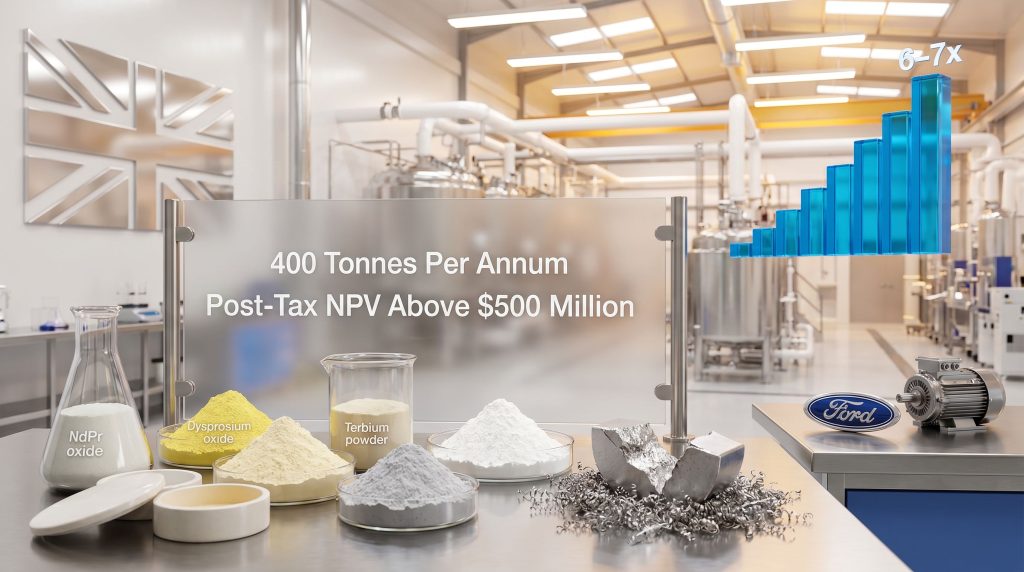
Ionic's confirmation that its separated oxide material has been validated within a Ford-produced motor represents the completion of this full chain of qualification — making it, by the company's account, the first recycler of separated magnet rare earth oxides to achieve this status. That claim, if sustained, is commercially meaningful in a market where OEM qualification history is itself a barrier to entry for competing recyclers. Independent analysis on building a circular supply chain for rare earth elements underscores just how structurally significant this kind of end-to-end validation is.
The Partnership Structure Behind the Validation
The Belfast validation did not occur in isolation. It involved a coordinated supply chain spanning multiple parties:
- Ionic Rare Earths — Magnet recycling and rare earth oxide separation at the Belfast demonstration facility.
- Less Common Metals (LCM) — Downstream conversion of separated oxides into rare earth alloys suitable for magnet production.
- British Geological Survey — Technical advisory and supply chain mapping across the UK critical minerals landscape.
- Ford — End-use validation and EV motor performance testing confirming material suitability for production applications.
This chain matters because it demonstrates that the Belfast output is not simply laboratory-certified — it has moved through an independent alloy production step and into a motor assembly that has been physically tested. Each link in that chain adds credibility that a laboratory purity certificate alone cannot provide.
First-Mover Advantage in OEM Qualification Compounds Over Time
In supply chain terms, the value of being first through a major OEM qualification process is not static — it compounds. Once a material source is qualified, switching costs for the OEM are high. Requalifying a new supplier requires repeating the multi-year process, which few procurement teams will undertake without a compelling reason. Ionic's position as the incumbent qualified recycled-origin oxide supplier within Ford's supply chain creates a structural advantage that newer entrants cannot replicate quickly, regardless of their processing economics.
Heavy Rare Earth Price Dynamics Since China's 2025 Export Restrictions
A Market That Has Bifurcated, Not Just Tightened
China's 2025 export restrictions on heavy rare earth elements did not reduce global supply uniformly — they created two parallel markets with diverging price trajectories. Inside China, heavy rare earth prices remain subject to domestic policy management. Outside China, prices for the same elements are now determined by whatever volume can be sourced from non-Chinese supply, which at present remains structurally insufficient to meet Western demand. The broader China rare earth trade strategy underpinning these restrictions signals that this bifurcation is unlikely to reverse in the near term.
| Element | Price Trend Post-2025 Restrictions | Strategic Relevance |
|---|---|---|
| Dysprosium oxide | Sharply higher outside China | Critical for high-temperature EV motor magnets |
| Terbium oxide | Sharply higher outside China | Key coercivity enhancer in NdFeB magnets |
| Yttrium | Reported increases exceeding 100-fold in some markets | Broad industrial and defence applications |
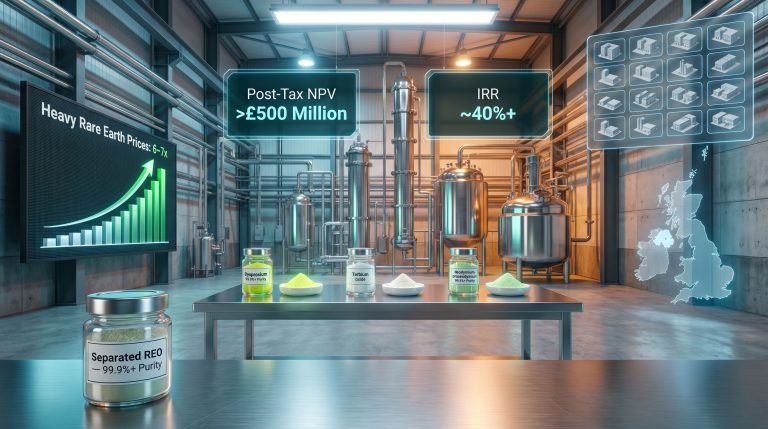
| Heavy REE basket (avg.) | Estimated 6 to 7 times increase outside China | Drives recycling economics at commercial scale |
The yttrium pricing observation deserves particular attention. Yttrium is not typically the rare earth element that attracts investor focus, but its applications in defence electronics, phosphors, and advanced ceramics mean that Western demand has no short-term substitute source. A more than 100-fold price increase in some non-Chinese markets reflects just how thin the non-Chinese supply position actually is for this element.
Why the November 2024 Feasibility Study Numbers Are Now a Floor, Not a Ceiling
The economic modelling underpinning the Belfast commercial project was completed before the most material phase of rare earth price escalation had occurred. The November 2024 feasibility study returned the following figures for an £85 million, 400-tonne-per-annum facility:
| Economic Metric | Modelled Outcome (Nov 2024 Study) |
|---|---|
| Total capital cost | £85 million |
| Annual production capacity | 400 tonnes of separated rare earth oxides |
| Post-tax NPV | Above $500 million |
| Internal Rate of Return (IRR) | Above 40% |
| Payback period | Just over 2 years |
| UK government grant secured | £12 million (Advanced Propulsion Centre) |
Management has indicated that rare earth prices have roughly doubled on average over the eighteen months since the study was completed, with the heavy rare earth basket rising by six to seven times in non-Chinese markets and selected elements moving even further. The implication is that the study's economic metrics represent a conservative baseline relative to current conditions, though no formally updated study reflecting post-restriction pricing has been published. Investors should treat the original figures as a reference point and exercise their own judgement regarding the potential upside from current market pricing.
Investor Note: The absence of a formally updated feasibility study means that the improved economics remain management commentary rather than independently verified numbers. Any updated study would need to incorporate current contracted pricing, not merely spot market figures, to provide a reliable forward picture.
The Capital Stack, the September 2026 FID, and What Must Still Be Resolved
What TRL 8 Means in Practice for Investment Readiness
Reaching Technology Readiness Level 8 is a meaningful threshold in the commercialisation of industrial processing technology. It means the system has been demonstrated in its intended operational environment, has passed qualification testing, and is technically ready for scale-up. It does not mean the project is fully funded or that feedstock and offtake arrangements are finalised — both of which remain prerequisites for a Final Investment Decision.
Ionic has secured a £12 million grant from the UK government's Advanced Propulsion Centre, which counts toward the £85 million total capital requirement. The company is currently completing due diligence processes with potential investors to close the remaining capital gap. A Final Investment Decision is targeted for September 2026, by which point management expects to have the full funding package assembled alongside greater feedstock and offtake visibility.
The Feedstock Opportunity Hidden in Supply Chain Realignment
One of the less-discussed dynamics within the Belfast project is the nature of the feedstock pipeline. A number of large industrial groups previously channelled their recycled rare earth material into Chinese processing supply chains. With those supply chains now disrupted or politically untenable, these groups are actively seeking Western alternatives. According to management commentary, some individual counterparties hold sufficient material to feed one or two Belfast-scale facilities independently — suggesting that feedstock scarcity is not the primary constraint on scaling, provided commercial terms can be agreed.
Why the United States Represents Ionic's Largest Near-Term Growth Opportunity
The Scale of the US Mine-to-Magnet Build-Out
The United States is in the process of constructing an entirely new domestic rare earth supply chain from the ground up, with the magnet manufacturing layer receiving the most concentrated capital deployment in recent history. Consequently, the critical minerals demand surge across North America is reshaping investment priorities well beyond the mining sector alone.
| US Magnet Build-Out Metric | Estimated Figure |
|---|---|
| Total strategic value of US mine-to-magnet programme | ~$14 billion |
| Government catalytic capital committed | In excess of $4 billion |
| Capital deployed across new magnet manufacturing | ~$7 billion |
| New magnet manufacturing facilities under development | ~8 facilities |
| Combined planned magnet output | ~50,000 tonnes per annum |
| Estimated annual swarf generated by new capacity | At least 20,000 tonnes |
| Belfast-scale recycling plants required to process swarf | At least 17 facilities |
The swarf generation figure is particularly instructive. Approximately 30 to 40 percent of rare earth content in sintered NdFeB magnet production is lost as swarf during the cutting and shaping process. Applying this ratio to 50,000 tonnes of annual US magnet output yields a swarf volume that would require the equivalent of at least seventeen Belfast-scale recycling facilities to process — a figure that puts the scale of the recycling opportunity in context.
The MOU, the Defence Angle, and the Funding Pathway
Ionic signed a Memorandum of Understanding with US Strategic Metals in November 2025 and has a commercial supply arrangement with Advanced Magnet Lab, which is validating magnets for the US defence sector. Defence applications carry particular significance because they require a documented domestic supply chain with material traceability — exactly the kind of qualification history that Ionic has been building through its Ford and Advanced Magnet Lab relationships.
Potential US funding sources under active discussion include the US Export-Import Bank and the Office of Strategic Capital, both of which have mandates that could be applicable to a facility supporting domestic critical mineral processing. In addition, US critical minerals policy frameworks currently under development could provide further non-dilutive capital pathways, though no commitments have been confirmed at the time of writing.
The next major ASX story will hit our subscribers first
Joint Ventures Over Licensing: A Business Model Built for a Structurally Tight Market
Why Retaining Control of Molecular Flow Matters
Ionic's stated preference for joint venture structures over technology licensing reflects a deliberate strategic choice about where value accrues in a constrained supply environment. Under a licensing model, the technology developer receives a royalty or fee but surrenders control over how the technology is operated, what volumes are produced, and where material is sold. In a market where qualified Western separated rare earth oxide supply is genuinely scarce, that loss of control represents a significant opportunity cost.
| Business Model | IP Ownership | Revenue Model | Material Flow Control | Capital Requirement |
|---|---|---|---|---|
| Technology licensing | Transferred or shared | Royalty or fee | None | Low |
| Joint venture | Retained | Margin participation | Direct | Moderate to high |
| Wholly owned replication | Retained | Full margin | Full | High |
By retaining direct participation in the flow of separated material through joint venture structures, Ionic positions itself to capture margin at the processing stage rather than receiving a fixed payment that does not scale with price. Given management's commentary on the current pricing environment, the economic difference between these two models is substantial.
The Modular Template Logic
The Belfast facility is explicitly designed as a replicable template. Locating Belfast-scale processing plants near Western magnet manufacturing hubs eliminates the logistical complexity and regulatory challenges of transporting rare earth-bearing feed material across international borders. Each new facility deployed under this template would draw on the same Queen's University Belfast IP, the same process flowsheet, and the accumulated operational knowledge from the demonstration plant — accelerating both permitting and commissioning timelines relative to a greenfield design process. This modular approach also directly strengthens the broader rare earth supply chain resilience that Western governments are prioritising.
Recycling vs. Primary Mining: Complementary Roles in a Sovereign Supply Strategy
How the Two Approaches Compare Across Strategic Dimensions
| Dimension | Rare Earth Recycling | Primary Mining |
|---|---|---|
| Lead time to production | Shorter (existing infrastructure base) | Longer (exploration through to production) |
| Environmental footprint | Generally lower | Higher (tailings, water use, land disturbance) |
| Feedstock security | Dependent on waste stream access and contracts | Dependent on ore grade and geological continuity |
| Geopolitical risk | Lower (Western waste streams) | Variable, jurisdiction dependent |
| Product range | Basket of separated oxides | Typically ore concentrate requiring further processing |
| Regulatory pathway | Waste processing permits | Full mining licence regime |
The critical insight that this comparison reveals is that recycling and primary mining are not competing strategies — they address different parts of the supply problem across different timeframes. Recycling can be deployed faster, at lower environmental cost, and with a more predictable feedstock base once industrial relationships are established. Primary mining provides the long-term production volume that recycling alone cannot supply given current Western waste stream volumes.
A sovereign Western rare earth supply chain almost certainly requires both. The Ionic Rare Earths Belfast recycling plant Ford validation represents progress on the recycling side of that equation, while the broader US mine-to-magnet programme attempts to address the primary production side simultaneously.
Frequently Asked Questions: Ionic Rare Earths Belfast Plant and Ford Validation
What rare earth elements does the Belfast facility produce?
The Belfast plant separates a full basket of rare earth oxides from recycled magnet material, extending well beyond the commonly traded NdPr pairing to include dysprosium, terbium, holmium, gadolinium, and yttrium. These heavy rare earth elements have experienced the most dramatic price escalation following China's 2025 export restrictions and represent the most commercially differentiated part of the Belfast output relative to competing recyclers. Detailed technical documentation on the facility's recycling approach is available via Ionic's recycling overview, which outlines how the process positions the company within the broader supply chain.
What does Ford's involvement in the Belfast project involve?
Ford has participated in validating magnets manufactured from separated rare earth oxides produced at the Belfast demonstration plant. This involved performance testing of recycled-origin magnets within Ford-produced motors to confirm the material meets EV drivetrain specifications. The process spanned multiple years and required the material to pass qualification at the oxide, alloy, sintered magnet, and motor assembly stages sequentially.
When is the Final Investment Decision for the commercial Belfast plant expected?
The company is targeting a Final Investment Decision by September 2026, contingent on completing the full £85 million capital stack and finalising both feedstock supply and offtake arrangements with industrial partners.
What is the planned production capacity of the commercial Belfast facility?
The commercial facility is designed to produce 400 tonnes per annum of separated rare earth oxides, representing a forty-fold increase over the demonstration plant's current annualised output of approximately 10 tonnes. The Belfast facility's move to 24/7 operations at the demonstration scale underscores the operational readiness being built ahead of that commercial transition.
Why does Ionic prefer joint ventures over technology licensing for international expansion?
Management has indicated a preference for retaining direct control over both its intellectual property and the physical flow of separated rare earth material. Joint venture structures allow the company to participate in the economics of material production at each facility rather than receiving a fixed royalty, which management views as more aligned with long-term value capture in a structurally tight supply environment.
How does the US magnet manufacturing build-out create demand for Belfast-style recycling plants?
Approximately $7 billion in new US magnet manufacturing capacity across roughly eight facilities is expected to generate at least 20,000 tonnes of manufacturing swarf annually once fully operational. Processing this volume would require the equivalent of at least 17 facilities operating at Belfast's planned commercial scale of 400 tonnes per annum, representing a very large addressable market for the Belfast template replication strategy.
What the September 2026 FID Timeline Signals for Investors
Three Structural Shifts That Make This Rare Earth Cycle Different
Earlier rare earth cycles, including the sharp price spike of 2010 to 2012, ultimately resolved because Western government and industry responses were too slow to sustain elevated prices and Chinese supply was restored before alternatives materialised. However, several factors suggest the current cycle has different characteristics:
- Supply chain bifurcation is now structural, not temporary. The political and strategic logic driving China's export restrictions is not expected to reverse in the near term, and Western manufacturers are actively designing Chinese-origin rare earths out of their supply chains regardless of whether restrictions ease.
- OEM qualification cycles are underway. The multi-year process of qualifying non-Chinese material sources has already begun across automotive, defence, and industrial sectors. Once completed, these qualifications create switching costs that sustain demand for Western-origin material.
- Further restrictions are anticipated. Additional Chinese export controls are expected around October 2026, which would add a further catalyst to an already elevated pricing environment before the Belfast commercial facility reaches its Final Investment Decision.
The September 2026 FID target sits directly within this window of anticipated policy escalation, making the timeline commercially meaningful beyond the project's own operational logic. Whether the full capital stack can be assembled and feedstock and offtake arrangements finalised within that window remains the key uncertainty for investors monitoring the Ionic Rare Earths Belfast recycling plant Ford validation story.
This article is intended for informational purposes only and does not constitute financial advice. All financial projections, feasibility study metrics, and management commentary referenced herein involve forward-looking elements and are subject to material uncertainty. Readers should conduct their own independent due diligence before making any investment decisions related to companies or projects discussed in this article.
Want to Stay Ahead of the Next Major Mineral Discovery on the ASX?
Discovery Alert's proprietary Discovery IQ model delivers real-time alerts the moment significant ASX mineral discoveries are announced, transforming complex data across more than 30 commodities into clear, actionable insights for both traders and long-term investors. Start your 14-day free trial today and see why historic discoveries have generated extraordinary returns by exploring Discovery Alert's dedicated discoveries page.