August 1, 2026
Why Western Rare Earth Recycling Has Become a Structural Imperative
For decades, the global rare earth supply chain operated as a largely invisible infrastructure underpinning everything from electric vehicle motors to precision-guided defence systems. Western manufacturers sourced processed rare earth materials from China with minimal friction, and the economics made it difficult to justify building alternative supply chains. That calculus has now fundamentally changed.
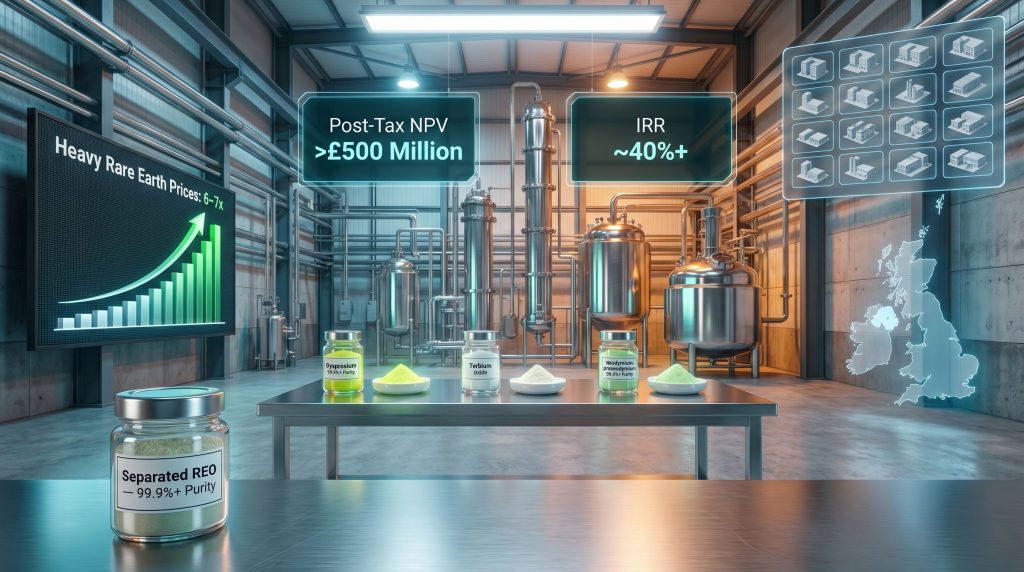
The imposition of Chinese export controls on heavy rare earth elements in 2024 triggered a repricing event that exposed just how fragile Western supply security had become. Dysprosium and terbium prices rose approximately six to seven times their pre-restriction levels in non-Chinese markets. Yttrium, a heavy rare earth with critical applications in phosphors and specialty alloys, reportedly experienced price increases exceeding 100-fold in select markets. Furthermore, these are not temporary dislocations. They reflect a structural bifurcation of global rare earth supply chains into Chinese and non-Chinese streams, a separation that is now being cemented by geopolitical momentum on both sides. China's rare earth export restrictions have fundamentally reshaped the competitive landscape for Western manufacturers.
Within this context, the Ionic Rare Earths magnet recycling Belfast plant has emerged as one of the few operating facilities outside China capable of producing individually separated rare earth oxides from recycled magnet materials. Understanding what that means, why it matters, and what the commercial pathway looks like requires unpacking both the technology and the market forces now converging around it.
When big ASX news breaks, our subscribers know first
What Rare Earth Magnet Recycling Actually Involves
The Separation Challenge: Why Is This Process So Difficult?
Rare earth elements are chemically similar to one another, which makes separating them into individual high-purity oxides technically demanding. The challenge is not simply extracting rare earths from a waste stream; it is isolating each element to a commercial purity standard, typically 99.9% or higher, from a mixed input that contains multiple elements in varying concentrations.
This difficulty is precisely why so few Western operators have achieved it. Rare earth separation has historically been concentrated in China, where decades of accumulated process knowledge, infrastructure investment, and vertically integrated supply chains created barriers that capital alone cannot easily replicate. Indeed, the processing challenges for rare earths in Western markets remain one of the most significant bottlenecks to supply chain independence.
From Magnet Waste to Separated Oxides: The Process Flow
The recycling process broadly follows this sequence:
-
Feed material collection: Input streams include manufacturing swarf (machining waste from magnet production) and end-of-life permanent magnets recovered from motors, drives, and other applications.
-
Upstream alloy feed preparation: Raw input material undergoes proprietary upstream processing to convert the alloy feed into a form suitable for hydrometallurgical separation. This upstream step represents a distinct area of intellectual property developed alongside the core separation chemistry.
-
Hydrometallurgical separation: The prepared feed enters a chemical separation process that isolates individual rare earth elements from one another. Reagent consumption at this stage has been validated against stoichiometric modelling at the Belfast demonstration plant, providing high confidence in operating cost projections.
-
Output of separated rare earth oxides: The facility produces individual oxides including dysprosium oxide, terbium oxide, neodymium-praseodymium oxide (NDPR), holmium, gadolinium, and yttrium at 99.9%+ purity.
The critical commercial distinction here is individual element separation rather than blended or mixed rare earth output. Customers in magnet manufacturing and defence applications require specific elements in isolation. A blended output does not meet that requirement.
Swarf: The Overlooked Base Load Feedstock
Much public discussion of rare earth recycling focuses on end-of-life magnet recovery. However, while that stream will grow in importance as the electric vehicle fleet ages, the near-term feedstock opportunity lies in manufacturing swarf.
Swarf is the cutting and shaping waste generated when block magnets are machined into their final geometries. Because finished magnets take shapes that are round, arc-shaped, or otherwise non-rectangular, a significant proportion of the starting material is removed during machining. The material loss equation is striking: for every 100 units of rare earth oxide entering magnet production, only approximately 60 to 75 units exit as finished magnets. This means between 25% and 40% of input material becomes recoverable swarf per production cycle.
Swarf provides a predictable, high-volume base load feedstock that is generated continuously at scale as new magnet manufacturing capacity comes online. Unlike end-of-life collection, which depends on product retirement timelines, swarf is produced in direct proportion to current magnet output.
The co-location advantage is also significant. Some forms of swarf present logistical challenges if transported over long distances. Processing swarf on-site or in close proximity to the magnet manufacturer eliminates much of this complexity, reduces transport costs, and creates an integrated supplier-customer relationship where the magnet manufacturer is simultaneously a provider of feed material and a recipient of recovered oxides.
The Belfast Demonstration Plant: Technology Validation at Operating Scale
Current Operating Status and Specifications
The Ionic Rare Earths magnet recycling Belfast plant operates through the company's subsidiary Ionic Technologies and is located in Northern Ireland. The facility is currently producing separated rare earth oxides at an annualised rate of approximately 10 tonnes per annum, with the demonstration plant designed for a full capacity of 30 tonnes per annum.
| Parameter | Detail |
|---|---|
| Facility Type | Magnet rare earth recycling demonstration plant |
| Location | Belfast, Northern Ireland |
| Operating Entity | Ionic Technologies (subsidiary) |
| Current Annualised Output | ~10 tonnes per annum of separated rare earth oxides |
| Full Demonstration Capacity | 30 tonnes per annum |
| Technology Readiness Level | TRL 8 (pre-commercial) |
| Key Outputs | Dysprosium oxide, terbium oxide, NDPR, holmium, gadolinium, yttrium |
| Purity Standard | 99.9%+ |
The current output is acknowledged as insufficient to meet inbound demand, which itself reflects the severity of the heavy rare earth supply shortage now affecting non-Chinese markets. The demonstration plant's primary function has been technology validation, not commercial-scale supply.
What Has the Demonstration Plant Proven?
Over approximately four years of operation, the Belfast facility has validated several critical parameters:
-
Reagent consumption rates have been confirmed on a stoichiometric basis, giving the company high confidence in operating cost modelling for commercial-scale deployment.
-
Feed composition flexibility has been demonstrated across variable magnet alloy specifications from different manufacturers, confirming the technology is robust rather than optimised for a single feedstock type.
-
Commercial sales of separated oxides are actively occurring, a distinction from most competitors who remain in laboratory or pilot phases.
-
Ford motor supply chain validation: The company has become the first recycler globally to have separated magnet rare earth oxides validated in a Ford motor production application. The validation process took approximately two years from initial engagement, illustrating the durability of the first-mover advantage this creates.
-
US defence supply chain entry: A material supply agreement with Advanced Magnet Laboratories supports magnet validation for US defence applications, positioning the company within the defence supply chain ahead of upcoming DFARS compliance deadlines.
Intellectual Property and Competitive Moat
The company's IP architecture combines two distinct but complementary layers. Core heavy rare earth separation chemistry was developed in partnership with Queen's University Belfast. A separate proprietary capability covers upstream processing of alloy feed material, preparing it for the separation stage. Together, these create a layered technical barrier that is difficult to replicate through capital investment alone.
The integration of AI-driven process control logic into the operational template adds a further dimension, enabling consistent process management and supporting the modular deployment model. A patent portfolio protects both the chemical process and the deployment methodology. For a closer look at the facility in action, visiting the Belfast plant provides a compelling illustration of how the technology operates at scale.
Commercial-Scale Belfast Facility: Project Economics and Investment Timeline
Feasibility Study Metrics
A feasibility study completed in November 2024 established the following baseline metrics for the commercial-scale Belfast facility:
| Metric | Value |
|---|---|
| Project Capital Cost | £85 million |
| Post-Tax NPV | >£500 million |
| Internal Rate of Return | ~40%+ |
| Payback Period | Just over 2 years |
| Annual Output Capacity | ~400 tonnes of separated rare earth oxides |
| Annual Magnet Input Capacity | ~1,200 tonnes of magnets |
These figures were modelled using November 2024 rare earth prices. Heavy rare earth prices have approximately doubled or more since that date, suggesting the project economics under current market conditions could be materially stronger than the baseline feasibility study indicates. This is not a confirmed revision of the study but a reasonable inference given the scale of price movements observed.
Disclaimer: Feasibility study metrics, NPV projections, and IRR figures are forward-looking estimates based on assumptions that may not be realised. Investors should review the full feasibility study and associated disclosures before drawing conclusions about financial performance.
Capital Stack and Path to Final Investment Decision
The total capital requirement for the commercial plant is £85 million. A confirmed grant of £12 million from the UK government's Advanced Propulsion Centre under the DRIVE35 programme reduces the remaining capital requirement to approximately £73 million. The company is working through institutional due diligence processes to assemble the remaining capital stack.
Key milestones on the path to commercialisation:
- Target Final Investment Decision (FID): September 2025
- Construction completion and ramp-up: Anticipated late 2026
- First commercial output: Potentially early 2027
- Feedstock agreements: Target in place prior to FID
The Modular Deployment Model and the US Market Opportunity
Why Modularity Is the Core Strategic Architecture
The Belfast plant is designed as a replicable commercial template. This modular approach addresses several practical constraints simultaneously. Some rare earth-bearing waste streams present logistical complications when transported over long distances, making proximate processing facilities preferable. Furthermore, Western governments seeking sovereign rare earth capability require facilities to be located within their own jurisdictions.
The modular model incorporates standardised flow sheets, AI-assisted process control, and a licensing and operational playbook that can be replicated across multiple jurisdictions. The company's stated preference is joint venture partnerships with in-country operators rather than pure technology licensing, preserving IP control and maintaining visibility over the flow of separated oxides through supply chains.
The US Scale Calculation: 17 Facilities and Counting
The United States is currently executing what has been described as a mine-to-magnet strategy, with over $14 billion in committed investment including approximately $4 billion in catalytic government capital. Of that total, roughly $7 billion is directed toward new magnet manufacturing capacity across eight facilities, targeting projected output of approximately 50,000 tonnes per annum of finished magnets. The broader context of America's rare earth supply chain ambitions makes the scale of this domestic buildout all the more significant.
Applying the 25-40% swarf generation ratio to that output produces a minimum estimate of around 20,000 tonnes per annum of swarf requiring processing. Based on the Belfast commercial plant's input capacity of approximately 1,200 tonnes of magnet material per year, this implies demand for at least 17 Belfast-equivalent facilities in the US alone.
This calculation covers only the swarf generated by new US magnet manufacturing capacity currently under construction. It excludes end-of-life magnet volumes, European demand, and Asian market requirements.
An MOU with US Strategic Metals, announced in November 2024, represents the anchor US partnership. Work to define the terms of that arrangement more concretely has been ongoing for several months, with the company indicating further announcements are anticipated in the second half of 2025.
Feedstock Security and the Partner Landscape
Who Are the Ideal Partners?
The company's preferred commercial partners share a common profile: large multinational industrials with existing networks for collecting and aggregating rare earth-bearing waste streams. Many of these organisations had previously been channelling recyclable rare earth materials into Chinese supply chains, avenues that were disrupted when Chinese export restrictions took effect.
These partners serve a dual commercial role. They provide feed material to the Belfast facility and receive separated rare earth oxides as outputs, creating a circular integrated relationship. Importantly, several of these prospective partners hold sufficient material volumes to supply one or more Belfast-equivalent facilities independently.
The OEM Validation Dynamic
A structural feature of the OEM supply chain relationship worth understanding is the validation cycle. When a new material supplier enters an OEM's production system, the qualification process typically takes approximately two years from initial engagement to full supply chain integration. This creates a significant first-mover advantage for the company.
OEMs that have already begun validating the company's separated oxides, as Ford has, cannot easily substitute a different supplier mid-cycle. Additional OEM validation processes are reportedly underway, with details pending formal announcement.
The dynamic within OEM organisations around pricing and supply security also deserves attention. At board level, the primary concern is access to molecules and production continuity. As export restrictions tighten toward October 2025, the board-level security concern is expected to increasingly override procurement-level price resistance, particularly for organisations with less than two years of material runway remaining.
The next major ASX story will hit our subscribers first
Risk Factors and the Geopolitical Pressure Point
Risks to Monitor
| Risk Factor | Current Status |
|---|---|
| Feedstock security pre-FID | Negotiations ongoing; no binding agreements disclosed |
| Capital stack completion | £12M secured; ~£73M subject to due diligence outcomes |
| Chinese supply chain normalisation | October 2025 escalation expected to reduce this risk |
| OEM price resistance | Procurement-level cost pressure remains a structural challenge |
| Commercial scale-up execution | TRL 8 validated; scale-up execution risk remains |
| Geopolitical timeline dependency | DFARS compliance deadlines creating near-term urgency |
The October 2025 Inflection Point
Chinese export restrictions on heavy rare earths are expected to tighten further toward October 2025. For Western manufacturers and defence contractors, this creates a narrowing window to secure non-Chinese material supply before stockpiles are exhausted. Some end-users are estimated to have less than two years of material runway remaining at current consumption rates.
US defence contractors face an additional compliance driver. DFARS requirements will mandate demonstrated non-Chinese rare earth sourcing for defence applications, with compliance timelines pointing to early 2026. This regulatory framework is creating urgency among defence primes to identify and validate non-Chinese supply chains for dysprosium, terbium, and other heavy rare earths. Consequently, the strategic importance of rare earth elements to Western defence and industrial sectors has never been more acute.
The broader strategic implication is that the window for first-mover advantage in Western rare earth recycling is finite. Companies that secure feedstock agreements, complete OEM validations, and establish integrated supply chain relationships before October 2025 will be structurally embedded in the value chains that Western manufacturers are now building as permanent alternatives to Chinese supply. In addition, the critical minerals demand surge underway across clean energy, defence, and advanced manufacturing sectors is further accelerating the urgency for facilities like the Ionic Rare Earths magnet recycling Belfast plant to reach commercial scale.
Frequently Asked Questions
What Does the Belfast Plant Produce?
The Belfast facility separates rare earth elements recovered from recycled magnet materials, including manufacturing swarf and end-of-life magnets, into individually separated high-purity rare earth oxides at 99.9%+ purity. Outputs include dysprosium oxide, terbium oxide, NDPR, holmium, gadolinium, and yttrium.
What Are the Commercial-Scale Plant Economics?
Based on the November 2024 feasibility study, the commercial plant requires £85 million in capital and is projected to deliver a post-tax NPV exceeding £500 million with an IRR of approximately 40% and a payback period of just over two years. These figures reflect November 2024 pricing conditions.
When Is the Final Investment Decision Expected?
The company has targeted a FID of September 2025, with construction and ramp-up expected to follow, targeting first commercial output in late 2026 to early 2027.
Why Is Swarf Prioritised as a Feedstock?
Manufacturing swarf provides a consistent, high-volume base load feedstock generated continuously as new magnet manufacturing capacity operates. It is more predictable than end-of-life magnet collection and enables co-location with magnet manufacturers, reducing logistics costs and creating integrated commercial relationships.
How Does the Company Plan to Expand Internationally?
The Ionic Rare Earths magnet recycling Belfast plant is designed as a modular, replicable template. The company's strategy is to deploy additional facilities, primarily through joint ventures, in close proximity to new magnet manufacturing capacity in the US and Europe. The US workstream is being advanced in parallel with the Belfast commercialisation effort.
Want to Know Which ASX Companies Are Positioned to Benefit From the Critical Minerals Supply Chain Shift?
Discovery Alert's proprietary Discovery IQ model scans ASX announcements in real time, instantly identifying significant mineral discoveries across rare earths and over 30 other commodities — including the historic returns some discoveries have delivered — so subscribers can act on actionable opportunities ahead of the broader market. Start your 14-day free trial at Discovery Alert and gain a market-leading edge as the critical minerals landscape continues to reshape global supply chains.