
June 22, 2026
The Processing Gap Between Africa's Rare Earths Potential and Its Production Reality
Africa holds an estimated 10% of global rare earth reserves, yet contributes a fraction of a percent of annual refined output. This disconnect between geological endowment and industrial-scale production is not a new problem, but it has taken on an urgent dimension as Western economies accelerate their push to diversify rare earth supply chains away from Chinese dominance. The infrastructure deficits, regulatory complexity, and capital access constraints that have historically suppressed African rare earths development are all well understood.
What is less discussed is the compounding effect of these barriers on project timelines, which has meant that even world-class deposits can spend a decade or more in the gap between discovery and nameplate production.
Against this backdrop, the Lindian Resources Kangankunde rare earths project first production milestone is approaching — a moment that very few African rare earths operations have reached in the modern era. With a Q4 2026 target now backed by concrete operational progress across mining, processing, and infrastructure, the project represents one of the most advanced rare earths development stories on the continent.
Disclaimer: This article is for informational purposes only and does not constitute financial advice. Readers should conduct their own due diligence and seek independent financial advice before making any investment decisions. Forward-looking statements and production targets are subject to risks and uncertainties that may cause actual results to differ materially.
When big ASX news breaks, our subscribers know first
Mining Readiness: The Operational State at Ground Level
From Hilltop Access to Blast-Ready Operations
Physical access to the top of the Kangankunde hill has been formally established, a prerequisite that unlocks the operational sequencing for the Stage 1 open-pit. Stage 1 pit development and haul road construction are both complete, meaning the infrastructure required to move ore from the mining face to the run-of-mine pad is in place.
The explosives supply chain is also fully operational. Approvals have been secured, materials are on site, and the project's explosives magazine has been formally commissioned. The production drill rig is actively drilling the first blast pattern, placing the project at the threshold of live mining operations rather than merely construction-phase preparation.
One of the more strategically important pre-production achievements is the accumulation of approximately 27,000 tonnes of run-of-mine ore on the ROM pad ahead of the first blast. This stockpile serves a critical function in commissioning management that is often underappreciated by investors. By providing a feed buffer independent of active blast-to-ore cycles, it allows the processing plant to begin operating under a controlled and consistent feed scenario.
In greenfield mine commissioning, the most common source of early performance shortfall is feed variability, not equipment failure. Pre-production stockpiling directly mitigates this risk.
Process Plant Construction: Civil Works Completion Across Key Units
Civil and structural works across the processing facility are tracking ahead of schedule. Concrete pours have been completed across multiple critical processing areas, representing a significant portion of the plant's physical infrastructure.
| Processing Area | Civil Works Status |
|---|---|
| Shaking Table | Concrete pour completed |
| Multi-Gravity Separator (MGS) | Concrete pour completed |
| Low-Mass Intensity Separator (LMIS) | Concrete pour completed |
| Wet High-Intensity Magnetic Separator (WHIMS) | Concrete pour completed |
| Product Shed | Concrete pour completed |
| SAG Mill Civil Package | Works advancing |
Each of these units plays a distinct role in the beneficiation sequence for rare earths-bearing monazite ore. The SAG mill performs primary grinding to reduce ore to a particle size that allows mineral liberation. Shaking tables and multi-gravity separators use density differentials to separate heavier mineral grains from gangue material.
The LMIS and WHIMS exploit variations in magnetic susceptibility to further concentrate rare earth-bearing minerals. Together, these units form an integrated physical separation circuit that produces a saleable monazite concentrate without requiring chemical leaching at the mine site. This significantly reduces the rare earth processing challenges and environmental permitting requirements compared to full hydrometallurgical operations.
The Tailings Storage Facility is approximately 50% complete as of mid-2026, with stripping works finalised and targeted completion set for September 2026. The TSF is not merely an infrastructure item; it is a regulatory prerequisite for sustained production. Without a compliant TSF in place, mining regulators in most jurisdictions will not grant permission to commence full-scale ore processing.
Infrastructure Systems Enabling Production Readiness
Power: The 27-Kilometre Transmission Corridor
One of the most capital-intensive and operationally significant achievements at Kangankunde is the completion of the 27-kilometre power transmission corridor, with 269 poles installed to connect the site to the Balaka ESCOM substation in Malawi's national grid. For remote African mining projects, the choice between grid-connected power and diesel generation has profound long-term implications.
Diesel-dependent operations carry a per-kilowatt-hour cost that can be three to five times higher than grid power, depending on fuel logistics, storage infrastructure, and regional supply security. Beyond direct cost, diesel reliance introduces supply chain vulnerability that can disrupt production schedules. Grid connectivity, once formalised through interconnection with the Balaka substation, transforms Kangankunde's long-term operating cost structure and reduces a major operational risk factor that has compromised the economics of comparable African mining projects.
Water: A Permitted Borehole Network in Place
Water security is an underappreciated operational risk dimension in Malawian mining. Seasonal variability, competing agricultural demand, and the regulatory complexity of water permitting in southern Africa can create material delays even for projects where mining and processing infrastructure are otherwise complete.
Kangankunde has addressed this risk proactively: all 17 boreholes have been drilled, water permits are formally secured, and planning for the site water ring main is underway. Having a permitted, multi-source borehole network in place before commissioning begins removes a dependency that has derailed production timelines at other African operations.
Workforce and Safety: 3,318 Personnel and 800,000+ LTI-Free Hours
The Lindian Resources Kangankunde rare earths project is operating with a total site workforce of 3,318 personnel, a figure that reflects the project's construction intensity and the breadth of concurrent activity across mining, civil works, and infrastructure. Importantly, the project has accumulated more than 800,000 lost-time-injury-free work hours, a safety performance metric that carries weight well beyond compliance optics.
For institutional investors and potential offtake counterparties, LTI-free performance at this scale on a greenfield African mining project is a material governance signal. It indicates that project management systems, contractor management, and site safety culture are functioning at a standard consistent with credible project delivery.
The concurrent rollout of the Pronto ERP platform across people, processes, and procurement functions reflects a transition from construction-phase management to production-ready operational systems. ERP deployment at this stage of a construction-to-commissioning handover is a marker of institutional maturity; furthermore, it signals that the project is being built to operate as an industrial enterprise, not simply to achieve a first-blast headline.
The Gerald Metals Termination: Strategic Repositioning, Not a Retreat
What the Original Agreement Represented
In 2023, Lindian Resources entered a 60-month sale and purchase agreement with Gerald Metals SARL for the offtake of monazite concentrate from Stage 1 of Kangankunde. At the time, this arrangement served a clear commercial function: it provided a defined sales pathway that could be cited during capital raising and project financing discussions, reducing perceived revenue risk for a project that was then years from production.
Monazite concentrate is the Stage 1 product type at Kangankunde. Monazite is a phosphate mineral that contains a suite of rare earth elements including cerium, lanthanum, neodymium, and praseodymium, along with thorium. Its economic value is primarily driven by the neodymium-praseodymium (NdPr) content, as NdPr oxide is the critical input for sintered neodymium-iron-boron (NdFeB) permanent magnets used in electric vehicle traction motors and direct-drive wind turbines.
Monazite's thorium content introduces radioactive material handling requirements that limit the number of processing facilities capable of accepting it, which historically constrained the monazite trading market relative to other rare earth feedstocks.
The Commercial Logic of Termination
Under the termination agreement, Lindian will issue 20 million fully paid ordinary shares to Gerald Metals within 14 days of executing the termination deed, with those shares subject to a 90-day voluntary escrow post-issuance. In exchange, the company gains full independence over its commercial strategy at precisely the moment when that independence has the greatest value.
What the company gains from this repositioning includes:
- Direct control over the construction of its own sales pipeline and the selection of strategic customers
- Flexibility to negotiate pricing structures, contract duration, product specifications, and volume commitments without legacy constraints
- The ability to direct monazite concentrate output to the SARECO hydrometallurgical facility in Kazakhstan, a processing pathway capable of producing higher-value separated rare earth compounds rather than raw concentrate
- Jurisdictional optionality to position product supply across multiple end-market geographies as rare earth geopolitics and trade flows evolve
The SARECO connection is particularly significant. Hydrometallurgical processing of monazite concentrate produces separated rare earth oxides, including NdPr oxide, which commands a substantial price premium over unseparated monazite concentrate sold to a commodity trading house. By retaining the option to direct product into a hydromet facility, Lindian preserves the potential to move up the rare earths value chain without committing to full on-site downstream processing in Stage 1.
Terminating an early-stage offtake arrangement at the point of near-production is a calculated commercial move. It trades the certainty of a defined buyer for the flexibility to capture superior pricing and build strategic supply relationships at a moment when demand from Western rare earths consumers is structurally elevated and supply alternatives remain scarce.
The Critical Path to Q4 2026 First Production
The milestone sequencing from current operational status to first concentrate production follows a defined critical path:
- First blast — imminent; production drill rig actively drilling blast pattern
- TSF completion — targeted September 2026
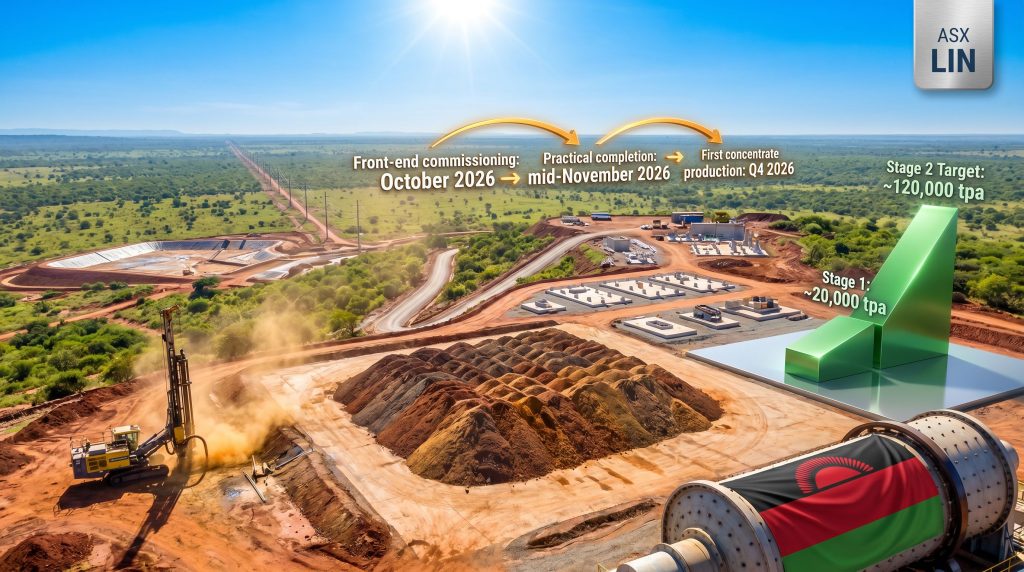
- Front-end commissioning — targeted October 2026
- Practical completion — targeted mid-November 2026
- First concentrate production — Q4 2026
Each milestone is sequentially dependent. A material delay at the TSF could compress the commissioning window and push practical completion into December. The key external dependencies include formal grid interconnection with the Balaka ESCOM substation, reagent and consumable procurement aligned with commissioning timelines, and final regulatory sign-offs associated with mining operations commencement.
Stage 2: The Scale Transformation
The Lindian Resources Kangankunde rare earths project first production phase is not being built as a single-phase operation. The DRA-led Stage 2 Feasibility Study is on track for completion in December 2026, following a drilling programme of 7,764.1 metres, which included 2,391 metres of existing reverse circulation holes extended with diamond core drilling to improve geological confidence and support resource conversion work.
| Parameter | Stage 1 | Stage 2 Target |
|---|---|---|
| Processing Throughput | Ramp-up to ~20,000 t/y | ~4.0 million tpa |
| Concentrate Capacity | ~20,000 tpa (full capacity) | ~120,000 tpa |
| Feasibility Status | Funded and under construction | DRA FS targeted Dec 2026 |
| First Production Target | Q4 2026 | Subject to FID post-FS |
A concentrate capacity of approximately 120,000 tonnes per annum at Stage 2 would represent a step-change in the scale of Kangankunde's contribution to global rare earths supply. To contextualise this, total ex-China rare earths production in recent years has been measured in the tens of thousands of tonnes of rare earth oxide equivalent annually. Consequently, a single project at this scale would represent a material addition to global supply outside China.
The next major ASX story will hit our subscribers first
Africa's Rare Earths Landscape: Where Kangankunde Sits
The most recent comparable African rare earths project to reach industrial production was the Gakara mine in Burundi, which commenced operations in 2017. The gap between discovery-stage announcements and actual production in African rare earths has historically been wide, driven by a combination of regulatory complexity, infrastructure deficits, limited access to processing technology, and the capital intensity of remote mine development.
What distinguishes Kangankunde's development model is the infrastructure-first approach. The completion of a 27-kilometre power corridor, the commissioning of a 17-borehole water network with secured permits, and the deployment of enterprise-grade operational systems before first production all represent a materially different approach to project delivery. Furthermore, the surge in critical minerals demand from Western economies has elevated the strategic relevance of projects like Kangankunde considerably.
Malawi's mining regulatory environment, while not without complexity, is regarded as relatively stable compared to several other African jurisdictions competing for rare earths investment. This jurisdictional factor, combined with the project's advanced construction status, positions Kangankunde within a narrow cohort of near-term, ex-China rare earths projects with credible production timelines. In addition, broader African mining finance trends are increasingly favouring well-structured projects in stable jurisdictions.
Frequently Asked Questions: Kangankunde Rare Earths Project
What is the Kangankunde Rare Earths Project?
Kangankunde is a rare earths development project located in Malawi, southern Africa, owned by Lindian Resources (ASX: LIN). It is focused on the mining and beneficiation of monazite-bearing ore to produce rare earth concentrate, with Stage 1 targeting first production in Q4 2026.
What rare earth minerals does Kangankunde produce?
Stage 1 production at Kangankunde targets monazite concentrate. Monazite is a phosphate mineral containing a range of rare earth elements, with its primary economic value driven by its neodymium and praseodymium content — the key inputs for permanent magnet manufacturing.
How large is the Kangankunde ore stockpile ahead of commissioning?
Approximately 27,000 tonnes of run-of-mine ore has been accumulated on the ROM pad ahead of the first blast, providing a commissioning feed buffer that de-risks the ramp-up phase.
What happened to the Gerald Metals offtake agreement?
Lindian and Gerald Metals agreed to terminate the 2023 sale and purchase agreement. Lindian will issue 20 million fully paid ordinary shares to Gerald Metals within 14 days of executing the termination deed, with shares subject to a 90-day voluntary escrow period. The termination gives Lindian full commercial independence over its sales strategy.
What is the Stage 2 production target at Kangankunde?
Stage 2 targets a processing throughput of approximately 4.0 million tonnes per annum, with a total concentrate capacity of approximately 120,000 tonnes per annum, subject to the completion of the DRA-led Feasibility Study targeted for December 2026 and a subsequent Final Investment Decision.
What is the SARECO facility and why does it matter?
SARECO operates a hydrometallurgical processing facility in Kazakhstan capable of processing monazite concentrate into separated rare earth compounds. Directing product to SARECO allows Lindian to potentially access higher per-tonne revenue by selling separated rare earth products rather than raw concentrate, representing a meaningful value chain upgrade relative to commodity trading arrangements.
How many workers are employed at Kangankunde?
The total site workforce stands at 3,318 personnel as of mid-2026, with the project having accumulated more than 800,000 lost-time-injury-free work hours across that workforce.
What First Production at Kangankunde Would Signal to the Rare Earths Sector
The convergence of completed infrastructure, advancing process plant construction, live mining readiness, and a restructured commercial strategy places the Lindian Resources Kangankunde rare earths project first production milestone at an inflection point that is rare in African critical minerals development. If first concentrate production is achieved in Q4 2026 as targeted, it would represent one of the first new industrial-scale rare earths operations to reach production on the continent in nearly a decade.
For supply chain planners in the US, Europe, Japan, and South Korea working to reduce dependence on Chinese rare earths processing, a fully operational Kangankunde represents something genuinely scarce: a near-term, non-Chinese monazite concentrate source with the operational infrastructure and processing connections to deliver into premium end-markets.
The Stage 2 pathway to 120,000 tpa of concentrate further extends that strategic relevance well beyond the initial production phase. The delivery of this milestone on schedule will be watched closely, not only for its implications for Lindian Resources as an ASX-listed critical minerals developer, but for what it demonstrates about the feasibility of infrastructure-first mine development models in sub-Saharan Africa more broadly.
Want to Track the Next Major Critical Minerals Discovery Before the Market Does?
Discovery Alert's proprietary Discovery IQ model scans ASX announcements in real time, instantly identifying significant mineral discoveries across rare earths and other critical commodities — turning complex geological data into actionable investment insights for both short-term traders and long-term investors. Explore historic discoveries and the returns they generated, then begin your 14-day free trial to ensure you're positioned ahead of the broader market.