June 21, 2026

Rethinking Resource Security: Why Processing Capacity Matters More Than Mining
For decades, Western industrial policy treated raw material supply chains as a background concern, something to be managed quietly through trade relationships rather than confronted as a structural vulnerability. That assumption has aged badly. As the global economy pivots toward electrification, the materials underpinning clean energy technology have moved from footnote to front page, and governments are discovering that the bottleneck was never really in the ground. It was always in the refinery.
This shift in thinking helps explain why the UK's approach to UK critical minerals investment looks less like a traditional mining policy and more like an industrial strategy built around the middle of the supply chain.
When big ASX news breaks, our subscribers know first
How Concentrated Are Global Critical Mineral Supply Chains?
The Processing Problem Is More Acute Than the Mining Problem
Most public discourse about critical mineral dependency focuses on where materials are dug out of the ground. The more strategically significant question is where they are transformed into usable industrial inputs. These are not the same places.
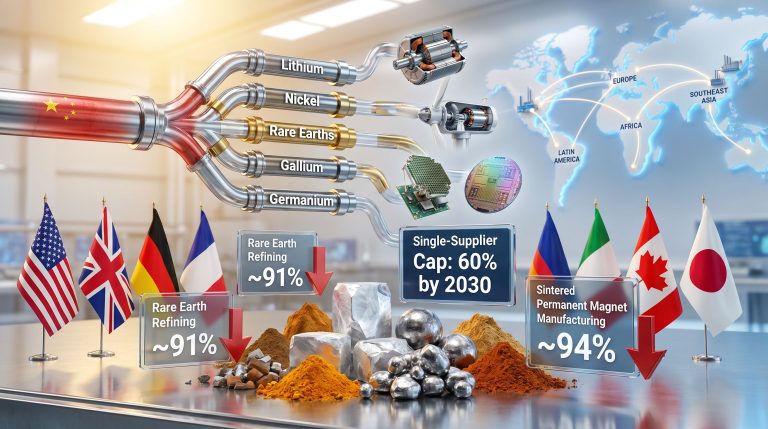
China accounts for approximately 70% of global rare earth mining output, but its grip on roughly 90% of global rare earth refining capacity is what genuinely constrains Western supply chain independence. A nation can theoretically source ore from Australia, Canada, or Africa, yet remain entirely dependent on Chinese processing infrastructure to convert that ore into the magnet-grade neodymium-iron-boron alloys used in EV motors and wind turbine generators.
This distinction matters enormously for policy design. Building mines is a decade-long undertaking. Building processing and refining capacity is also slow and capital-intensive, but it can be developed closer to existing industrial centres, leveraging existing workforce skills and energy infrastructure. Furthermore, rare earth supply chains remain disproportionately concentrated at the refining stage, where Western nations have the least presence.
Key Insight: The UK's strategic vulnerability is concentrated at the refining and processing stage, not primarily at extraction. China's dominance over separation and alloying technology represents the harder competitive barrier to overcome.
What Falls Under the Critical Minerals Umbrella
The term critical mineral is sometimes used loosely, but it has a specific policy meaning that reflects the intersection of supply risk and economic exposure. Materials on the UK's critical minerals list include:
- Rare earth elements (neodymium, dysprosium, praseodymium) used in permanent magnets
- Lithium for battery cathode and electrolyte applications
- Cobalt used in battery chemistry and aerospace alloys
- Nickel for battery cathodes and stainless steel production
- Magnet-grade alloys used directly in EV drivetrains, defence systems, and industrial motors
- Graphite, which China dominates at the anode production stage
The range of downstream applications is broader than most people appreciate. These materials are embedded in smartphones, domestic appliances, medical imaging equipment, wind turbines, fighter jet actuators, and the motors inside every battery electric vehicle on UK roads.
One aspect that receives less attention is the grade sensitivity of these supply chains. Rare earth separation produces a spectrum of products at different purity levels, and magnet manufacturers require specific compositions. The ability to produce magnet-grade rare earth oxides, as opposed to lower-value mixed concentrates, requires sophisticated hydrometallurgical separation infrastructure that very few Western facilities currently possess. The broader challenge of sourcing critical raw materials for the green transition compounds this problem further.
What Is the UK Government's £50 Million Critical Minerals Investment Strategy?
Breaking Down the Three-Pillar Funding Architecture
The new £50 million commitment announced in June 2026 is structured across three distinct intervention areas, each targeting a different constraint in the domestic supply chain:
| Funding Pillar | Allocation | Strategic Purpose |
|---|---|---|
| Rare Earth Magnet Manufacturing Hub | £20 million | Scale domestic magnet production for EV motors and clean tech |
| Project Accelerator Programme | £25 million | De-risk and scale early-stage extraction and processing ventures |
| Demand Aggregation Platform | Up to £5 million | Consolidate industry demand signals to attract private capital |
The allocation logic reflects a deliberate sequencing. The accelerator programme tackles the financing gap that strands viable projects between exploration and commercial production. The magnet hub creates a downstream anchor that justifies upstream investment. The demand platform addresses the market signal problem that has historically made it difficult for private capital to underwrite long-duration mineral projects.
How This Fits Within the Broader Public Finance Ecosystem
The £50 million does not stand alone. It sits atop a substantial pre-existing commitment base:
- Over £165 million in prior government support already allocated to the critical minerals sector
- £24 million deployed by the National Wealth Fund into Cornish Lithium in 2023
- £31 million committed to Cornish Lithium in a subsequent NWF funding round
- £28.6 million invested by the NWF into Cornish Metals in 2025
- Additional instruments including UK Export Finance, the British Business Bank, and British International Investment for international supply partnerships
Cumulatively, public support for UK critical minerals investment has now exceeded £215 million, representing a meaningful policy commitment even against the backdrop of larger programmes in the US and EU. The UK's Vision 2035 Critical Minerals Strategy sets out the long-term framework underpinning this escalating public commitment.
Industry Minister Chris McDonald has publicly characterised critical mineral security as a national security matter, framing the programme not as economic stimulus but as a strategic imperative, consistent with the broader Western policy consensus that supply chain concentration in adversarial nations constitutes a systemic risk.
Is the UK Building a Full Critical Minerals Ecosystem?
The Four-Layer Value Chain Approach
A critical feature of the UK strategy is its deliberate span across the entire mineral value chain, rather than focusing resources exclusively on upstream extraction:
- Extraction – Domestic projects in Cornwall, northeast England, and other geologically prospective areas
- Processing and Refining – Developing onshore separation and purification capacity to reduce dependence on overseas intermediaries
- Manufacturing Integration – Connecting refined materials to downstream industrial applications, most visibly through magnet production
- Recycling and Secondary Recovery – Closing the material loop through end-of-life product streams
This circular approach is particularly significant from a feedstock perspective. The UK generates substantial volumes of electronic waste and, as EV adoption grows, will produce increasing quantities of end-of-life battery and motor components. These secondary streams contain recoverable rare earth elements and battery metals that can bypass the primary mining stage entirely, offering a lower-cost and lower-geopolitical-risk feedstock pathway.
The Rare Earth Magnet Plant Milestone
Britain's first commercial rare earth magnet facility in 25 years opened in Birmingham, operated by Mkango Resources' HyProMag unit. The facility uses recycled rare earth materials, specifically hydrogen decrepitation processing of end-of-life magnets, to produce new magnet alloys for electric motors and related technologies.
The hydrogen decrepitation technique used at the Birmingham plant is worth understanding in some depth, as it represents a technically sophisticated approach that is not widely understood outside specialist circles. Rather than smelting or acid leaching, the process exposes scrap magnets to hydrogen gas, which causes the alloy to disintegrate along grain boundaries into a powder that can be re-pressed and sintered into new magnets. This preserves the rare earth content in a chemically useful form with significantly lower energy input than primary production.
Technical Note: Hydrogen decrepitation-based recycling can recover neodymium-iron-boron alloy with relatively high compositional fidelity, making it suitable for direct magnet remanufacturing rather than requiring full chemical separation back to individual rare earth oxides. This represents a material efficiency advantage over conventional recycling pathways.
The Birmingham operation signals that the UK's industrial base can support advanced magnet manufacturing when appropriately capitalised and provided with a reliable secondary feedstock stream. In addition, advances in the battery recycling process are creating new secondary material streams that could further strengthen this feedstock pipeline.
Industrial Clusters as Strategic Assets
Two regional clusters are emerging as the geography of UK critical mineral development:
- Cornwall has become the UK's primary domestic lithium hub, supported by successive National Wealth Fund equity rounds into Cornish Lithium and Cornish Metals. The region's lithium brines and hard rock deposits offer a genuine domestic resource base, though grade consistency and extraction economics require continued technical development.
- Northeast England is positioning as a centre for metal recovery technology and processing research. The launch event for the new programme was anchored in the region, reflecting its industrial heritage and existing skills base in heavy processing.
These clusters are designed to generate agglomeration effects, attracting component suppliers, technical talent, and follow-on private capital around publicly seeded anchors.
How Does the UK's Investment Scale Compare to Global Peers?
Benchmarking UK Commitment Against Competing Jurisdictions
| Country / Bloc | Headline Commitment | Primary Focus |
|---|---|---|
| United Kingdom | £215 million+ cumulative | Processing, magnets, recycling, extraction |
| United States | Multi-billion via IRA and Defence Production Act | Domestic mining, processing, allied supply chains |
| European Union | Critical Raw Materials Act strategic project pipeline | Diversification, domestic extraction targets |
| Australia | Critical Minerals Strategy + $2 billion+ facility | Export-oriented processing, allied nation supply |
The UK's absolute investment scale is modest relative to the US and EU. However, the UK's targeted deployment model, combining equity stakes through the NWF, demand aggregation infrastructure, and recycling-oriented manufacturing, reflects a strategy calibrated to a different national endowment profile. Britain lacks the large-scale primary mineral deposits of Australia or Canada, but possesses deep financial markets, world-class universities capable of supporting processing R&D, and growing secondary material streams from its own industrial economy.
What Role Does Private Capital Play in the UK's Critical Minerals Ambition?
The Crowding-In Hypothesis and Its Challenges
The demand aggregation platform, funded at up to £5 million, is explicitly designed to consolidate fragmented industrial demand signals and present a coherent investment case to private capital markets. The logic is straightforward: individual manufacturers may each require relatively small volumes of domestically processed rare earth materials, but aggregating those demand commitments creates an offtake profile sufficient to underpin project financing.
This matters because critical mineral projects face a structural financing challenge that is often described as the valley of death. Projects that have completed initial exploration and demonstrated resource viability are frequently too risky for commercial lenders applying standard credit criteria, yet too small or too early-stage for major infrastructure funds seeking stabilised assets.
Public equity through the NWF and grant funding through the accelerator programme are designed to bridge this gap, absorbing early-stage technical and commercial risk to the point where projects can attract institutional capital on commercial terms. The growing recognition of critical minerals demand driven by the energy transition is, furthermore, strengthening the long-term investment case for these projects.
Investor Perspective: One underappreciated dynamic in critical mineral project financing is that the price risk for these materials is structurally different from conventional commodities. Rare earth prices are thinly traded, opaque, and susceptible to Chinese export policy adjustments, making standard commodity price hedging mechanisms largely unavailable. This opacity amplifies perceived project risk and further justifies public de-risking instruments.
Why the UK's Financial Centre Status Is an Underutilised Asset
London's capital markets represent a competitive advantage for the UK critical minerals sector that is frequently overlooked in policy discussions. The City has deep experience financing long-duration resource and infrastructure assets, a global investor base with appetite for energy transition themes, and legal and governance frameworks that provide the certainty sophisticated investors require.
Mobilising this infrastructure in support of domestic critical mineral projects, rather than channelling UK capital exclusively into overseas mining equities, represents a significant opportunity. The demand aggregation platform is a modest step in this direction, but the broader prize is positioning London as the financing hub for European critical mineral development.
The next major ASX story will hit our subscribers first
How Is the UK Reducing Import Reliance Through International Partnerships?
Ally-Sourcing as a Complement to Domestic Production
Formalised critical minerals cooperation agreements with the United States and South Korea focus on supply chain mapping, joint processing investment, and coordinated approaches to securing upstream access in resource-rich third countries. These partnerships reflect a recognition that full domestic self-sufficiency is neither achievable in any realistic timeframe nor economically rational as a policy objective.
The realistic goal is diversification across trusted-partner supply chains, reducing exposure to any single point of control while maintaining access to the volumes and specifications that UK industry requires. This mirrors the US Minerals Security Partnership model and the EU's Critical Raw Materials Act strategic project pipeline, though with a smaller fiscal footprint.
South Korea is a particularly significant partner in the rare earth magnet context. Korean manufacturers are among the world's most sophisticated producers of neodymium-iron-boron magnets, and knowledge transfer through joint venture structures could accelerate UK magnet manufacturing capability beyond what domestic R&D alone could achieve. Notably, innovations in direct lithium extraction technology are also expanding the range of viable domestic and allied-nation supply options available to the UK.
What Is the Current Economic Footprint of the UK Critical Minerals Sector?
Sector Snapshot
The scale of the existing sector provides important context for understanding the investment programme's ambition:
| Indicator | Current Estimate |
|---|---|
| Sector contribution to UK economy | £1.79 billion |
| Jobs supported across the value chain | 50,000+ |
| Active critical mineral projects in the UK | 50+ |
These figures reflect the sector in its current, relatively early-stage configuration. The growth scenarios that underpin the government's investment rationale are considerably more ambitious.
Growth Potential Scenarios
- Conservative pathway: Existing projects reach production with current funding support; domestic processing capacity expands incrementally; sector GDP contribution grows in line with project delivery timelines
- Accelerated pathway: The demand aggregation platform successfully mobilises private capital at scale; industrial clusters in Cornwall and northeast England attract anchor manufacturing tenants; magnet production scales to serve EV and defence procurement
- Transformative pathway: The UK becomes a net exporter of processed rare earth products and magnet components, leveraging its recycling feedstock advantage and financial infrastructure to establish a globally competitive position
The transformative scenario is speculative at current investment levels, but it is not incoherent as a long-term industrial policy direction. The feedstock advantage from secondary material recovery is real, and it compounds over time as the installed base of EVs and electronic devices in the UK economy grows.
Structural Advantages and Constraints: A Balanced Assessment
What the UK Can Genuinely Leverage
- Deep capital markets with proven capacity to finance long-duration infrastructure and resource assets
- Growing secondary feedstock streams from electronic waste and end-of-life EV components, which reduce primary mining dependency
- Allied network access through US and South Korean partnerships providing diversified upstream supply without requiring large-scale domestic extraction
- World-class processing R&D capacity at universities and industrial research centres, particularly relevant to hydrometallurgical separation and magnet manufacturing
Where Structural Constraints Remain
- Limited primary mineral endowment means the UK cannot pursue a self-sufficiency model and must remain dependent on allied sourcing for primary materials
- Energy cost pressures on processing operations create competitive challenges against jurisdictions with lower industrial electricity costs
- Development timeline misalignment between the urgency of clean energy transition demand and the multi-year development timelines of most domestic mineral projects creates a near-term supply gap that domestic investment cannot close alone
Strategic Conclusion: The UK's £50 million investment, when viewed in isolation, is modest. When understood as a catalyst within a £215 million+ cumulative public commitment, combined with NWF equity, international partnerships, and a growing secondary material base, it represents a coherent industrial strategy. Its ultimate measure of success will not be the volume of public capital deployed, but the scale of private investment it attracts and the permanent industrial capacity it helps to establish.
Frequently Asked Questions: UK Critical Minerals Investment
What minerals is the UK prioritising for domestic investment?
The strategy concentrates on rare earth elements, lithium, cobalt, nickel, and magnet-grade alloys, specifically those materials where supply chain concentration creates the greatest strategic exposure for defence, clean energy, and advanced manufacturing applications.
How much has the UK government invested in critical minerals to date?
Cumulative public support exceeds £215 million, combining prior commitments of over £165 million with the new £50 million allocation. The National Wealth Fund has deployed direct equity exceeding £80 million into specific UK projects including Cornish Lithium and Cornish Metals.
What is the rare earth magnet hub and why does it matter?
The £20 million rare earth magnet hub is designed to scale domestic production of permanent magnets critical to EV motors, wind turbines, and defence electronics. It builds on the recent opening of Britain's first commercial rare earth magnet facility in 25 years in Birmingham, which demonstrated the viability of recycling-based magnet manufacturing at commercial scale.
How does the UK plan to attract private investment into critical minerals?
The demand aggregation platform consolidates fragmented industrial offtake signals to present a coherent commercial case to private investors. Combined with NWF equity participation and grant-based risk reduction through the accelerator programme, the strategy aims to mobilise institutional and strategic capital by reducing the early-stage uncertainty that has historically deterred private involvement. Chatham House's analysis of the UK's critical minerals strategy highlights that sustained political championship will be equally essential to converting this ambition into durable industrial outcomes.
Which regions of the UK are leading in critical mineral development?
Cornwall leads as the primary domestic lithium hub with successive NWF equity rounds into lithium projects. Northeast England is emerging as a centre for metal recovery technology and processing research, and Birmingham has established itself as the location of the UK's first commercial rare earth magnet facility in a generation.
Disclaimer: This article is intended for informational purposes only and does not constitute financial or investment advice. Projections and scenario analyses are speculative and subject to change based on market conditions, policy developments, and project delivery outcomes.
Want to Track the ASX Mineral Discoveries Powering the Clean Energy Supply Chain?
Discovery Alert's proprietary Discovery IQ model delivers real-time alerts on significant ASX mineral discoveries across rare earths, lithium, cobalt, and other critical minerals, instantly translating complex data into actionable investment insights for both short-term traders and long-term investors. Explore historic discoveries and their returns to understand the scale of opportunity, then begin your 14-day free trial at Discovery Alert to position yourself ahead of the market.