June 22, 2026
The Race to Rewire Global Rare Earth Supply Chains
Rare earth supply chains have spent decades operating in near-total obscurity, treated as a logistics footnote rather than a strategic priority. That era is ending. The convergence of electric vehicle manufacturing, advanced defence systems, and renewable energy infrastructure has transformed a handful of obscure elements into some of the most contested commodities on earth. For Europe, which imports the overwhelming majority of its strategic minerals from a narrow group of suppliers, the stakes of getting supply chain architecture right have never been higher.
Understanding why the EU Brazil critical minerals partnership has emerged as a centrepiece of European industrial policy requires stepping back from the headlines and examining the structural forces that made the status quo untenable.
When big ASX news breaks, our subscribers know first
Europe's Critical Raw Material Vulnerability Is Structural, Not Cyclical
Supply disruptions triggered by the COVID-19 pandemic and the war in Ukraine exposed how deeply European manufacturing had become embedded in single-source dependency structures. Rare earth supply chains, along with lithium and nickel, all essential inputs for electric vehicles and clean energy systems, flow into European factories through pathways that remain dangerously concentrated.
China currently controls an estimated 85 to 90 percent of global refined rare earth output. This dominance extends beyond mining into the separation, processing, and alloying stages that European manufacturers actually need. For European EV producers, defence contractors, and clean-tech companies, this creates direct exposure to Chinese export policy decisions, a risk that became impossible to ignore after China imposed export restrictions on germanium, gallium, and graphite in recent years.
The EU's legislative response, the Critical Raw Materials Act (CRMA), establishes binding supply-security thresholds. The most significant is a requirement that no single third country supplies more than 65% of any strategic material to the EU by 2030. This threshold alone requires a complete restructuring of current procurement patterns for multiple mineral categories.
The CRMA defines strategic raw materials as those combining high economic importance with significant supply risk, mandating diversification across extraction, processing, and recycling stages. Complying with this threshold for rare earths, given current Chinese dominance, requires sourcing from entirely new geographies at scale.
Why Brazil Occupies a Unique Position in the EU's Diversification Strategy
Brazil holds the world's second-largest critical mineral reserves, a geological endowment that positions it as a tier-one partner candidate for any serious European diversification strategy. The concentration of mineral wealth in the southeastern state of Minas Gerais makes this region particularly significant for project-level engagement. Furthermore, the critical minerals demand surge accelerating across global clean energy sectors only strengthens Brazil's strategic position.
| Mineral | Brazil's Global Standing | Key Producing Region |
|---|---|---|
| Rare Earth Elements | 2nd largest reserves globally | Minas Gerais |
| Niobium | Dominant global producer (~90% share) | Minas Gerais, Goiás |
| Nickel | Top 5 global producer | Pará, Goiás |
| Lithium | Significant and growing reserves | Minas Gerais |
What makes Brazil structurally distinct from other resource-rich nations is the combination of geological abundance with functioning industrial infrastructure. Brazil possesses a skilled technical workforce, established environmental regulatory frameworks, and governance standards broadly compatible with EU environmental, social, and governance requirements. This reduces the implementation risk that often accompanies partnerships with frontier resource jurisdictions.
Critically, Brazil's own national industrial policy explicitly prioritises value-added mineral exports over raw ore. The country has signalled clearly that it wants to capture processing and refining margins domestically rather than exporting unrefined material at low margins. This domestic policy objective creates a structural alignment with the EU's partnership model, which centres on processing capacity investment and technology transfer rather than simple commodity extraction.
From Policy Declarations to Capital-Committed Projects
The EU has moved beyond broad diplomatic positioning by identifying four priority projects in Brazil to accelerate bilateral collaboration. This project-selection methodology mirrors the EU's Strategic Projects framework under the CRMA, which fast-tracks investment support for qualifying operations. European critical raw materials policy has been steadily evolving to support exactly this kind of structured, multi-project engagement.
The most advanced of these is a rare earth research and processing centre located in Poços de Caldas, Minas Gerais, operated by Australian mining company Viridis Mining and Minerals. EU Commissioner for International Partnerships Jozef Síkela visited the facility in June 2026 as part of a diplomatic engagement aimed at deepening the bilateral relationship.
The Minas Gerais Rare Earth Processing Project: Technical Breakdown
The Viridis pilot facility represents the most concrete example of what the EU Brazil critical minerals partnership looks like in practice. Several technical details are worth examining closely:
- The pilot mining project was inaugurated in May 2026 and is capable of processing 100 kg of ore per hour
- Current pilot output is rated at up to 2.92 kg of mixed rare earth carbonate (MREC) per year
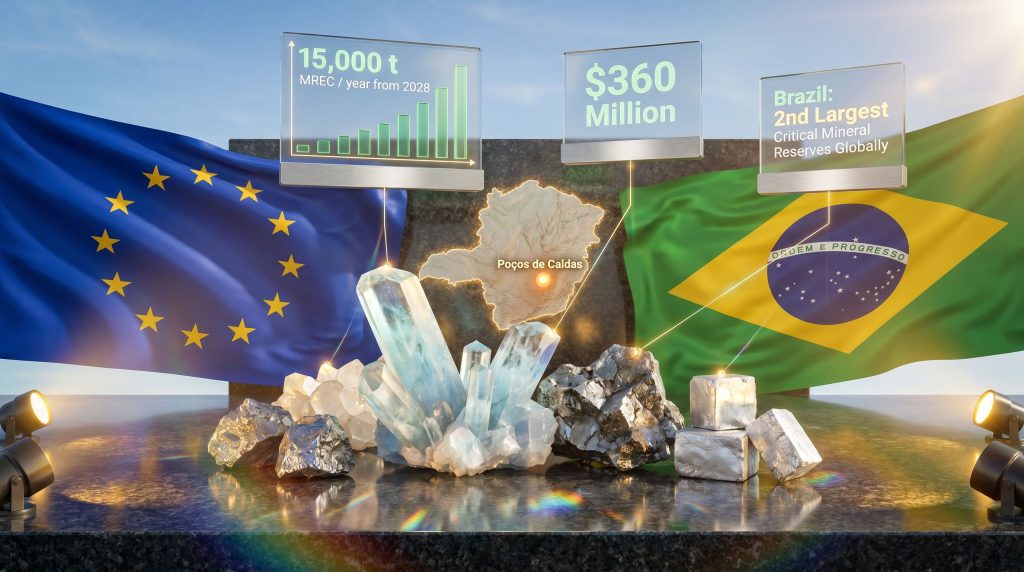
- Planned commercial-scale expansion involves a $360-million capital investment in a full-scale processing plant
- The commercial facility targets production of 15,000 tonnes of MREC annually from 2028
- The licensed operating area spans 228.62 km² within Minas Gerais
The distinction between the pilot phase and the commercial target reveals the significant scaling challenge ahead. Moving from under 3 kg of annual MREC output to 15,000 tonnes requires not just capital but grid connectivity, water management, tailings infrastructure, and a workforce of considerable scale. This is precisely why the EU's involvement, particularly its ability to facilitate European technology partnerships, carries material value for the project's development trajectory.
For context, mixed rare earth carbonate is an intermediate product in the rare earth processing chain. It sits between raw ore and the separated rare earth oxides that manufacturers ultimately require. The economic value of MREC is substantially higher than ore but substantially lower than fully separated oxides, meaning the Minas Gerais project is designed to capture mid-chain value while leaving further refining to downstream partners such as Solvay.
The Solvay Letter of Intent: What a Non-Binding Agreement Actually Signals
In June 2026, a non-binding letter of intent was signed between the Minas Gerais rare earth project and Solvay, a Belgian specialty chemicals company with established rare earth processing capabilities. Viridis CEO Rafael Moreno has indicated that a commercial supply agreement could be finalised as early as late July 2026.
The Solvay partnership is significant for reasons beyond the supply agreement itself. Solvay's involvement introduces a downstream processing dimension: the company can provide technological support for refining MREC into the separated rare earth oxides that European manufacturers require for magnet production and other applications. This model, bundling a supply agreement with technology transfer, directly reflects the EU's stated preference for integrated value chain partnerships rather than transactional commodity purchases.
For investors and industry observers, the involvement of a European corporate of Solvay's scale and technical reputation provides meaningful third-party validation of the project's processing credentials. It also signals that European industrial buyers are willing to move toward binding commitments rather than simply monitoring developments from a distance.
The EU-Mercosur Agreement: Trade Architecture as Supply Chain Infrastructure
The commercial viability of the EU Brazil critical minerals partnership does not rest solely on individual project agreements. The EU-Mercosur Agreement, currently advancing through ratification, provides the broader trade architecture within which project-level supply deals operate. According to Fast Markets analysis, this agreement could substantially boost Brazil's role as a strategic supplier of lithium and rare earths to European markets.
The agreement's mineral-relevant provisions include:
- Reduced tariffs on processed minerals, creating a price advantage for value-added Brazilian exports to the EU
- Restrictions on export taxes, limiting Brazil's ability to impose future levies on raw material exports
- Improved conditions for EU firms to invest in downstream processing within Mercosur member states
- Investment protection clauses that reduce sovereign risk for long-duration capital commitments
For Brazil, the framework offers access to European capital, technology transfer pathways, and expanded market reach, particularly relevant for its ambition to export processed materials. However, a critical caveat applies: the agreement still requires approval from all EU member states, with agricultural and environmental lobbies in France, Ireland, and Austria historically opposing ratification.
Until the EU-Mercosur Agreement is fully implemented, the structural trade benefits it creates for mineral supply chain integration remain conditional. Project-level agreements like the Solvay letter of intent can proceed independently, but the broader commercial environment that the agreement would establish remains contingent on ratification.
How the EU, US, and China Are Competing for Brazilian Mineral Access
The EU is not operating in an uncontested environment. American and Chinese interests have been active in Brazilian minerals considerably longer, and the competitive window for securing long-term offtake agreements is narrowing as global demand accelerates toward 2030 decarbonisation targets. Moreover, broader rare earth geopolitics are reshaping how each major power bloc positions itself in the competition for Brazilian resources.
| Dimension | EU Approach | US Approach | Chinese Model |
|---|---|---|---|
| Primary Incentive | Sustainability and value-chain integration | Strategic offtake and financing | Infrastructure investment and raw material offtake |
| Technology Transfer | Explicitly central to partnership design | Selective | Limited to processing equipment |
| Environmental Standards | EU-aligned ESG requirements | Variable | Minimal conditionality |
| Trade Framework | EU-Mercosur Agreement | Bilateral MOU structures | Belt and Road investment agreements |
| Local Processing Focus | Central to partnership design | Emerging | Generally absent |
EU Commissioner Síkela has directly addressed the question of whether Europe arrived too late to secure Brazilian mineral assets. His argument is that the EU's offering represents a qualitatively superior proposition centred on sustainability, job creation, and knowledge transfer, rather than volume and speed. Whether this differentiation proves compelling to Brazilian project developers operating under commercial time pressure remains to be seen.
Importantly, Viridis CEO Rafael Moreno has indicated the company favours an approach that remains open to partners across multiple regions, including both European and American buyers. This suggests Brazil's most promising project developers are deliberately maintaining optionality rather than committing exclusively to a single geopolitical bloc.
The next major ASX story will hit our subscribers first
Lithium, Nickel, and the Expanding Minerals Agenda
While rare earth processing in Minas Gerais represents the most advanced project-level engagement, the EU's Brazil partnership extends across a broader mineral portfolio. In January 2025, European Commission President Ursula von der Leyen confirmed that negotiations were advancing toward a political agreement on critical raw materials, explicitly naming lithium, nickel, and rare earths as the focus minerals.
A Memorandum of Understanding (MOU) between the EU and the Brazilian federal government is under active negotiation, though specific terms remain undisclosed. Lithium is particularly significant given Brazil's emerging hard-rock lithium deposits in Minas Gerais, which could complement the EU's existing supply partnerships with producers in Chile and Argentina.
Brazil's lithium geology is distinct from the brine deposits that dominate Latin American lithium supply, and hard-rock sources can offer different production characteristics in terms of grade consistency and processing chemistry. Nickel adds another dimension to the partnership, with Brazil ranking among the top five global producers. European EV battery manufacturers require both nickel and rare earths, making Brazil one of the few jurisdictions capable of supplying multiple battery-critical materials under a single partnership framework.
Key Risks That Could Delay Full Partnership Realisation
Despite the evident momentum, several structural barriers could delay the partnership's commercial impact:
- EU-Mercosur ratification risk remains the most significant systemic obstacle, with member state opposition potentially extending negotiations further
- Brazilian environmental licensing complexity involves federal, state, and municipal approvals, with timelines that can add years to project development schedules
- Currency and sovereign risk exposure from large-scale Brazilian processing investments, given real volatility and inflationary dynamics
- Competition from earlier movers, with US and Chinese buyers having established market positions that cannot be quickly displaced
- Political continuity risk on both sides, as multi-year infrastructure commitments require sustained political commitment across election cycles in both the EU and Brazil
The GIGA Hamburg assessment of Europe's quest for critical raw materials in Latin America further underscores that structural and political risks across the region require careful, long-term management strategies.
Partnership Status Snapshot: Mid-2026
| Dimension | Current Status (Mid-2026) |
|---|---|
| Partnership Framework | EU-Mercosur Agreement advancing; bilateral MOU under negotiation |
| Priority Minerals | Rare earths, lithium, nickel |
| Priority Projects Identified | 4 (including Minas Gerais rare earth facility) |
| Pilot Processing Capacity | 100 kg ore per hour; up to 2.92 kg MREC per year |
| Planned Commercial Capacity | 15,000 t MREC per year from 2028 |
| Capital Investment (Commercial Plant) | $360 million |
| Key Commercial Agreement in Progress | MREC supply and technology partnership with Solvay (Belgium) |
| Political Milestone | Von der Leyen-Brazil alignment confirmed January 2025 |
| Ratification Risk | EU-Mercosur Agreement pending full member-state approval |
Is This a Structural Shift or a Policy Statement?
The $360-million commercial plant investment and the Solvay supply agreement framework suggest the EU Brazil critical minerals partnership has moved beyond rhetorical diplomacy into capital-committed project execution. That is a meaningful distinction. Many bilateral mineral agreements announced over the past decade have remained at the declaration stage, undone by regulatory complexity, market timing, or competing political priorities.
What differentiates this partnership is the convergence of three reinforcing forces: the EU's binding legislative obligation under the CRMA to diversify supply, Brazil's structural policy preference for value-added mineral exports, and the concrete involvement of European industrial buyers like Solvay who have both the technical capability and the commercial incentive to make the supply chain function.
The period from mid-2026 through 2028, spanning the anticipated finalisation of the Solvay agreement, the EU-Mercosur ratification process, and the targeted commissioning of the Minas Gerais commercial facility, will likely determine whether the Minas Gerais rare earth corridor becomes a cornerstone of European supply security or remains a promising but unfulfilled pivot in global critical minerals geopolitics.
This article contains forward-looking statements and projections based on publicly available information as of June 2026. Timelines, investment figures, and commercial agreements referenced may be subject to change. This content does not constitute financial or investment advice. Readers should conduct independent due diligence before making investment decisions.
Want to Stay Ahead of the Next Major Mineral Discovery?
Discovery Alert's proprietary Discovery IQ model instantly scans ASX announcements across rare earths and other critical minerals, delivering real-time alerts on significant discoveries before the broader market reacts — explore historic examples of exceptional returns on the Discovery Alert discoveries page and begin your 14-day free trial to position yourself ahead of the next major find.