August 14, 2026
What Makes Brazil's Rare Earth Strategy Different from Traditional Mining Approaches?
Brazil's approach to critical minerals development diverges fundamentally from the commodity-export model that has dominated Latin American resource extraction for centuries. While traditional mining focuses on maximizing extraction volumes and export revenues from raw ore concentrates, Brazil's rare earth industrial policy integrates extraction with downstream processing, technology development, and manufacturing ecosystems designed to capture higher-value economic activity domestically.
The distinction becomes clear when examining the numbers. Brazil holds approximately 17% of global rare earth reserves (estimated 22 million tonnes of rare earth oxide equivalent), positioning it as the second-largest reserve holder globally after China. However, China controls approximately 60-70% of global rare earth processing capacity despite holding only 37% of global reserves, demonstrating the critical gap between reserve ownership and value-chain control.
Research by Manuel Mindreau, published in The Extractive Industries and Society, emphasises that reserves alone do not create strategic advantage. Brazil's rare earth opportunity will only translate into strategic leverage if the country sustains industrial policy extending beyond mining into processing, technology, and value-added manufacturing. This represents a fundamental shift from volume-based commodity thinking to strategic value capture.
Defining Industrial Policy vs. Resource Extraction Models
The traditional mining model prioritises three core elements:
• Mining and concentration: Extraction and initial beneficiation to ore concentrate form
• Export orientation: Sale of concentrate to foreign processors at commodity prices
• Limited domestic employment: Mining jobs dominate while processing and manufacturing occur abroad
Brazil's industrial policy integration model requires a different framework:
• Separation and refining: Conversion of concentrate to separated oxides and individual rare earth elements
• Metals production: Reduction of oxides to metallic forms for specific applications
• Magnet manufacturing: Conversion to permanent magnet alloys for end-use applications
• Domestic value capture: Economic multiplier effects through employment, technology spillovers, and high-margin manufacturing
Current data shows separation and refining capture 40-50% of value-added, with permanent magnet production capturing 30-40%, while mining represents only 10-20% of total value. This distribution explains why China's processing monopoly generates far more strategic leverage than raw material access alone.
Brazil's Critical Minerals Classification System
Brazil's approach distinguishes between strategic and commercial mineral designations within national policy frameworks. Strategic minerals integrate with defence, energy transition, and technology sovereignty goals, while commercial minerals follow traditional export-oriented development paths.
The Serra Verde operations in Minaçu, Goiás, achieved first commercial production of rare earth carbonate and oxides in 2024, marking Brazil's transition from pure mining to mixed production. This milestone represents less than 5% of Brazil's rare earth processing capacity relative to domestic production, with the majority of concentrate still exported for offshore processing.
Brazil's regulatory framework differs significantly from conventional mining codes by incorporating:
• Technology transfer requirements for foreign investment in processing facilities
• Local content mandates for value-added production stages
• Strategic reserve calculations based on national security rather than purely commercial criteria
• Cross-ministry coordination linking mining permits to industrial development objectives
When big ASX news breaks, our subscribers know first
How Does Brazil's Three-Phase Policy Evolution Shape Current Strategy?
Brazil's rare earth development has progressed through three distinct periods, each characterised by different institutional approaches and strategic priorities. Furthermore, the pattern reveals how policy discontinuity repeatedly undermined value-chain development whilst commodity-export logic reasserted itself during periods of weakened industrial policy.
2010-2016 Foundation Period Analysis
The foundation period began with academic catalysis through the "Letter of Aracaju" in 2010, which mobilised scientific consensus around Brazil's rare earth strategic potential and prompted federal attention across ministries. This academic document succeeded in establishing interministerial coordination mechanisms that had previously been absent from Brazilian critical minerals strategy planning.
During this period, rare earth development became integrated within the Plano Brasil Maior framework under the Rousseff administration. The plan aimed to strengthen manufacturing competitiveness and technological capacity whilst moving beyond traditional commodity exports. Key institutional developments included:
• Cross-ministry working groups coordinating mining, industrial development, and technology policies
• Research and development funding for separation and processing technology development
• Strategic planning frameworks linking rare earth development to broader industrial upgrading goals
• International cooperation initiatives with technology-advanced partners
The period demonstrated that when industrial policy frameworks were present, rare earth planning advanced through roadmaps, studies, and institutional coordination rather than ad-hoc project approvals.
2016-2022 Policy Discontinuity Impact Assessment
The Temer and Bolsonaro administrations (2016-2022) marked a significant reversal in industrial policy continuity. This period was characterised by weakened institutional frameworks and a return to commodity-export logic that undermined previous momentum in value-chain development.
Key impacts during this discontinuity period included:
• Investment delays as policy uncertainty discouraged long-term processing investments
• Technology transfer setbacks as international partnerships lost institutional backing
• Institutional capacity erosion through reduced cross-ministry coordination
• Private sector confusion about government priorities and support mechanisms
The period illustrated how rare earth processing and magnet ecosystems require sustained policy support over many years to mature. Political and institutional resets repeatedly cut momentum before value-chain investments could achieve commercial scale, pushing Brazil back toward raw material export patterns.
2024-Present Mission-Driven Approach Under Nova Indústria Brasil
The Lula III administration launched Nova Indústria Brasil in January 2024, establishing mission-oriented industrial policy targeting energy transition, digital transformation, and defence. This represents a reactivation of industrial policy after years of institutional dormancy.
The current approach differs from previous periods through:
• Mission-driven coordination: Rare earths integrated within energy transition and defence missions rather than standalone mineral policy
• Institutional reactivation: National Mining Policy Council (CNPM) formally reactivated to coordinate cross-ministry alignment
• International partnership focus: Emphasis on technology transfer and joint venture frameworks with allied nations
• Strategic patience recognition: Acknowledgement that value-chain development requires sustained support across electoral cycles
The three-phase evolution reveals that effective rare earth strategy requires sustained alignment across Mining, Industrial Development, Technology and Innovation, Defence, Energy, and Finance ministries. When coordination exists through frameworks like Nova Indústria Brasil, policy momentum advances; when institutional separation occurs, progress reverses toward commodity exports.
Where Are Brazil's Processing Capabilities vs. Global Supply Chain Chokepoints?
Brazil currently faces a significant processing capacity deficit across the entire rare earth value chain. In addition, while the country has made initial progress in separation technology, substantial gaps remain in refining, metals production, and permanent magnet manufacturing where China maintains dominant market positions.
Current Domestic Processing Infrastructure Assessment
Brazil's processing infrastructure remains in early development stages despite holding substantial reserve positions. Current capabilities include:
Serra Verde Operations (Minaçu, Goiás): The facility achieved first commercial production of rare earth carbonate and oxides in 2024, representing Brazil's initial transition from pure mining to processing. However, this operation processes less than 5% of Brazil's rare earth production domestically.
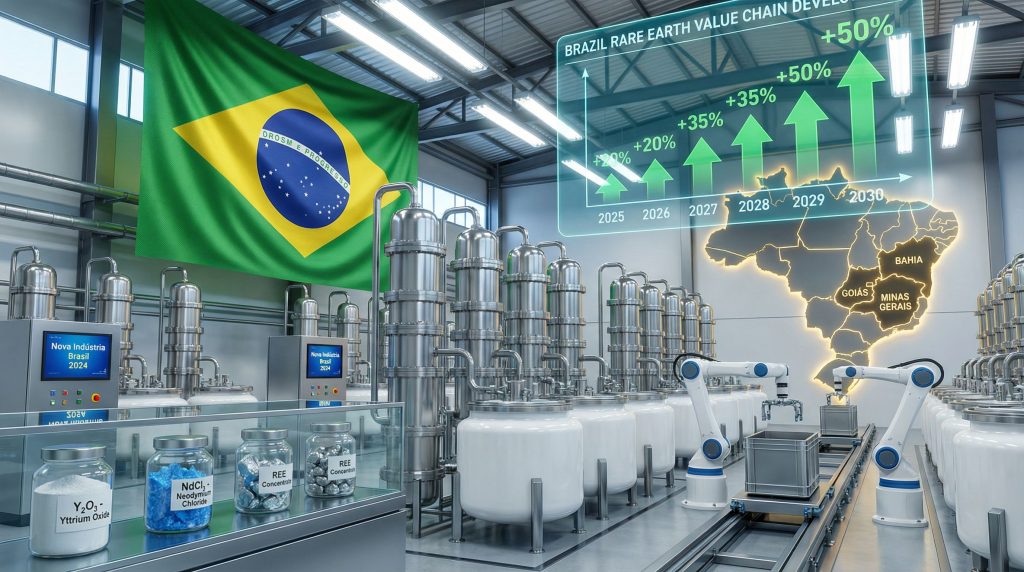
Research and Development Pipeline: 27 research and development projects operate across 17 companies in Brazil's rare earth sector, concentrated primarily in Goiás, Minas Gerais, and Bahia. These projects focus on various stages of the value chain but most remain in exploration or early development phases.
State-Level Distribution: Processing development clusters in three primary regions:
• Goiás: Serra Verde operations and additional separation projects
• Minas Gerais: Research facilities and pilot-scale processing development
• Bahia: Early-stage separation technology and academic partnerships
Brazil's current processing capacity covers only initial separation stages, producing rare earth carbonates and basic oxides. The country lacks commercial-scale capabilities for advanced separation, metals production, or permanent magnet manufacturing.
China's Downstream Monopoly: Separation, Refining, and Magnet Production
China's processing dominance creates structural bottlenecks that affect global supply chain security. The concentration spans multiple value chain stages:
Separation Capacity: China controls approximately 65% of global capacity to convert ore concentrates to separated rare earth oxides. These facilities require specialised solvent extraction or ion-exchange processes with significant capital intensity and environmental controls.
Refining Operations: China maintains roughly 70% of global capacity for converting separated oxides to individual elements and metals. This stage involves vacuum induction melting technology and specialised chemical infrastructure concentrated historically in Chinese industrial zones.
Permanent Magnet Production: China dominates 80-85% of global permanent magnet manufacturing capacity, including 95% of high-purity magnet alloy production. These facilities integrate powder metallurgy, casting processes, and quality control infrastructure for motor and turbine applications.
The processing gap creates strategic vulnerabilities for Western supply chains. Separation and refining are capital-intensive, environmentally sensitive, and commercially risky, especially when incumbents can undercut prices and control market access. Without industrial policy tools including financing, offtakes, procurement, coordinated planning, and sustained incentives, private capital typically avoids building midstream processing capacity at scale.
Value-Chain Integration Opportunities with Allied Nations
Brazil's processing development increasingly aligns with Western supply chain diversification efforts. Key partnership frameworks include:
U.S. Development Finance Corporation (DFC) Commitment: The DFC has structured a $465 million financing commitment for rare earth value-chain development in Brazil, with explicit focus on processing capability expansion rather than raw material access. The financing includes technology transfer requirements and joint venture frameworks linking international capital to Brazilian value addition.
Technology Transfer Requirements: International partnerships increasingly mandate domestic processing capability development as a condition for market access. This creates incentives for joint ventures that build Brazilian separation, refining, and manufacturing capacity rather than simple extraction agreements.
Allied Nation Coordination: Partnership opportunities exist with European, Australian, and Japanese partners seeking supply chain diversification. These arrangements often combine:
• Capital investment in Brazilian processing facilities
• Technology sharing for separation and refining processes
• Long-term offtake agreements that reward value-added production
• Market development for Brazilian-processed rare earth products
Brazil's geographic position and industrial base create opportunities for value-chain integration that could serve both domestic development and Western supply chain diversification, provided institutional coordination sustains long-term investment frameworks.
What Are the Economic Scenarios for Brazil's Rare Earth Value Chain Development?
Brazil's economic trajectory in rare earths will largely depend on which development path emerges over the next decade. However, three distinct scenarios present different risk-reward profiles for both Brazilian development and international supply chain diversification efforts.
Scenario 1: Commodity Export Trap Continuation
Under this scenario, Brazil continues prioritising raw concentrate exports with minimal domestic processing development. This path offers limited strategic value despite reserve access.
Revenue Characteristics:
• Export volumes: Potential for 10,000-15,000 tonnes annually of rare earth concentrate by 2030
• Price capture: Commodity-level pricing at 15-25% of final product value
• Economic multipliers: Limited job creation concentrated in mining regions
• Strategic position: Continued dependence on Chinese processing for value realisation
Structural Limitations: Raw concentrate export generates revenue but creates no processing expertise, technological capacity, or strategic leverage. Brazil becomes a price-taker in global markets whilst value-added manufacturing occurs elsewhere. This scenario perpetuates the resource curse dynamics that have historically constrained Latin American industrial development.
Market Vulnerabilities: China's processing monopoly allows manipulation of concentrate prices through market flooding or supply restrictions. Brazilian producers face price volatility without control over downstream margins or end-user demand.
Scenario 2: Partial Processing Integration
This scenario involves Brazil developing separation capabilities for mixed rare earth carbonates and basic oxides whilst remaining dependent on foreign partners for advanced refining and magnet production.
Investment Requirements:
• Capital needs: $500 million to $1.2 billion for commercial-scale separation facilities
• Technology partnerships: Joint ventures with established separation technology providers
• Market positioning: Intermediate products capturing 35-50% of final product value
• Employment effects: 2,000-4,000 direct jobs in processing facilities plus indirect employment
Regional Development Impact: State-level incentive programmes in Goiás, Minas Gerais, and Bahia could create processing hubs with supporting chemical infrastructure. This generates more significant economic multiplier effects than pure mining whilst building technical expertise.
Strategic Positioning: Brazil gains leverage in global supply chains by controlling separation capacity whilst remaining integrated with international partners for advanced processing stages. This balances domestic value capture with market access through established downstream networks.
Scenario 3: Full Value-Chain Development
The most ambitious scenario involves Brazil developing complete processing capabilities from separation through permanent magnet production, creating domestic supply chain independence.
Capital Requirements and Timeline:
• Total investment: $2.5-4.5 billion across the full value chain over 8-12 years
• Magnet production facilities: $800 million to $1.5 billion for commercial-scale permanent magnet manufacturing
• Workforce development: 8,000-12,000 highly skilled technical positions across the value chain
• Technology sovereignty: Domestic capability for defence, energy transition, and industrial applications
Economic Impact Modelling: Full value-chain development could generate:
• Export value increase: 400-600% compared to concentrate exports
• Industrial spillovers: Supporting industries in motors, generators, and precision manufacturing
• Strategic autonomy: Reduced dependence on Chinese processing for critical applications
• Innovation clusters: Research and development capabilities supporting broader industrial upgrading
Market Positioning Challenges: Achieving commercial competitiveness requires sustained policy support, market protection during development phases, and coordination with end-user industries. Success depends on Brazil's ability to maintain institutional coordination across electoral cycles.
How Do Environmental and Social Factors Impact Industrial Policy Success?
Environmental and social considerations significantly influence the viability of Brazil's rare earth industrial policy. For instance, these factors determine project timelines, investment risk profiles, and long-term social licence for value-chain development across multiple states and communities.
Community Engagement and Land Use Conflicts
Brazil's rare earth development faces complex land use challenges that require careful stakeholder management and regulatory coordination.
Overlapping Land Claims: Multiple exploration applications overlap with agrarian settlements and conservation areas, creating potential conflicts between mineral development and existing land uses. These conflicts often emerge during environmental licensing processes and can delay project timelines significantly.
Indigenous and Traditional Community Rights: Brazilian law requires consultation with indigenous and traditional communities when mineral projects affect their territories or livelihood systems. These consultation processes follow specific protocols under the National Indigenous Foundation (FUNAI) and can extend project development timelines by 2-4 years depending on complexity.
Civil Society Engagement: Environmental organisations and local communities often express concerns about mining expansion, particularly regarding water quality, land degradation, and displacement risks. These concerns require proactive engagement and impact mitigation measures to maintain project viability.
Stakeholder Balance: Successful projects demonstrate that economic development and community concerns can be balanced through transparent consultation, benefit-sharing agreements, and robust environmental controls. However, achieving this balance requires sustained institutional capacity and political commitment.
Environmental Licensing and Regulatory Compliance
Environmental licensing represents a critical bottleneck for Brazil's rare earth processing development, with complex requirements across multiple regulatory levels.
Processing Facility Permitting: Rare earth separation and refining facilities require extensive environmental impact assessments covering:
• Wastewater treatment systems for chemical effluent management
• Air quality controls for processing emissions and dust management
• Tailings management for processing waste disposal and long-term monitoring
• Chemical storage and handling protocols for solvent extraction processes
Regulatory Timeline Expectations: Environmental licensing for processing facilities typically requires 3-5 years from application to approval, depending on project complexity and stakeholder engagement quality. This timeline often becomes a critical path constraint for project development.
State vs. Federal Coordination: Projects spanning multiple states or involving federal conservation areas require coordination between state environmental agencies and federal institutions like IBAMA. This coordination can create approval delays when institutional priorities differ.
International Standards Alignment: Projects seeking international financing increasingly must meet enhanced environmental standards that exceed minimum Brazilian requirements, creating additional compliance costs but improving access to development finance.
ESG Investment Criteria and International Finance
Environmental, social, and governance (ESG) criteria increasingly determine access to international capital for Brazil's rare earth development projects.
Development Bank Conditionalities: International development banks including the U.S. Development Finance Corporation require comprehensive environmental and social safeguards that often exceed Brazilian regulatory minimums. These conditionalities can delay financing but improve project sustainability.
Investor Due Diligence Requirements: International investors conduct independent assessments of:
• Community consent processes and ongoing stakeholder relationships
• Environmental impact mitigation measures and monitoring systems
• Governance structures ensuring transparency and accountability
• Supply chain responsibility for downstream environmental and social impacts
Reputation Risk Management: International partners increasingly face reputation risks when associated with controversial projects. This creates incentives for higher environmental and social standards but can exclude projects that fail to meet enhanced criteria.
Market Access Implications: Projects meeting enhanced ESG standards gain preferential access to international markets and financing, whilst those falling short face restricted options and higher capital costs. This dynamic increasingly rewards proactive environmental and social management.
Which Policy Instruments Will Determine Brazil's Strategic Success?
Brazil's rare earth strategic success depends on coordinated deployment of multiple policy instruments across regulatory, financial, and international cooperation frameworks. Consequently, the effectiveness of these tools will determine whether Brazil captures value-chain opportunities or remains trapped in commodity export patterns.
National Policy on Critical Minerals and Rare Earths (PNMCTR)
The development of Brazil's National Policy on Critical Minerals and Rare Earths represents the cornerstone policy instrument for strategic coordination across government levels and ministries.
Strategic Mineral Classification: The PNMCTR framework will establish formal criteria distinguishing strategic minerals from commercial minerals based on national security, energy transition, and technological sovereignty considerations. This classification determines access to enhanced government support and coordination mechanisms.
Regulatory Framework Updates: Policy development includes modernisation of mining codes to incorporate:
• Processing development requirements linked to mineral extraction permits
• Technology transfer mandates for foreign investment in strategic mineral sectors
• Cross-ministry coordination mechanisms ensuring alignment between mining, industrial, and defence policies
• Strategic reserve calculations based on national security rather than purely commercial criteria
Public-Private Partnership Structures: The policy framework establishes institutional mechanisms for sustained collaboration between government agencies, private investors, and international partners. These structures aim to reduce investment uncertainty whilst maintaining Brazilian strategic control over critical minerals development.
Implementation Timeline: PNMCTR development and publication is expected during 2025-2026, with institutional implementation requiring an additional 2-3 years for full effectiveness across federal and state levels.
Financial Incentives and Investment Coordination
Financial policy instruments create economic incentives that shape private sector investment decisions toward value-chain development rather than raw material exports.
Development Bank Financing: Brazilian development banks including BNDES increasingly structure financing mechanisms that reward processing development over extraction. These mechanisms include:
• Preferential interest rates for value-added production investments
• Risk-sharing arrangements that reduce private sector exposure to processing technology risks
• Long-term financing aligned with processing facility development timelines rather than short-term commodity cycles
Tax Incentive Structures: Federal and state tax policies increasingly distinguish between raw material exports and processed products:
• Export tax differentiation creating higher costs for concentrate exports relative to processed products
• Investment tax credits for processing facility construction and technology acquisition
• Accelerated depreciation allowances for separation and refining equipment
Public Procurement Policies: Government purchasing power provides demand anchoring for domestic rare earth products in defence, energy infrastructure, and technology applications. This creates bankable demand that supports processing investment business cases.
International Cooperation and Technology Transfer Frameworks
Brazil's strategic success requires careful management of international partnerships that build domestic capacity rather than perpetuating resource extraction relationships.
Bilateral Supply Chain Agreements: Brazil increasingly negotiates bilateral frameworks with allied nations that link market access to domestic value addition:
• Technology transfer requirements ensuring Brazilian capability development
• Joint research and development programmes for processing technology advancement
• Workforce training partnerships building technical expertise across the value chain
• Market development cooperation for Brazilian-processed rare earth products
Offtake Agreement Structures: Long-term purchasing agreements increasingly include domestic processing requirements:
• Value addition milestones linking international purchases to Brazilian processing capability development
• Price premiums for processed products over raw concentrates
• Technology licensing arrangements that build Brazilian manufacturing capability
• Joint venture mandates ensuring Brazilian partnership in processing facilities
Development Finance Coordination: International development banks coordinate financing that supports Brazilian value-chain development:
• Conditional lending requiring domestic processing capability as a financing condition
• Technical assistance for regulatory framework development and institutional capacity building
• Risk mitigation instruments that reduce private sector investment uncertainty
• Multi-lateral coordination ensuring aligned approaches across Western development institutions
The next major ASX story will hit our subscribers first
What Timeline and Milestones Will Indicate Policy Effectiveness?
Brazil's rare earth strategic development will unfold across distinct phases, each characterised by specific decision points and measurable outcomes that indicate policy effectiveness and trajectory toward strategic independence or continued commodity dependence.
2025-2026 Critical Decision Points
The immediate period represents a crucial foundation phase where institutional frameworks and major project decisions will determine longer-term development trajectories.
PNMCTR Publication and Implementation: The National Policy on Critical Minerals and Rare Earths publication during 2025 will establish the regulatory foundation for strategic coordination. Key implementation milestones include:
• Inter-ministerial working group establishment with defined responsibilities and coordination mechanisms
• Strategic mineral classification criteria providing clear guidance for project prioritisation
• Investment incentive framework linking government support to value-chain development milestones
• International partnership guidelines ensuring technology transfer and domestic capability building
Major Environmental Licensing Decisions: Several critical materials facility applications currently under review will receive environmental licensing decisions during 2025-2026. These decisions will indicate government commitment to processing development and establish precedents for future projects.
International Financing Agreement Finalisation: The U.S. Development Finance Corporation's $465 million commitment structure requires finalisation of technology transfer conditions and Brazilian partnership requirements. Similarly, negotiations with European and Asian development banks will establish the framework for international cooperation.
Institutional Capacity Indicators: The National Mining Policy Council (CNPM) reactivation success will become evident through budget allocations, staffing decisions, and cross-ministry coordination effectiveness during this period.
2027-2029 Infrastructure Development Phase
The middle period focuses on translating policy frameworks into physical infrastructure and operational capability development across processing facilities and supporting systems.
Processing Facility Construction and Commissioning: Major separation and refining facilities should enter construction phases during this period, with commissioning schedules extending into 2028-2029. Key milestones include:
• Construction milestone achievement indicating sustained investor confidence and regulatory stability
• Technology transfer execution demonstrating effective knowledge transfer from international partners
• Environmental compliance verification showing successful implementation of licensing requirements
• Workforce deployment indicating effective technical training programme outcomes
Workforce Development Programme Outcomes: Brazil's technical education institutions should demonstrate measurable progress in rare earth processing expertise development:
• Technical training programme graduation rates for separation and refining specialisations
• Industry-academia partnership effectiveness in curriculum development and research advancement
• Professional certification systems for rare earth processing technical roles
• Knowledge transfer metrics from international technology partnerships
Market Share Evolution: Brazil's position in global separated oxides and intermediate products markets should show measurable advancement:
• Export composition changes with increasing share of processed products relative to concentrates
• International market penetration for Brazilian-processed rare earth products
• Supply chain integration with Western manufacturing and defence industries
• Price capture improvement demonstrating movement up the value chain
2030+ Strategic Independence Assessment
The longer-term period enables evaluation of Brazil's achievement of strategic rare earth independence and value-chain control across multiple applications and markets.
Domestic Supply Chain Resilience Metrics: Strategic independence measurement requires comprehensive assessment of Brazil's supply chain autonomy:
• Processing capacity sufficiency relative to domestic production and strategic requirements
• Technology sovereignty in separation, refining, and magnet production capabilities
• Market independence from Chinese processing and manufacturing monopolies
• Strategic stockpile adequacy for defence and critical infrastructure applications
Export Value Composition Analysis: Success indicators include fundamental shifts in Brazil's rare earth export profile:
• Raw materials vs. processed products ratio: Target of 30-40% processed products by 2030
• Value capture per tonne: Increase from $2,000-4,000 per tonne (concentrate) to $8,000-15,000 per tonne (separated oxides)
• Market diversification: Reduced dependence on Chinese processing for Brazilian rare earth products
• Premium market access: Ability to serve high-specification defence and aerospace applications
Technology Sovereignty Indicators: Long-term success requires measurable technological independence:
• Domestic research and development capability for processing technology advancement
• Intellectual property development in rare earth processing and manufacturing
• Industrial ecosystem maturity supporting domestic equipment and chemical supply chains
• Innovation spillover effects supporting broader industrial upgrading across related sectors
How Should International Partners Approach Brazil's Rare Earth Opportunity?
International engagement with Brazil's rare earth development requires strategic frameworks that build Brazilian processing capability rather than perpetuating traditional resource extraction relationships. Furthermore, the approach determines whether partnerships create mutual strategic value or reproduce commodity dependence patterns.
Value-Chain Integration vs. Resource Access Strategies
Successful international partnerships must structure engagement around Brazilian value-chain development rather than simple resource access, recognising that sustainable supply chain diversification requires processing capability distribution.
Joint Venture Frameworks for Processing Development: Effective partnerships establish shared ownership structures for separation and refining facilities:
• Technology transfer mandates ensuring Brazilian capability development alongside international expertise
• Staged ownership transitions allowing Brazilian partners to increase control as capabilities mature
• Knowledge sharing protocols building domestic technical expertise through operational partnerships
• Market development cooperation ensuring Brazilian-processed products gain access to international end-user markets
Long-Term Offtake Agreements with Value Addition Requirements: Purchasing commitments should incentivise Brazilian processing development:
• Price premiums for processed products over raw concentrate pricing
• Volume commitments that support processing facility investment business cases
• Quality specifications encouraging technical capability advancement
• Supply security provisions balancing buyer needs with Brazilian strategic control
Risk-Sharing Mechanisms for Capital-Intensive Investments: Processing facility development requires patient capital and risk mitigation:
• Development finance coordination between international banks and Brazilian institutions
• Political risk insurance protecting long-term investments against policy reversals
• Technical risk sharing for processing technology deployment and optimisation
• Market risk mitigation through diversified end-user demand anchoring
Avoiding the "New Ore Spigot" Trap
International partnerships must explicitly avoid replicating colonial resource extraction patterns that leave Brazil supplying raw materials whilst value-added processing occurs elsewhere.
Partnership Frameworks Building Brazilian Capability: Engagement structures should strengthen rather than substitute for Brazilian industrial capacity:
• Mandatory local content requirements for processing equipment and services
• Technical training partnerships developing Brazilian workforce capabilities
• Research and development collaboration advancing Brazilian technological sophistication
• Supply chain localisation building supporting industries within Brazil
Technology Transfer Requirements and Implementation: Effective partnerships ensure knowledge transfer rather than technology dependence:
• Licensing arrangements allowing Brazilian partners to adapt and improve processing technologies
• Joint research initiatives advancing processing efficiency and environmental performance
• Equipment manufacturing localisation building Brazilian capability in processing infrastructure
• Intellectual property sharing ensuring Brazilian access to technological improvements
Market Development Strategies for Brazilian-Processed Products: International partners should actively develop markets for Brazilian value-added production:
• End-user relationship development connecting Brazilian processors with final customers
• Quality certification support meeting international standards and specifications
• Brand development assistance establishing Brazilian reputation in processed rare earth markets
• Supply chain integration incorporating Brazilian processors into established manufacturing networks
Strategic Patience and Policy Continuity Support
Successful international engagement requires understanding that value-chain development occurs over decades and across multiple electoral cycles, requiring sustained institutional support.
Multi-Election Cycle Investment Commitments: Partnership structures must accommodate Brazilian political cycles whilst maintaining development momentum:
• Institutional backing through development banks and export credit agencies
• Cross-party political engagement building support across Brazilian political spectrum
• Technical assistance for policy framework development and institutional capacity building
• Diplomatic engagement supporting Brazilian industrial policy objectives through international forums
This development reflects broader trends in mining innovation trends that prioritise sustainable value-chain development over traditional extraction models.
Development Finance Structures Rewarding Value-Chain Advancement: Financial mechanisms should create incentives for processing capability development:
• Milestone-based disbursement linking financing to processing capability achievements
• Performance incentives rewarding successful technology transfer and local capability building
• Patient capital provision recognising extended development timelines for processing infrastructure
• Risk mitigation instruments protecting against political and market uncertainties
International partnerships should demonstrate commitment to Brazilian strategic success whilst considering lessons from strategic antimony financing models that prioritise domestic value addition. The critical minerals energy transition requires sustainable supply chain development that benefits both producing and consuming nations.
Long-Term Strategic Alignment: International partners should demonstrate commitment to Brazilian strategic success rather than short-term resource access:
• Mutual dependence creation ensuring Brazilian processing becomes integral to international supply chains
• Knowledge transfer reciprocity learning from Brazilian innovations and adaptations
• Market development cooperation expanding global demand for rare earth products and applications
• Strategic communication supporting Brazilian industrial policy through international advocacy and coordination
According to PwC's analysis of Brazil's critical minerals positioning, strategic alignment requires balancing economic development with environmental sustainability. Additionally, research from Capital Economics highlights the importance of sustained policy frameworks for achieving competitive positioning in global markets.
Disclaimer: This analysis involves forecasts and strategic assessments that reflect current policy trends and institutional developments. Actual outcomes will depend on political continuity, market conditions, and implementation effectiveness across multiple countries and institutions. Investors and policymakers should conduct independent due diligence and consider multiple scenarios when evaluating Brazil's rare earth development opportunities.
Ready to Capitalise on Brazil's Rare Earth Processing Revolution?
Discovery Alert's proprietary Discovery IQ model delivers instant notifications on significant ASX mineral discoveries, empowering subscribers to identify actionable opportunities in critical minerals and rare earth sectors ahead of the broader market. Understand how major mineral discoveries have historically generated substantial returns by exploring Discovery Alert's dedicated discoveries page and begin your 30-day free trial today to position yourself ahead of the market.