May 11, 2026
The Hidden Fault Line in the Global Energy Transition
The global energy transition is frequently discussed in terms of gigawatts installed, carbon targets, and climate commitments. Yet beneath this surface narrative runs a far more consequential contest — one measured not in renewable capacity but in manufacturing control, processing capability, and technological self-sufficiency. The nations that will genuinely lead the clean energy era are not simply those that deploy the most solar panels or electric vehicles. They are the ones that control the laboratories, refineries, semiconductor fabs, and recycling plants that make those technologies possible in the first place.
This distinction — between deploying clean energy and commanding the full technology stack behind it — defines what deeptech in achieving energy sovereignty actually means in practice. And in 2026, that distinction has never mattered more.
When big ASX news breaks, our subscribers know first
Why Processing Power Beats Mining Rights
A widespread assumption in energy transition planning positions critical mineral mining as the central strategic vulnerability. This assumption is fundamentally incomplete. The deeper chokepoint is not where minerals are extracted — it is where they are transformed.
China's dominance in clean energy supply chains is not primarily rooted in ore production. It is rooted in the downstream refining and processing infrastructure that converts raw geological material into battery-grade lithium compounds, cathode precursors, and cell-ready inputs. According to analysis published by ETEnergyWorld in May 2026, China controls over 60 percent of global rare earth processing capacity and holds a market share of approximately 70 percent in the refining of 19 out of 20 critical minerals required for clean energy systems.
Furthermore, critical minerals and energy security are deeply intertwined — a reality that underscores why processing capability matters as much as geological abundance.
Nations can possess abundant mineral deposits and still remain structurally dependent if they lack the domestic processing infrastructure to convert ore into usable industrial inputs.
This is the mineral dependency trap in its sharpest form. A nation may celebrate a lithium discovery within its borders, yet without sovereign refining capability, that discovery contributes little to genuine energy independence. The ore travels abroad for processing, returns as a finished cell manufactured elsewhere, and is installed in a grid managed by imported semiconductors. The geology is domestic; the sovereignty is not.
The Three Layers of Strategic Vulnerability
Understanding the full depth of mineral dependency requires distinguishing between three separate layers of the supply chain:
- Extraction — the mining of raw ore from geological deposits
- Processing and refining — the conversion of ore into battery-grade compounds, cathode materials, and industrial feedstocks
- Cell and component manufacturing — the assembly of refined materials into functional energy storage and power electronics
Most policy conversations focus on the first layer. However, the strategic competition is being decided by the second and third.
The Secondary Supply Chain That No One Is Mining Enough Attention
Among the most underappreciated dimensions of the deeptech and energy sovereignty equation is the emergence of end-of-life electric vehicle batteries as a strategic mineral resource. As EV fleets scale globally and age, the battery packs within those vehicles become recoverable sources of lithium, cobalt, nickel, and manganese — without requiring any new geological discoveries.
India's position here is particularly instructive. The country already operates the world's third-largest electric vehicle fleet, according to ETEnergyWorld. As those vehicles reach retirement, the battery packs transition from transport assets into mineral feedstock. Nations that invest early in hydrometallurgical and direct recycling technologies gain a compounding structural advantage: the larger the EV fleet, the larger the recoverable mineral pool.
Battery recycling is not a waste management challenge. It is a mineral sovereignty mechanism with a supply base that grows automatically as clean energy adoption scales.
The battery recycling process represents a genuine industrial deeptech challenge — one where early movers accumulate durable advantages. Refining infrastructure capable of extracting high-purity lithium and cobalt from degraded cells, and integrating recovered materials back into new cell manufacturing ecosystems at costs competitive with primary mineral sources, is central to this effort.
Critical Mineral Dependency at a Glance
| Material / Component | Current Dependency Profile | Strategic Risk Level |
|---|---|---|
| Lithium-ion cells | Predominantly imported across non-Chinese markets | High |
| Rare earth refining | China: ~70% global market share across 19 of 20 critical minerals | Very High |
| Battery-grade compounds | Upstream refining bottlenecks prevent rapid domestic conversion | High |
| Semiconductor components | India imports above 90% of semiconductor and electronic components | Very High |
| EV battery recycling capacity | Largely underdeveloped outside China and select EU facilities | Medium-High |
Deeptech in Achieving Energy Sovereignty: Four Technology Vectors That Matter
The path from mineral dependency to genuine energy sovereignty runs through four converging technology domains. Each addresses a different layer of vulnerability in the clean energy supply chain. Together, they define what it means to build sovereign industrial capability in the 21st century energy system.
Vector One: Solid-State Battery Architecture
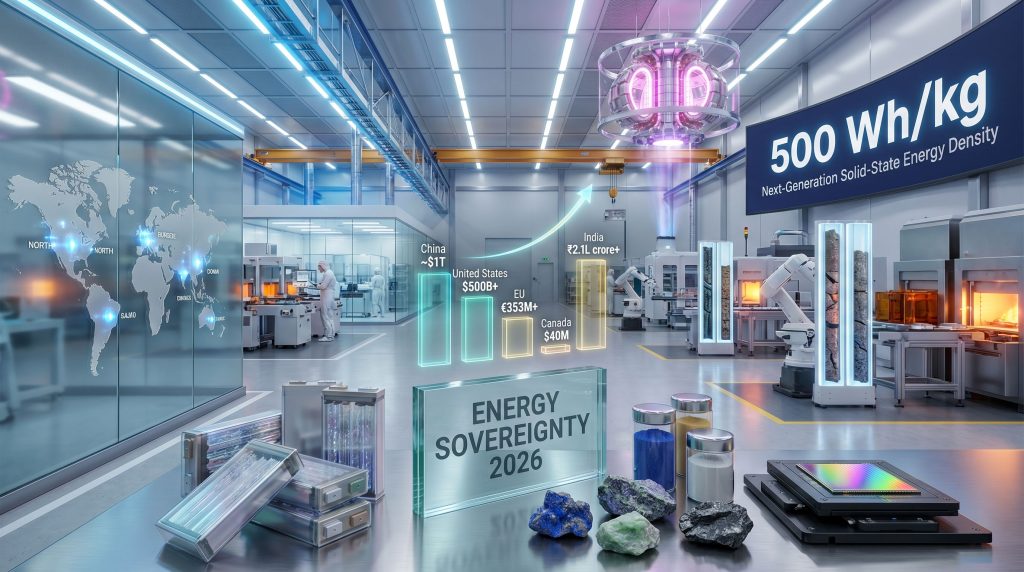
Solid-state batteries represent the most consequential near-term shift in energy storage technology. With theoretical energy densities reaching up to 500 Wh/kg — approximately five times that of conventional lithium-ion configurations — this technology offers superior performance alongside reduced dependence on cobalt-intensive cell chemistries.
The sovereign value is twofold. Nations that develop domestic solid-state manufacturing capability do not simply gain a performance advantage. They gain independence from the Asia-dominated lithium-ion supply chain that currently underpins virtually all grid storage and EV deployment globally. Three primary technical hurdles remain:
- Solid electrolyte scalability across manufacturing volumes
- Interface stability under sustained high-cycle charging conditions
- Cost-competitive production at gigawatt-hour scale
Overcoming these challenges requires precisely the kind of patient, capital-intensive, iterative research that commercial venture timelines cannot absorb — which is why sovereign capital commitment is a structural prerequisite, not a policy preference.
Vector Two: Semiconductors and Photonic Manufacturing
Chip sovereignty and energy sovereignty are inseparable. Smart grids, solar inverters, EV charging infrastructure, and industrial energy management systems all depend on semiconductor components. A nation that imports over 90 percent of those components — as India currently does — does not meaningfully control the operational layer of its own clean energy infrastructure.
In addition, the relationship between critical minerals and semiconductors illustrates how deeply these supply chains are intertwined. Spain's SPARC Foundry in Vigo illustrates what targeted regional deeptech investment can produce: a competitive European production capability for high-value photonic semiconductor chips serving both energy management and communications applications. India's Semiconductor Mission, carrying a ₹76,000 crore outlay, signals recognition of the same imperative at national scale.
The logic is straightforward: you cannot claim sovereign control over a grid you cannot manufacture the components to manage.
Vector Three: Nuclear Fusion as a Categorical Sovereignty Play
Nuclear fusion's strategic value, if realised, is categorically different from incremental improvements in renewable efficiency. A commercially viable fusion reactor simultaneously eliminates dependence on fossil fuel imports, removes uranium supply chain exposure, and resolves the intermittency problem that makes large-scale storage a requirement of renewable-heavy grids.
The technology has transitioned from a perpetual thirty-year horizon to a domain of credible near-term development, with accelerating private capital and targeted national investment shortening timelines. Spain's investments in fusion infrastructure, including facilities in Granada, position Europe as a serious anchor for fusion development. McKinsey's analysis projects that European deeptech broadly could unlock $1 trillion in enterprise value by 2030, with novel energy technologies including fusion representing a significant component of that figure.
Vector Four: AI-Driven Geology and Digital Mineral Infrastructure
Canada's March 2026 federal commitment of up to $40 million for the Canadian Digital Core Library represents a model of mineral sovereignty that operates through data rather than physical excavation. By digitising historical geological drill core records and applying AI-powered analytics to that dataset, governments can identify previously uneconomic mineral deposits, optimise extraction sequencing, and reduce exploration costs substantially.
AI in mineral exploration is also reshaping how nations assess and prioritise their geological assets, making data infrastructure a core component of sovereign capability. Furthermore, direct lithium extraction technologies are complementing these advances by enabling faster and more efficient recovery of lithium from both conventional and unconventional sources.
The sovereignty caveat embedded in this model is critical: the strategic advantage lies not merely in possessing the geological data but in controlling the analytical platforms that interpret it. Outsourcing AI analysis to foreign software providers effectively exports the strategic intelligence derived from national geological assets.
Patient Capital: The Structural Prerequisite That Markets Cannot Provide Alone
Every technology vector described above shares a common investment profile that sits outside the return horizons of conventional venture capital. Battery recycling refineries, solid-state battery development programmes, semiconductor fabrication facilities, and fusion research programmes all require:
- Development timelines of five to fifteen years before commercial returns emerge
- Large upfront capital expenditure with limited near-term revenue
- Institutional tolerance for iterative failure across research cycles
- Infrastructure investment that precedes market demand rather than following it
ETEnergyWorld identifies this as the patient capital problem — and frames India's current policy architecture as a direct response to it. The Anusandhan National Research, Development and Innovation Fund carries a ₹1 lakh crore allocation for long-cycle research across strategic and sunrise sectors. The India Semiconductor Mission has deployed a ₹76,000 crore outlay for domestic fabrication capacity. The Critical Minerals Mission adds a further ₹34,300 crore committed to refining, processing, and recycling infrastructure.
Combined, these commitments represent a sovereign capital bet exceeding ₹2.1 lakh crore — one of the largest coordinated technology investment programmes of its scale in the developing world.
The historical precedent for this approach is instructive. The United States' global dominance in semiconductor manufacturing was constructed over decades of defence-linked public procurement before commercial markets could sustain the industry independently.
Policy commitment and capital allocation are necessary but not sufficient. The translation from announced outlay to operational industrial capability requires transparent disbursement mechanisms, performance-linked funding structures, long-timeline institutional patience that survives political cycles, and ecosystem development around anchor investments — including supplier networks, specialised talent pipelines, and testing infrastructure.
The Spain and Europe Deeptech Model: Distributed Capability as Strategic Resilience
Spain's deeptech trajectory over the past decade offers a regional blueprint for how sovereign energy technology capability can be built from institutional investment. By 2025, the Spanish deeptech ecosystem had scaled to more than 1,007 spin-off companies, generating €1.4 billion in revenue and sustaining 13,400 jobs — demonstrating measurable economic return within a decade of coordinated investment.
A €353 million fund co-managed by CDTI, Innvierte, and the European Investment Bank has provided the patient capital foundation enabling this scale. What is particularly notable is how regional specialisation has emerged organically from this investment:
- Catalonia concentrating capability in biotech and life sciences
- The Basque Country developing industrial deeptech and energy applications
- Galicia building expertise in coastal resilience and photonic semiconductor manufacturing
This distributed structure is not simply an economic outcome — it is a strategic architecture. Sovereign industrial capability concentrated in a single geography creates single-point-of-failure risk. Distributed regional clusters create systemic resilience. As one analysis of deeptech sovereignty notes, distributed capability across regions is one of the most durable forms of strategic protection available to modern economies.
Europe's evolving regulatory environment, including streamlined permitting pathways for energy innovation projects, reinforces this position. Regulatory certainty reduces the risk premium that long-cycle deeptech investment carries, making European projects more attractive to patient capital than equivalent projects in jurisdictions where policy environments shift with electoral cycles.
The next major ASX story will hit our subscribers first
Two Futures: The Cost of Delayed Deeptech Investment
The strategic calculus of deeptech and energy sovereignty is most clearly illustrated by contrasting two plausible trajectories for nations that delay investment:
Trajectory A — Import-Dependent Transition:
A nation achieves high renewable energy penetration by 2035 using imported solar panels, foreign-manufactured battery cells, and externally sourced semiconductor components. Clean energy targets are met. But the underlying infrastructure remains operationally dependent on supply chains controlled elsewhere. Export restrictions, pricing decisions, or geopolitical disruptions made in other capitals can degrade grid performance, stall EV deployment, or prevent system upgrades. The energy transition succeeds. The sovereignty it was supposed to deliver does not.
Trajectory B — Sovereign Deeptech Development:
The same nation invests from 2025 in battery recycling infrastructure, domestic semiconductor packaging, critical mineral processing, and AI-driven exploration capability. By 2035, it draws meaningful quantities of lithium and cobalt from recycled domestic EV batteries, manufactures a significant share of its own power electronics, and holds intellectual property in next-generation cell chemistry. Renewable penetration is comparable to Trajectory A — but the infrastructure beneath it is domestically controlled, resilient to external disruption, and commercially exportable.
The difference between these trajectories is not renewable ambition. It is deeptech investment timing.
The Intellectual Property Dimension: Sovereignty That Does Not Deplete
Manufacturing capability is one pillar of energy sovereignty. Intellectual property is another — and it is the one that compounds over time without being consumed.
Nations that fund deeptech research through sovereign capital but fail to retain IP ownership through inadequate protection frameworks or disadvantageous technology transfer agreements effectively subsidise the sovereign capabilities of other nations. The full-stack sovereignty model requires not just physical manufacturing capacity but IP ownership, standards-setting influence, and the capacity to licence rather than perpetually purchase technology.
This IP dimension is where early deeptech ecosystems, like those emerging across Spain's regional clusters and India's mission-backed research institutions, have the potential to generate durable competitive advantages. Research conducted today under robust IP frameworks can produce licensing revenue, export capacity, and standards influence for decades.
What Energy Sovereignty Actually Requires
Measured against these realities, the definition of deeptech in achieving energy sovereignty requires significant expansion beyond its conventional framing. A nation is not energy sovereign because it has abundant sunshine, lithium deposits, or ambitious renewable targets. It is energy sovereign when:
- It manufactures a meaningful share of the clean energy components it deploys
- It processes critical minerals domestically rather than exporting ore and importing finished materials
- It controls the semiconductor layer managing its energy systems
- It holds intellectual property in the technologies underpinning its energy infrastructure
- It operates secondary mineral supply chains — through battery recycling — that reduce dependence on primary imports
- It possesses domestically controlled AI analytical platforms interpreting its geological and industrial data
Each of these conditions requires deeptech in achieving energy sovereignty to be treated not as a long-term aspiration but as an immediate industrial priority. The nations moving fastest on this understanding in 2026 — through capital commitment, ecosystem development, and patient institutional frameworks — are building advantages that will compound for decades.
The nations that delay, hoping to purchase sovereignty later, may find that the technology has been locked up, the supply chains consolidated, and the standards set by others who moved earlier.
Disclaimer: This article draws on analysis published by ETEnergyWorld and presents macro-level industry perspectives. It does not constitute financial or investment advice. Forward-looking projections and scenario analyses represent illustrative frameworks rather than confirmed outcomes. Readers should conduct independent research before making any investment or policy-related decisions.
Want to Identify the Next Major Critical Mineral Discovery Before the Market Does?
Discovery Alert's proprietary Discovery IQ model delivers real-time alerts on significant ASX mineral discoveries — instantly translating complex geological data into actionable investment insights across the critical minerals powering the energy transition. Explore how historic mineral discoveries have generated extraordinary returns and begin your 14-day free trial today to position yourself ahead of the market.