July 17, 2026
When Metal Markets Break: Understanding the Mechanics of a Supply-Side Shock
Industrial metals markets operate on a deceptively fragile equilibrium. Unlike financial instruments that can be conjured or cancelled at will, physical aluminium must be mined as bauxite, refined into alumina, and smelted into metal before it reaches any downstream user. This multi-step production chain spans continents, crosses critical maritime corridors, and depends on uninterrupted flows of raw materials and finished product. When any node in that chain fails, the reverberations spread far beyond the immediate point of disruption.
The LME aluminium supply crisis now unfolding represents precisely this kind of cascading failure. What distinguishes it from a typical price event is not simply the magnitude of the disruption, but the architecture of vulnerability it has exposed: a global market that had already drawn down its inventory cushions before the most severe external shock arrived. Understanding what this means for prices, industries, and supply chains requires moving beyond headlines and into the technical mechanics of how LME aluminium markets actually function under stress.
When big ASX news breaks, our subscribers know first
Key Market Signals That Confirm a Structural Deficit Is Underway
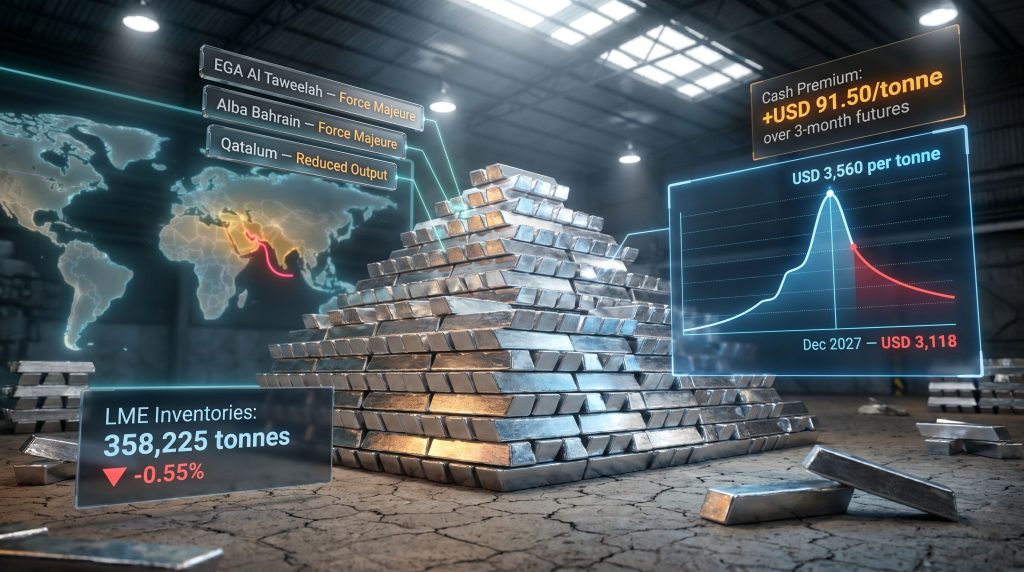
On May 8, 2026, the London Metal Exchange recorded a modest price recovery in aluminium following two consecutive sessions of declines. The LME aluminium cash bid price edged up 0.04% to USD 3,560 per tonne, while the offer price settled at USD 3,560.50 per tonne. The three-month bid rose 0.06% to USD 3,511 per tonne, and the Asian Reference Price closed at USD 3,503 per tonne, representing a 0.29% gain from the May 7 session.
On the surface, these figures might suggest stabilisation. The deeper signal, however, sits in the longer-dated contracts. December 2027 bid and offer prices both fell 0.22%, settling at USD 3,118 per tonne and USD 3,123 per tonne respectively. This divergence between strengthening near-term prices and weakening long-dated contracts is not incidental.
When spot prices rise while contracts dated 18 months forward decline, the market is not expressing confidence in a demand surge. It is pricing a short-term scarcity premium while simultaneously signalling doubt that supply will be restored at scale. This structure is one of the most reliable early indicators of a genuine supply crisis.
The cash-to-futures spread reinforces this reading. The LME aluminium market has moved from a USD 12 per tonne cash discount to a USD 91.50 per tonne cash premium over three-month futures, a condition known in commodities markets as backwardation. This shift is significant: traders are now paying a substantial premium above forward prices simply to secure immediate physical delivery, a behaviour pattern historically associated with acute physical scarcity rather than speculative positioning. Furthermore, these metal pricing dynamics are increasingly being tracked by analysts across multiple commodities sectors.
How Did the Strait of Hormuz Disruption Trigger a Global Aluminium Shock?
The Geopolitical Catalyst
The proximate cause of the LME aluminium supply crisis traces back to the breakdown of diplomatic negotiations between the United States and Iran in early 2026 and the subsequent military escalation that commenced on February 28, 2026. The imposition of a U.S. naval blockade on Iranian maritime traffic effectively closed one of the world's most consequential industrial shipping corridors. The Strait of Hormuz, through which approximately 9% of global aluminium production flows in some capacity, became a chokepoint not just for energy markets but for the broader industrial metals complex.
Infrastructure Damage Across Gulf Smelting Operations
The consequences for physical production infrastructure were rapid and severe. Three facilities of significant scale declared force majeure or reduced output within weeks of the escalation:
| Facility | Annual Capacity | Status | Recovery Estimate |
|---|---|---|---|
| Emirates Global Aluminium (EGA), Al Taweelah, UAE | 1,500,000 mt | Force Majeure | Up to 12 months |
| Aluminium Bahrain (Alba) | 1,600,000 mt | Force Majeure | Undetermined |
| Norsk Hydro Qatalum, Qatar | ~640,000 mt | Reduced Output | Undetermined |
EGA's Al Taweelah facility, one of the largest single-site aluminium smelters in the world, declared force majeure on outbound shipments following missile strikes on March 28, 2026, with full restoration estimated to take up to 12 months. Alba, operating at 1.6 million metric tonnes per year, similarly declared force majeure on outbound shipments. Norsk Hydro's Qatalum joint venture in Qatar curtailed production following gas supply interruptions, adding a further reduction in available output.
The Dual-Channel Constraint No One Expected
What separates this disruption from a conventional smelter outage is the bidirectional nature of the blockade's impact. Aluminium smelters in the Gulf region are not vertically integrated in isolation. They depend on continuous inbound flows of alumina and bauxite, raw materials that must be shipped in before any metal can be shipped out.
The Hormuz disruption simultaneously chokes both directions of trade:
- Outbound: Finished aluminium and aluminium billet cannot reach European or North American customers
- Inbound: Alumina shipments destined for Gulf smelters face transit restrictions, meaning affected facilities cannot receive the raw materials needed to resume production even if infrastructure is restored
This self-reinforcing constraint is why analysts have characterised the situation as a structural deficit rather than a logistical delay. Alternative supply routes exist but require months to establish at scale, and no single replacement corridor can compensate for the volume concentration around Hormuz. Consequently, concerns around global bauxite supply have intensified as inbound raw material flows remain severely constrained.
What Do LME Inventory Levels Reveal About the Depth of This Crisis?
Warehouse Stock Collapse: The Most Reliable Structural Signal
LME registered aluminium warehouse inventories offer the most objective window into the severity of the supply deficit. These stocks function as the market's physical buffer: when production and consumption are roughly balanced, warehouse levels remain stable. When supply falls short of demand, inventories draw down. The current trajectory is unambiguous.
LME registered aluminium warehouse stocks stood at 418,675 tonnes as of March 27, 2026, already the lowest level recorded since July 2025, representing a 28.4% year-on-year decline from December 2025 levels of approximately 522,771 tonnes.
By May 8, 2026, inventories had declined further to 358,225 tonnes, a 0.55% single-session drop from 360,225 tonnes on May 7. Live warrants held steady at 331,725 tonnes, but cancelled warrants fell sharply by 9.25% from 26,500 to 24,050 tonnes. Reuters has reported extensively on how this aluminium crisis is leaving markets running critically short of available metal.
| Inventory Metric | May 7, 2026 | May 8, 2026 | Change |
|---|---|---|---|
| Opening Stock (tonnes) | 360,225 | 358,225 | -0.55% |
| Live Warrants (tonnes) | 331,725 | 331,725 | Unchanged |
| Cancelled Warrants (tonnes) | 26,500 | 24,050 | -9.25% |
Understanding What Cancelled Warrants Actually Signal
For readers unfamiliar with LME mechanics, the distinction between live and cancelled warrants is worth explaining. A live warrant represents metal sitting in an LME-registered warehouse that is available for delivery and trade. When a warrant is cancelled, it means the holder has initiated the process of physically withdrawing that metal from the warehouse system.
Declining cancelled warrants, as observed on May 8, might initially suggest reduced demand for physical withdrawal. However, in the context of a supply shock, this interpretation can be misleading. Falling cancellations may instead reflect an absence of metal available to withdraw, or logistical constraints that prevent timely removal. The combination of falling total stocks and falling cancelled warrants points toward systemic tightness rather than demand softening.
The 300,000 Tonne Threshold: Why It Matters
If LME inventories continue declining at approximately their current pace of roughly 0.5% per session, total registered stocks could approach the psychologically significant 300,000 tonne level within approximately 40 to 50 trading sessions, absent any meaningful supply restoration. At that level, the market's physical buffer would be critically thin, and backwardation would likely intensify materially. Historically, base metal markets operating with inventory coverage this shallow tend to exhibit sharp price acceleration as buyers compete aggressively for available units.
How Are Regional Aluminium Markets Responding to the Supply Shock?
North America: Tariff Pressure Compounds Geopolitical Disruption
North American aluminium consumers entered this crisis period in an already stressed condition. The impact of US aluminium tariffs of 50% on Canadian aluminium imports had already constrained the region's most accessible supply alternative before Gulf disruptions emerged. The Midwest Premium, a key indicator of physical aluminium pricing above the LME benchmark in North America, surged 186.5% year-on-year to 110.95 cents per pound as of April 10, 2026.
Jean Simard, President and CEO of the Aluminium Association of Canada, stated publicly that North American aluminium markets were already operating with very low inventories before the Iran situation developed, characterising the near-term outlook as moving toward a shortage environment where prices would continue rising.
The region's structural exposure is compounded by an inability to rapidly substitute Middle Eastern supply. Domestic U.S. smelting capacity has contracted significantly over the past two decades, and Canadian alternatives face both tariff barriers and logistical constraints that limit their effectiveness as short-notice replacements.
Europe: Structurally Exposed at the Worst Possible Time
European downstream aluminium consumers face perhaps the most acute near-term pressure of any major importing region. The Middle East represents a structurally critical supply corridor for European aluminium billet, the semi-fabricated form used extensively in automotive extrusions, construction profiles, and renewable energy components.
Aluminium billet premiums in European markets have approximately doubled since the conflict onset in late February 2026, reflecting the immediate pressure on physical availability. Michael Liesegang of the German Mineral Resources Agency has indicated that supply constraints are expected to persist given the ongoing nature of regional disruptions, offering little near-term comfort to European buyers.
The sectors carrying the highest exposure include:
- Automotive manufacturing: European OEMs relying on aluminium-intensive platforms, particularly electric vehicles, face both cost inflation and scheduling uncertainty
- Construction and infrastructure: Structural aluminium and curtain walling applications face premium escalation with limited substitution options in the short term
- Renewable energy: Solar mounting systems, wind turbine nacelles, and grid transmission hardware are aluminium-intensive precisely at the moment when demand for these products is accelerating fastest
- Packaging: Beverage can and food packaging producers operate on thin margins where sustained metal price elevation directly compresses profitability
Asia-Pacific: Buffered But Not Immune
The LME Asian Reference Price of USD 3,503 per tonne on May 8 confirms that price transmission from LME benchmarks is reaching regional markets. China's large domestic smelting base provides a partial structural buffer, though domestic demand absorption and export policy constraints limit the degree to which Chinese capacity can serve as a global relief valve. Japanese and South Korean manufacturers with significant exposure to Gulf-sourced aluminium supply face growing procurement cost pressures that are beginning to filter through to upstream contract renegotiations.
What Are the Price Forecasts and Bull-Case Scenarios for LME Aluminium?
Institutional Price Targets
| Institution | Near-Term Target | Bull-Case Ceiling | Timeframe |
|---|---|---|---|
| Citi | USD 3,600 per tonne | USD 4,000 per tonne | 0 to 3 months |
| ING (Ewa Manthey) | Elevated | Above USD 4,000 per tonne | Escalation scenario |
| BMI (Fitch Group) | Elevated | Undetermined | Near-term weeks |
The most significant data point anchoring these forecasts is the April 13, 2026 peak, when three-month LME aluminium futures reached USD 3,686.90 per metric tonne, a four-year high representing a 17.9% increase from the onset of military operations on February 28, 2026. Meanwhile, the LME alumina Platts price held steady at USD 307.15 per tonne on May 8, suggesting raw material pricing has not yet fully reflected the downstream metal tightness — a lag that could create additional upward pressure as the deficit propagates upstream. The alumina market pressures building throughout this period have compounded the already severe disruption to finished metal supply.
What Would Push Prices Above USD 4,000 Per Tonne?
The pathway to USD 4,000 per tonne requires the convergence of several conditions:
- Military conflict escalating further into additional Gulf production zones beyond currently affected facilities
- Alternative supply routing demonstrably failing to compensate for Hormuz-blocked volumes within a reasonable timeframe
- LME registered inventories declining through the 300,000 tonne level, intensifying physical backwardation
- Energy transition demand sectors (electric vehicles, solar infrastructure, grid expansion) maintaining their growth trajectory and compressing available supply further
This scenario is not the base case, but it represents a credible escalation pathway that institutional analysts are actively pricing into options structures. The fact that multiple institutions independently identify USD 4,000 per tonne as a stress ceiling suggests underlying market consensus around this level as a meaningful threshold.
The next major ASX story will hit our subscribers first
Which End-Use Industries Face the Greatest Exposure?
Sector-by-Sector Vulnerability Assessment
Different downstream industries carry materially different exposure profiles depending on their aluminium intensity, margin structure, contract flexibility, and geographic supply chain orientation.
Automotive Manufacturing faces input cost inflation and potential production scheduling disruptions. Electric vehicle platforms are particularly aluminium-intensive relative to traditional internal combustion vehicles, meaning cost exposure scales with the very products where demand is growing fastest. European OEMs face the greatest regional concentration of risk.
Construction and Infrastructure projects face both price escalation and delivery timeline uncertainty. Structural aluminium, curtain walling, and extrusion-dependent applications have limited short-notice substitution options. Long-lead infrastructure projects locked into fixed-price contracts face the most severe margin compression.
Renewable Energy sits at an uncomfortable intersection: a sector where demand is accelerating fastest now faces supply constraints on one of its primary input materials. Solar panel mounting systems, wind turbine nacelles, and high-voltage transmission components all rely heavily on aluminium billet and extrusion supply.
Packaging manufacturers operate on thin unit margins where sustained aluminium price elevation of this magnitude directly erodes profitability. Beverage can producers in particular have limited ability to pass through material cost increases quickly given retailer contract structures.
Aerospace and Defence benefits from long-lead procurement cycles that provide some insulation, but contract renegotiation pressure is building as spot and forward premium divergence widens.
How Are Downstream Buyers Responding?
- Accelerating forward purchasing and building inventory where balance sheet capacity allows, despite the cost of carrying elevated-premium metal
- Accepting spot market premiums as preferable to production halts
- Exploring aluminium substitution with steel or composite materials in applications where performance specifications permit
- Engaging LME hedging instruments, though backwardation makes forward locking structurally expensive when spot prices already carry a premium over futures
The Lesser-Known Dynamics Driving This Crisis Deeper
Secondary Aluminium and the Scrap Buffer
One structural factor not widely discussed in mainstream coverage is the role of secondary (recycled) aluminium as a potential supply buffer during primary production shortfalls. Secondary aluminium, produced from scrap rather than bauxite, bypasses the Gulf supply chain entirely and requires approximately 95% less energy per tonne than primary smelting. However, scrap collection and processing infrastructure cannot be scaled overnight, and the quality specifications for many aerospace, automotive, and electrical applications still require primary-grade metal that secondary production cannot substitute directly.
This quality distinction matters enormously during supply crises. Secondary aluminium can relieve pressure in packaging and construction segments, but high-specification downstream users remain structurally dependent on primary supply regardless of scrap availability. In addition, the top aluminium producers outside the Gulf region are under mounting pressure to accelerate output, though capacity constraints limit how quickly they can respond.
The Alumina Price Lag: A Warning Signal Being Ignored
The LME alumina Platts price remaining unchanged at USD 307.15 per tonne while finished aluminium prices have surged creates an unusual disconnect in the production economics chain. Typically, raw material prices and finished metal prices move in correlated fashion during supply disruptions. The current static alumina pricing may reflect the fact that Gulf smelters, which are the primary buyers of traded alumina, are not purchasing due to operational shutdowns rather than reduced demand. If and when these smelters attempt to resume production, a sudden increase in alumina procurement could trigger a secondary price shock upstream that the market has not yet priced.
Supply Chain Architecture: Why Diversification Takes Years
A frequently underestimated factor in assessing the resolution timeline for the LME aluminium supply crisis is the structural inertia of alternative supply routes. Redirecting aluminium shipments from Australia, Canada, or West Africa to European or North American destinations requires not just available tonnage but compatible logistics infrastructure, established contractual frameworks, and in some cases smelter qualification processes that downstream manufacturers apply before accepting new material sources. For aerospace and automotive applications, incoming material qualification can take 12 to 24 months regardless of how urgent the procurement need is. The AFR has noted that fragile aluminium markets are being pushed to the brink precisely because this diversification groundwork was never laid in advance.
What Should Market Participants Monitor to Gauge Crisis Trajectory?
The Three Leading Indicators That Will Define the Next Phase
-
LME Inventory Trend: The single most reliable near-term signal. Continued decline at or above current rates validates the structural deficit thesis. Any stabilisation above 330,000 tonnes would suggest alternative supply routing is partially functioning.
-
Cash-to-Three-Month Spread (Backwardation Depth): The current USD 91.50 per tonne cash premium is already historically elevated for aluminium. Widening beyond USD 150 per tonne would signal acute physical scarcity entering a more severe phase. Narrowing toward USD 30 per tonne would suggest supply normalisation is underway.
-
Force Majeure Status at Gulf Facilities: Any official announcement of partial or full production resumption at EGA Al Taweelah or Alba would represent a material shift in the supply outlook and would likely trigger significant price correction from current elevated levels.
Secondary Risk Factors Worth Tracking
- Geopolitical escalation or de-escalation signals in the Strait of Hormuz corridor, including any diplomatic engagement between U.S. and Iranian representatives
- Chinese export policy adjustments that could redirect domestic aluminium surplus toward international markets, though this remains constrained by domestic demand and trade policy considerations
- U.S. tariff policy evolution affecting Canadian aluminium imports, which represents the fastest-acting lever available to North American supply relief
- LME alumina Platts price movement, currently static at USD 307.15 per tonne but potentially vulnerable to a sharp upward repricing if Gulf smelters attempt coordinated production resumption
Frequently Asked Questions: LME Aluminium Supply Crisis
What is causing the LME aluminium supply crisis in 2026?
The crisis combines geopolitical disruption affecting Gulf aluminium production facilities and Strait of Hormuz shipping access with pre-existing inventory tightness caused by U.S. tariff policies constraining North American supply chains. The dual-channel nature of the blockade, restricting both metal exports and alumina imports simultaneously, creates a self-reinforcing deficit that cannot be resolved quickly through supply substitution.
How low are LME aluminium inventories right now?
As of May 8, 2026, LME registered warehouse stocks stood at 358,225 tonnes, down from 418,675 tonnes in late March 2026 and representing a 28.4% year-on-year decline from December 2025 levels.
What is the current LME aluminium cash price?
The LME aluminium cash offer price settled at USD 3,560.50 per tonne on May 8, 2026, reflecting a modest recovery from the prior session.
Could LME aluminium prices reach USD 4,000 per tonne?
Citi and ING analysts have both identified USD 4,000 per tonne as a credible bull-case scenario under continued escalation. This is not the base case but represents a plausible pathway if Gulf smelter restoration is delayed and LME inventories continue declining.
What does backwardation mean in the LME aluminium market?
Backwardation occurs when the cash price exceeds the forward price. The shift from a USD 12 discount to a USD 91.50 per tonne cash premium over three-month futures signals acute physical scarcity: buyers are paying significantly above forward prices to secure immediate metal delivery.
A Supply Crisis With No Quick Resolution in Sight
The LME aluminium supply crisis of 2026 is structurally distinct from cyclical price events driven by demand acceleration or speculative positioning. Its defining characteristic is a simultaneous attack on both metal output capacity and raw material supply chains, creating a self-reinforcing deficit mechanism that demand-side adjustment cannot resolve alone.
LME inventory levels were already declining from a base that was historically low before Gulf disruptions emerged. The quality distinctions that prevent secondary aluminium from substituting primary grades in high-specification applications mean that even aggressive scrap mobilisation cannot cover the full volume gap. Alternative supply routing requires months to years to establish at scale.
The longer-term structural implications are becoming visible:
- Accelerated investment interest in non-Gulf primary aluminium production capacity across West Africa, Australia, and Canada as supply chain diversification becomes a strategic priority for downstream users
- Growing commercial importance of recycled and secondary aluminium infrastructure as a buffer in segments where quality specifications permit substitution
- Potential structural repricing of aluminium as a critical material given its centrality to electric vehicles, renewable energy, and grid infrastructure
The resolution timeline for this crisis will be measured in months, not weeks. The downstream industries, investors, and procurement professionals who recognise this structural reality earliest, rather than treating it as a transient disruption, will be best positioned to navigate what comes next.
This article contains forward-looking statements and price forecast references sourced from institutional analysts. These represent analytical scenarios rather than guaranteed outcomes. Commodity markets are subject to rapid and unpredictable change. Nothing in this article constitutes financial or investment advice. Readers should conduct independent research before making any investment or procurement decisions.
Want to Stay Ahead of the Next Major Commodity Discovery?
Discovery Alert's proprietary Discovery IQ model delivers real-time alerts on significant ASX mineral discoveries — including those tied to critical materials like aluminium and bauxite — instantly translating complex data into actionable investment opportunities before the broader market catches on. Explore historic examples of major discoveries and their returns and begin your 14-day free trial today to position yourself ahead of the next significant find.