May 11, 2026
The Price of an Unacceptable Answer: What Iran's Counter-Proposal Reveals About the Road to War's End
Every major geopolitical standoff eventually reaches a moment where the gap between two sides becomes impossible to paper over with diplomatic language. The collapse of US-Iran negotiations in May 2026 is one such moment, and the Trump Iran counter-proposal totally unacceptable declaration has become the defining phrase of that breakdown. What makes this failure particularly significant is not simply that talks failed, but why they failed and what the structural incompatibility between the two sides tells us about the months ahead for global energy markets, regional stability, and the future of the Strait of Hormuz.
Understanding this impasse requires moving beyond the headline rejection and examining the architecture of each side's demands, the sequencing logic that divides them, and the energy market consequences that are already playing out in real time. Furthermore, the crude oil trade geopolitics at play here extend far beyond any single bilateral dispute.
When big ASX news breaks, our subscribers know first
The Fault Lines That Made Failure Predictable
When US President Donald Trump declared Iran's counter-proposal "totally unacceptable" on 10 May 2026, the response was emphatic but not entirely surprising. The two sides had entered the negotiating process carrying fundamentally incompatible frameworks, not merely different opening bids.
The American position, communicated through mediating channels involving Pakistan and Oman, centred on a near-comprehensive rollback of Iran's nuclear capability. This encompassed the permanent dismantlement of enrichment infrastructure, the removal of enriched uranium stockpiles from Iranian territory, and the sustained application of sanctions until independently verified compliance was achieved.
The reopening of the Strait of Hormuz was also embedded within the framework, linked to Lebanon ceasefire conditions as a bundled demand, not a standalone concession. Iran's counter-position, however, operated from an entirely different sequencing logic.
What Did Iran's Counter-Proposal Actually Demand?
Tehran's response emphasised several non-negotiable preconditions before substantive nuclear discussions could proceed:
- An immediate end to the US naval blockade
- Full removal of sanctions on Iranian oil sales
- Iranian management authority over the Strait of Hormuz, contingent on separate US commitments
- Explicit rejection of any permanent dismantlement of enrichment capacity as a precondition
The core problem here is sequencing. The US framework was designed to extract maximum nuclear concessions before offering economic relief. Iran's counter-proposal reversed that sequence entirely, demanding economic breathing room before any structural nuclear commitments were made. These are not positions that can be split down the middle.
Consequently, as Reuters reported, Trump's rejection was immediate and forceful, with the oil market impact rippling through energy futures within hours of the announcement.
The transit of vessels through the Strait of Hormuz remains at a fraction of pre-war levels even after a ceasefire was reached on 7 April 2026, according to Argus Media reporting, illustrating how the economic and strategic stakes of this standoff extend well beyond the negotiating table.
What Iran's Nuclear Offer Actually Contained
The nuclear component of Iran's counter-proposal deserves careful scrutiny because it is often mischaracterised as a flat refusal to engage. Tehran's position was more nuanced than outright rejection, but the architecture of its concessions was deliberately designed to preserve maximum reversibility.
Informed sources cited by Tasnim, the news agency affiliated with Iran's Islamic Revolutionary Guard Corps, indicated that Tehran's response included a proposed 30-day window for nuclear discussions, an offer to dilute a portion of its highly enriched uranium stockpiles, and a conditional offer to transfer some uranium to a third country.
The critical qualifier on the transfer provision was that it remained reversible if the United States exited any future agreement, a direct reference to the deep institutional memory of the 2018 JCPOA withdrawal. Enrichment levels that were capped at 3.67% under the original JCPOA have since been reported at 60% and above, representing a qualitatively different nuclear posture than existed when the original deal was struck.
Israeli Prime Minister Benjamin Netanyahu made clear in a televised interview on CBS on 10 May 2026 that the Israeli position functions as a structural constraint on any settlement framework. Netanyahu stated that the conflict could not be considered finished while enriched uranium remained in Iran and enrichment facilities remained operational. This effectively creates a veto mechanism over any potential agreement.
The Hormuz Disruption and Its Oil Market Consequences
The negotiation breakdown sent crude futures sharply higher in Asian trading on 11 May 2026. The scale and speed of the move reflected not just the immediate diplomatic failure, but the accumulated supply anxiety that has built since the effective closure of the Strait of Hormuz from early March onwards. In addition, the broader global trade tensions surrounding this conflict have amplified market volatility considerably.
| Benchmark | Price Level | Single-Session Gain | Date |
|---|---|---|---|
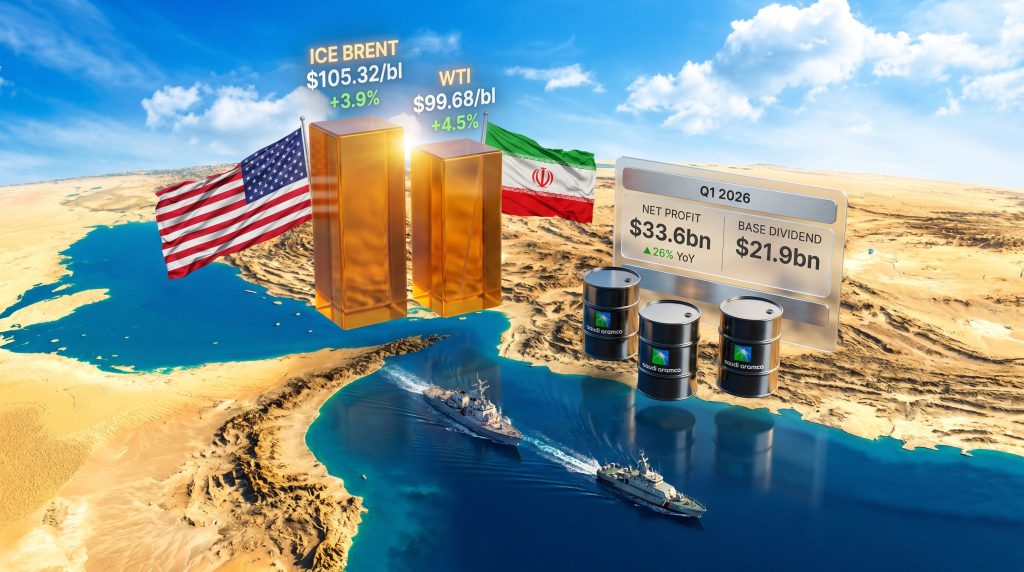
| ICE Brent (July front-month) | $105.32/bl | +3.9% | 11 May 2026 |
| WTI (June front-month) | $99.68/bl | +4.5% | 11 May 2026 |
Source: Argus Media, 11 May 2026
WTI's sharper percentage move relative to Brent is analytically significant. The US benchmark's proximity to the psychologically important $100/bl threshold amplified speculative interest, while the physical tightness in Gulf crude supply pushed WTI's risk premium above its typical spread to Brent.
The Strait of Hormuz carries approximately 20% of globally traded oil, making it the single most important maritime energy corridor on the planet. The disruption has not fallen equally across Gulf producers. According to Argus Media reporting, Kuwait, Qatar, Bahrain, and Iraq have absorbed the most severe production curtailments relative to their total output capacity.
How Are Saudi Arabia and the UAE Coping?
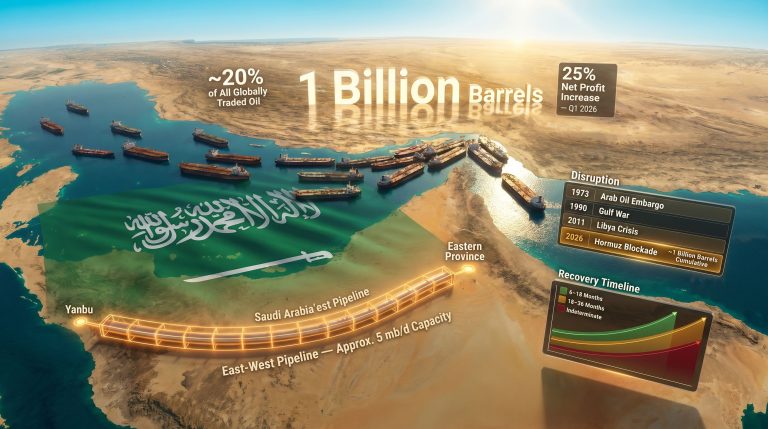
Saudi Arabia and the UAE have experienced significant disruption but retain a partial bypass capability through pipeline infrastructure. The 7 million b/d East-West pipeline, running from the Abqaiq processing complex to the Red Sea port of Yanbu, has been operating at maximum capacity since disruptions began.
Saudi Aramco CEO Amin Nasser described the pipeline as a critical supply artery providing relief to customers affected by Hormuz shipping constraints, while also confirming it had reached its operational ceiling. Furthermore, the Saudi Arabia strategy of leveraging alternative infrastructure has provided a degree of competitive advantage over regional peers entirely dependent on Hormuz access.
That ceiling matters enormously. With alternative routing capacity fully utilised, any further deterioration in Hormuz transit conditions has no additional infrastructure buffer. The pressure moves directly onto production volumes.
Saudi Aramco's Q1 2026 Performance: Profit Through Disruption
Saudi Aramco's first-quarter 2026 results, released on 10 May 2026, offer a counterintuitive illustration of how war economics can produce financial outperformance even as physical volumes fall.
| Metric | Q1 2026 | Q1 2025 | Change |
|---|---|---|---|
| Revenue | $115 billion | $108 billion | +6.5% |
| Adjusted net profit | $33.6 billion | ~$26.7 billion | +26% |
| Analyst forecast (median) | $31.16 billion | N/A | Exceeded by $2.44bn |
| Average crude realisation | $76.9/bl | $76.3/bl | +0.8% |
| Estimated Saudi output (March) | 7.0 mn b/d | N/A | vs. 10.88 mn b/d in Feb |
| Q1 average Saudi output | ~9.32 mn b/d | 8.93 mn b/d | +4.4% |
| Base dividend declared | $21.9 billion | ~$21.2 billion | +3.5% |
Source: Argus Media, "Aramco 1Q Profit Jumps 26pc Despite Hormuz Disruption," 10 May 2026
The paradox here is instructive for energy market analysts. March production collapsed from 10.88 million b/d in February to an estimated 7 million b/d as Hormuz restrictions tightened. Yet the 26% year-on-year profit increase indicates that price inflation more than compensated for lost volume during the quarter.
However, this price-volume offset dynamic has a meaningful ceiling. If Hormuz remains restricted through Q2 and Q3 of 2026, volume losses will compound while the marginal impact of price appreciation diminishes, particularly if consuming nations begin coordinating strategic reserve releases or alternative supply arrangements.
The Timeline That Explains How We Got Here
The current impasse did not emerge suddenly. It is the product of a compressed escalation sequence beginning in late February 2026.
| Date | Event |
|---|---|
| 28 February 2026 | US military operation designated "Epic Fury" commences against Iran |
| 7 April 2026 | US-Iran ceasefire agreement reached |
| 4 May 2026 | US launches "Project Freedom" mission; naval clash occurs in Hormuz |
| 5 May 2026 | Trump pauses Project Freedom |
| 7 May 2026 | Second US-Iran naval exchange; Iranian forces target three US destroyers |
| 8 May 2026 | Iran seizes US-sanctioned tanker Ocean Koi off the Omani coast |
| 10 May 2026 | Trump rejects Iran's counter-proposal as totally unacceptable |
Sources: Argus Media reporting, 4–11 May 2026
The Project Freedom episode is particularly revealing. When the US launched a military mission on 4 May to challenge Iranian control of Hormuz, Iran suspended its review of the US peace proposal. The Ocean Koi seizure on 8 May, involving a US-sanctioned tanker carrying Iranian oil cargo off the coast of Oman, added another layer of friction to an already fraught negotiating environment. As CNBC noted, this sequence of events significantly complicated the path to any resumption of meaningful dialogue.
The next major ASX story will hit our subscribers first
Three Scenarios for the Path Forward
With formal talks effectively suspended following the Trump Iran counter-proposal totally unacceptable declaration, energy analysts and geopolitical observers are modelling three broad trajectories. Moreover, global market risks remain elevated across all three scenarios.
Scenario 1: Extended Stalemate with Managed Tension
Both sides maintain limited military posturing without triggering full re-escalation. Hormuz transit remains partially restricted, sustaining Brent prices above $95/bl. Diplomatic back-channels through Pakistan and Oman continue without producing a breakthrough. This is arguably the path of least political resistance for both Washington and Tehran in the near term.
Scenario 2: Mediated Breakthrough via Third-Party Framework
Chinese or Pakistani diplomatic intervention produces a sequenced agreement in which Iran receives partial blockade relief upfront in exchange for phased nuclear commitments. Hormuz partially reopens under a monitored transit framework. The primary obstacle is the US domestic political constraint on accepting anything that falls short of the "zero enrichment" position.
Scenario 3: Full Military Re-Escalation
A trigger event, whether additional US warship transits through Hormuz, expanded Israeli military action, or Iranian proxy escalation in Lebanon, pushes both sides beyond the current managed tension threshold. In a sustained conflict scenario, Brent could test $120/bl or beyond. Historical parallel: the September 2019 Abqaiq-Khurais attack temporarily removed approximately 5% of global oil supply, producing a sharp but short-lived price spike. A sustained Hormuz closure represents a fundamentally larger and longer-duration supply shock.
Why the Nuclear Dimension Is the Hardest Problem to Solve
Strip away the Hormuz leverage and the sanctions framework, and the negotiation ultimately comes down to one irresolvable question: can Iran retain any enrichment capability under a future agreement?
The gap between the two positions is not a matter of degree. The US, with Israeli alignment, is demanding permanent elimination of Iran's theoretical capacity to produce nuclear weapons. Iran has characterised this as incompatible with national sovereignty. The post-JCPOA period, during which Iran expanded enrichment from the 3.67% ceiling under the original deal to reported levels above 60%, has made the technical gap between the two positions wider than it was when diplomacy initially failed in 2018.
A frequently overlooked structural constraint is that Trump faces significant political difficulty achieving terms superior to those negotiated under the Obama administration's JCPOA framework. Any agreement perceived as weaker than the original framework would face immediate political attack, further narrowing the viable negotiating space.
What the Breakdown Means for Energy Markets Beyond the Headlines
For commodity market participants, the Trump Iran counter-proposal totally unacceptable outcome has implications that extend beyond the immediate crude price reaction.
- Asia-Pacific refineries dependent on Middle Eastern crude grades face tightening supply and widening differentials as Hormuz disruption persists
- US shale producers benefit structurally from sustained high prices, with WTI above $95/bl triggering accelerated drilling investment at many unconventional plays
- Gulf producers with pipeline bypass capability (Saudi Arabia, UAE) are outperforming those entirely dependent on Hormuz access for exports
- Emerging market importers, particularly India, South Korea, and Japan, face energy cost inflation that compounds existing macroeconomic pressures
- LNG spot markets are experiencing indirect price support as buyers diversify away from Middle Eastern oil exposure where alternative energy sourcing is feasible
The fundamental tension driving all of these dynamics is that neither side in the US-Iran negotiation currently faces the level of pain required to make meaningful concessions. Iran's economic resilience under sanctions, though significantly strained, has proven greater than US policymakers anticipated. Until those pressure dynamics shift, the world's most important oil corridor will remain contested, and global energy markets will continue pricing the Trump Iran counter-proposal totally unacceptable moment as a prolonged, unresolved crisis.
Disclaimer: This article contains forward-looking analysis and scenario projections that involve inherent uncertainty. Energy price forecasts and geopolitical outcome assessments should not be construed as investment advice. Market conditions and diplomatic developments can change rapidly and unpredictably.
Want to Spot the Next Major Resource Discovery Before the Market Moves?
While geopolitical disruptions reshape global energy markets, Discovery Alert's proprietary Discovery IQ model scans the ASX daily to deliver real-time alerts on significant mineral discoveries — turning complex data across 30+ commodities into clear, actionable opportunities the moment they're announced. Explore how historic ASX discoveries have generated substantial returns and start your 14-day free trial at Discovery Alert to position yourself ahead of the market.