
July 12, 2026
When Governments and Markets Collide: Indonesia's Mining Revenue Dilemma
Resource nationalism has long followed a predictable cycle. Commodity prices rise, governments redesign fiscal frameworks to capture a larger share of windfall profits, and industries push back. Prices fall, implementation stalls, and the debate resets. What makes Indonesia's current situation particularly instructive is that it is playing out across multiple commodities simultaneously, against the backdrop of a structural global nickel oversupply, a government with genuine fiscal ambitions, and an industry increasingly sensitive to the cumulative weight of regulatory change.
Understanding why Indonesia delays higher mineral royalties and export duties requires looking beyond the headline announcement. The decision is less about policy reversal and more about the inherent difficulty of designing fiscal instruments that function equitably across boom and bust conditions, whilst simultaneously serving an industrial transformation agenda.
When big ASX news breaks, our subscribers know first
The Architecture of Indonesia's New Royalty Regime
For much of Indonesia's modern mining history, royalty structures were relatively straightforward: flat rates applied to commodity volumes regardless of prevailing market prices. The new framework established under Government Regulations No. 18/2025 and No. 19/2025 represents a fundamental departure from that model, introducing a progressive, price-linked structure designed to extract more revenue when commodity markets are strong while theoretically reducing the burden during downturns.
The logic is conceptually sound. A sliding-scale royalty tied to the London Metal Exchange price means the state captures more value during a nickel price surge without necessarily crushing operators when prices are weak. In practice, however, the calibration of those thresholds determines whether the policy achieves its goals or simply shifts production economics in ways that deter investment.
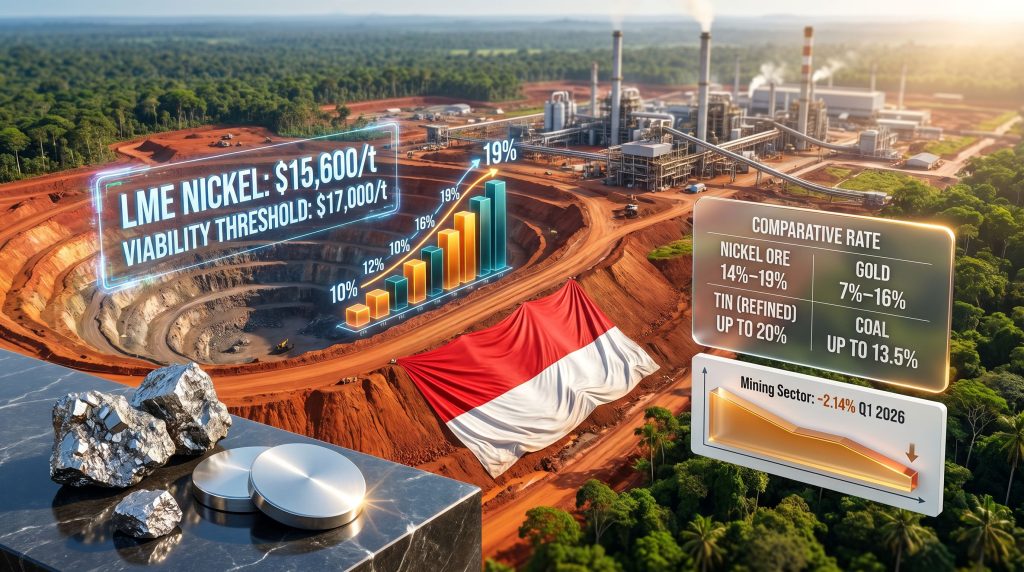
The proposed rate structure across key commodities illustrated the ambition of the framework:
| Commodity | Previous Structure | New Progressive Rate Range | Price-Linkage Mechanism |
|---|---|---|---|
| Nickel Ore | Flat (approximately 10%) | 14% to 19% | Linked to LME nickel price and ore grade |
| Copper Ore/Concentrate | Flat rate | 10% to 17% | Price-linked |
| Gold | Flat rate | 7% to 16% | Price-linked |
| Coal | Flat rate | Up to 13.5% | Volume and price-linked |
| Tin (Refined) | Flat rate | Up to 20% | Price-linked |
Separate from these royalty increases, the government had planned to introduce export duties on processed and semi-processed mineral products from April 2026, targeting nickel pig iron (NPI), ferronickel, and coal shipments. According to Reuters reporting on Indonesia's mineral policy, that rollout was postponed indefinitely pending inter-ministerial coordination between the Ministry of Energy and Mineral Resources (ESDM) and the Ministry of Finance.
Why Indonesia Needs More Revenue From Mining
Indonesia's fiscal position has created genuine pressure to find additional revenue streams. The government's broader economic agenda, which encompasses large-scale infrastructure commitments, social programme expansion, and sovereign wealth fund capitalisation, demands sustained public investment at a level that creates structural gaps in the budget.
The mining sector, which contributes substantially to Indonesia's export earnings and GDP, has become a primary target for fiscal optimisation. Officials have previously stated that increasing mining sector revenue is a stated government objective, and the new royalty framework was designed as the primary instrument for achieving that goal.
The timing, however, has proven problematic. A contraction in mining sector output in early 2026 has complicated the revenue calculus precisely at the moment the government was seeking to extract more from the industry. When the sector is contracting, higher royalties capture less in absolute terms whilst simultaneously compressing the margins of already-strained operators. Furthermore, the Indonesian nickel industry faces a unique convergence of challenges that make fiscal timing particularly sensitive.
Indonesia's Downstreaming Agenda: Where Fiscal Policy Meets Industrial Strategy
A dimension of this situation that is frequently underappreciated is the relationship between Indonesia's royalty framework and its broader downstreaming strategy. The two are not separate policies operating in parallel; they are architecturally linked.
Indonesia has spent years attempting to shift from being a raw commodity exporter to a processor and manufacturer of refined mineral products. The strategic logic is well understood: an ore exporter captures a fraction of the value that a battery material producer captures. By imposing higher royalties on unprocessed ore and differential export duties on semi-processed materials like NPI and ferronickel, the government creates an economic incentive for producers to invest in domestic smelting and refining.
The problem is that this incentive structure requires private capital to build expensive processing infrastructure. And private capital requires fiscal predictability. When the royalty framework itself becomes a source of uncertainty, the investment calculus for new smelter development becomes increasingly difficult to justify.
This creates an internal contradiction at the heart of Indonesia's mineral policy: the same fiscal instruments designed to accelerate industrial transformation can, if poorly calibrated, undermine the investment climate that transformation depends upon.
The Nickel Price Problem and Industry Pushback
The most acute challenge facing Indonesia's royalty timeline is the state of the global nickel market. Nickel prices on the London Metal Exchange have been trading well below levels that Indonesian smelters identify as the minimum threshold for operational viability. The Indonesian Nickel Smelters Association formally requested the ESDM delay royalty implementation until prices recover to adequate levels, while the Nickel Miners Association echoed this position, citing thin operating margins in a market defined by structural global oversupply.
Both industry bodies indicated support for the progressive framework in principle. Their objection was to the timing of implementation under current market conditions, not the policy design itself. This distinction matters: an industry that opposes a policy entirely is a different negotiating partner from an industry that supports the framework but contests its activation threshold. In addition, monitoring Indonesian nickel price trends reveals just how persistently prices have remained below viable thresholds.
The global nickel oversupply is not a short-term market aberration. It reflects structural changes in production capacity, particularly from Indonesian operations themselves, which expanded rapidly in response to earlier price surges. The country's success in building nickel processing capacity has paradoxically contributed to the price environment that now makes higher royalties difficult to absorb.
When a country's own industrial policy success contributes to the market conditions that make its fiscal policy unworkable, the solution requires more sophisticated calibration than either the industry or the government may initially recognise.
Beyond nickel, the broader mining sector has raised concerns about regulatory fatigue. High domestic energy costs compound the effect of higher royalties, squeezing margins across multiple commodity segments. Jakarta Stock Exchange mining stocks experienced notable selling pressure following announcements of royalty increases on tin, copper, and gold, reflecting investor concern about the cumulative fiscal burden.
Industry analysts have noted the risk of investment migration toward competing jurisdictions with more stable fiscal regimes, including the Philippines, the Democratic Republic of Congo, and parts of Latin America. Even when policies are eventually delayed or moderated, the perception of regulatory unpredictability can suppress exploration spending and capital allocation decisions before any measures formally take effect. This lag effect is one of the least visible costs of fiscal policy uncertainty in the resource sector.
Indonesia's Delay in a Global Context
Indonesia's dilemma sits within a broader pattern of resource-rich nations navigating the tension between revenue maximisation and investment attraction. The fiscal policy environment for mining has tightened globally, with resource governments designing progressively more sophisticated frameworks for capturing commodity upside. Consequently, understanding critical minerals and energy transition dynamics is essential context for evaluating these policy shifts.
| Country | Fiscal Approach | Central Tension |
|---|---|---|
| Indonesia | Progressive price-linked royalties; delayed implementation | Industry viability versus fiscal revenue |
| Philippines | Windfall profit tax proposals under legislative debate | Environmental concerns versus revenue capture |
| Chile | Lithium nationalisation; copper royalty reform | State control versus private investment |
| Democratic Republic of Congo | Revised mining code with royalty increases | Governance capacity versus investor confidence |
| Australia | State-level royalty reviews within stable federal framework | Revenue optimisation versus competitiveness |
What distinguishes Indonesia's situation from most of these comparators is the simultaneous pursuit of downstreaming policy and fiscal consolidation, two objectives that can create opposing pressures on the same investment base. Chile's nationalisation of lithium is a state control question. Australia's royalty reviews are incremental adjustments within a stable institutional context. Indonesia is attempting to reshape its entire commodity value chain while also extracting more fiscal value from the existing one.
The Stakeholder Consultation Process: Strength and Vulnerability
Indonesia's Energy and Mineral Resources Minister Bahlil Lahadalia confirmed in May 2026 that the government would pause its planned mineral revenue measures to develop what he described as a mutually beneficial framework — one that serves state revenue objectives without undermining the competitiveness of the sector. The ministry stated it was collecting feedback from mining companies to ensure the policy would not place undue burden on the industry.
This consultative approach has genuine merit. Engaging industry before finalising rate structures reduces the risk of unintended consequences, allows operators to provide real cost data that improves calibration accuracy, and builds legitimacy for eventual policy adoption. An industry that helped shape the framework it operates under is more likely to comply fully and less likely to seek creative avoidance strategies.
The risks of extended consultation, however, are equally real:
- Revenue capture is delayed during periods when commodity prices may be relatively elevated, reducing the government's share of the value cycle
- Extended uncertainty creates a planning vacuum that can suppress investment decisions even when operators ultimately support the policy framework
- Prolonged consultation processes can invite escalating lobbying, with each industry participant seeking further concessions beyond what the initial feedback period was designed to accommodate
- Governments that delay policy implementation under industry pressure can develop a reputation for reversibility, which increases the frequency and intensity of future lobbying efforts
The balance between genuine policy refinement and perceived capitulation to industry pressure is difficult to maintain publicly. How the government communicates the outcome of its consultation process will be as important as the rate structure it ultimately adopts. As Fitch Ratings has noted, the impact of Indonesia's mining rules differs considerably across the commodity value chain, further complicating a unified policy approach.
The next major ASX story will hit our subscribers first
Downstream Implications for Global Commodity Markets
Indonesia's position in global nickel supply chains means that fiscal policy decisions made in Jakarta have consequences that extend well beyond the archipelago. The country is the world's largest producer of nickel ore, and policy decisions affecting the cost structure of Indonesian operations ripple through battery supply chains, stainless steel manufacturing, and electric vehicle production globally.
A sustained delay in royalty implementation effectively preserves a lower cost base for Indonesian nickel producers. In a market already characterised by oversupply, this maintains downward pressure on LME prices, which in turn makes the royalty implementation threshold harder to reach. There is a circular dynamic here that is not easily resolved through policy design alone.
For coal, the dynamic is different. The proposed export duties on coal shipments were framed partly as a mechanism to manage domestic energy supply and influence the reference price used for domestic coal transactions. A delay in these measures preserves existing export economics but defers the government's ability to use fiscal tools to prioritise domestic energy security over export revenue.
The strategic implication for Asian energy markets is meaningful. Indonesia is one of the largest thermal coal exporters globally, supplying a significant share of energy demand across Southeast and Northeast Asia. Any fiscal measure affecting Indonesian coal export economics has direct consequences for energy pricing across the region. Furthermore, the lithium boom driven by battery storage expansion adds further urgency to how these commodity chains are managed fiscally.
Scenario Pathways for Indonesia's Mineral Fiscal Policy
The trajectory of Indonesia's royalty and export duty framework is not predetermined. Several distinct resolution scenarios are plausible depending on commodity price recovery, political dynamics, and the outcome of stakeholder consultation:
Scenario 1: Phased Implementation Tied to Price Recovery
The government introduces royalty increases on a commodity-by-commodity basis as LME prices recover toward industry-identified viability thresholds. This minimises industry disruption but delays revenue capture and creates ongoing threshold-management complexity.
Scenario 2: Modified Rate Structure with Industry Concessions
Following stakeholder consultation, the ESDM revises the progressive rate schedule, accepting lower revenue capture in exchange for faster implementation and reduced investment uncertainty.
Scenario 3: Indefinite Delay Amid Continued Market Weakness
Persistent low commodity prices and sustained industry lobbying result in open-ended postponement, effectively shelving the measures until a new political or economic catalyst emerges.
Scenario 4: Selective Implementation Targeting High-Margin Operators
The government applies higher rates only to large-scale or highly profitable operations while granting exemptions or reduced rates to smaller or marginal producers, balancing revenue objectives against sector-wide competitiveness concerns.
Each scenario carries distinct implications for foreign investment, domestic processing capacity development, and Indonesia's ability to meet its longer-term revenue objectives. The battery metals investment landscape in 2025 and beyond will be shaped significantly by whichever path Jakarta ultimately chooses.
FAQ: Indonesia's Mineral Royalty and Export Duty Delay
What commodities are affected by Indonesia's delayed royalty increases?
The primary commodities subject to the new progressive royalty regime include nickel ore, copper ore and concentrate, gold, coal, and refined tin. Rates vary by commodity and are designed to move with global market prices.
Why was the April 2026 export duty rollout delayed?
The government cited the need for further technical analysis and inter-ministerial coordination between the ESDM and the Ministry of Finance to determine appropriate rate structures and the conditions under which presidential approval would be required for implementation.
What viability threshold have Indonesian nickel smelters identified?
Industry bodies have indicated that current LME nickel price levels fall below what smelters identify as the minimum required for viable operations under the new royalty regime, making the timing of additional fiscal burdens a central point of contention.
Will the royalty increases eventually be implemented?
The government has not abandoned the policy framework. Officials have explicitly confirmed that increasing mining sector revenue remains a government objective. The delay reflects the search for a better-calibrated formula rather than policy abandonment.
How does this affect foreign investment in Indonesian mining?
Regulatory uncertainty, even when policies are ultimately delayed rather than cancelled, can suppress capital allocation decisions. Mining investors typically require multi-year fiscal stability to justify large-scale infrastructure commitments, and the perception of unpredictability has costs that precede any formal measure.
What Indonesia's Royalty Delay Signals for the Global Mining Sector
Several broader lessons emerge from Indonesia's experience that apply across the global resource governance landscape. However, the most significant insight is that Indonesia delays higher mineral royalties and export duties not from a lack of ambition, but from the genuine complexity of balancing multiple competing policy objectives simultaneously.
- Progressive rate structures are the new standard: Price-linked, sliding-scale royalty regimes are increasingly the preferred tool for resource governments seeking to participate in commodity upside without compromising sector viability during downturns. Indonesia's framework, despite its implementation challenges, represents the direction of travel for fiscal policy across resource-rich nations.
- Downstreaming policy creates fiscal complexity: Nations pursuing industrial transformation through processing incentives face an inherent tension between extracting value from raw materials and attracting the investment that downstream processing requires. Resolving this tension demands more nuanced calibration than either flat-rate royalties or simple progressive structures typically provide.
- The circular nickel problem is self-reinforcing: Indonesia's own success in building nickel processing capacity has contributed to the global oversupply that depresses prices below the royalty viability threshold. This feedback loop complicates the government's fiscal timeline in ways that are largely outside Jakarta's control.
- Stakeholder consultation is both a governance strength and a tactical exposure: Inclusive policy development produces better-designed instruments but extends the uncertainty window that suppresses investment and invites ongoing lobbying pressure.
- Indonesia's nickel policy has global battery material consequences: Given the country's dominant position in nickel production, any sustained fiscal delay effectively shapes the economics of global battery supply chains, EV production costs, and stainless steel market pricing in ways that extend well beyond the Indonesian mining sector itself.
This article is intended for informational purposes only and does not constitute financial or investment advice. All references to commodity prices, policy timelines, and industry projections reflect conditions as reported at the time of publication and are subject to change. Investors should conduct independent research and seek appropriate professional advice before making investment decisions.
Want to Stay Ahead of the Next Major Mineral Discovery Before the Broader Market?
Discovery Alert's proprietary Discovery IQ model delivers real-time alerts on significant ASX mineral discoveries, instantly converting complex mineral data into actionable investment insights — whether you're tracking nickel, copper, gold, or any of the 30-plus commodities it monitors. Explore historic discoveries and their market-moving returns, then begin your 14-day free trial at Discovery Alert to position yourself ahead of the market.