May 15, 2026
The Hidden Value Gap in One of the World's Most Mineral-Rich Nations
The global energy transition is fundamentally a minerals story. Every electric vehicle motor, every grid-scale battery, and every wind turbine nacelle depends on a narrow set of raw materials that are unevenly distributed across the earth's crust. Nations that hold these deposits face a defining strategic choice: export the rocks, or capture the value chain. For most of its modern industrial history, Brazil has done the former. That may now be changing.
Brazil sits atop one of the most diverse and abundant mineral endowments on the planet. Yet for decades, the country's economic return from that endowment has been disproportionately thin, constrained by a structural pattern of raw commodity export rather than processed materials production. The launch of the Brazil strategic minerals working group by the federal government marks a formal attempt to address this structural imbalance, coordinating institutional capacity around a single ambition: transforming mineral extraction into knowledge, innovation, and industrial value.
Understanding why this matters requires looking beyond the headlines and into the mechanics of how mineral value chains actually work, where Brazil currently sits within them, and what it would realistically take to move up.
When big ASX news breaks, our subscribers know first
Brazil's Reserve Endowment vs. Its Industrial Output: A Structural Mismatch
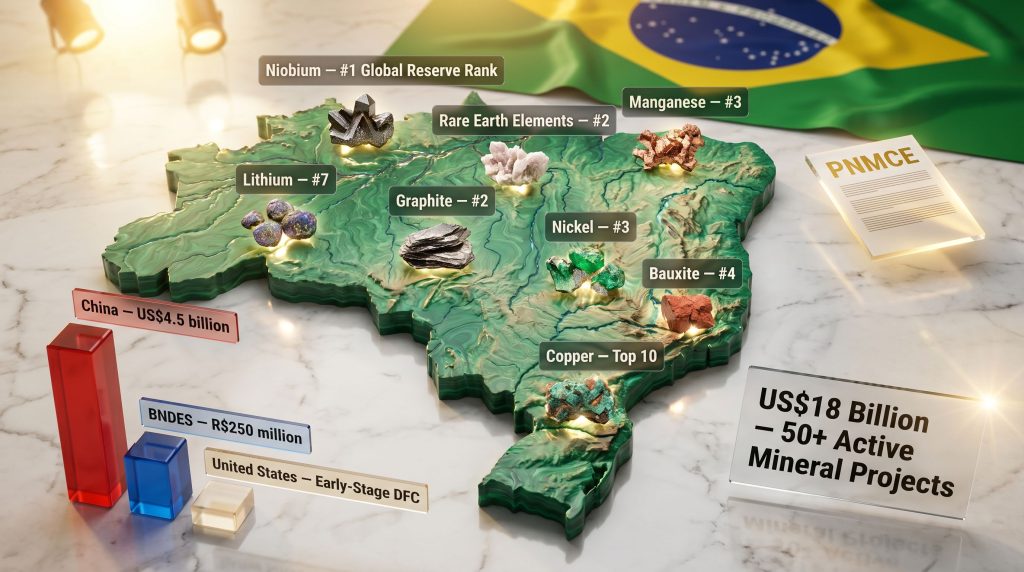
Brazil's geological endowment is extraordinary by any global measure. According to data from the United States Geological Survey (USGS) and Brazil's own Serviço Geológico do Brasil (CPRM), the country holds top-tier global rankings across a wide range of critical minerals demand categories and strategic resources.
| Mineral | Global Reserve Rank | Strategic Significance |
|---|---|---|
| Niobium | #1 | Steel hardening, aerospace alloys |
| Rare Earth Elements | #2 | Permanent magnets, EV motors |
| Graphite | #2 | Battery anodes, energy storage |
| Manganese | #3 | Battery cathodes, steel production |
| Nickel | #3 | EV batteries, stainless steel |
| Bauxite | #4 | Aluminium production |
| Lithium | #7 | Battery electrolytes, energy storage |
| Copper | Top 10 | Grid infrastructure, electrification |
Despite these rankings, Brazil's downstream processing capacity across nearly all of these minerals remains underdeveloped relative to what its reserve base could theoretically support. The country produces and exports significant volumes of mineral concentrates and ores, but the high-value conversion stages — battery-grade chemical production, refined rare earth oxides, advanced alloy manufacturing — remain largely absent or nascent.
This is not purely a Brazilian phenomenon. The so-called "resource curse" literature in development economics has long documented how commodity-dependent economies can struggle to capture the full value embedded in their natural endowments, particularly when foreign investors focus on extraction rather than processing, and when domestic industrial policy lacks the institutional architecture to redirect that dynamic.
The gap between reserve rank and processing depth is not a geological problem. It is a governance, infrastructure, and institutional capacity problem. Brazil's new working group model addresses the institutional dimension, but the infrastructure and capital dimensions require parallel policy action to unlock the full strategic opportunity.
What the Brazil Strategic Minerals Working Group Actually Does
The Governance Instrument Explained
Interministerial working groups function as coordination mechanisms within Brazil's federal system. They convene representatives from multiple ministries and agencies around a shared mandate, producing recommendations, aligning institutional priorities, and facilitating policy coherence across departments that might otherwise operate in silos.
It is important to be precise about what this instrument can and cannot do. A working group is not a regulatory agency. It cannot issue binding rules, approve permits, or deploy capital independently. Its power lies in coordination and recommendation, which ultimately depends on whether those recommendations are translated into legislative reform, budget allocation, and regulatory action by the relevant ministries.
Brazil's Ministry of Mines and Energy (MME) has historically used working group structures to align mineral policy across departments, and the current body sits within that tradition. The key distinction in the present case is the explicit innovation mandate: the Brazil strategic minerals working group's stated objective is expanding Brazil's capacity to convert raw strategic mineral extraction into applied knowledge, technological capability, and industrial output.
The Legislative Foundation: PNMCE
The working group operates within the framework of Brazil's National Policy for Critical and Strategic Minerals (PNMCE), the overarching legislative architecture governing how the country identifies, classifies, and manages its strategic mineral resources. Under PNMCE, minerals are classified along two conceptually distinct axes:
- Critical minerals are defined primarily by supply risk, where high import dependency or geographic concentration of global production creates vulnerability.
- Strategic minerals are defined by national sovereignty and industrial policy relevance, where control over the resource has implications beyond commercial value.
Minerals receiving priority status under this framework include cobalt, copper, lithium, nickel, graphite, rare earth elements, tungsten, and other inputs deemed essential to Brazil's energy and technological transition agenda. The working group's mandate covers this full list, though lithium, rare earths, and nickel are receiving particular institutional attention given their centrality to battery and EV supply chains.
The Four-Pillar Policy Architecture
PNMCE structures Brazil's strategic mineral ambitions around four interconnected pillars:
- Geological Knowledge Expansion — accelerating national survey and mapping programmes to reduce exploration uncertainty and de-risk private capital deployment.
- Production and Processing Capacity Building — creating incentive structures that attract domestic refining, smelting, and value-added manufacturing investment rather than pure extraction plays.
- Import Dependency Reduction — identifying substitution pathways for minerals where Brazil is currently a net importer despite holding domestic reserves.
- Energy and Technology Transition Sovereignty — ensuring that the mineral inputs required for Brazil's own decarbonisation agenda are not subject to geopolitical supply disruption from externally concentrated processing networks.
The Investment Pipeline Supporting Policy Execution
Brazil's strategic minerals agenda is being developed against a backdrop of significant capital commitment. The active mineral project pipeline spans more than 50 initiatives in pre-operational and extraction phases nationally, with total planned investment exceeding US$18 billion across these projects.
The Brazilian Development Bank (BNDES) has committed direct support of up to R$250 million for priority projects, with Vale contributing additional co-investment alongside national and international capital partners. This positions BNDES not only as a financier but as a signal of sovereign commitment to the downstream processing agenda — a role development banks play in other jurisdictions where private capital alone has been insufficient to drive processing investment.
Furthermore, critical minerals and energy security considerations have amplified the urgency of these capital commitments, as energy-importing economies increasingly seek to secure diversified supply chains.
Brazil's active mineral project pipeline of 50+ initiatives, backed by more than US$18 billion in planned capital, represents one of Latin America's largest coordinated resource development programmes. Yet analysts consistently note that permitting delays and infrastructure gaps continue to constrain conversion rates from exploration to production.
Geopolitical Competition and the Race for Brazil's Minerals
China's Established Footprint
Brazil's strategic minerals do not exist in a geopolitical vacuum. China has committed approximately US$4.5 billion in direct investment into Brazil's mining sector, establishing meaningful upstream supply chain influence across multiple critical mineral categories. The pattern of this investment is consistent with China's broader global minerals strategy: focused on extraction-phase assets rather than knowledge transfer or processing infrastructure, which effectively reinforces the raw commodity export model that Brazilian industrial policy is now trying to move beyond.
This creates a structural tension at the heart of Brazil's working group mandate. Foreign extraction capital accelerates production but does not build domestic processing capability. If Brazil's policy ambition is to capture value-chain depth, the composition and conditionality of incoming investment matters as much as its volume. The broader dimensions of critical minerals geopolitics are increasingly shaping how nations negotiate the terms of these resource relationships.
U.S. Engagement: Promising but Nascent
American interest in Brazil's strategic mineral endowment has grown substantially, driven by supply chain diversification imperatives following the concentration risks exposed during the post-pandemic period. A bilateral U.S.-Brazil Critical Minerals Working Group was established to coordinate supply chain cooperation, though independent policy analysis has characterised tangible outcomes as limited relative to the scale of the strategic opportunity both nations have identified.
The Minerals Security Partnership (MSP), a multilateral framework coordinating supply chain investment among advanced-economy partners, has been discussed as a potential framework for Brazil's formal alignment. As of early 2024, former U.S. Secretary of State Antony Blinken publicly endorsed the possibility of Brazil joining the MSP during engagement with President Lula, though formal membership and associated bilateral commitments remained in progress at that time.
At the project level, the U.S. Development Finance Corporation's equity stake in TechMet's Piaui nickel-cobalt mine represents an early-stage American capital commitment in Brazil's strategic minerals sector, though this remains modest compared to China's established investment footprint.
Comparative Investment Positioning
| Partner | Estimated Investment in Brazil Mining | Primary Focus | Processing Depth |
|---|---|---|---|
| China | ~US$4.5 billion | Extraction-phase assets | Limited downstream |
| United States | Early-stage (DFC equity in TechMet/Piaui) | Supply chain diversification | Nascent |
| BNDES (Domestic) | Up to R$250 million | Transition minerals | Processing and innovation |
The Structural Barriers That Policy Alone Cannot Solve
Permitting Complexity
Environmental licensing in Brazil operates across federal and state layers, with the federal environmental agency IBAMA holding primary authority over projects with significant environmental impact. Projects in biome-sensitive regions, particularly those near Amazon or Cerrado ecosystems, are subject to extended Environmental Impact Assessment procedures, indigenous consultation requirements under FUNAI, and state-level supplementary approvals.
Mining projects in Brazil can face multi-year permitting timelines from discovery to construction approval — a structural drag on capital deployment that is well-documented across the sector. This contrasts with jurisdictions like Australia and Canada, where streamlined federal-state coordination frameworks have reduced average permitting windows considerably, making those markets more competitive for attracting mid-stage development capital.
Infrastructure Deficits in Mineral-Rich Regions
A significant portion of Brazil's untapped critical mineral endowment sits in remote regions of the Amazon and Cerrado biomes — areas characterised by limited road and rail connectivity, inadequate power grid infrastructure, and significant logistics cost premiums relative to accessible coastal processing and port facilities.
These infrastructure gaps do not simply add cost to extraction. They actively deter downstream investment, since processing facilities require reliable energy supply, labour access, and logistics connectivity that remote extraction sites often cannot provide. Bridging this gap requires infrastructure investment at a scale that falls outside the working group's direct mandate.
Technology Transfer and Processing Capability
Brazil's refining and chemical processing capabilities have not kept pace with reserve growth. For lithium, for example, Brazil primarily exports spodumene concentrate rather than battery-grade lithium carbonate (Li₂CO₃) or lithium hydroxide (LiOH) — the forms required directly by battery manufacturers. The conversion from concentrate to chemical is where most of the margin and strategic value resides, and this conversion currently happens predominantly in China and South Korea.
The same pattern applies across rare earth elements, where Brazil's ore and mixed concentrate exports are processed into separated oxides and metals elsewhere, capturing only a fraction of the value embedded in the original resource.
The next major ASX story will hit our subscribers first
Lithium: Brazil's Most Commercially Urgent Value-Chain Challenge
Where Brazil Sits in the Lithium Value Chain
Ranked seventh globally in lithium reserves, with hard-rock spodumene deposits concentrated in Minas Gerais state, Brazil holds meaningful long-term lithium supply potential. However, current production levels significantly underperform that reserve ranking due to the same structural constraints affecting the broader sector: permitting complexity, limited processing infrastructure, and insufficient domestic demand to anchor battery-grade chemical production.
The lithium value chain can be understood as a sequential series of processing stages, each adding significant value:
- Stage 1 (Extraction): Mining of spodumene-bearing pegmatite ore. Partially developed in Brazil.
- Stage 2 (Concentration): Spodumene extraction and flotation to produce spodumene concentrate (typically 6% Li₂O). Some domestic capacity, but most concentrate exported.
- Stage 3 (Chemical Conversion): High-temperature calcination and chemical processing to produce lithium carbonate or lithium hydroxide. Nascent in Brazil; BNDES-supported projects targeting this stage.
- Stage 4 (Battery-Grade Material): Purification to battery-grade specifications and cell manufacturing. Largely absent; the long-term ambition of the innovation-focused working group mandate.
The working group's mandate directly targets stages three and four, where value capture is most significant and where China currently dominates global processing capacity. In addition, emerging direct lithium extraction technologies could potentially accelerate Brazil's transition through these processing stages, offering faster routes to battery-grade output than conventional conversion pathways.
The Brazil Lithium and Critical Minerals Summit 2026
A near-term catalyst for translating working group policy signals into concrete investor commitments is the Brazil Lithium and Critical Minerals Summit, scheduled for June 17–18, 2026 in Belo Horizonte. The event is designed to convene global industry leaders, policymakers, and capital allocators to align on development priorities and investment frameworks, representing a significant test of whether Brazil's institutional momentum can convert into capital deployment commitments across the value chain.
How Brazil Compares to Peer Mining Jurisdictions
| Dimension | Brazil | Australia | Chile | Indonesia | DRC |
|---|---|---|---|---|---|
| Reserve Diversity | Very High (8+ critical minerals) | High | Concentrated (Li, Cu) | Concentrated (Ni, Co) | Concentrated (Co, Cu) |
| Downstream Processing Depth | Low to Moderate | Moderate | Moderate | Growing rapidly | Very Low |
| Geopolitical Alignment | Emerging (MSP candidate) | Strong (MSP member) | Neutral | China-aligned | China-aligned |
| Policy Framework Maturity | Developing (PNMCE active) | Advanced | Advanced | Developing | Weak |
| FDI Environment | Complex (permitting) | Favourable | Moderate | Improving | High-risk |
The Indonesia Parallel: A Cautionary and Instructive Case
Indonesia's decision to mandate domestic nickel processing before export, implemented from 2020 onward, delivered rapid domestic value-chain development but triggered World Trade Organisation disputes with the European Union and created short-term investor uncertainty. The outcome was a significantly expanded domestic nickel processing industry, but at the cost of considerable geopolitical friction and a concentrated alignment with Chinese capital that shaped the composition of that new processing capacity.
Brazil's working group approach is more gradualist, pursuing incentive-based rather than prohibition-based industrial policy. The trade-off is lower geopolitical friction and better alignment with multilateral partners, but potentially a longer timeline to achieve the processing depth that Indonesia's nickel sector reached relatively quickly. Whether Brazil's democratic governance structures and institutional complexity can execute at sufficient speed to capture near-term energy transition demand is a central strategic question.
The Strategic Outlook: Near-Term Catalysts and Long-Term Ambition
Key Developments to Monitor (2025 to 2026)
- Formal publication of working group terms of reference, deliverable timelines, and participating institutional members.
- Progress on Brazil's MSP membership formalisation and associated bilateral investment facilitation frameworks with key partner nations.
- BNDES financing disbursements to lithium chemical conversion and rare earth processing projects.
- Outcomes and investor commitments arising from the Brazil Lithium and Critical Minerals Summit (June 2026, Belo Horizonte).
- Federal permitting reform proposals linked to the PNMCE implementation roadmap and their legislative progress.
The Long-Term Value Proposition
Brazil's combination of extraordinary reserve diversity, democratic governance, geographic scale, and emerging multilateral alignment positions it as a structurally important alternative source of critical minerals to supply chains currently dominated by China-controlled processing networks. That positioning is real and valuable.
However, converting geological rank into industrial leadership requires more than policy coordination. It demands sustained infrastructure investment in mineral-rich but infrastructure-poor regions, regulatory streamlining that reduces the multi-year gap between discovery and production, technology transfer arrangements that build domestic processing capability rather than simply attracting extraction capital, and capital market development that gives mid-stage mineral companies access to financing on competitive terms.
The Brazil strategic minerals working group addresses the institutional coordination dimension of this challenge. Whether it proves to be a genuine inflection point or another policy signal that falls short of industrial transformation will depend on whether its recommendations generate sustained legislative action, budgetary commitment, and regulatory reform — areas where Brazil's complex federal-state governance architecture has historically created significant friction between policy ambition and execution outcome.
Brazil's strategic mineral opportunity is not primarily a question of what lies in the ground. It is a question of institutional capacity, infrastructure commitment, and political will to capture the value-added stages that have historically been exported alongside the ore.
This article contains forward-looking analysis and references to policy frameworks, investment pipelines, and geopolitical dynamics that are subject to change. Readers should conduct independent due diligence before making investment decisions based on information contained herein. Investment figures and reserve rankings referenced are drawn from publicly available sources and government announcements; readers are encouraged to verify current data against primary sources including USGS Mineral Commodity Summaries, CPRM geological surveys, and official BNDES and MME publications.
Want to Identify the Next Major Mineral Discovery Before the Broader Market Does?
Brazil's extraordinary mineral endowment underscores just how transformative a significant discovery can be — and Discovery Alert's proprietary Discovery IQ model delivers real-time ASX alerts the moment such discoveries are announced, turning complex mineral data into actionable investment insights for both traders and long-term investors. Explore how historic discoveries have generated substantial returns on Discovery Alert's dedicated discoveries page, and begin a 14-day free trial to position yourself ahead of the market.