May 15, 2026
When Energy Corridors Become Geopolitical Weapons
Every significant shift in the global energy order begins not with a dramatic rupture, but with a quiet procedural change that most observers misread as temporary. The moment a naval force begins deciding which commercial vessels may transit a waterway and which must wait, the underlying architecture of global trade has already changed. The question is no longer whether a chokepoint can be closed, but who controls the terms of access, and at what price.
Furthermore, understanding the broader context of crude oil price trends helps explain why control over this corridor carries such extraordinary economic and strategic weight.
That question is now being answered in real time in the Strait of Hormuz, where Chinese tankers in the Strait of Hormuz have resumed movement under a framework that has no modern precedent: coordinated passage granted by a revolutionary guard corps to vessels aligned with a specific sovereign power, while vessels from other nations face tolls, delays, or outright denial.
When big ASX news breaks, our subscribers know first
The 33-Kilometre Corridor That Moves 20% of the World's Oil
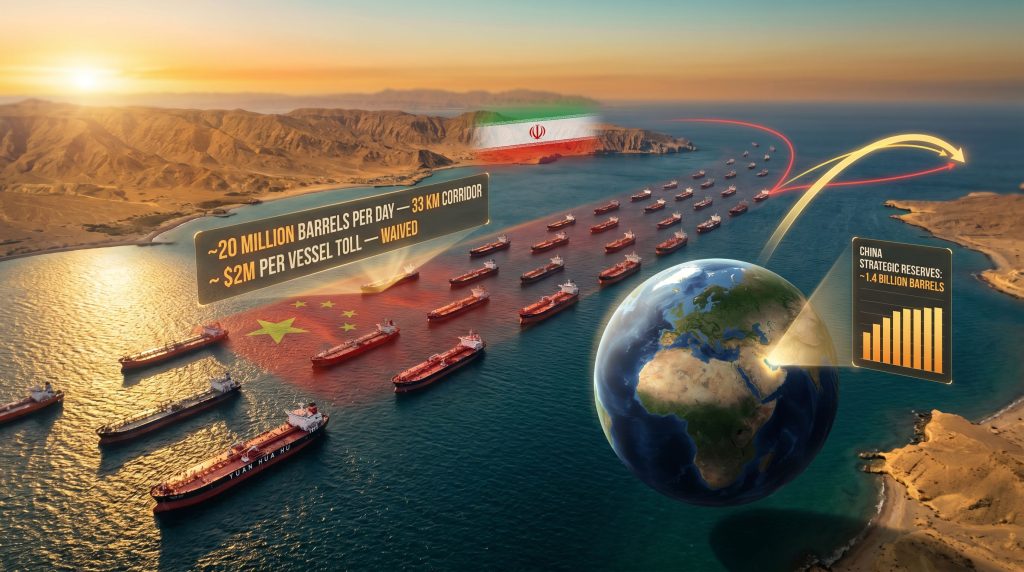
Few geographic features carry the economic weight of the Strait of Hormuz. At its narrowest point, the waterway spans roughly 33 kilometres, yet under normal operating conditions it channels approximately 20 to 21 million barrels of crude oil and refined products per day, representing close to one-fifth of total global oil consumption flowing through a single navigable corridor.
The downstream dependency on this passage is heavily concentrated across Asia. Japan, South Korea, India, and China collectively account for the overwhelming share of Hormuz-transiting crude, with each nation's industrial base structurally reliant on Persian Gulf supply chains that have no cost-equivalent alternative.
Unlike the Suez Canal, which allows for rerouting via the Cape of Good Hope at significant additional cost and transit time, the Persian Gulf has no pipeline infrastructure capable of substituting for tanker volumes at comparable scale. The waterway is not merely important. It is, for practical purposes, irreplaceable.
Chinese Tankers in the Strait of Hormuz: What Is Actually Happening
The 30-Vessel Authorisation and the IRGC's New Role
Iranian state media confirmed that approximately 30 Chinese-flagged and China-linked vessels received coordinated authorisation to transit the strait, with passage facilitated directly through the Islamic Revolutionary Guard Corps (IRGC) naval command. The semi-official Fars news agency cited a knowledgeable source confirming that transit was granted following an understanding over Iranian management protocols for the waterway, as reported by Reuters.
The IRGC framed this arrangement in explicitly institutional terms, with an IRGC naval official stating through Bloomberg that a new chapter in Hormuz management had begun, and that coordination with IRGC naval forces represents the most efficient and reliable pathway for all future transits. This is not the language of a temporary accommodation. It is the language of a new administrative norm.
The Yuan Hua Hu: A Case Study in Coordinated Dark-Mode Transit
The mechanics of this new transit framework were most clearly illustrated by the Yuan Hua Hu, a Cosco Shipping-operated supertanker carrying approximately 2 million barrels of Iraqi crude, which became the third Chinese state-owned vessel to exit the Gulf since the conflict began. According to ABC News reporting, Lloyd's List Intelligence tracking data confirmed the vessel traversed the northern IRGC-controlled corridor.
What makes this transit analytically significant is the transponder pattern. Ship trackers recorded the vessel deactivating its transponder while departing a Dubai anchorage toward Larak Island, briefly reactivating for a short window, then going dark again. This is not routine operational behaviour. It is the signature of a coordinated concealment strategy designed to reduce exposure during the most sensitive segments of the crossing.
Critically, the Yuan Hua Hu transited without paying the toll that applies to vessels crossing through the Larak corridor. Brokers estimate that crossing fee at approximately $2 million per vessel. The toll waiver was not incidental. It was the direct commercial consequence of bilateral diplomatic engagement, representing real financial value that non-aligned operators cannot access.
Other China-Linked Vessels Navigating the Access Divide
The broader pattern of Chinese and China-linked transit reveals a tiered system operating below the level of formal announcement:
- The AVA 6, a Hong Kong-flagged tanker, completed a transit over a 10-hour window departing from a UAE port and anchoring near Sohar Port in Oman
- The Rich Starry, a US-sanctioned tanker carrying approximately 250,000 barrels of methanol loaded from the UAE's Hamriyah port with a Chinese crew, became the first sanctioned vessel to exit the Gulf since the disruption began
- The Murlikishan (formerly MKA), a second US-sanctioned vessel with a documented record of transporting Russian and Iranian crude, was tracked heading into the strait to load fuel oil from Iraq
The cargo profiles here are worth noting. Methanol and fuel oil transits alongside crude reflect the breadth of supply chain pressure that the Hormuz disruption has created across multiple product categories, not just benchmark crude.
How US-China Diplomatic Alignment Created the Conditions for Transit
The Trump-Xi Agreement on Freedom of Navigation
The diplomatic scaffolding that enabled Chinese tanker transit was constructed at the highest levels of bilateral engagement. During President Trump's state visit to China, both governments reached a formal understanding that no sovereign power or armed force should be permitted to impose transit fees on vessels passing through internationally recognised maritime corridors.
US State Department spokesperson Tommy Pigott publicly confirmed that Washington and Beijing had reached agreement that no country or organisation should be permitted to charge tolls for passage through international waterways including the Strait of Hormuz, according to Reuters reporting from May 12, 2026. Al Jazeera's coverage of the Trump-Xi discussions confirms this statement established the principled framework that Beijing could then leverage in its direct engagement with Tehran.
China's Bilateral Pressure on Tehran
The principle-level agreement with Washington gave Beijing political cover. The operational outcome required a separate track of engagement with Iran. China's foreign minister and Beijing's ambassador to Tehran both made formal requests for the facilitation of Chinese commercial vessel transit.
Iran's agreement was framed around preserving the strategic depth of the China-Iran partnership, a relationship anchored by China's longstanding role as Iran's most significant crude oil customer. This dual-track approach, however, is one that most nations simply cannot replicate.
This dual-track approach — aligning with Washington on principle while engaging Tehran on operational terms — represents a form of energy statecraft that most nations cannot replicate. It requires deep, simultaneously maintained relationships with parties that are in active conflict with each other.
The IRGC's Managed Access System and What It Means for Non-Chinese Shipping
From Blockade Enforcement to Gatekeeping Authority
The IRGC's public declarations surrounding Chinese tanker passage reveal an important structural evolution. The shift is from outright closure or unpredictable interdiction toward a managed access model that extracts value — whether financial or geopolitical — without triggering the full economic consequences of a complete Hormuz shutdown.
This distinction matters enormously for global shipping risk calculation. A complete closure is a crisis that forces multilateral intervention. A managed access system, in contrast, is a new normal that different parties adapt to differently, depending on their geopolitical positioning.
| Vessel Category | Transit Status | Toll Exposure | Coordination Framework |
|---|---|---|---|
| Chinese state-owned tankers | Active, coordinated | Waived (~$2M/vessel) | IRGC + bilateral diplomacy |
| China-linked / Hong Kong-flagged | Active, case-by-case | Unclear | Partial coordination |
| US-sanctioned Chinese vessels | Active, limited | Unclear | Unilateral dark-mode |
| India-bound LPG tankers | Active, dark mode | Unknown | Minimal |
| Western / European commercial | Severely restricted | Full toll or blocked | None confirmed |
The Differential Risk Calculus for Asian Importers
Japanese and South Korean operators face a uniquely difficult position. Both nations are formal US treaty allies, creating friction with any arrangement that would require direct coordination with IRGC naval forces. Their inability to replicate the Chinese diplomatic framework means their vessels face fundamentally different transit terms despite being equally dependent on Persian Gulf energy.
Indian-flagged and India-bound vessels occupy an ambiguous middle ground, with reporting indicating that LPG tankers have been transiting in dark mode, suggesting informal workarounds rather than formal coordination. European commercial operators face the highest barrier of all, with no comparable bilateral framework available and no diplomatic pathway currently confirmed.
China's Oil Dependency and the Economic Pressure Behind the Push for Transit
Strategic Reserves as a Finite Buffer
China draws the overwhelming share of its crude oil imports from the Middle East, making Persian Gulf supply lanes structurally critical to its industrial economy. The country has reportedly accumulated strategic crude reserves estimated at approximately 1.4 billion barrels, a stockpile that has provided meaningful short-term insulation from the worst of the current supply disruption.
However, strategic reserves function as a time-buying instrument, not a structural solution. They absorb the initial shock of supply disruption and prevent immediate economic crisis, but they cannot substitute for restored commercial flows over any medium-term horizon. The longer the Hormuz disruption persists, the more Beijing's reserve buffer erodes, and the more urgent the commercial case for restored transit becomes.
Teapot Refiners Under Pressure
One of the clearest signals of supply chain stress within China's domestic energy system comes from its independent refining sector. China's so-called teapot refiners — smaller privately operated facilities that process significant volumes of discounted crude on thin operating margins — have been forced to cut output as the Hormuz crisis compresses their economics.
These operators lack the balance sheet resilience of state-owned majors and are typically the first to reduce throughput when feedstock costs escalate. Consequently, output reductions at the teapot level translate directly into downstream fuel availability constraints and price escalation across Chinese industrial supply chains, creating a feedback loop from Persian Gulf disruption to domestic manufacturing cost pressures.
Brazil as a Costly Alternative and the Consumption Outlook
Brazil's crude oil exports to China reportedly doubled as Beijing sought to partially offset Persian Gulf supply losses with Atlantic Basin alternatives, according to OilPrice.com reporting. The substitution is physically possible but economically punishing. Transportation distances from Brazilian offshore fields to Chinese refineries are substantially greater than Gulf-to-China routes, and the crude quality profiles differ in ways that require refinery configuration adjustments.
Against this backdrop, analysts are projecting that China's gasoline consumption could contract by as much as 5.5% in 2026 if sustained elevated oil prices persist. This is a demand destruction signal of considerable magnitude, one that would have cascading implications for global commodity markets, particularly given China's scale as the world's largest oil importer.
The next major ASX story will hit our subscribers first
Broader Market and Geopolitical Consequences
Oil Prices, OPEC Output, and the IEA's Revised Outlook
WTI crude prices have climbed to above $101 per barrel and Brent to approximately $106 per barrel, reflecting persistent uncertainty about the durability of Chinese transit arrangements and the status of broader shipping access. Understanding OPEC's global influence is essential here, as a Reuters survey has found OPEC oil output has reached a 26-year low amid the Iran conflict, a supply compression that makes every incremental Hormuz transit development acutely price-sensitive.
The IEA has separately revised its 2026 forecasts to reflect a widening oil deficit as Iranian production losses outpace any offsetting increases from other OPEC members.
Russia's Structural Windfall
Perhaps the most consequential secondary effect of the Hormuz situation is the financial windfall accruing to Russia. Elevated global oil prices driven by Persian Gulf supply constraints have generated an estimated $6.3 billion surge in Russian oil revenues, even as production volumes face their own pressures from sanctions and infrastructure constraints.
This creates a structural misalignment of interests: Russia benefits commercially from every day that the Hormuz situation remains unresolved, while the US-China diplomatic effort aims at precisely the opposite outcome.
The Emerging Bifurcation of Global Oil Markets
The Chinese transit arrangement has established a visible precedent: geopolitical alignment with Iran's IRGC, even in partial or informal terms, can secure preferential energy market access that Western-aligned nations cannot obtain through any currently available framework. The broader geopolitical trade tensions shaping global energy flows have made this access divide more pronounced than at any point in recent history.
Furthermore, the US-China trade war has paradoxically created conditions where both powers can align on a narrow maritime principle while competing across virtually every other dimension of global commerce. The long-term consequence may be the acceleration of pricing differentials between supply corridors accessible to geopolitically aligned nations and those available to non-aligned or Western-allied operators.
The 1973 oil embargo demonstrated how quickly energy access can become a geopolitical instrument. The current Hormuz situation suggests the architecture for a more permanent and structurally embedded version of that dynamic may already be forming.
Scenarios for What Comes Next
Four Pathways Forward
-
Bilateral Expansion (near-term most likely): Other major Asian importers, particularly Japan, South Korea, and India, attempt to negotiate their own coordination frameworks with Tehran modelled on the Chinese precedent. Transit volumes increase gradually but remain subject to IRGC gatekeeping authority.
-
US-Iran Diplomatic Resolution (transformative but uncertain): A formal ceasefire or negotiated settlement removes the underlying conflict driver and restores multilateral freedom of navigation. Oil prices would experience a sharp downward correction from current elevated levels.
-
Entrenched Managed Access (structurally destabilising): The IRGC coordination and toll system becomes institutionally embedded, with geopolitically aligned nations accessing preferential transit terms and Western-allied shipping facing persistent barriers. In addition, the trade war impact on oil markets would amplify the fragmentation, with global oil markets splitting along political lines with sustained and widening price premiums.
-
Escalation and Full Closure (tail risk): A breakdown in US-Iran diplomatic engagement triggers renewed military confrontation and complete closure. At 20-plus million barrels per day of throughput, a sustained two-week closure would represent the most severe energy supply shock in modern market history.
FAQ: Chinese Tankers and the Strait of Hormuz
How many Chinese vessels have been granted passage through the Strait of Hormuz?
Iranian state media reported that approximately 30 Chinese vessels have been granted coordinated passage, with the IRGC's naval forces facilitating transit under a newly declared management protocol.
Did Chinese tankers pay the Hormuz transit toll?
The Yuan Hua Hu, operated by Cosco Shipping, transited without paying the toll. Brokers estimate the average Larak corridor toll at approximately $2 million per vessel crossing.
Why can Chinese tankers transit when others cannot?
China secured access through a combination of high-level bilateral diplomacy with Tehran, formal requests by its foreign minister and ambassador to Iran, and a broader US-China agreement opposing transit tolls in international waterways.
How much oil does China hold in strategic reserves?
China is estimated to hold approximately 1.4 billion barrels in strategic crude oil stockpiles, providing short-term buffer capacity against Persian Gulf supply disruption.
What is the IRGC's role in Hormuz transit?
The IRGC has positioned itself as the de facto coordination authority for strait transit, framing direct coordination with its naval forces as the standard protocol for all future vessel passage.
What happens to non-Chinese vessels?
Western and non-aligned commercial operators face significantly higher barriers, including potential toll demands of approximately $2 million per crossing, transit denial, or the requirement to operate in dark mode without formal coordination or protections.
This article is intended for informational purposes only and does not constitute financial or investment advice. Forecasts and projections cited reflect analyst estimates at the time of publication and are subject to change. Readers should conduct their own due diligence before making any decisions based on the information presented.
Want to Stay Ahead of the Commodity Shifts Driving ASX Mineral Discoveries?
Geopolitical disruptions like the Hormuz crisis reshape global commodity markets and energy supply chains in ways that can create significant opportunities for investors in ASX-listed resource companies — and Discovery Alert's proprietary Discovery IQ model delivers real-time alerts the moment significant mineral discoveries hit the exchange, turning complex market signals into actionable insights. Explore how historic discoveries have generated substantial returns by visiting Discovery Alert's dedicated discoveries page, and begin your 14-day free trial today to position yourself ahead of the broader market.