June 15, 2026
The Dual-Use Mineral Reshaping North Africa's Strategic Calculus
Few commodities occupy as complex a position in the global resource landscape as phosphate. It feeds the world through fertilisers, and it is increasingly powering the energy transition through lithium iron phosphate battery chemistry. Yet despite holding one of the planet's most significant concentrations of this mineral, Tunisia has spent more than a decade watching its production capacity erode while global demand accelerated. The question now is whether the Tunisia phosphate revival in Gafsa represents a genuine structural turning point or another false dawn in a sector defined by unrealised potential.
Understanding why this matters requires stepping back from the immediate headlines and examining the geological and geopolitical forces converging on the Gafsa basin simultaneously.
When big ASX news breaks, our subscribers know first
Why Phosphate Has Become a Critical Mineral, Not Just a Commodity
Phosphate's traditional identity as an agricultural input is being rapidly supplemented by its role in the clean energy economy. Lithium iron phosphate, commonly abbreviated as LFP, has emerged as a dominant battery chemistry in electric vehicles and grid-scale energy storage, chosen for its thermal stability, cycle longevity, and lower cost profile compared to nickel-manganese-cobalt alternatives.
This dual-use demand profile is why Western governments and supply chain strategists increasingly classify phosphate alongside lithium and cobalt as a material warranting strategic attention. Furthermore, the fertiliser dimension alone is significant: phosphate-based inputs underpin a substantial share of global agricultural productivity, and supply disruptions transmit directly into food price volatility. The broader picture of critical minerals demand reinforces just how strategically sensitive these supply chains have become.
Against this backdrop, Tunisia's reserve position is genuinely formidable:
- The Gafsa basin holds over 800 million tonnes of active mining reserves
- The northern Sra Ouertane deposit carries an estimated 5 billion tonnes of raw phosphate rock, with a feasibility study currently underway
- Tunisia possesses more than 130 years of phosphate mining heritage and over 70 years of downstream transformation expertise, including phosphoric acid and fertiliser production
- The sector contributes approximately 2% of Tunisia's GDP, a figure that understates its multiplier effects across employment, transport, and industrial linkages in interior regions
Global phosphate reserves reached a pricing peak of approximately $350 per tonne in 2023, driven partly by disrupted Russian export flows following the conflict in Ukraine, reinforcing the commodity's strategic sensitivity to geopolitical shocks.
A Decade of Contraction: Mapping the Production Collapse
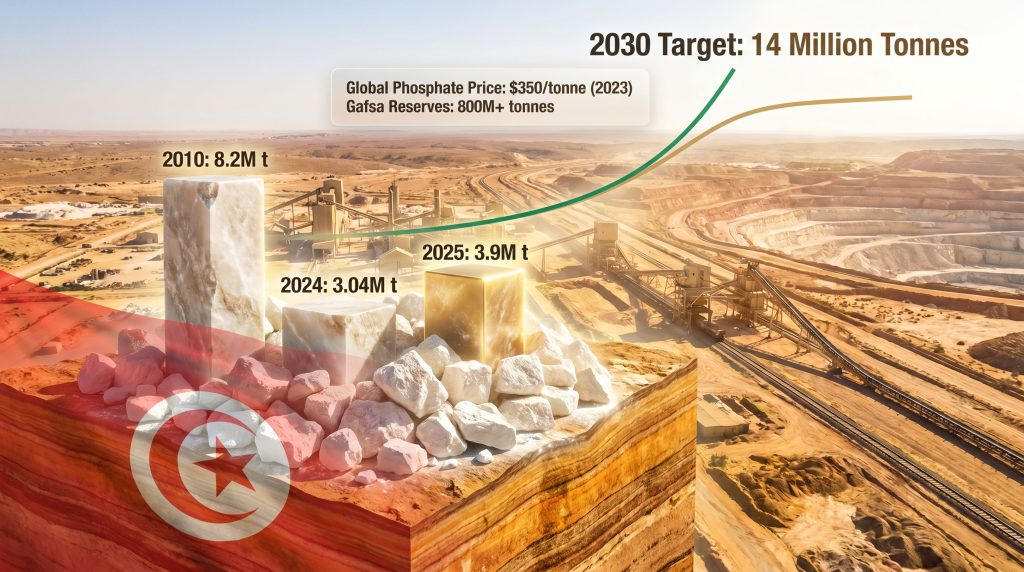
Tunisia's phosphate story over the past fifteen years is fundamentally one of squandered potential. At its 2010 peak, the country produced approximately 8.1 to 8.2 million tonnes annually, placing it among the world's top five producers. By 2023 and 2024, output had contracted to between 3.0 and 3.6 million tonnes — a decline of more than 60% from peak levels.
The primary inflection point was the 2011 Tunisian Revolution, which unleashed longstanding social grievances concentrated in the Gafsa mining basin and fundamentally disrupted the political economy of phosphate extraction. What followed was not a single crisis but a compounding sequence of structural deteriorations:
| Year | Production (Million Tonnes) | Key Context |
|---|---|---|
| 2010 | 8.1 to 8.2 | Pre-revolution peak; top-five global ranking |
| 2023 | 3.04 to 3.6 | Post-revolution low; social unrest primary driver |
| 2024 | 3.03 to 3.04 | Marginal stabilisation; early recovery signals |
| 2025 | 3.9 | Confirmed rebound; CPG director general figures |
| 2030 Target | 14.0 | National five-year plan objective |
Chronic capital deferral since approximately 2014 compounded the social disruption problem significantly. Extraction equipment, processing infrastructure, and rail transport networks have all entered states of advanced deterioration without coherent renewal programmes in place. Two washing plants in Redeyef and Moularès have remained idle since 2021, representing an estimated 400,000 tonnes of annually recoverable output that could theoretically be reactivated at relatively modest capital cost.
The Mezzouna processing plant under the Tunisian Chemical Group (GCT) also remains closed, adding further drag to system capacity. CPG Director General Abdelkader Amidi acknowledged in parliamentary testimony that loan tranches mobilised in recent years have not delivered the expected operational improvements, citing aging equipment and the absence of a coherent rail wagon renewal programme as primary constraints on performance.
According to reporting on Tunisia's phosphate rebound, the 2025 output of 3.9 million tonnes represents approximately a 28% year-on-year increase over 2024 levels and confirms that the sector has stabilised. However, the analytical challenge is distinguishing genuine structural recovery from a cyclical rebound off an abnormally depressed base.
The Architecture of Tunisia's 2025 to 2030 Recovery Plan
Tunisia's national phosphate strategy targets 14 million tonnes of annual output by 2030, more than tripling current production and nearly doubling the 2010 peak. The ambition is significant; the execution pathway is where complexity accumulates.
Core Strategic Pillars
The recovery plan rests on three intersecting priorities:
- Extraction modernisation across active mining zones in the Gafsa basin
- Processing infrastructure upgrades, with particular emphasis on the Gabès and Mdhilla corridors
- Railway rehabilitation to address the transport bottleneck that limits throughput from mine to processing facility and export port
An additional technical dimension involves integrating treated wastewater into phosphate washing operations, targeting the sector's intensive water consumption rate of approximately 1.5 cubic metres per tonne produced. In a region already under severe water stress, this innovation is not merely an environmental gesture but an operational necessity.
Financing Commitments
The broader infrastructure renovation programme carries an estimated cost of approximately 500 million Tunisian dinars, equivalent to roughly USD $171 million, drawing on committed financing from multiple multilateral and bilateral sources.
| Financing Source | Instrument | Value | Status |
|---|---|---|---|
| Arab Fund for Economic and Social Development | Loan (rail component) | 16 million Kuwaiti dinars (~USD $52 million) | Approved April 2026 |
| Saudi Fund for Development | Committed financing | Part of total programme | Committed 2024 |
| Kuwait Fund for Arab Economic Development | Committed financing | Part of total programme | Committed 2025 |
The gap between financing commitments and operational outcomes is the critical variable. Amidi's own parliamentary disclosure that prior loans have not produced commensurate improvements is a significant credibility constraint that investors and analysts should weigh carefully when assessing recovery timelines.
Private Capital Entering the Sector
Perhaps the most structurally significant recent development is the entry of private capital into Tunisian phosphate exploration for the first time in over a decade. Australian company PhosCo announced in May 2026 the identification of two new phosphate deposits at its Gasaat project, lifting total estimated resources to 166.6 million tonnes grading 20.6% phosphorus pentoxide (P2O5). PhosCo has raised A$5 million (approximately USD $3.5 million) to advance Gasaat toward development, with a preliminary 2022 assessment projecting annual output potential of 1.5 million tonnes over a 46-year mine life.
The Oum Lakhcheb project adds further development potential, with projected annual capacity of 2.4 million tonnes, representing a material addition to national output capacity if brought online within the planning horizon.
The 20.6% P2O5 grade at Gasaat warrants attention from a technical standpoint. In phosphate mining, P2O5 (phosphorus pentoxide) content is the primary quality benchmark, with commercial operations typically viable above approximately 18% and increasingly attractive above 20%. The Gasaat deposit sits at the higher end of commercially competitive grades, which has implications for processing economics and product marketability in global fertiliser supply chains. For context, comparably positioned projects such as the Ammaroo phosphate project in Australia illustrate how high-grade deposits are attracting renewed investor interest globally.
The Fault Lines That Could Derail Recovery
The Gafsa Social Contract Deficit
The Gafsa mining basin uprising of 2008 is not merely a historical footnote. It represents the foundational expression of grievances that have structurally constrained Tunisian phosphate production ever since. Driven by demands for equitable employment distribution, local revenue sharing, and social justice in one of the country's poorest and highest-unemployment regions, the 2008 movement was suppressed under the Ben Ali regime but is widely acknowledged as a precursor to the 2011 revolution itself.
This history establishes a direct causal link between phosphate sector governance and national political stability. Consequently, the sector cannot be managed as a purely technical or financial challenge when its operating context is embedded in one of Tunisia's deepest political fault lines.
The practical financial dimension is severe. In 2019, then-Industry and Energy Minister Slim Feriani indicated that protest-related disruptions were costing CPG approximately USD $1 billion annually, a figure that contextualises the extraordinary depth of the sector's financial erosion over the post-revolution decade. The state company's practice of absorbing excess workers into its payroll as a social stabilisation mechanism continues to suppress unemployment statistics in Gafsa while simultaneously undermining CPG's cost structure and financial viability.
In May 2026, workers at CPG launched a strike across Mdhilla and Métlaoui, subsequently spreading to Redeyef and Moularès. The immediate trigger was a dispute over the Eid al-Adha bonus payment. The episode illustrates a crucial insight: in the Gafsa context, seemingly routine labour grievances carry systemic risk because they draw on a reservoir of structural discontent that neither employment programmes nor production targets have resolved.
The cost of social peace in Gafsa is embedded directly into CPG's operating cost structure. Improving financial performance while simultaneously expanding genuine employment opportunities under fiscal constraint represents one of the most difficult concurrent challenges in North African resource governance.
Environmental Constraints and Community Opposition
The environmental dimension adds a second layer of structural risk. Phosphate processing generates phosphogypsum, an industrial waste product with significant management challenges. In Gabès, decades of toxic industrial discharge have affected both air quality and coastal marine ecosystems, with active community protests demanding remediation. This legacy creates a political environment in which processing expansion proposals face organised local opposition that can translate into production delays.
The water intensity figure of 1.5 cubic metres per tonne produced is operationally significant in a water-scarce region. Processing expansion without credible water management solutions risks intensifying both environmental impact and community opposition simultaneously.
Infrastructure and Capital Execution Gaps
The third risk layer is arguably the most tractable but still unresolved. Aging extraction and rail equipment, the absence of a coherent wagon renewal programme, and the persistent gap between financing commitments and actual capital deployment collectively constrain the pace at which the recovery plan can translate into production gains. These challenges are further compounded by export control risks emerging from competing producer nations, which add external pressure on global phosphate supply chains. The idle capacity at Redeyef, Moularès, and Mezzouna represents the most immediately accessible lever for output improvement, yet it remains unactivated.
Scenario Pathways to 2030: What Recovery Could Actually Look Like
Given the structural complexity described above, three plausible production trajectories emerge for Tunisia's phosphate revival in Gafsa over the five-year horizon.
| Scenario | 2030 Output Range | Key Conditions |
|---|---|---|
| A: Accelerated Recovery | 8 to 10 million tonnes | Infrastructure on schedule; social compact formalised; private projects reach milestones |
| B: Constrained Recovery | 5 to 7 million tonnes | Partial implementation; manageable disruptions; private projects delayed |
| C: Structural Stagnation | 3.5 to 4.5 million tonnes | Renewed unrest; environmental opposition; capital absorbed by operating costs |
Scenario B represents the most analytically defensible base case given current conditions. The 14 million tonne target requires a pace of expansion with no precedent in post-revolution Tunisia. The 2010 peak of 8.2 million tonnes would itself represent a historically significant achievement if reached within the current planning horizon.
The probability weighting across these scenarios is heavily influenced by two variables: the government's capacity to establish a durable social contract with Gafsa communities, and the speed at which idle processing capacity is reactivated. Neither variable is currently resolved.
The next major ASX story will hit our subscribers first
Tunisia's Position in the Global Phosphate Hierarchy
| Metric | Tunisia (Gafsa) | Morocco (OCP Group) | China |
|---|---|---|---|
| Reserve Scale | 800M+ tonnes active; 5B tonnes Sra Ouertane | World's largest (~70% of global reserves) | Significant but declining grade |
| 2024 Production | 3.0 to 3.9 million tonnes | 40+ million tonnes | ~100 million tonnes |
| Primary Challenge | Social unrest, infrastructure decay | Water, expansion capital | Grade decline, export controls |
| Recovery Trajectory | Gradual rebound | Continued expansion | Stable |
Morocco's OCP Group, operating at a scale approximately ten times Tunisia's current output, demonstrates what sustained institutional investment in phosphate infrastructure can achieve. Tunisia's reserve base, while smaller than Morocco's, is substantial enough to support a significantly larger production profile than current levels suggest. The gap between geological endowment and operational performance is precisely where the recovery opportunity lies and where the structural risks concentrate.
The Macroeconomic Stakes of Getting This Right
Tunisia's phosphate sector and its downstream derivatives, particularly phosphoric acid and compound fertilisers produced by the Tunisian Chemical Group (GCT), represent a critical source of foreign currency earnings for an economy operating under sustained fiscal pressure. The sector's 2% GDP contribution understates its actual economic weight when employment multipliers across the transport sector, industrial supply chains, and interior region economies are included.
Gafsa itself is one of Tunisia's highest-unemployment regions, with limited alternative economic activity. The phosphate sector's performance directly determines the economic viability of entire communities in ways that make the social stabilisation challenge inseparable from the production recovery objective.
The emerging LFP battery demand signal adds a longer-term dimension to this calculus. As battery storage expansion accelerates globally, the secondary demand curve for phosphate beyond traditional fertiliser markets is growing. Tunisia's reserve base therefore carries dual-use strategic value that could attract categories of international investment interest not previously active in the sector. The Tunisia phosphate revival in Gafsa, if successfully executed, positions the country to benefit from both the agricultural and clean energy dimensions of this structural demand shift.
Disclaimer: This article contains forward-looking statements, scenario projections, and financial analysis based on publicly available information as of the date of publication. Production targets, financing outcomes, and scenario probabilities described herein are not guaranteed and are subject to significant uncertainty. Readers should not treat any content in this article as investment advice. Independent financial and geological due diligence is recommended before making any investment decisions related to the Tunisian phosphate sector or associated companies.
Want to Capitalise on the Next Major Mineral Discovery Before the Market Moves?
Discovery Alert's proprietary Discovery IQ model delivers real-time alerts on significant ASX mineral discoveries — transforming complex resource data into actionable investment insights for both short-term traders and long-term investors. Explore how historic discoveries have generated substantial returns on Discovery Alert's dedicated discoveries page, and begin your 14-day free trial today to position yourself ahead of the market.