May 15, 2026
When a Prairie Province Rewrites the Rules of Global Resource Security
The global mining industry is entering a period unlike any in its modern history. Supply chain fragmentation, the accelerating clean energy transition, and growing geopolitical rivalry over mineral access have collectively elevated the strategic importance of stable, high-output jurisdictions to levels not seen since the Cold War-era scramble for strategic metals. Against this backdrop, investors and policymakers are no longer evaluating mining regions purely on production volume. They are scrutinising jurisdictional depth: how many minerals does a region hold, how reliably can it deliver them, and how insulated is it from political disruption?
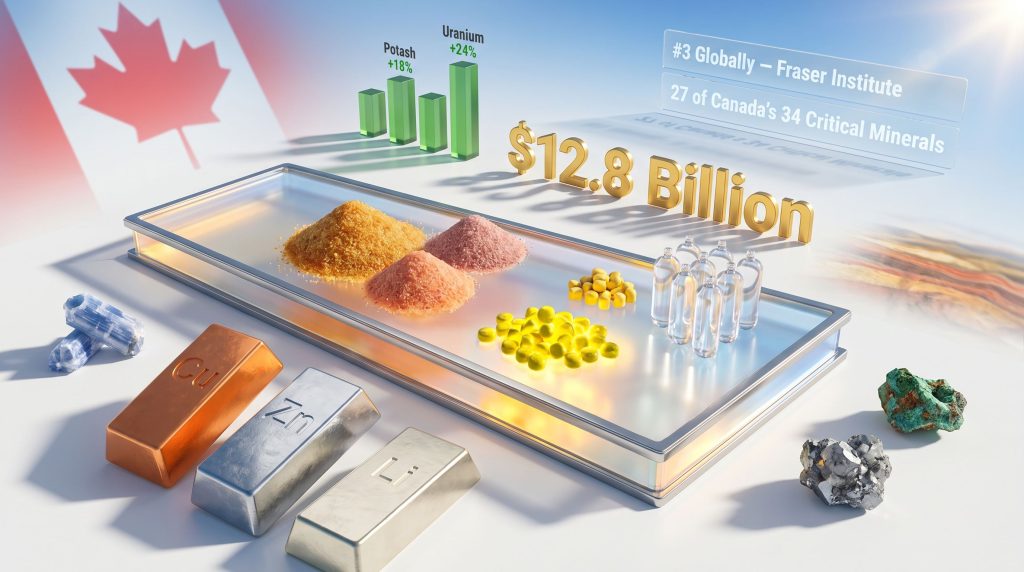
These questions are reshaping capital flows, and one jurisdiction is increasingly capturing the attention of resource analysts, institutional investors, and sovereign supply chain planners alike. Saskatchewan, Canada's prairie province more commonly associated with wheat fields than underground mining operations, recorded more than $12.8 billion in total mineral sales in 2025, a new industry record confirmed by the province's Energy and Resources Minister, Chris Beaudry, in May 2026. Potash sales climbed 18% year-over-year, while uranium surged 24%, both hitting records within a single reporting period.
But the headline figure alone understates the structural shift underway. What is materialising in Saskatchewan is not a commodity price windfall. It is the culmination of years of geological discovery, strategic investment in infrastructure, and deliberate policy architecture converging at precisely the moment critical minerals demand is accelerating fastest.
When big ASX news breaks, our subscribers know first
The Geological Foundation: Why Saskatchewan's Mineral Portfolio Is Structurally Unique
Most major mining jurisdictions are built around one or two dominant commodities. Western Australia is synonymous with iron ore and gold. Chile is copper and lithium. The Democratic Republic of Congo remains the world's dominant cobalt source. Saskatchewan defies this pattern entirely.
The province hosts 27 of Canada's 34 federally designated critical minerals within its operational and development portfolio, representing approximately 79% of the national critical minerals list concentrated within a single jurisdiction. This is not a coincidence of geography. It reflects the exceptional diversity of Saskatchewan's geological formations, which span ancient Precambrian Shield exposures, Athabasca Basin sandstone sequences hosting ultra-high-grade uranium mineralisation, and extensive Devonian-age potash-bearing evaporite sequences at depths accessible to conventional shaft mining.
The Athabasca Basin: A Class of Its Own
The Athabasca Basin in northern Saskatchewan represents arguably the most strategically significant uranium district on Earth. Uranium deposits in this region routinely exceed grades of 10% U₃O₈, with some historical intersections at the McArthur River and Cigar Lake operations recording grades exceeding 20% U₃O₈ in discrete zones. For context, global uranium reserves outside the Athabasca Basin typically operate at grades ranging from 0.02% to 0.15% U₃O₈, meaning Athabasca deposits can be 100 times richer than the global average.
This grade differential matters enormously from an economic standpoint. Higher-grade deposits translate into lower tonnes of material mined per unit of uranium produced, compressing operating costs, reducing surface disturbance, and improving capital efficiency relative to lower-grade global competitors. It is this structural cost advantage that allows Saskatchewan uranium producers to remain economically viable across a wider range of spot price environments than producers operating lower-grade deposits in Kazakhstan, Australia, or Namibia.
Saskatchewan's uranium deposits are not merely higher grade than the global average. In some cases, the grade differential is so extreme that direct comparison to most other uranium-producing regions is almost misleading. The Athabasca Basin occupies a tier of its own in global uranium economics.
Saskatchewan's status as the world's second-largest uranium-producing jurisdiction reflects this geological endowment, and uranium sales have now exceeded the province's own 2030 growth targets by more than 50% in consecutive years. This is a remarkable data point that deserves careful unpacking. When a jurisdiction surpasses decade-long targets in back-to-back years by such margins, it signals either conservative target-setting, faster-than-anticipated market adoption, or both. In uranium's case, the answer is almost certainly the latter: the global nuclear energy renaissance has accelerated demand beyond what most strategic planning scenarios projected just three to four years ago. Furthermore, current uranium market trends suggest this momentum is unlikely to reverse in the near term.
Potash: Saskatchewan's Role in Global Food Security Cannot Be Overstated
While uranium captures the headlines in the context of clean energy, Saskatchewan's potash endowment represents a different but equally strategic form of supply security: food. Potash is one of three primary macronutrients essential to crop production, and Saskatchewan sits atop some of the world's most commercially viable potash reserves, with the province controlling a substantial share of global potash production capacity.
The 2025 figures showing an 18% year-over-year increase in potash sales reflect both volume expansion and favourable pricing, driven by ongoing recovery in agricultural commodity markets and continued global population growth requiring higher crop yields per hectare of arable land. The Bethune potash mine, operated by K+S Potash Canada in southern Saskatchewan, exemplifies the infrastructure maturity supporting this output, with established mine-to-market logistics networks linking prairie production to international export terminals.
What makes Saskatchewan's potash position strategically distinctive is not merely scale, but the combination of reserve quality, infrastructure connectivity, and political stability. Major competing potash-producing regions face varying degrees of geopolitical exposure, infrastructure constraints, or reserve quality limitations that Saskatchewan does not share. For food-importing nations seeking reliable fertiliser supply chain security, Saskatchewan's mineral output represents a genuinely differentiated sourcing option.
2026 and the Three-Commodity Expansion: Copper, Zinc, and Lithium
Perhaps the most consequential development within Saskatchewan's critical minerals trajectory is not what is already being produced, but what is scheduled to enter production within the near term. The province has confirmed that copper, zinc, and lithium are all on track to achieve commercial production by late 2026, representing a simultaneous three-commodity expansion that is extraordinary by historical standards.
Most resource jurisdictions manage portfolio expansion sequentially, with each new commodity development proceeding through distinct feasibility, permitting, and construction phases separated by years of timeline. The compression of three separate commodity streams into a single production window suggests a convergence of pre-developed project pipelines, favourable capital market conditions during earlier development phases, and permitting efficiency within the provincial regulatory framework.
Why the Copper-Zinc-Lithium Triad Matters Strategically
The three commodities entering Saskatchewan's production portfolio are not arbitrary additions. They collectively address the primary mineral inputs driving electrification infrastructure globally:
-
Copper serves as the foundational conductive material in EV charging networks, grid transmission upgrades, and renewable energy installations. The anticipated copper supply crunch consistently places copper among the most supply-constrained metals of the next decade relative to required electrification infrastructure buildout.
-
Zinc performs both industrial functions (galvanisation, corrosion protection in construction) and emerging battery-grade applications, particularly in zinc-air battery chemistries gaining traction as alternatives to lithium-ion systems for grid-scale energy storage applications.
-
Lithium remains the central input for lithium-ion battery cathode and electrolyte chemistry, and North American supply chain localisation efforts driven by policy dynamics in the United States and Canada have created premium incentives for domestically sourced lithium supply that Saskatchewan producers are positioned to access.
The simultaneous entry of all three into Saskatchewan's production portfolio by late 2026 would reduce the province's revenue concentration risk meaningfully, complementing the established potash and uranium base with three electrification-critical commodities at precisely the point where demand acceleration is most pronounced.
Helium and Rare Earths: The Frontier Commodities Reshaping Saskatchewan's Value Proposition
Helium: Strategic Scarcity in an Industrial Context
Saskatchewan is already Canada's largest helium producer, and the province's Helium Action Plan targets capturing 10% of global helium supply by 2030. This is an ambitious objective that, if achieved, would represent a significant reorientation of global helium supply geography.
Helium's strategic importance is frequently underappreciated by generalist investors. Unlike most industrial gases, helium cannot be synthesised or substituted in its primary end-use applications. MRI cooling systems require liquid helium at temperatures approaching absolute zero. Semiconductor fabrication processes use helium as a carrier gas and cooling medium. Fibre optic cable manufacturing requires helium for internal atmosphere control during the draw process. In each case, there is no economically viable alternative.
Helium is also a finite, non-renewable resource extracted as a byproduct of natural gas production from specific geological formations where radioactive decay has generated accumulated helium concentrations over geological time. Saskatchewan's geology, particularly within its conventional gas-producing formations, contains commercially meaningful helium concentrations that are attracting dedicated extraction investment.
Rare Earth Processing: From Raw Exporter to Value-Added Node
Perhaps the most strategically significant long-term development within the Saskatchewan critical minerals powerhouse landscape is the development of North America's first minerals-to-metals rare earth processing facility within the province. This development is transformative in a way that raw production statistics cannot fully capture.
The global rare earth supply chain has historically been characterised by a profound asymmetry: most mining of rare earth elements occurs outside China, but the overwhelming majority of rare earth processing and refining occurs within China, which controls an estimated 85–90% of global rare earth separation and processing capacity. This means that raw rare earth ore extracted from mines in Canada, Australia, or the United States has typically been shipped to China for processing before re-entering global supply chains as refined materials, creating a structural dependency that persists even when upstream mining is domestically controlled.
By developing domestic processing infrastructure, Saskatchewan is positioning itself not merely as a raw materials exporter but as a value-added supply chain node capable of delivering processed rare earth materials directly to magnet manufacturers, EV motor producers, wind turbine component suppliers, and defence electronics integrators. The economic capture from this processing step is substantially higher than raw ore revenues, and the strategic value to downstream manufacturers seeking non-Chinese supply chain options is considerable.
Natural Hydrogen: The Exploration Frontier
Beyond established commodity categories, Saskatchewan is attracting early-stage exploration capital targeting geological hydrogen accumulations within its subsurface formations. Natural hydrogen, also described as geologic or gold hydrogen in industry parlance, refers to naturally occurring molecular hydrogen (H₂) that has accumulated in subsurface geological structures through processes including serpentinisation of ultramafic rocks, radiolysis of water by radioactive minerals, and metamorphic reactions.
The Genesis Trend has emerged as a focal point for natural hydrogen acreage consolidation within Saskatchewan, with the largest publicly held natural hydrogen land position in North America reportedly concentrated within the province. This represents a speculative but potentially transformative exploration opportunity, and investors should assess it accordingly. Natural hydrogen exploration is at an early stage globally, with limited production history and considerable geological uncertainty about the distribution, concentration, and producibility of natural hydrogen accumulations at commercial scales.
Important: Natural hydrogen represents an exploration-stage opportunity with significant technical and commercial uncertainty. Investors should not treat exploration acreage positions as equivalent to production-stage assets when conducting risk-adjusted portfolio analysis.
The next major ASX story will hit our subscribers first
Investment Attractiveness: What the Fraser Institute Ranking Actually Reflects
Saskatchewan's top-three global ranking on the Fraser Institute's annual mining investment attractiveness index is frequently cited as a validation of the province's investment environment, but the specific dimensions driving this ranking deserve examination. The Fraser Institute's methodology assesses jurisdictions across two primary axes: policy perception (reflecting regulatory quality, permitting efficiency, fiscal terms, and political stability) and best practices mineral potential (reflecting geological endowment and resource quality relative to current regulations).
Saskatchewan's composite score reflects strength across multiple measurable dimensions that institutional capital allocators evaluate when allocating long-cycle exploration and development capital. Saskatchewan's mining sector continues to demonstrate these competitive strengths across the following dimensions:
| Assessment Dimension | Saskatchewan's Competitive Position |
|---|---|
| Regulatory consistency | High: established mining code with predictable amendment cycles |
| Permitting efficiency | Competitive relative to other Canadian provinces |
| Fiscal terms | Structured royalty framework with development incentives |
| Geological endowment | Tier 1: multiple world-class deposit categories |
| Workforce availability | Deep skilled mining workforce in northern communities |
| Infrastructure maturity | Established rail, power, and logistics networks |
| Indigenous employment | Ranked second in Canada for Indigenous mining sector employment |
The #2 ranking for Indigenous employment within the mining sector represents more than a social metric. Institutional investors with ESG mandates now actively screen for Indigenous participation rates as a proxy for social licence quality, community relationship stability, and project execution risk reduction. Operations with strong Indigenous employment and partnership frameworks have demonstrated lower community-related project delays and disruptions than operations without such frameworks, making this metric financially material for long-cycle capital allocation decisions.
Commodity Price Risk and the Road to Revenue Diversification
No analysis of the Saskatchewan critical minerals powerhouse is complete without acknowledging the structural risks inherent in any resource jurisdiction operating at this scale. The province's revenue base, while diversifying, remains concentrated in potash and uranium. A meaningful price correction in either commodity would reduce total mineral sales significantly, regardless of the growth momentum observed in 2025.
Potash pricing is influenced by global fertiliser demand cycles, currency dynamics in key agricultural markets, and the production decisions of major competing producers. Uranium pricing reflects long-term utility contracting cycles, reactor operating rates globally, and the pace of new nuclear capacity additions, which can vary considerably from policy announcements to actual grid connection dates.
The addition of copper, zinc, and lithium to Saskatchewan's production portfolio by late 2026 will progressively de-risk this revenue concentration. However, investors should note that new commodity production entries carry their own execution risks: construction cost overruns, permitting delays, commissioning challenges, and market timing uncertainty relative to commodity price cycles. These are standard risks in any greenfield or brownfield mine development, and Saskatchewan is not immune to them simply by virtue of its jurisdictional strengths.
Scenario Analysis: Saskatchewan's Production Trajectory to 2030
Saskatchewan's provincial 2030 strategy targets a doubling of critical minerals production from baseline levels. Given that uranium revenues have already exceeded the province's own 2030 sub-targets by more than 50% in consecutive years, and given the pipeline of copper, zinc, and lithium projects scheduled for late 2026 production entry, this overall 2030 target appears achievable on current trajectory, though not without execution risk.
Three broad scenarios characterise the plausible range of outcomes:
Base Case: Potash and uranium volumes continue expanding within long-term offtake agreement frameworks. Copper, zinc, and lithium enter commercial production by late 2026 as projected. Helium output grows toward 10% global supply share by 2030. Rare earth processing facility reaches nameplate capacity within the planning period. Total mineral sales approach or exceed the 2030 doubling target.
Upside Case: Global nuclear capacity additions accelerate uranium demand beyond current International Energy Agency projections. North American battery supply chain localisation drives premium pricing for Saskatchewan's domestically sourced lithium and copper. Helium demand growth from semiconductor and medical sectors outpaces supply expansion elsewhere. Saskatchewan achieves its 2030 production doubling target ahead of schedule.
Downside Case: Potash price compression from capacity additions in competing jurisdictions reduces aggregate revenue despite volume growth. Capital or permitting delays push copper, zinc, and lithium production timelines beyond late 2026. Broader commodity market correction reduces exploration investment appetite, slowing the development pipeline feeding 2027–2030 production growth.
Saskatchewan Mining Association president Pam Schwann framed the province's position within global uncertainty dynamics clearly: mineral producers in Saskatchewan offer a stable and reliable supply source for critical materials underpinning both food systems and clean energy infrastructure for trading partners globally, while simultaneously generating economic and social returns within the province.
Trident Resources CEO Jon Weisblatt characterised the investment sentiment surrounding the Saskatchewan critical minerals powerhouse as increasingly positive across both critical and precious metals categories, reflecting institutional confidence in the province's development trajectory and regulatory environment.
Key Data Summary: Saskatchewan Critical Minerals at a Glance
| Metric | Figure | Context |
|---|---|---|
| Total 2025 mineral sales | $12.8 billion+ | New industry record |
| Potash sales growth (YoY) | +18% | Structural demand, not cyclical |
| Uranium sales growth (YoY) | +24% | Record consecutive year |
| 2030 target excess (uranium) | +50%+ in back-to-back years | Ahead of decade-long plan |
| Critical minerals in portfolio | 27 of 34 designated | 79% of Canada's national list |
| Global investment ranking | Top 3 (Fraser Institute) | Tier 1 capital destination |
| Indigenous employment ranking | #2 in Canada | Material ESG differentiator |
| New commodities entering production | 3 (copper, zinc, lithium) | Targeted by late 2026 |
| Helium supply target | 10% of global supply | By 2030, via provincial action plan |
| Rare earth processing | North America's first | Minerals-to-metals facility |
Saskatchewan's transformation from a resource province dominated by a two-commodity export base into a diversified, strategically significant critical minerals jurisdiction is not a projection. It is a process already well underway, evidenced by consecutive record-breaking production years, an expanding development pipeline, and frontier commodity opportunities in helium, rare earths, and natural hydrogen that position the province for continued relevance across multiple industrial demand cycles in the decades ahead.
Disclaimer: This article is intended for informational purposes only and does not constitute financial, investment, or professional advice. Forecasts, projections, and scenario analyses presented herein are based on publicly available information and involve inherent uncertainty. Past production performance does not guarantee future results. Readers should conduct independent due diligence and consult qualified professional advisers before making any investment decisions.
Want to Capitalise on the Next Major Critical Minerals Discovery Before the Broader Market?
Discovery Alert's proprietary Discovery IQ model delivers real-time alerts on significant ASX mineral discoveries — instantly transforming complex geological data into actionable investment insights for both short-term traders and long-term investors. Explore historic examples of major mineral discoveries and their market returns, then begin your 14-day free trial at Discovery Alert to position yourself ahead of the market.