June 6, 2026
The World's Most Consequential Waterway Is at the Centre of a Diplomatic Paradox
Few geographic features carry as much weight in global energy markets as a narrow strip of water barely 33 kilometres wide at its most constricted point. The Strait of Hormuz has long functioned as the jugular vein of the world's oil and gas supply system, and any disruption to its navigability sends immediate tremors through commodity markets, government planning rooms, and shipping boardrooms simultaneously. The Trump Xi Strait of Hormuz reopening conversation matters precisely because it sits at the intersection of energy security, great power rivalry, and unresolved regional conflict.
What emerged from Trump's May 2026 visit to Beijing was not a formal agreement, a binding protocol, or a coordinated diplomatic framework. It was something more ambiguous and, in some ways, more revealing: a convergence of stated interests that sits atop a foundation of deeply divergent strategies, incompatible demands, and operational realities that contradict the political declarations made at the highest levels.
When big ASX news breaks, our subscribers know first
Why the Strait of Hormuz Commands Global Attention
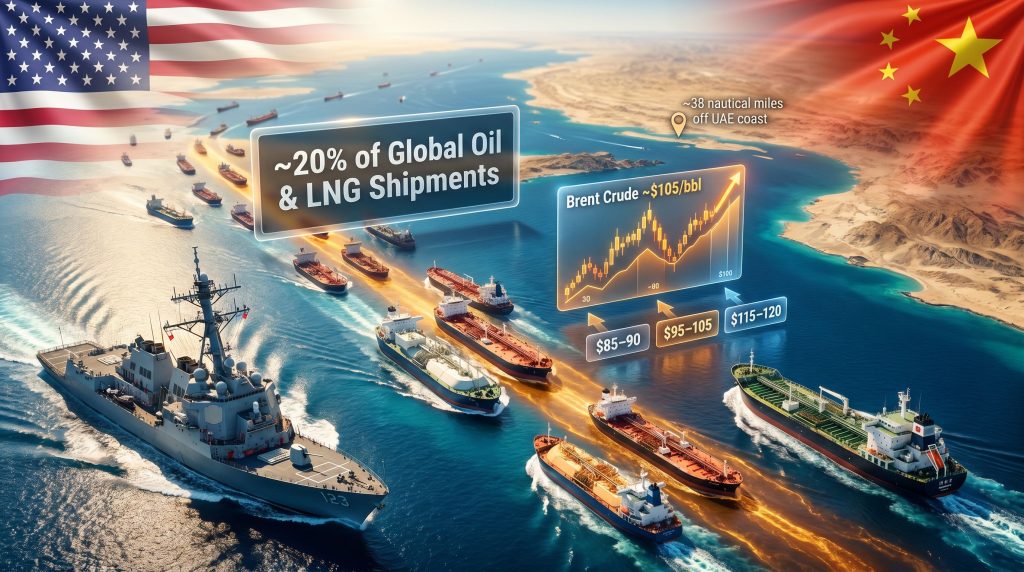
The Strait of Hormuz is not strategically important because of its size. It is strategically important because of what flows through it. Approximately one-fifth of all global oil and LNG shipments transit this narrow passage annually, according to World Oil's reporting on the May 2026 crisis. No other single maritime chokepoint concentrates this density of energy trade in such a geographically constrained corridor.
Furthermore, to put this in perspective, consider the breadth of economic exposure across different regions:
| Region | Nature of Hormuz Exposure |
|---|---|
| China | World's largest crude oil importer; significant Gulf supply volumes transit Hormuz |
| Japan and South Korea | Heavily reliant on Middle Eastern LNG and crude moving through the strait |
| India | Major energy importer with growing dependence on Gulf supply chains |
| European markets | Increasingly exposed through LNG flows priced against Hormuz-linked benchmarks |
| United States | Less import-dependent but exposed through global price benchmarks and allied energy security commitments |
The IMF has warned that prolonged disruption to Hormuz shipping could generate measurable drag on global economic growth, elevating this issue from a regional security concern to a systemic macroeconomic risk. Brent crude was trading near $105 per barrel as of mid-May 2026, a level that reflects the sustained risk premium the market has priced into energy assets since the conflict escalated. Broader crude oil geopolitics have played a significant role in shaping this pricing environment throughout the year.
The "Iranian Management Protocols" Concept: A Parallel Transit System
One of the less widely understood dimensions of the current situation involves what Iranian state media has described as "Iranian management protocols" for vessel transit. According to World Oil's reporting, Chinese-linked vessels are expected to transit the strait under this framework, which represents an assertion of Iranian operational sovereignty over vessel movement independent of U.S. naval coordination.
This parallel transit architecture introduces complexity that goes well beyond standard maritime law. In effect, it suggests the existence of two competing frameworks for Hormuz navigation: one governed by U.S. naval enforcement mechanisms and one asserted by Iran over its adjacent waters. The presence of both simultaneously is not a stable equilibrium — it is a pressure point that could intensify without warning.
What the Trump–Xi Beijing Dialogue Actually Established
During Trump's visit to Beijing in May 2026, both leaders publicly aligned on the principle that the Strait of Hormuz should remain accessible to global shipping. A White House official confirmed that Trump and Xi agreed on this foundational point. Trump also indicated that Xi expressed an interest in seeing a diplomatic resolution to the underlying Iran conflict, though Beijing did not publicly confirm any active mediation role.
The language Trump used is worth examining carefully. His public statement conveyed that Xi wanted to see a deal reached and that Trump offered assistance if it could be of any use. This framing communicates goodwill while making no binding commitment, establishing no mechanism, and defining no timeline. It is the diplomatic equivalent of noting that two parties would both prefer a storm to pass without committing to any particular action to make it happen.
The Central Contradiction: Open in Principle, Blocked in Practice
The most revealing tension in the Trump–Xi Hormuz dialogue is not what was agreed upon, but what continued operating unchanged immediately afterward.
At the same time Trump was publicly framing the strait as something that should remain open to global energy flows, U.S. naval restrictions affecting Iranian port access remained fully operational. The World Oil reporting confirmed that shipping flows through the chokepoint remained limited as of mid-May 2026, even as vessel traffic showed tentative signs of gradual recovery.
This creates a structural paradox that sits at the heart of the current diplomatic situation:
- Declared position: The strait should be open for all legitimate global energy trade
- Operational reality: U.S. naval enforcement mechanisms remain active against Iranian port access
- Strategic subtext: The definition of "open" appears to be conditioned on the exclusion of Iranian-flagged or Iran-destined commerce
This is not necessarily a contradiction born of incoherence. It may reflect a deliberate negotiating posture in which "openness" is offered as an incentive for Iranian concessions rather than as an unconditional baseline. However, it does mean the political declaration and the ground-level reality point in opposite directions, at least in the short term.
Iran's Position: The Critical Variable No Agreement Can Bypass
Despite an April 2026 ceasefire between the U.S. and Iran, negotiations over restoring full Hormuz shipping access have remained stalled. Iran has continued demanding the removal of U.S. naval restrictions and broader sanctions relief as preconditions for fully restoring shipping access. The trade war oil impact dimension of this standoff adds further complexity to an already fragile negotiating environment.
These demands are not minor concessions easily packaged into a diplomatic side agreement. They represent structural changes to the U.S. posture in the region that would require significant political capital on the American side and credible verification mechanisms on the Iranian side.
Why Iran's Demands Are Structurally Difficult to Meet
Iran's conditions for full normalisation of Hormuz access involve requirements that cut across multiple U.S. policy domains simultaneously:
- End to U.S. naval restrictions on Iranian port access, which are tied to broader military deterrence posture in the Gulf
- Broad sanctions relief, which involves Congressional as well as executive-branch decision-making and touches on decades of accumulated sanctions architecture
- Operational sovereignty recognition over Iranian-adjacent waters, which intersects with international maritime law and U.S. freedom-of-navigation doctrine
Each of these elements is politically costly for Washington to concede individually. As a package, they represent a significant restructuring of U.S. regional engagement that would face opposition across multiple institutional stakeholders in Washington, regardless of executive intent.
Meanwhile, Iran has simultaneously been developing contingency strategies to reduce dependency on Hormuz-adjacent U.S. naval presence, including exploration of alternative port routing. This hedging behaviour suggests Tehran is not negotiating from a position of desperation but is rather managing a sustained pressure environment while maintaining its core demands.
China's Energy Arithmetic and Its Diplomatic Ambiguity
China's interest in Hormuz reopening is not ideological. It is mathematical. As the world's largest crude oil importer, Beijing's energy security architecture depends directly on uninterrupted access to Gulf supply routes, the majority of which transit Hormuz. Any sustained closure threatens not just energy costs but the supply continuity underlying Chinese industrial and manufacturing output.
This creates a powerful economic incentive for China to support a resolution. However, Beijing's diplomatic posture has been carefully calibrated to preserve maximum optionality:
| China's Role | Operational Description |
|---|---|
| Energy consumer | Directly exposed to supply disruption through Hormuz-dependent imports |
| Diplomatic signal | Privately supportive of resolution without formal mediation commitment |
| Commercial operator | Chinese-linked vessels reportedly transiting under Iranian management protocols |
| Strategic balancer | Maintaining productive relationships with both Washington and Tehran simultaneously |
Reports indicate China has been exploring increased purchases of U.S. oil as a partial hedge against Hormuz disruption, a development that aligns with the White House's preference for redirecting energy trade toward American suppliers. In addition, OPEC's market influence continues to shape how competing blocs respond to the pricing volatility emerging from the current disruption.
China's refusal to publicly confirm a mediation role while privately signalling support for a resolution is a classic exercise in strategic ambiguity. If a deal emerges, Beijing can claim influence. If negotiations collapse, it bears no institutional liability.
This positioning is diplomatically sophisticated but limits China's ability to apply decisive pressure on either party when a specific outcome is required. It is influence without accountability, which is useful for preserving relationships but less effective for producing concrete results under deadline pressure.
Energy Market Consequences: Reading the Risk Premium
The $105 per barrel Brent crude price observed in mid-May 2026 reflects a market that has already internalised significant Hormuz disruption risk into its base case. The price had risen sharply since the conflict escalated, and showed little meaningful change as the Trump–Xi dialogue unfolded. This is consistent with broader patterns of oil price shock behaviour observed across major energy-producing economies during geopolitical standoffs.
This price stability amid diplomatic activity is itself informative: markets were not interpreting the Trump–Xi alignment as a near-term resolution signal. Traders appear to be pricing the stalemate as the operative scenario rather than treating the diplomatic statements as credible indicators of imminent progress.
Three Possible Scenarios and Their Market Implications
Scenario 1: Negotiated Reopening
Iran accepts meaningful sanctions relief in exchange for restoring full transit access. U.S. naval restrictions are progressively wound back. The geopolitical risk premium deflates from crude pricing, and Brent retreats toward the mid-to-upper $80s range. Asian LNG importers reduce emergency procurement and return to spot market normalcy.
Scenario 2: Fragmented Partial Access
A two-tier transit system solidifies, with Chinese-linked and other select vessels operating under Iranian management protocols while U.S. restrictions remain active against Iranian-flagged or Iran-destined shipping. Pricing differentials emerge between "cleared" and "restricted" cargoes. Brent remains elevated in the $95 to $105 range with persistent volatility.
Scenario 3: Prolonged Stalemate
Negotiations break down entirely. Iran expands alternative port capacity and hardens its position. U.S. naval posture intensifies. The risk of an unplanned maritime incident increases, and energy markets reprice upward. The IMF's growth warnings become more operationally relevant for energy-importing economies.
Disclaimer: The scenario analysis above represents analytical projections based on current reported conditions and is not financial advice. Energy markets are subject to rapid change driven by geopolitical developments, and actual price outcomes may differ materially from any projected range.
The next major ASX story will hit our subscribers first
Maritime Security on the Ground: The Gap Between Diplomacy and Operations
The high-level diplomatic dialogue occurring between Washington and Beijing is unfolding against a backdrop of active maritime insecurity that underscores how far the operational situation is from resolution. A commercial vessel was recently seized by unauthorised personnel approximately 38 nautical miles off the UAE coast, reportedly intercepted while en route toward Iran. UK Maritime Trade Operations confirmed the incident.
This type of incident is significant not just for the individual vessel involved but for what it signals about the broader security environment in Hormuz-adjacent waters. When vessel seizures occur in international shipping lanes close to major Gulf economies, the insurance risk premium for all transiting vessels rises, shipping operators apply additional scrutiny to route planning, and energy supply chains must account for elevated delivery uncertainty.
The geopolitical trade tensions feeding into this environment have furthermore complicated diplomatic resolution efforts across multiple fronts simultaneously. The EIA has launched new chokepoint datasets specifically designed to track oil and LNG movements through Hormuz in real time, a development that reflects the elevated analytical priority now assigned to this waterway by major energy institutions.
When the world's leading energy statistics agency creates dedicated monitoring tools for a single waterway, it indicates that the disruption has crossed from temporary anomaly into sustained structural concern. Al Jazeera's coverage has noted that any Chinese assistance in resolving the Iran situation may ultimately require U.S. concessions, reinforcing just how structurally complex this diplomatic challenge remains.
The Three-Power Standoff: Why Resolution Is Structurally Difficult
The Hormuz situation has crystallised into a triangular dynamic in which each actor holds leverage the others cannot easily neutralise through unilateral action:
- The United States controls the naval enforcement mechanism but cannot unilaterally restore civilian shipping flows without Tehran's active cooperation
- China holds economic leverage over Iran and diplomatic credibility with Washington but has structured its position to avoid formal mediation accountability
- Iran retains ultimate authority over the access decision but faces mounting economic pressure from the blockade while simultaneously building alternative trade pathways
What makes this triangulation particularly resistant to straightforward resolution is that each actor's optimal strategy diverges from what a cooperative outcome would require. The U.S. benefits from maintaining naval pressure as a negotiating tool. China benefits from maintaining relationships with both sides without committing to either. Iran benefits from prolonging negotiations while building bypass infrastructure that reduces the long-term leverage of the blockade.
The Trump Xi Strait of Hormuz reopening dialogue is best understood as a convergence of economic interests that stops well short of a coordinated diplomatic strategy. Both powers want the strait open, but for different reasons, through different mechanisms, and on terms that may ultimately be incompatible with Iran's stated conditions.
Key Takeaways: What the Hormuz Situation Tells Investors and Analysts
- The Trump Xi Strait of Hormuz reopening position reflects shared economic interests, not a unified operational strategy
- A fundamental contradiction exists between declaratory policy ("permanently open") and operational reality (active U.S. naval restrictions on Iranian port access)
- Iran's demands — including the removal of naval restrictions and broad sanctions relief — remain the primary obstacle to any near-term resolution
- China is playing a dual commercial and diplomatic role without formal mediation commitment, preserving optionality at the cost of decisive influence
- Brent crude at approximately $105 per barrel reflects a sustained risk premium that will only deflate when a credible and specific resolution pathway emerges
- The EIA's new Hormuz chokepoint monitoring datasets signal that this disruption has moved from acute incident to sustained structural market variable
- The IMF's warnings about global growth impacts add macroeconomic urgency to what is already a critical energy security situation
This article draws on reporting from World Oil (worldoil.com), May 14, 2026. Scenario analyses and market projections represent analytical frameworks and do not constitute financial or investment advice. Readers should conduct independent research and consult qualified advisors before making decisions based on geopolitical or commodity market analysis.
Want to Capitalise on Commodity Market Volatility Driven by Global Energy Disruptions?
When geopolitical flashpoints like the Strait of Hormuz crisis send Brent crude surging past $105 per barrel, the ripple effects reach far beyond oil markets — creating significant opportunities across ASX-listed resource and energy companies. Discovery Alert's proprietary Discovery IQ model delivers real-time alerts on significant ASX mineral discoveries, instantly translating complex commodity signals into actionable investment insights, while its dedicated discoveries page showcases how historic finds by companies like De Grey Mining and WA1 Resources have generated substantial returns — start your 14-day free trial today and position yourself ahead of the broader market.