May 14, 2026
The Permian Basin's Impossible Economics: When Producing Gas Costs More Than Giving It Away
Few market dynamics expose the structural limitations of commodity pricing theory quite like a situation where a seller must compensate the buyer simply to accept delivery. This is not a thought experiment or a hypothetical edge case. In the spring of 2026, natural gas producers operating in West Texas found themselves doing exactly that, and the Permian gas glut is at the heart of this remarkable situation.
The Permian gas glut is not merely a pricing anomaly. It is the visible symptom of a deeper structural tension between geological productivity, physical infrastructure, and the co-production economics that govern one of the world's most prolific hydrocarbon basins.
When big ASX news breaks, our subscribers know first
A World of Two Gas Markets Running in Opposite Directions
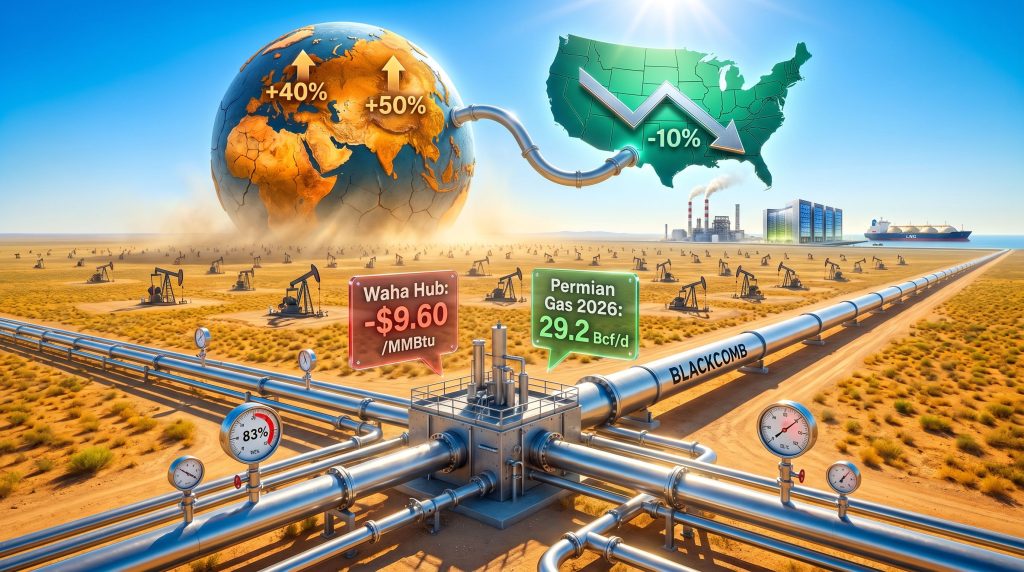
Across Europe and Asia in 2026, natural gas has become a precious and increasingly rationed commodity. The geopolitical disruptions stemming from the Iran conflict have choked LNG supply dynamics, sending European benchmark prices approximately 40% higher and pushing Asian spot prices more than 50% above pre-conflict levels. Fuel rationing and rolling blackouts have become features of daily life in markets that depend on long-haul liquefied natural gas cargoes to meet baseload demand.
Simultaneously, in the Permian Basin of West Texas and southeastern New Mexico, natural gas is so abundant that producers have been paying buyers to take it away. U.S. natural gas prices, rather than benefiting from the global supply shock, have declined roughly 10% over the same period.
This counterintuitive divergence has a structural explanation that goes beyond geopolitics.
Unlike crude oil, which moves fluidly across international markets via tankers with relatively modest infrastructure requirements, natural gas is physically constrained by pipelines and liquefaction terminals. When those pathways reach capacity, regional markets become isolated from global price signals entirely, making extreme divergences not just possible but structurally inevitable.
The U.S. domestic gas market does not operate as a fully integrated component of global gas trade. It functions in partial isolation, shaped by the reach of its pipeline network and the throughput capacity of its Gulf Coast LNG export terminals. Until physical infrastructure can bridge the gap between production growth and export capability, the Permian will continue generating gas that has nowhere cost-effective to go.
What Is Associated Gas and Why Producers Cannot Simply Turn It Off
Understanding the mechanics of the Permian gas glut requires a working knowledge of associated gas, a term that is central to shale basin economics but rarely explained to non-technical audiences.
Associated gas is natural gas that is produced as an unavoidable byproduct of crude oil extraction. When a drill bit penetrates an oil-bearing formation, gas dissolved within the reservoir fluids comes to the surface alongside the crude. In conventional reservoirs, this relationship was often manageable. In the tight-rock formations of the Permian, however, the coupling between oil and gas production has intensified dramatically.
Key geological zones within the Permian, including the Wolfcamp A and Midland Wolfcamp B formations, have seen rising gas-to-oil ratios (GORs) over time. As a well matures, the gas fraction of total production tends to increase relative to oil output. This means that operators who have been running their wells for several years are now extracting progressively more gas per barrel of oil, whether they want it or not.
The critical implication: a Permian oil producer cannot simply throttle back gas output without simultaneously curtailing crude production. The two are physically linked at the wellbore. Since oil prices and oil-driven economics justify the drilling activity in the first place, operators continue producing even when gas prices make gas itself worthless or worse.
Permian Production: The Numbers Behind the Surplus
The scale of production growth in the Permian puts the infrastructure problem into sharp relief.
| Metric | 2024 Figure | 2025/2026 Projection | Growth Rate |
|---|---|---|---|
| Permian crude oil output | 6.44 MMb/d | 6.73 MMb/d (2025) | +4.5% YoY |
| Permian residue gas production | 18.6 Bcf/d | 20.9 Bcf/d (2025) | +12% YoY |
| EIA Permian gas forecast (2026) | — | 29.2 Bcf/d | +6% vs. 2025 |
| U.S. Lower 48 dry gas (2026 revised) | — | 110.61 Bcf/d | Revised up from 109.60 Bcf/d |
| U.S. Lower 48 projected average (2027) | — | 124.0 Bcf/d | Consecutive record trajectory |
Sources: EIA Short-Term Energy Outlook, May 2026
Gas production in the Permian has grown at roughly twice the pace of oil output over recent years, a structural acceleration that infrastructure planning has repeatedly failed to anticipate. Active U.S. natural gas rigs reached a 2.5-year high in late February 2026, reinforcing the trajectory. Furthermore, EIA gas inventories as of late April 2026 sat 7.7% above their five-year seasonal average, confirming that the surplus is systemic rather than transient.
Negative Gas Prices: What They Are and Why They Happen
The Waha Hub, located in West Texas, is the primary pricing benchmark for Permian Basin natural gas. It is at this hub that the infrastructure deficit becomes most visible, and most painful, for producers.
On April 24, 2026, Waha Hub prices hit an all-time low of -$9.60 per million British thermal units (MMBtu). This is not a typo. The price was negative, meaning producers were paying buyers to accept gas deliveries.
How negative gas pricing works: When gas volumes at a regional hub exceed the physical capacity of pipelines to transport them elsewhere, the gas has nowhere to go. Storage fills. Pipelines reach maximum throughput. At that point, producers face a binary choice: either pay buyers to take the gas off their hands, or shut in their wells. Since shutting in a gas well in the Permian also means curtailing crude oil production, the economically rational response is to accept a negative price and keep the oil flowing. The negative price is, in effect, a disposal cost.
Intermittent negative pricing at the Waha Hub has been a recurring feature since 2019, but 2026 has seen these events become both more frequent and more severe. The April 17 collapse pushed nearest-futures natural gas prices to an 18-month low before the record-breaking low arrived just one week later.
The Pipeline Bottleneck: Infrastructure Always Chasing Production
The reason Waha prices turn negative is simple in principle and complex in execution: there is not enough pipeline capacity to move Permian gas out of the basin as fast as it is being produced.
Eastbound Permian pipeline capacity has been running at approximately 83% utilisation, a threshold at which incremental production volumes have outsized and disproportionate consequences for regional pricing. Pipeline infrastructure operates efficiently when utilisation remains in the 70–80% range. Above 83%, there is minimal buffer for volume surges, and any unexpected production increase translates directly into a pricing collapse at the hub.
The lag between drilling activity and pipeline commissioning is a structurally persistent feature of high-growth shale basins. Pipelines require years of planning, permitting, and construction. Shale wells can be drilled and completed in weeks. The result is a recurring infrastructure deficit that developers consistently underestimate.
Pipeline Expansion Projects: Near-Term Relief and Its Boundaries
| Pipeline Project | Capacity Addition | Expected In-Service |
|---|---|---|
| Matterhorn Express | 2.5 Bcf/d | Online (2024) |
| Blackcomb Pipeline | Part of ~11 Bcf/d total | ~October 2026 |
| Three additional projects | ~7.3 Bcf/d combined | 2026–2028 |
| Total new takeaway capacity (by end-2028) | ~11 Bcf/d | End-2028 |
The Blackcomb Pipeline, expected to enter service around October 2026, is widely anticipated to be the near-term structural catalyst that shifts Waha forward pricing from negative back into positive territory. Forward market pricing for Waha gas already reflects this expectation, with the curve showing a price inflection point around that timeline.
Five new Permian pipeline projects in aggregate are projected to deliver approximately 11 Bcf/day of additional takeaway capacity by end-2028, representing roughly 10% of total U.S. natural gas production.
However, this relief carries an important caveat. The same crude oil pipeline infrastructure that enables higher Permian oil production also generates more associated gas. New capacity enabling higher oil output may recreate the bottleneck at a larger absolute volume, particularly if oil drilling activity accelerates in response to elevated global oil price movements driven by the Iran conflict.
Who Wins When American Gas Is Effectively Free
The Permian gas glut creates a distinct set of winners and losers, and understanding which side of that divide different economic actors fall on has meaningful implications for investors, industrial strategists, and macroeconomic forecasters.
Bloomberg Economics chief economist Anna Wong has assessed that the widening price divergence between U.S. domestic gas and international benchmarks could prove to be a meaningful economic buffer for the United States, noting that natural gas holds greater importance for the manufacturing sector than crude oil, particularly across chemicals, fertilisers, and electricity generation.
Sector-by-Sector Beneficiaries
Petrochemicals and Industrials
Petrochemical producers, including Dow, are among the most direct beneficiaries of the current pricing environment. Natural gas serves as both a feedstock and an energy input for chemical manufacturing. When feedstock costs collapse, operating margins expand even if product prices remain stable. U.S. chemical manufacturers consequently gain a structural cost advantage over European and Asian competitors who are paying 40–50% more for the same input.
Power Generation and Household Electricity Bills
The surplus has a tangible and quantifiable moderating effect on U.S. electricity prices. Utility gas prices fell 0.9% in the March 2026 CPI data, a direct transfer of value from the Permian glut to American households and businesses. Without the ongoing gas surplus, electricity prices would be materially higher at precisely the moment when geopolitical energy shocks are pressuring costs globally.
Artificial Intelligence Infrastructure and Data Centers
One of the less widely recognised dimensions of this story is the alignment between cheap Permian gas and the electricity-intensive buildout of AI data centre infrastructure across the United States. Natural gas-fired generation remains the primary dispatchable power source supporting large-scale compute facilities. Diamondback Energy has explicitly identified data centres as a premium demand destination, repositioning its gas sales strategy toward markets in proximity to planned AI infrastructure.
This creates an emerging premium-tier market segment within the domestic gas landscape, one where geography and connectivity to electricity-hungry data centre campuses determines pricing power rather than traditional hub benchmarks.
LNG Export Economics
Gulf Coast LNG export terminals that purchase Permian gas as feedstock benefit directly when that feedstock costs less, improving margins on fixed-price or long-term export contracts. The theoretical arbitrage between near-zero Permian gas and Asian LNG spot prices trading more than 50% above pre-conflict levels represents a compelling economic opportunity. The constraint is physical: pipeline connectivity between the Permian and coastal liquefaction terminals limits the speed at which this arbitrage can be monetised.
The next major ASX story will hit our subscribers first
The Producers Caught on the Wrong Side of the Equation
For Permian-focused operators, the gas glut creates a structural drag on realised revenues that oil price optimism alone cannot fully offset.
Diamondback Energy (NASDAQ: FANG) has moved to actively reduce its exposure to Waha Hub pricing, redirecting gas volumes toward higher-value markets serving population centres, export facilities, and data centre load zones. This strategic pivot reflects an understanding that Waha basis differentials are not a temporary market condition to be waited out, but a persistent structural feature requiring active portfolio management.
EQT Corporation (NYSE: EQT), one of the largest natural gas producers in the United States, took the more drastic step of curtailing output in response to persistently suppressed spot prices. For an Appalachian dry gas producer without the oil revenue cushion that Permian operators enjoy, the economics of continued production at deeply negative effective realisations simply do not stack up.
| Producer Type | Pricing Exposure | Strategic Response |
|---|---|---|
| Permian pure-play oil operators | High associated gas at Waha | Redirect to premium markets; reduce Waha exposure |
| Appalachian dry gas producers (e.g., EQT) | Direct spot price exposure | Output curtailments during low-price periods |
| Petrochemical consumers (e.g., Dow) | Buyer benefits from low prices | Expand utilisation; cost advantage vs. global peers |
| Gulf Coast LNG exporters | Indirect feedgas cost reduction | Improved margins on existing export contracts |
Operators concentrated in high-GOR geological zones face disproportionate exposure. As wells age in gassy formations, the gas fraction of total production climbs, meaning exposure to Waha pricing actually increases over time for mature Permian producers unless actively managed through gas marketing agreements that prioritise non-Waha delivery points.
How Long Does the Permian Gas Glut Last? Three Scenarios
The most important question for producers, industrial consumers, and infrastructure investors is duration. Is this a 12-month anomaly or a multi-year structural condition?
U.S. government forecasts suggest it is the latter. The natural gas price forecast from the EIA projects prices will average well below $4/MMBtu through 2027, with Lower 48 production reaching 118.9 Bcf/d in 2026 and 124.0 Bcf/d in 2027, both consecutive record highs.
Scenario 1: Infrastructure Keeps Pace (Base Case)
- Blackcomb Pipeline delivers relief in October 2026, returning Waha prices to positive territory
- Five pipeline projects deliver ~11 Bcf/d of new capacity by end-2028
- U.S. gas prices remain structurally low but recover modestly toward the $3–4/MMBtu range
- Basis differential between Waha and Henry Hub narrows but does not close entirely
Scenario 2: Oil Drilling Accelerates and Overwhelms New Capacity (Bear Case)
- Elevated global crude oil prices, driven by the Iran conflict, incentivise accelerated Permian drilling
- Associated gas volumes outpace the already robust 12% YoY growth trajectory
- New pipeline capacity is absorbed by incremental production before it can normalise pricing
- Negative Waha pricing events become deeper and more frequent; more producers follow EQT into curtailments
Scenario 3: LNG Export Expansion Monetises the Surplus (Bull Case)
- Accelerated Gulf Coast LNG terminal development absorbs rising Permian gas volumes
- Permian gas increasingly priced against international benchmarks rather than isolated domestic hubs
- A structural price floor emerges as export arbitrage creates sustained demand
- The estimated 17 Bcf/day of incremental LNG export demand potentially supported by expanded infrastructure begins to materialise ahead of schedule
The October 2026 inflection point represented by Blackcomb's commissioning is the nearest-term structural catalyst. The broader pipeline expansion delivering ~11 Bcf/d by end-2028 represents the more meaningful medium-term shift. Neither resolves the fundamental tension between oil-driven production economics and gas market infrastructure constraints.
The Broader Picture: U.S. Energy Exceptionalism in a Supply-Constrained World
Viewed through a macro-economic lens, the Permian gas glut represents something more significant than a regional pricing inconvenience. It is a structural pillar of U.S. economic resilience at a moment when competing economies face energy-driven inflationary pressure from supply disruptions they cannot domestically resolve.
European manufacturers are competing with feedstock costs running 40% above prior benchmarks. Asian industrial consumers face similar pressures. In contrast, American petrochemical producers, power generators, and AI infrastructure developers are operating in an environment where the primary energy input has periodically carried a negative price tag.
That asymmetry has real consequences for capital allocation, industrial competitiveness, and long-term manufacturing investment patterns. Furthermore, Bloomberg's analysis concludes that abundant shale production combined with limited export capacity means U.S. gas prices are positioned to remain structurally lower than international equivalents for years ahead, regardless of pipeline additions.
Consequently, the Permian gas glut, in this reading, is not simply a problem to be solved. For large segments of the U.S. economy, it represents a competitive advantage rooted in oil's economic role and geological endowment that other nations cannot readily replicate.
This article is intended for informational purposes only and does not constitute financial or investment advice. Forward-looking statements, price projections, and scenario analyses involve inherent uncertainty and should not be relied upon as predictions of future market outcomes. Readers should conduct independent research and consult qualified financial advisors before making investment decisions.
Want to Stay Ahead of the Next Major Resource Discovery?
Whilst the Permian gas glut illustrates how infrastructure and commodity economics can create dramatic market dislocations, Discovery Alert's proprietary Discovery IQ model instantly identifies significant ASX mineral discoveries the moment they are announced — transforming complex resource data into actionable opportunities for investors at every level. Explore historic discoveries and the returns they generated, then begin your 14-day free trial to position yourself ahead of the broader market.