May 14, 2026
The Race Beneath the Surface: Why the West Keeps Arriving Late to Africa's Mineral Table
Every industrial revolution in human history has been preceded by a scramble for the raw materials that make it possible. Steel defined the nineteenth century. Oil shaped the twentieth. The China Africa critical minerals race now unfolding across Africa's mineral belts will determine who controls the foundational inputs of the twenty-first — electric vehicles, AI computing infrastructure, advanced defence systems, and next-generation energy grids. Unlike previous resource cycles driven by a single dominant commodity, the current contest spans an entire periodic table of strategic materials simultaneously, making Africa not merely important but genuinely irreplaceable in the architecture of global industrial power.
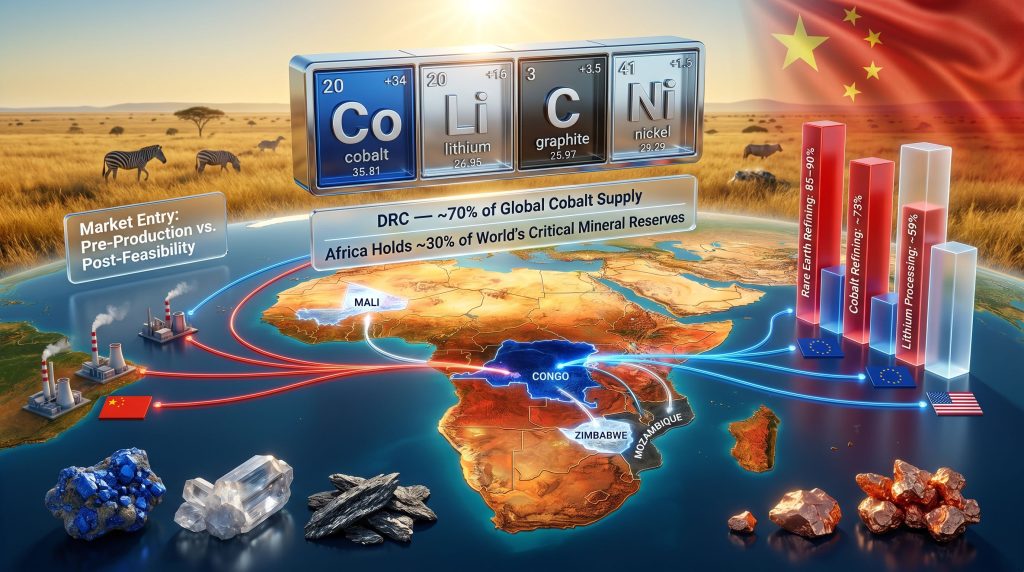
The continent holds an estimated 30% of the world's critical mineral reserves, including deposits of lithium, cobalt, graphite, nickel, manganese, uranium, and rare earth elements distributed across dozens of countries. The Democratic Republic of Congo alone controls approximately 70% of global cobalt supply, a mineral without which the lithium-ion battery chemistry underpinning electric vehicles and grid storage systems cannot currently function at scale. Namibia contributes between 10 and 12% of global uranium output, with major producing operations actively running and supplying international nuclear fuel markets.
Zimbabwe, Mali, and Ghana host lithium deposits increasingly central to battery supply chain conversations. Mozambique and Tanzania hold graphite reserves critical to anode manufacturing. The critical minerals demand trajectory for all of these resources is accelerating in parallel, driven by the green energy transition, AI infrastructure buildout, and advanced weapons manufacturing converging simultaneously.
Whoever shapes access to these resources shapes the industrial capacity of the next several decades. China understood this earlier, invested more deeply, and structured its approach more intelligently than any Western competitor. The result is a positional advantage that extends far beyond mine ownership into the financial, logistical, and processing architecture that transforms raw ore into finished industrial materials.
When big ASX news breaks, our subscribers know first
China's Playbook: Building Dominance Before the First Tonne Is Extracted
Beijing's position in the China Africa critical minerals race was not assembled through a single policy decision or a single decade of investment. It reflects a deliberate, layered strategy applied consistently across multiple mineral categories, multiple African jurisdictions, and multiple phases of project development — beginning, crucially, before commercial production ever becomes viable.
Entry at Exploration: Securing Tomorrow's Supply Today
Chinese firms have demonstrated a consistent pattern of entering African mineral projects during exploration or early feasibility phases, often years before Western competitors begin due diligence. By acquiring equity stakes in junior mining companies, negotiating joint ventures at early-stage valuations, and locking in long-term offtake agreements before projects reach bankable feasibility status, Chinese operators effectively secure future mineral flows at a fraction of the cost that later-stage entry would require.
This pre-production entry model has been replicated across lithium, cobalt, graphite, and rare earth projects spanning Mali, Zimbabwe, the DRC, Ghana, and South Africa. By the time Western publicly-listed companies arrive to assess the same opportunities, valuations have risen, geopolitical competition has intensified, and the most strategically valuable offtake arrangements have already been committed.
Industry analysis indicates this allows Beijing to shape project development from inception, embedding Chinese commercial interests into the foundational agreements that govern mineral flows for decades. The contrast with Western corporate behaviour is structural rather than incidental. Western mining companies face shareholder scrutiny, quarterly earnings pressure, environmental compliance timelines, and governance due diligence requirements that extend decision-making cycles considerably.
Financing What Western Institutions Won't Touch
China's second structural advantage in Africa lies in its ability to deploy capital into jurisdictions that Western multilateral financing institutions classify as too politically or commercially risky to support. Chinese policy banks, including the Export-Import Bank of China and the China Development Bank, alongside state-backed commercial entities, can extend project financing across the politically unstable Sahel corridor — precisely the regions from which Western financial institutions have largely withdrawn.
The architecture of Chinese financing packages adds a further dimension that Western instruments cannot easily replicate. Rather than separating the financing function from the construction function from the logistics function, Chinese capital deployment bundles all three into a single integrated package. A mining finance agreement commonly incorporates:
- Road and railway construction connecting the mine to regional transport networks
- Port facility development or access agreements enabling mineral export
- Power infrastructure supplying electricity to the mining operation
- Hospital and community infrastructure generating political goodwill with host governments
- Security support through training programmes, equipment transfers, and joint exercises
This integration dramatically compresses project timelines and deepens political relationships with host governments in ways that transactional Western financing models structurally cannot match. The model also reduces host government dependence on Western capital markets, making Chinese partnerships attractive even where interest rate or term structures may be less favourable on paper.
The practical consequence of this financing flexibility was illustrated at Ghana's Ewoyaa lithium project, where Zhejiang Huayou Cobalt moved to assume development funding obligations following the withdrawal of U.S.-linked Elevra Lithium. As China tightens its grip on West Africa's lithium, such episodes are not isolated — Chinese state-affiliated companies function as strategic backstops across African mineral development, absorbing commercial risk that Western publicly-listed firms cannot sustain under shareholder and regulatory pressure.
Infrastructure as Strategic Lock-In: Beyond the Mine Gate
Industry analysts have consistently observed that mines are only as valuable as their export routes. This insight sits at the core of China's logistics strategy in Africa, and it represents one of the most underappreciated dimensions of Beijing's structural advantage. Furthermore, by pairing mining investments with complementary transport and power infrastructure, Chinese operators ensure that extracted minerals flow through Chinese-controlled or Chinese-built trade networks, regardless of who formally holds the mining concession.
The pattern is documented across multiple corridors:
- Guinea's bauxite and Simandou iron ore corridor, where Chinese-financed railway and port infrastructure underpins mineral export logistics
- The DRC-Zambia copper belt, where Chinese mining operators and infrastructure investors maintain interlinked presences
- Lithium export routes in Zimbabwe and Mali, where Chinese firms have established positions across mine development and associated logistics
- Mozambique's graphite export networks, where Chinese processing and trade relationships shape downstream flows
The strategic logic creates a form of supply chain lock-in that persists even when Western parties hold formal mining rights. A U.S. or European company that secures a mining concession but lacks alternative export infrastructure remains effectively dependent on Chinese-built logistics networks to move its product. Control of the route, not the resource, is frequently the decisive competitive variable.
The Processing Monopoly: China's Most Durable Weapon
If pre-production entry and infrastructure bundling represent China's offensive tools in Africa, its dominance over mineral processing and refining is its most structurally entrenched defensive position. It is also the dimension of the China Africa critical minerals race that Western strategists have been slowest to address.
Where Pricing Power Actually Lives in Critical Mineral Supply Chains
The critical minerals supply chain follows a sequential path from ore extraction through concentration, smelting, refining, and chemical processing to final battery-grade or magnet-grade product manufacturing. Profit margins and pricing power are not distributed evenly across this chain — they concentrate at the processing and refining stages, where technical complexity, capital intensity, and accumulated expertise create genuine barriers to competitive entry. China controls those stages across nearly every strategically significant mineral category.
| Processing Stage | China's Estimated Global Market Share |
|---|---|
| Rare earth separation and refining | 85 to 90% |
| Cobalt refining output | Approximately 73% |
| Nickel processing output | Approximately 68% |
| Lithium chemical processing | Approximately 59% |
| Copper smelting and refining | Approximately 40% |
These figures reflect a processing infrastructure advantage built over three decades of deliberate state investment, technology development, and capacity scaling. The rare earth separation and refining segment is particularly significant because the technical complexity of separating individual rare earth elements from mixed ore concentrates requires specialised chemistry and accumulated process expertise that cannot be replicated quickly at scale elsewhere.
The practical consequence for Western mineral strategy is stark. Even when a U.S. or European company successfully secures mining rights in an African country, the extracted material overwhelmingly passes through Chinese-controlled processing networks before reaching the battery manufacturers, magnet producers, or defence contractors that represent the actual end market. Securing a mining concession without parallel investment in processing capacity does not break supply chain dependency on China.
The Beneficiation Gap: Africa's Aspirations vs. China's Interests
African governments have increasingly demanded local beneficiation — in-country processing of raw minerals into higher-value intermediate products — as a condition of resource development. This represents a structural shift in how African policymakers conceptualise mineral wealth, moving from raw export revenue extraction toward genuine industrial development.
In practice, however, Chinese operators have frequently responded by establishing limited downstream processing within Africa while retaining higher-value refining and advanced manufacturing capacity inside China. The result is that African nations capture marginally more value than raw ore export alone would deliver, but the majority of processing margin remains concentrated in Chinese industrial facilities. This dynamic creates a genuine opening for Western partners willing to offer credible in-country processing investment alongside mining development.
What the West Has, What It Lacks, and Why the Gap Persists
Genuine Western Strengths in the Competition
The Western position is not without foundation. Several structural advantages remain meaningful:
- The United States maintains dominant influence over global maritime shipping routes and naval security infrastructure, providing theoretical capacity to disrupt Chinese mineral logistics flows under extreme geopolitical scenarios
- Western financial institutions, including the U.S. International Development Finance Corporation and the U.S. Trade and Development Agency, have redirected capital toward African mineral exploration and infrastructure in recent years
- Europe and the U.S. retain significant advantages in technology transfer, governance standards, and access to deep capital markets, which some African governments value as counterweights to Chinese debt dependency
- The U.S. is fully import-reliant on 14 critical minerals and more than 75% import-reliant on a further 10, creating domestic political pressure beginning to translate into policy action
Where Western Strategy Consistently Falls Short
Despite these advantages, four structural weaknesses continue to limit Western effectiveness:
- Speed asymmetry: Western project financing requires environmental assessments, governance compliance, shareholder approvals, and multilateral review processes that extend decision timelines by years
- Fragmented approach: Competing industrial priorities between U.S. and European governments have prevented formation of a unified Western alternative to China's integrated minerals strategy
- Processing gap: Neither the U.S. nor Europe has invested sufficiently in domestic or partner-country processing infrastructure to absorb African mineral output at commercially meaningful scale
- Political flexibility deficit: Western financing institutions attach human rights, environmental, and governance conditionalities that some African governments view as obstacles
The combination of these factors means that even well-intentioned Western mineral initiatives frequently arrive late, move slowly, and lack the processing infrastructure necessary to create genuine supply chain independence. Consequently, Europe's critical minerals supply chain remains particularly exposed to the structural gaps outlined above.
The deepest structural challenge facing Western policymakers is not a shortage of capital or technical expertise — it is the inability to match China's integrated execution model across financing, construction, logistics, and processing simultaneously.
The Geopolitical Dimension: Minerals at the Centre of Great Power Negotiations
The broader energy security challenge has become inseparable from high-level trade discussions between Washington and Beijing, with critical mineral supply chains increasingly incorporated as a central negotiating variable. This energy security challenge reflects the degree to which mineral access has become intertwined with economic security calculations on both sides.
China's ability to restrict or redirect African mineral flows gives Beijing meaningful leverage in trade negotiations beyond its conventional economic instruments. The sourcing of minerals from politically unstable African states has also attracted involvement from actors beyond the U.S.-China bilateral dynamic. Furthermore, arrangements involving defence critical materials and military-for-minerals exchanges in several Sahel jurisdictions are expanding the competitive landscape further.
The US-Congo minerals partnership represents one of the more significant recent attempts to establish a Western strategic foothold in the region. However, African nations themselves are increasingly sophisticated in leveraging competing great power interest to extract development commitments, technology transfers, and infrastructure investment. This transforms the minerals race from a straightforward extraction contest into a complex development negotiation in which African governments hold considerably more agency than Western strategic assessments have historically credited.
The next major ASX story will hit our subscribers first
Africa's Strategic Agency: The Variable Western Analysis Most Often Misses
A persistent analytical blind spot in Western assessments is the framing of African nations as passive recipients of external competition rather than active strategic actors capable of shaping the terms of engagement. Multiple African governments have moved to introduce export restrictions on unprocessed minerals, mandatory local processing requirements, and renegotiated royalty structures designed to capture greater economic value from their resource endowments.
The beneficiation push, if successfully implemented across multiple mineral categories, could fundamentally alter the competitive landscape of the global critical minerals economy. As African countries look to make their own rules in the China Africa critical minerals race, an Africa that transitions from raw ore exporter to mid-stream processing hub forces both Chinese and Western companies to invest in African processing infrastructure as a condition of market access. Under that scenario, the geography of the processing monopoly shifts substantially.
Comparative Framework: How the Competing Strategies Stack Up
| Strategic Dimension | China's Approach | Western Approach |
|---|---|---|
| Market entry timing | Pre-production and exploration stage | Post-feasibility and commercial stage |
| Financing model | Integrated policy bank plus construction | Multilateral and commercial with conditionalities |
| Infrastructure investment | Mining, logistics, and power bundled | Typically mining-focused only |
| Processing capacity | Dominant domestic refining infrastructure | Largely absent or early-stage |
| Political flexibility | High, with minimal conditionalities | Low, with ESG and governance requirements |
| Speed of execution | Rapid through state coordination | Slow through regulatory and shareholder processes |
| Long-term supply security | Locked in via offtake agreements | Largely unsecured |
Three Scenarios for How the Competition Resolves
Scenario One: Incremental Western Catch-Up
Western development finance institutions gradually expand financing into higher-risk African jurisdictions. Processing investment remains limited and supply chain dependency on China persists through the early 2030s. Partial supply diversification is achieved for select minerals such as uranium and copper, but rare earth and lithium dependency remains structurally entrenched.
Scenario Two: Coordinated Western Industrial Policy
The U.S. and EU align on a unified critical minerals framework, pooling DFC, EXIM, and European investment bank resources into a coherent counter-strategy. Significant investment flows into both African infrastructure and domestic or allied-country processing capacity. Meaningful reduction in Chinese processing dependency becomes achievable by the mid-2030s, but requires sustained political commitment across multiple electoral cycles.
Scenario Three: African-Led Beneficiation Reshapes the Race
African governments successfully mandate in-country processing across multiple mineral categories, compelling both Chinese and Western companies to invest in African refining infrastructure as a condition of project access. Africa transitions from raw mineral exporter to mid-stream processing hub, fundamentally redistributing value capture and competitive positioning across the global critical minerals economy.
Disclaimer: The scenarios outlined above represent analytical projections based on current strategic trends and are inherently speculative. They are not investment advice, and actual outcomes will depend on policy decisions, commodity price movements, geopolitical developments, and technological changes that cannot be reliably forecast.
Frequently Asked Questions
What critical minerals does Africa supply that are essential to global supply chains?
Africa's most strategically significant mineral endowments include cobalt, with the DRC holding approximately 70% of global reserves; lithium across Zimbabwe, Mali, Ghana, and Namibia; graphite in Mozambique and Tanzania; manganese, nickel, copper, uranium from Namibia's major producing operations, and rare earth elements distributed across multiple countries on the continent.
Why has China been able to build such a dominant position in African critical minerals?
China's advantage reflects a multi-decade strategy combining early-stage project entry before commercial production begins, integrated financing and infrastructure packages through policy banks, a near-monopoly on downstream processing and refining capacity, and political relationship-building conducted without the governance conditionalities that Western institutions typically impose.
Why does China's processing dominance matter even when other companies own African mines?
Because the pricing power in critical minerals supply chains resides at the refinery and chemical processing stages, not at the point of ore extraction. Even minerals mined by non-Chinese companies in Africa typically pass through Chinese processing infrastructure before reaching battery manufacturers, magnet producers, or defence contractors. Mine ownership without processing control does not deliver supply chain independence.
What is the U.S. currently doing to counter China's position in African minerals?
The U.S. has deployed the International Development Finance Corporation, the Export-Import Bank, and the U.S. Trade and Development Agency to finance African mineral exploration and infrastructure. However, analysts note that these efforts remain fragmented, lack the processing investment necessary for genuine supply chain independence, and operate at timelines considerably slower than Chinese state-coordinated deployment.
What role do African governments play in the minerals competition?
African governments are increasingly active and sophisticated participants rather than passive hosts. Multiple countries have introduced export restrictions on unprocessed minerals, mandatory beneficiation requirements, and renegotiated royalty structures. Growing concern about debt sustainability and limited technology transfer from Chinese partnerships has also created openings for Western partners able to offer credible alternatives.
Want to Track the ASX Mineral Discoveries Shaping the Next Industrial Revolution?
The critical minerals race reshaping global supply chains begins with identifying significant discoveries the moment they are announced — and Discovery Alert's proprietary Discovery IQ model delivers real-time alerts on major ASX mineral discoveries, including lithium, cobalt, uranium, and rare earths, transforming complex geological data into actionable investment insights. Explore how historic mineral discoveries have generated extraordinary returns and begin your 14-day free trial today to position yourself ahead of the market.