May 14, 2026
The Industrial Logic Behind Central Asia's Biggest Aluminium Bet
Commodity markets rarely transform overnight. The shifts that matter most tend to accumulate quietly, driven by capital allocation decisions made years before the production data reflects any change. When a top-tier global aluminium producer commits USD 12.6 billion to build a vertically integrated mine-to-metal complex in a landlocked Central Asian nation, it signals something structurally significant is underway — not just for Kazakhstan, but for how the global aluminium supply chain is being redrawn.
The East Hope Group investment in Kazakhstan's aluminium industry represents precisely this kind of slow-burn structural transformation. It is not a speculative resource play or an opportunistic land grab. It is a calculated, multi-decade industrial repositioning strategy that places Kazakhstan at the intersection of Chinese capital, European demand, and Central Asian industrial ambition.
When big ASX news breaks, our subscribers know first
What East Hope Group Is, and Why Kazakhstan Fits Its Strategy
East Hope Group is among the world's largest primary aluminium producers, with its industrial roots firmly established in China before expanding its strategic horizons internationally. The company has built its reputation on executing large-scale, capital-intensive aluminium projects that integrate energy generation with metals processing — a model that requires enormous upfront commitment but delivers structural cost advantages once operational.
Kazakhstan's appeal within this framework is not accidental. The country holds substantial bauxite deposits across the Aktobe and Kostanay regions, mineral endowments that have historically been extracted and exported in largely unprocessed form. This creates a pronounced value gap between the raw resource base and the downstream industrial output the country currently produces — a gap that the East Hope Group project is specifically designed to close.
The strategic discussions underpinning this investment involved East Hope Group's Director for Strategic Investments, Chen Lei, and Kazakhstan's Industry and Construction Minister, Yersayin Nagaspayev. These are not working-level conversations. The seniority of the participants on both sides signals that the project carries genuine institutional weight within both organisations.
Kazakhstan's Resource Base: Underleveraged Relative to Global Demand
Bauxite, the primary ore from which aluminium is derived, is not evenly distributed globally. Guinea, Australia, and Indonesia dominate the world's proven reserves, but Kazakhstan's deposits in the Kostanay and Aktobe regions represent a meaningful and historically underutilised resource base in a geography that sits at the crossroads of European and Asian industrial demand. Furthermore, global bauxite production trends increasingly highlight the strategic value of underexploited reserves in politically stable jurisdictions.
The structural problem Kazakhstan has faced is not resource scarcity but value capture. Exporting unprocessed or semi-processed ore generates a fraction of the revenue that domestic alumina refining and primary aluminium smelting would produce. This is the classic resource-nation dilemma: abundant raw materials, insufficient downstream processing capacity, and the consequent export of economic value alongside physical commodities.
East Hope Group's project is structured explicitly to reverse this dynamic.
Breaking Down What USD 12.6 Billion Actually Builds
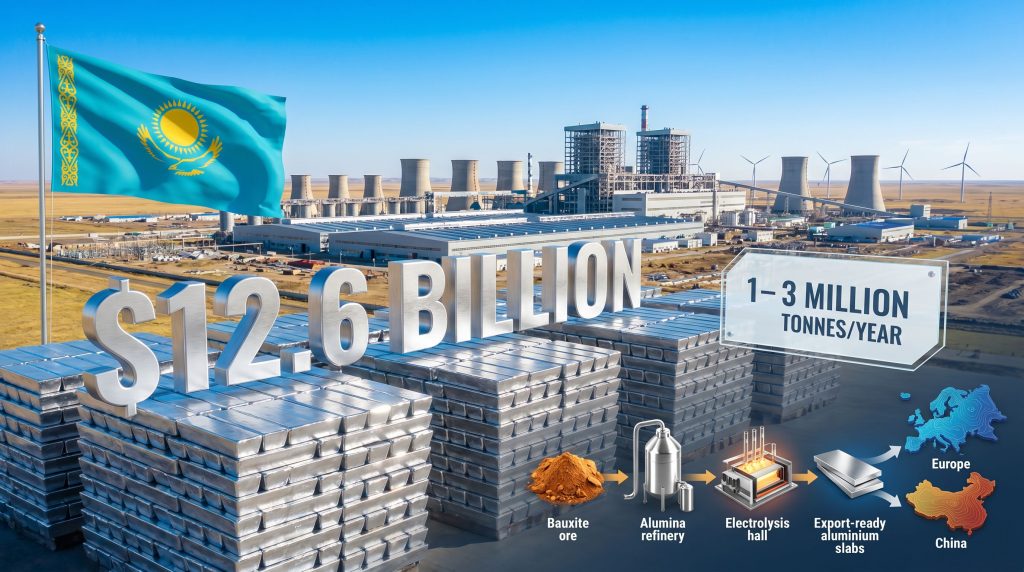
The investment covers a fully vertically integrated industrial complex spanning every stage of the aluminium production chain. This is not a single-facility expansion or a modular upgrade to existing infrastructure. It is a ground-up construction programme designed to take Kazakhstan from bauxite extraction to finished primary aluminium and downstream fabricated products within a single industrial ecosystem.
The confirmed components of the project include:
- Bauxite mining and ore-dressing operations across multiple sites in the Aktobe and Kostanay regions
- On-site alumina refining infrastructure targeting substantial annual output from ore input
- Primary aluminium electrolysis smelting capacity, with Phase 1 targeting approximately 1 million tonnes per year, scaling toward 3 million tonnes per year across subsequent phases
- A captive power generation facility, anchored by a 4.5 GW coal-fired thermal power plant, supplemented by renewable energy exploration of up to 3 GW wind capacity
- Downstream industrial park and value-added fabrication infrastructure to produce export-ready aluminium products
This vertical integration model is strategically significant. Aluminium smelting is extraordinarily energy-intensive, typically consuming between 13,000 and 15,000 kilowatt-hours per tonne of primary aluminium produced. Without captive power generation at scale, smelting economics are hostage to grid pricing volatility. East Hope Group's insistence on building its own power infrastructure reflects hard-won operational knowledge from its Chinese projects, where energy cost control is the single most important lever in smelting economics.
The 1 GW Power Plant Already in the Ground
One of the most concrete indicators that this project has moved from aspiration to implementation is the 1 GW power facility currently under construction in the Kostanay region. Power plant construction at this scale takes years and requires substantial upfront capital commitment. The fact that this infrastructure is already being built confirms that EHG's commitment to the Kazakhstan project is not contingent on further deliberation. The foundation is being poured.
This also introduces an important technical nuance. The dual-track energy strategy — combining coal-fired baseload capacity with renewable energy exploration — reflects a pragmatic sequencing approach. Coal-based power enables early-phase smelting operations to proceed at predictable cost while the renewable energy component is developed in parallel. Over time, the integration of wind capacity is intended to reduce the carbon intensity of production, a transition that is commercially necessary given the trajectory of European aluminium procurement standards.
Phased Rollout: Managing Sovereign Risk Through Sequential Execution
The three-phase development structure serves a dual purpose. It stages capital deployment to match infrastructure readiness, and it provides natural decision gates where progress can be assessed before the next tranche of investment is committed. This phased architecture reduces EHG's exposure to sovereign risk events while maintaining project momentum.
| Phase | Key Activities | Primary Output Target |
|---|---|---|
| Phase 1 | Ore-dressing, alumina refining, initial electrolysis, power commissioning | 1M t/y primary aluminium, 2M t/y alumina |
| Phase 2 | Smelter capacity expansion, power infrastructure scaling | Expanded primary aluminium output |
| Phase 3 | Full downstream fabrication, value-added industrial park operations | Export-ready products, full vertical integration |
Kazakhstan as a BRI Industrial Node, Not Just a Transit Route
Within Belt and Road Initiative discourse, Kazakhstan has historically been framed as a logistics corridor: a transit nation connecting Chinese manufacturing to European end markets via rail and road infrastructure. The East Hope Group investment challenges this framing at a fundamental level, echoing a broader cross-border infrastructure strategy that China has been advancing across the region.
By constructing a vertically integrated aluminium complex on Kazakhstani soil, EHG is repositioning the country as a manufacturing and processing node within BRI industrial architecture. This is a qualitatively different type of engagement. Instead of Kazakhstan facilitating the movement of goods produced elsewhere, it becomes a producer of strategically important industrial materials in its own right.
The geographic logic is compelling. Kazakhstan sits within practical export reach of three distinct demand centres:
- European markets, which are actively seeking low-carbon aluminium supply chain diversification under the EU's Carbon Border Adjustment Mechanism
- Chinese domestic markets, where demand for primary aluminium remains structurally elevated despite domestic production growth
- Central Asian markets, where infrastructure development and industrialisation are creating sustained base metal demand
The Green Aluminium Export Corridor and the CBAM Dynamic
The EU's Carbon Border Adjustment Mechanism entered its transitional phase in late 2023 and progressed toward full enforcement through 2026. Under this framework, importers of carbon-intensive goods — including aluminium — face a carbon cost aligned with EU Emissions Trading System pricing. This creates a structural price premium for aluminium produced with lower carbon intensity, a premium that Kazakhstan-origin green aluminium could theoretically capture at scale. Consequently, green metals pricing dynamics are becoming an increasingly critical factor in project economics across the sector.
The intersection of Chinese industrial capital, Central Asian resource endowment, and European carbon pricing policy creates a rare arbitrage opportunity in global aluminium supply chains. Whether that opportunity materialises depends on whether EHG's green credentials survive independent verification.
The critical tension within this narrative is the coal-fired power plant. A 4.5 GW coal-based energy system is not, by any conventional definition, a green infrastructure asset. The credibility of EHG's green aluminium export ambitions will depend entirely on the pace and scale of renewable energy integration, and on whether independent carbon accounting frameworks confirm that the emissions profile of Kazakhstan-produced aluminium falls within CBAM compliance thresholds.
This is not an insurmountable challenge, but it is a genuine one. Aluminium Stewardship Initiative certification, third-party lifecycle emissions auditing, and transparent carbon intensity disclosures will likely be prerequisites for accessing the EU green premium pricing that justifies much of the project's strategic rationale.
Economic and Employment Transformation: What This Means for Kazakhstan
The project is projected to generate approximately 10,000 permanent employment positions spanning mining operations, engineering, processing facilities, construction, and power generation infrastructure. For context, this represents a substantial addition to Kazakhstan's non-ferrous metals industrial workforce and carries meaningful regional economic multiplier effects across the Aktobe and Kostanay oblasts.
Beyond job creation, the structural economic significance lies in the shift from raw material export revenue to value-added processing revenue. The difference in export value between bauxite ore and finished primary aluminium can exceed a factor of ten to twenty times per unit of raw material input, depending on processing efficiency and prevailing market prices. This value capture transformation is the most durable long-term economic benefit of the project for Kazakhstan.
Technology Transfer and Workforce Localisation
EHG's bilateral agreement framework incorporates commitments around technology transfer and increasing Kazakh national employment ratios over the project lifecycle. These are standard features of large-scale foreign direct investment agreements in resource-dependent economies, but their implementation quality varies significantly. The depth of genuine skills transfer — versus nominal compliance with localisation ratios — will determine whether Kazakhstan emerges from this project with genuinely enhanced industrial capability or simply with aluminium production volumes managed by foreign-trained technical staff.
High-level political alignment between EHG and the Kazakh government, including meetings between EHG leadership and Prime Minister Olzhas Bektenov, confirms institutional commitment at the executive level. This is an important signal for investor confidence in project continuity, though it does not substitute for rigorous contractual enforcement mechanisms on localisation and technology transfer obligations.
Geopolitical Risks and the Three Scenarios Worth Considering
No investment of this scale in a frontier industrial market is without material risk. Responsible analysis requires mapping the realistic range of outcomes rather than anchoring to the optimistic base case.
Scenario 1: Full Execution
All three phases complete broadly on schedule. Kazakhstan establishes itself as a 1 to 3 million tonne per year primary aluminium producer. Green credentials are independently verified, EU CBAM compliance is achieved, and EHG secures long-term upstream resource control while Kazakhstan captures significant value-added export revenue.
Scenario 2: Partial Execution
Phase 1 mining and alumina refining proceed as planned, but smelter expansion stalls due to energy cost pressures, permitting friction, or renewable integration delays. The project delivers substantial employment and infrastructure benefits but falls materially short of the headline aluminium output targets.
Scenario 3: Geopolitical Disruption
Western scrutiny of Chinese-linked supply chains intensifies under CBAM enforcement, creating market access barriers for Kazakhstan-origin aluminium attributable to EHG's Chinese corporate structure. Alternatively, domestic political shifts in Kazakhstan alter the foreign investment terms. The project is restructured, scaled back, or subject to prolonged renegotiation.
Sovereignty, Dependency, and the Diversification Imperative
Kazakhstan's government is acutely aware of the risks associated with anchoring a critical industrial sector to a single foreign investor. Managing this dependency requires maintaining parallel engagement with Western multilateral partners, World Bank affiliated financing vehicles, and European industrial partners to ensure that Kazakhstan retains genuine regulatory sovereignty over its natural resource extraction and processing industries.
The precedents from other Central Asian and African resource nations suggest that the most durable outcomes occur when host governments build robust regulatory frameworks before, rather than after, large-scale foreign capital is deployed. Whether Kazakhstan has structured this investment agreement with sufficient protections for long-term sovereign control will be a determining factor in how this project is ultimately assessed.
The next major ASX story will hit our subscribers first
How the Numbers Stack Up Against Global Peers
To contextualise the scale of the East Hope Group investment in Kazakhstan's aluminium industry, it is worth benchmarking against comparable global projects. In addition, understanding where the top aluminium producers are committing capital helps frame why this project stands out within the competitive landscape.
| Project | Investor | Country | Investment Scale | Primary Output |
|---|---|---|---|---|
| EHG Kazakhstan Aluminium Complex | East Hope Group | Kazakhstan | USD 12.6 billion | 1–3M t/y primary aluminium |
| Guinea Bauxite Expansion Projects | Multiple investors | Guinea | USD 5–8 billion (cumulative) | Bauxite and alumina |
| Rio Tinto Amrun Bauxite Project | Rio Tinto | Australia | ~USD 2.6 billion | Bauxite |
| Vedanta Aluminium Expansion | Vedanta Resources | India | USD 3–4 billion | Primary aluminium |
| Emirates Global Aluminium | EGA (UAE State) | UAE | USD 1–2 billion | Primary aluminium |
The EHG Kazakhstan project is structurally larger than most comparable single-investor greenfield commitments in the aluminium sector globally. Its distinguishing feature is the mine-to-metal integration combined with captive power generation — a combination that most competitors access through separate contracted arrangements rather than owned infrastructure.
What This Means for Global Aluminium Markets
Global primary aluminium production is estimated at approximately 70 million tonnes per year, a figure that has expanded steadily over the past two decades, driven primarily by Chinese capacity additions. The incremental addition of 1 to 3 million tonnes per year from a new Central Asian production complex would represent a 1.4% to 4.3% increase in global supply — a non-trivial addition that would register in LME pricing dynamics, particularly if timed against periods of supply tightness.
However, the timeline from investment commitment to first commercial production in integrated mine-to-metal projects of this complexity typically spans five to eight years from groundbreaking. The 1 GW power plant currently under construction in Kostanay is an early infrastructure milestone, but primary aluminium volumes reaching global markets from this complex are realistically a medium-term rather than near-term market event.
The Green Premium Opportunity
Institutional buyers across automotive, aerospace, and packaging sectors are increasingly incorporating carbon intensity thresholds into aluminium procurement specifications. Verified low-carbon aluminium commands a price premium above standard LME benchmarks in European and North American markets — a differential that industry participants estimate in the range of USD 50 to USD 200 per tonne depending on carbon intensity verification and buyer specificity.
For the East Hope Group investment in Kazakhstan's aluminium industry, capturing this premium at scale requires a credible and independently verified pathway from the current coal-dominated energy base toward a renewable-integrated production model. Furthermore, the broader context of aluminium tariff impacts reshaping global trade flows adds further urgency to securing reliable, low-carbon supply corridors. This is technically achievable but will require transparent carbon accounting, third-party certification, and a demonstrated renewable energy integration timeline that satisfies EU CBAM compliance requirements.
Disclaimer: This article contains forward-looking statements, projections, and scenario analyses based on publicly available information. These do not constitute financial advice. Investment decisions should be made based on independent research and professional consultation. Project timelines, capacity figures, and market impact estimates are subject to material change based on regulatory, geopolitical, and operational developments.
Frequently Asked Questions
What is the total value of East Hope Group's investment in Kazakhstan?
East Hope Group has committed a total of USD 12.6 billion toward a vertically integrated aluminium industrial complex in Kazakhstan, encompassing bauxite mining, alumina refining, primary aluminium smelting, and captive power generation across the Aktobe and Kostanay regions.
When were the foundational investment discussions formalised?
High-level discussions between East Hope Group and Kazakh officials took place on February 17, 2025, with a broader investment framework subsequently confirmed. The project scope was updated to USD 12.6 billion in discussions reported in May 2026, building on the initial announcement of more than USD 12 billion.
How many jobs will the project create in Kazakhstan?
The project is expected to generate approximately 10,000 permanent employment positions across mining operations, engineering, processing facilities, construction, and power generation infrastructure.
What is the planned aluminium production capacity?
Phase 1 targets approximately 1 million tonnes per year of primary aluminium via electrolysis, with expansion potential to 3 million tonnes per year across subsequent phases. Alumina refining capacity in Phase 1 is targeted at 2 million tonnes per year from 6 million tonnes per year of ore input.
What energy sources will power the aluminium smelter?
The project includes a 4.5 GW coal-fired thermal power plant as the primary baseload energy source, with active exploration of up to 3 GW of wind and renewable energy capacity to progressively reduce the carbon intensity of production over the project lifecycle.
How does this project relate to the Belt and Road Initiative?
The Kazakhstan aluminium complex is structured as an integrated BRI industrial node, repositioning Kazakhstan as a manufacturing and processing centre rather than merely a logistics corridor, with export channels designed to supply green aluminium to European, Chinese, and Central Asian markets.
Want to Spot the Next Major Resource Discovery Before the Market Does?
Discovery Alert's proprietary Discovery IQ model scans ASX announcements in real time, instantly identifying high-potential mineral discoveries across more than 30 commodities — from bauxite to base metals — and delivering actionable alerts to subscribers ahead of the broader market. Explore how historic discoveries have generated exceptional returns on Discovery Alert's dedicated discoveries page, and begin your 14-day free trial today to position yourself at the forefront of the next major find.