August 8, 2026
The Architecture of Dependence: How a 33-Kilometre Waterway Controls Global Energy Flows
There is a structural fragility buried inside the world's energy system that most people never think about until it fails. The global oil market has, for decades, been quietly organised around the assumption that a single, narrow maritime corridor in the Persian Gulf will remain open, always. That assumption has been stress-tested before. In 2026, China buying more U.S. oil amid Strait of Hormuz disruption became the defining energy story of the year.
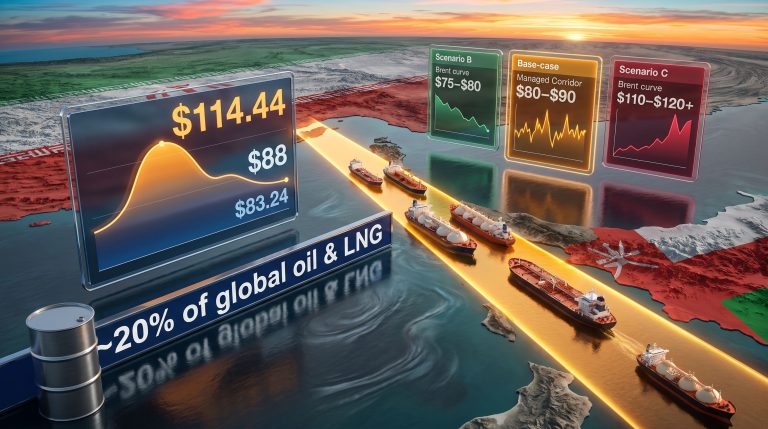
The Strait of Hormuz is only about 33 kilometres wide at its most constricted point, with navigable shipping lanes measuring roughly three kilometres in each direction. Yet through this sliver of water passes approximately one-fifth of all seaborne oil and an equivalent share of global LNG supply exports. No other chokepoint in the world concentrates this much energy supply into this little geography.
When it closes, the arithmetic is brutal: every week of disruption removes an estimated 100 million barrels of available supply from world markets, according to energy logistics modelling. Furthermore, the compounding effect on insurance premiums, freight scheduling, and downstream procurement planning amplifies the disruption far beyond the raw barrel count.
What makes the Strait particularly dangerous as a pressure point is not just its throughput, but what lies behind it. The overwhelming majority of OPEC's market influence stems from spare production capacity sitting within Persian Gulf nations. Consequently, when Hormuz is blocked, the world's emergency production buffer is simultaneously locked away. You cannot simply pump more oil from outside the region quickly enough to compensate.
When big ASX news breaks, our subscribers know first
From Geopolitical Tension to Active Blockade: The 2026 Escalation
The sequence of events that led to the effective closure of the strait in 2026 unfolded with the logic of escalation rather than accident. Following U.S. and Israeli military strikes against Iran, Tehran moved to impose retaliatory maritime measures, including threatening to levy transit tolls on commercial shipping attempting to pass through the corridor.
The geopolitical implications of that proposal extend well beyond economics. It would mean that a nation-state could monetise a chokepoint through which a quarter of the world's oil trade moves, setting a precedent with no parallel in modern energy history.
The United States subsequently initiated a counter-blockade aimed at preventing vessels from exiting the Persian Gulf, creating a layered disruption that trapped shipping in both directions. The resulting pressure on global oil and gas supplies has been severe throughout 2026, with the closure affecting roughly a fifth of the world's combined oil and LNG exports.
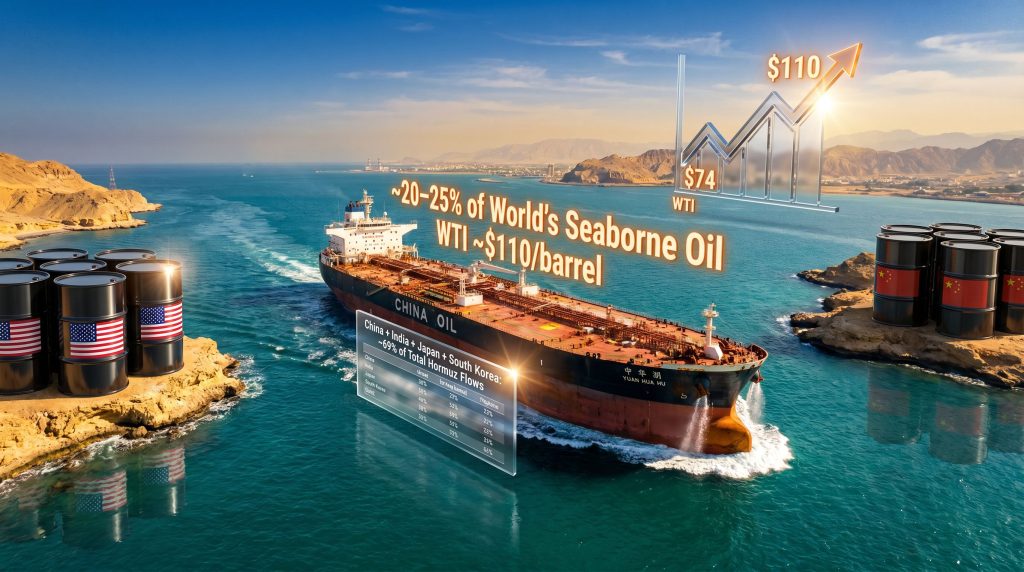
A telling data point arrived mid-May 2026, when the Chinese supertanker Yuan Hua Hu was observed navigating through the contested corridor without incident. The significance lies not in the single vessel, but in what it signals: that some commercial traffic continues to move through the blockade zone, suggesting the closure is selective, unpredictable, and therefore deeply disruptive to the scheduling, insurance, and logistics planning that underpin global energy trade.
Asia's Exposure: Mapping the Supply Chain Vulnerability
No region carries more concentrated exposure to Hormuz disruption than Asia. The combination of China, India, Japan, and South Korea accounts for an estimated 69% of total flows through the strait, creating a collective vulnerability that dwarfs any individual nation's risk.
| Country / Region | Hormuz Exposure | Key Vulnerability Factor |
|---|---|---|
| China | Largest single destination | Record crude imports; LNG dependence |
| India | Second-largest destination | High reliance on Persian Gulf crude grades |
| Japan and South Korea | Combined major importers | Limited alternative supply infrastructure |
| Asia-Pacific Combined | ~69% of total Hormuz flows | Systemic collective exposure |
China's structural position is particularly acute. As the world's largest importer of both crude oil and natural gas, Beijing cannot pivot its energy system away from high-volume imports on any short-term timeline. Industrial scale, refinery configuration, and petrochemical feedstock requirements create a demand floor that is essentially non-negotiable.
There is also a technical dimension that deserves attention. Chinese refineries, many of which were built or optimised during the 2000s and 2010s, were configured around the medium and heavy sour crude grades predominantly produced in the Persian Gulf and sourced from Russia. Processing U.S. light sweet crude at scale requires operational adjustments, meaning any large-scale pivot to Atlantic Basin supply involves both a commercial and an engineering transition.
How China Built Its Energy Buffer: Reserves, Shadow Logistics, and Discounted Supply
What distinguishes China's position in the 2026 crisis from the vulnerabilities of other major Asian importers is the scale of the strategic buffer Beijing accumulated in the years preceding it. China holds a strategic petroleum reserve estimated at approximately 1.2 billion barrels, representing roughly 109 days of import cover at current consumption rates. This is a substantial cushion, however, it is not an unlimited one.
The source of that buffer is where the geopolitical complexity deepens considerably. A meaningful share of China's strategic reserves was accumulated through the purchase of discounted crude from producers operating under Western sanctions, including Iran, Russia, and Venezuela. Collectively, sanctioned crude sources have represented an estimated 22% of China's total import mix in recent years.
The logistics enabling these purchases relied heavily on what the shipping industry describes as the shadow fleet: a network of tankers operating under opaque ownership structures, flagging arrangements, and intermediary companies that facilitate the movement of sanctioned crude outside the reach of conventional Western financial enforcement.
The geopolitical irony is substantial: the United States is now appealing to Beijing to deploy a strategic reserve that was largely constructed using oil purchased in defiance of U.S. foreign policy. Washington's request that China release petroleum reserves to ease global supply pressure runs directly into this uncomfortable history.
The finite nature of the buffer matters enormously for scenario planning. At 109 days of cover, China can manage a three-to-four month Hormuz closure without experiencing acute supply shortages, provided consumption remains steady and alternative procurement channels supplement reserve drawdowns. Beyond that horizon, the calculus shifts sharply.
Why China Is Now Buying More U.S. Oil: Strategic Recalibration in Practice
Understanding why China buying more U.S. oil amid Strait of Hormuz disruption represents a meaningful strategic shift requires first appreciating how completely bilateral energy trade had collapsed before this moment. In 2025, the ongoing US-China trade war prompted Beijing to impose retaliatory levies on American crude oil and LNG, effectively halting shipments between the two countries within months.
A trade relationship in energy commodities that had been growing steadily through the late 2010s was severed in less than a year, demonstrating how quickly commercial energy flows can be redirected when geopolitical friction overrides market incentives. Compounding this, global supply to China had already been compressed by an estimated 1.6 million barrels per day between 2022 and 2024 due to OPEC+ production cuts and parallel Red Sea shipping disruptions.
The Xi-Trump bilateral meeting in Beijing in May 2026 appears to have created the diplomatic conditions under which this situation could begin to reverse. According to a White House official, President Xi expressed opposition to Iran's transit toll proposals and signalled an interest in expanding purchases of American crude to reduce China's dependence on Hormuz-routed supply chains.
What makes this alignment analytically interesting is the divergence between the two governments' official readouts of the same meeting. China's published account referenced Middle East discussions broadly but omitted any mention of energy as a specific topic. Beijing appears to be framing resumed U.S. crude purchases as a commercially rational response to market conditions rather than as a diplomatic concession.
The Numbers Behind the Pivot
Tanker loading data from April 2026 indicates that U.S. crude shipments bound for China reached approximately 600,000 barrels per day, equivalent to roughly 18 million barrels over the course of the month. At prevailing WTI prices of approximately $110 per barrel, that monthly volume represents a market value of approximately $2 billion.
For context, Japan's comparable purchases over the same period amounted to approximately 3 million barrels, placing China's volume at roughly six times the level of the next largest Asian buyer of U.S. crude. Simultaneously, Chinese buyers have been resuming bookings for U.S. LNG cargoes as Asian spot market tightness intensifies, reflecting a parallel diversification strategy.
What Oil Prices Are Signalling
Benchmark crude prices have traced the arc of the Hormuz crisis with considerable clarity. The crude oil price trends observed in this period show Brent reaching approximately $74 per barrel amid early phases of geopolitical tension in mid-2024. By May 2026, as the strait closure materialised, WTI had surged to approximately $110 per barrel, fundamentally reordering the commercial attractiveness of different supply sources for Asian buyers.
At $110 WTI, U.S. crude becomes economically compelling for Chinese refiners despite the significantly longer shipping distance from U.S. Gulf Coast export terminals to Chinese ports. The Cape of Good Hope routing adds roughly 5,000 nautical miles and several weeks of transit time. However, when Persian Gulf crude is simply unavailable, freight cost comparisons become secondary to supply availability.
Energy analysts have noted an unusual feature of the current price environment: despite the severity of supply disruption, a corresponding demand spike has not yet materialised. Traders appear to be in a cautious positioning phase, weighing whether the disruption will resolve quickly against the risk of a prolonged structural supply ceiling.
The next major ASX story will hit our subscribers first
U.S. Production Capacity: Can America Fill the Hormuz Gap?
The United States occupies a structurally unique position in the 2026 energy landscape. It is simultaneously the world's largest producer of both crude oil and natural gas, the precise mirror image of China's status as the world's largest importer of both. This symmetry creates a natural commercial alignment that geopolitical friction had suppressed but that market forces are now pushing to the fore.
However, several practical constraints limit a complete substitution of Persian Gulf supply with American crude:
- Refinery configuration: Chinese refinery complexes optimised for heavier, sourer crude grades require blending adjustments or secondary processing modifications to efficiently process U.S. light sweet crude at scale.
- Contractual obligations: U.S. exporters already hold long-term supply commitments to European customers and other Asian buyers, requiring either new production growth or reallocation from other markets.
- Crude grade mismatch: U.S. WTI and similar light sweet grades produce a different yield profile relative to Persian Gulf medium sour crudes, creating downstream product market implications.
- Volume ceiling: Whether existing U.S. export terminal infrastructure can sustain the throughput required to supply China at current loading rates while meeting other obligations remains an open operational question.
Geopolitical Consequences: What Comes After the Crisis
The 2026 Hormuz disruption is reshaping energy trade architecture in ways that are likely to persist well beyond any diplomatic resolution. In addition, monitoring WTI and Brent futures provides a real-time gauge of how traders are pricing the duration and severity of the ongoing disruption.
Iran's decision to weaponise the strait has accelerated something that energy security strategists had been warning about for years: Asian buyers are now actively pursuing supply chain diversification that reduces Hormuz dependency. The crisis has provided an undeniable operational proof of concept for the risk, transforming what had been a theoretical vulnerability into a lived experience for procurement teams across the region.
For OPEC+ producers, this dynamic is strategically threatening. If Asian buyers structurally reduce their reliance on Hormuz-routed supply, the pricing power of Gulf producers over the world's largest demand growth market erodes meaningfully. This is a multi-year structural headwind with compounding implications for OPEC+ revenue projections.
Three Scenarios for the Road Ahead
| Scenario | Hormuz Status | China-U.S. Energy Trade | Global Oil Price Trajectory |
|---|---|---|---|
| Rapid Resolution | Reopens within 60 days | Moderate increase in U.S. purchases; partial reversal | WTI retreats toward $85-90/barrel |
| Prolonged Disruption | Closed 90-180 days | Sustained high-volume U.S. crude and LNG imports | WTI holds above $100/barrel; rationing risk in Asia |
| Structural Realignment | Intermittent, unpredictable access | Permanent diversification toward Atlantic Basin supply | Structurally elevated prices; accelerated energy transition spending |
Disclaimer: The scenario projections above represent analytical frameworks for understanding possible outcomes and should not be interpreted as investment advice or financial forecasts. Energy markets are subject to rapid changes driven by geopolitical developments, regulatory shifts, and market dynamics that cannot be reliably predicted.
Frequently Asked Questions
Why Did China Halt U.S. Oil Purchases in the First Place?
China suspended purchases of American crude and LNG during 2025 as a retaliatory trade measure following the Trump administration's imposition of sweeping tariffs on Chinese goods. The levies made bilateral energy trade both economically and politically untenable at the time, effectively halting a commercial relationship that had been building for years.
What Percentage of Global Oil Trade Passes Through the Strait of Hormuz?
Approximately one-fifth of the world's combined oil and LNG exports transit the Strait of Hormuz. The disruption caused by its effective closure in 2026 has affected supply chains across Asia, Europe, and beyond.
Does China Have Sufficient Reserves to Weather a Prolonged Hormuz Closure?
China holds a strategic petroleum reserve estimated at approximately 1.2 billion barrels, providing roughly 109 days of import cover at current consumption levels. This buffer is substantial but finite. A closure extending beyond three to four months would significantly test its adequacy, particularly if global inventory levels continue declining at the pace observed in early 2026.
What Did the Xi-Trump Beijing Summit Produce on Energy?
According to U.S. officials, both leaders aligned on the position that the Strait of Hormuz must remain open to support the free flow of global energy. President Xi also expressed opposition to Iran's toll proposals and indicated interest in expanding U.S. crude purchases, though China's own official meeting readout did not explicitly reference energy among the topics discussed.
Why Is U.S. Crude Commercially Viable for China Despite Longer Shipping Distances?
At prevailing WTI prices of approximately $110 per barrel, the supply security premium of Atlantic Basin crude outweighs the additional freight costs associated with longer shipping routes. When Persian Gulf supply is disrupted or unavailable, the question shifts from cost optimisation to supply availability, fundamentally altering the commercial calculus for Chinese procurement teams.
What Are the Long-Term Implications of This Supply Shift for OPEC?
If Asian buyers structurally reduce their dependency on Hormuz-routed supply as a result of the 2026 crisis, OPEC+ producers face a gradual erosion of pricing power over their most important demand growth market. The crisis may prove to be an inflection point that accelerates diversification strategies that would otherwise have taken a decade or more to mature under normal market conditions. Furthermore, China buying more U.S. oil amid Strait of Hormuz disruption signals a structural realignment in global energy trade whose full consequences are only beginning to materialise.
Want to Track the Next Major Commodity Market Shift Before the Crowd Does?
Discovery Alert's proprietary Discovery IQ model scans ASX announcements in real time, instantly identifying significant mineral discoveries and actionable investment opportunities across more than 30 commodities — so subscribers gain a market-leading edge the moment news breaks. Explore how historic discoveries have generated substantial returns and begin your 14-day free trial at Discovery Alert to position yourself ahead of the broader market.