
August 5, 2026
The Hidden Fault Line Beneath the Crude Oil Narrative
Energy markets have a long history of fixating on the wrong variable. Investors track crude benchmarks obsessively, geopolitical headlines move equity markets in real time, and diplomatic press releases trigger billions in algorithmic trading activity. Yet the physical product that actually keeps the modern economy functional — the diesel that moves freight, harvests crops, and powers industrial equipment — frequently sits outside the mainstream conversation until a crisis forces it to the surface.
That moment may have arrived in 2026. While Brent crude oscillates between diplomatic optimism and geopolitical escalation around the US-Iran conflict, a quieter but potentially more consequential story is unfolding in the US distillate market. Inventories are approaching levels not seen since the late 1990s, domestic refining capacity has been permanently reduced by nearly 430,000 barrels per day, and the structural mechanisms that historically rebalanced tight US diesel markets are less available than they were during previous supply crunches.
Understanding why the US diesel supply crunch of 2026 is structurally different from past episodes — and why its inflationary consequences could ripple well beyond the energy sector — requires looking past crude benchmarks and examining the physical supply architecture underneath.
When big ASX news breaks, our subscribers know first
Why Diesel Operates on a Different Clock Than Crude Oil
The Structural Disconnect Between Headline Benchmarks and Physical Reality
Crude oil prices are a forward-looking signal. They respond to diplomatic developments, OPEC+ production decisions, inventory estimates, and geopolitical risk premiums in near real time. Distillate markets, by contrast, are governed by physical supply and demand fundamentals that move on longer timescales and are far less responsive to negotiated settlements or policy announcements.
This distinction matters enormously in the current environment. For broader context on crude price behaviour, our crude oil volatility guide illustrates how headline benchmarks can diverge sharply from downstream physical realities. Commodity research firm Sparta Commodities has noted that even a successful resolution to the US-Iran conflict would not restore the refinery capacity retired in 2025, nor would it rapidly rebuild distillate inventories drawn down over more than 18 months of structural deficit.
When crude prices fall on optimistic negotiation headlines, diesel prices do not necessarily follow with the same magnitude or speed. This decoupling is not a market anomaly but a fundamental feature of how downstream petroleum markets function, and it is precisely what makes the current US diesel supply crunch so poorly understood by mainstream market commentary.
Refinery Configuration and the Crude Grade Problem
US Gulf Coast refineries were largely built and optimised to process heavy, high-sulphur crude feedstocks — the so-called sour crude grades. These configurations maximise diesel yield relative to lighter crude inputs. When geopolitical disruption constrains access to heavy sour grades, refiners face a yield penalty even when crude is available at moderate prices.
The result is reduced diesel output per barrel processed, compounding the capacity loss from permanent refinery closures. This technical reality is rarely captured in crude price headlines but has direct consequences for distillate supply during periods when sour crude access is restricted.
How the US Diesel Supply Crunch Reached Historical Extremes
A Timeline of Structural Refinery Capacity Losses
The inventory depletion underpinning the 2026 US diesel supply crunch did not emerge overnight. It is the product of a multi-year contraction in domestic refining capacity that accelerated sharply in 2025 with two significant facility closures:
- LyondellBasell Houston refinery: Approximately 290,000 barrels per day of capacity, ceased operations in early 2025
- Phillips 66 Wilmington, California refinery: Approximately 139,000 barrels per day of capacity, shuttered later the same year
- Combined structural loss: Approximately 429,000 barrels per day of domestic refining capacity permanently removed in a single year
- Total US operable refineries: Declined from approximately 132 in 2019 to roughly 125 as of mid-2026
- National diesel output trajectory: Declining from 4.58 million barrels per stream day in 2019 toward approximately 4.3 million b/d
These are structural losses. Unlike temporary maintenance outages or utilisation reductions, permanently closed refineries do not respond to diplomatic breakthroughs, OPEC+ production adjustments, or government policy directives. The capacity is gone.
What the EIA Inventory Data Actually Shows
The Energy Information Administration's data on US distillate inventories paints a concerning picture that has been building for several years. The following table summarises the key inventory metrics as of mid-2026:
| Inventory Metric | Current Status | Historical Benchmark |
|---|---|---|
| Combined US gasoline, distillate and jet fuel (year-end 2026 forecast) | ~375 million barrels | Lowest since 2000 (358 MMb) |
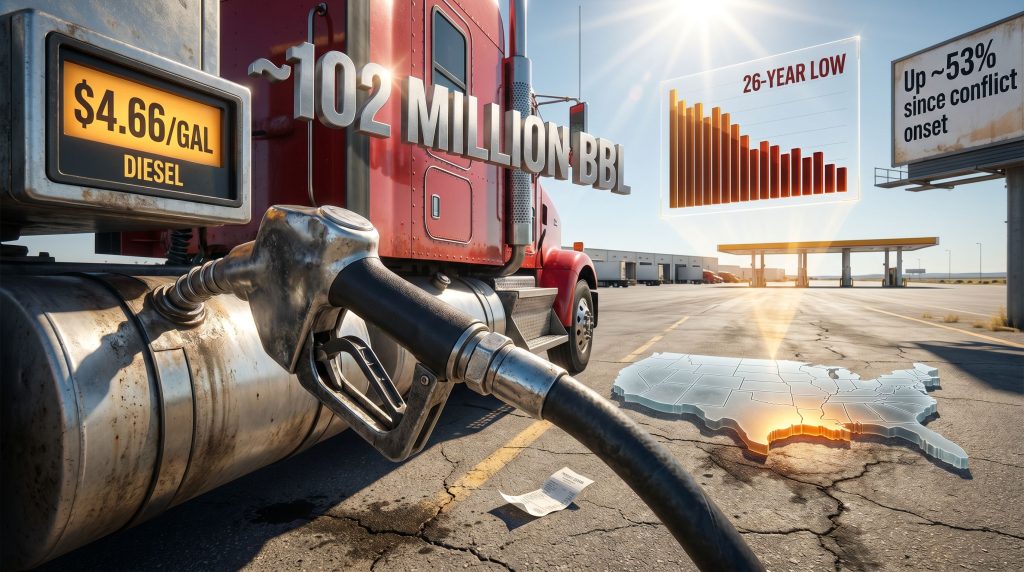
| US distillate stocks (late April 2026) | ~102 to 106.7 million barrels | Lowest for this time of year since 1996 to 2003 |
| Days of supply coverage (~4.2 Mb/d consumption) | ~25 days | Below critical buffer thresholds |
| Year-on-year inventory change (4 weeks ending April 24, 2026) | Down 24.1 million barrels | Accelerating drawdown |
The EIA's most recent weekly data had already flagged multi-year low distillate inventory levels as a structural risk heading into 2026, noting that persistent international distillate demand had placed sustained downward pressure on US stockpiles. The accelerating drawdown visible in the four-week April data suggests this trajectory is worsening rather than stabilising.
Export Demand and the "Swing Producer" Paradox
A less discussed dimension of the US diesel supply crunch involves export flows. The United States has been a significant exporter of distillate products to Latin American and European markets. During previous supply crunches, the natural response was to reduce exports and redirect supply domestically. However, long-term supply contracts, infrastructure dependencies, and trade relationships create friction in this rebalancing process.
Furthermore, Sparta Commodities' analysis highlights an additional complication: European markets are currently better supplied than historical norms due to demand softness and rerouted Russian diesel flows finding alternative pathways to the Atlantic Basin. This means the transatlantic rebalancing mechanism that historically helped tighten US-European distillate arbitrage is less available in 2026 than during previous supply stress events, including the 2022 crisis. The broader European energy price pressures have also reshaped how Atlantic Basin supply flows are distributed.
The Geopolitical Dimension: US-Iran Conflict and Diesel Market Exposure
Why Gulf Coast Refinery Configuration Creates Specific Vulnerability
The US-Iran conflict has introduced a crude supply dimension that interacts with the structural inventory deficit in a particularly damaging way. As noted above, Gulf Coast refineries are configured for heavy sour crude feedstocks. Iran historically supplied or enabled access to crude grades that match this configuration.
Disruption to these supply flows forces refineries to either process less optimal crude blends, accept throughput reductions, or pay premium prices for alternative sour crude sources. Each of these responses results in either reduced diesel output, higher production costs, or both — compounding the structural supply deficit that the refinery closures had already created.
Diplomatic Timelines vs. Physical Market Realities
As of mid-May 2026, US-Iran negotiations had stalled significantly. The Trump administration characterised Iran's negotiating position as unacceptable, while Iran reportedly rejected demands to dismantle nuclear facilities, though Iranian media disputed specific characterisations of these positions. The latest diplomatic setback pushed Brent crude 4.2% higher to US$105.50 per barrel.
Physical diesel markets do not benefit from diplomatic optimism. Even a complete resolution to the Iran conflict would not restore the 429,000 barrels per day of domestic refining capacity permanently retired in 2025, nor would it immediately rebuild distillate inventories that have been depleting for over 18 months. Geopolitical negotiations operate on a political clock; diesel inventories deplete on a physical one.
UBS' market analysis acknowledged that equity markets had briefly reached fresh record highs on optimism for a US-Iran agreement before the latest round of talks collapsed. This pattern — where equity market sentiment responds to diplomatic signals that ultimately prove unresolved — illustrates the disconnect between geopolitical hope and physical commodity reality. The trade war oil impact adds yet another layer of complexity to an already pressured supply environment.
US Diesel Price Scenarios: What Could Happen Through Summer 2026
Where Prices Stand Today
The price impact of the US diesel supply crunch is already visible at the pump and in freight cost structures across the economy:
| Geography | Diesel Price (May 2026) | Key Threshold |
|---|---|---|
| US National Average Diesel | ~$4.66/gallon (rising) | Up approximately 53% since conflict onset |
| California (San Francisco) | Greater than $6.00/gallon | Regional extreme |
| US Gasoline National Average | $4.48/gallon (as of May 6) | Highest since 2022 |
| Potential upside scenario | ~$5.00+ per gallon | Record territory if Hormuz unresolved |
Patrick De Haan, Head of Petroleum Analysis at GasBuddy, has characterised the situation as a race against time, warning that if the Strait of Hormuz bottleneck remains unresolved, prices could conceivably reach record levels around the US$5.00 per gallon threshold nationally. California, where regulatory complexity and supply chain factors amplify national price trends, has already exceeded $6.00 per gallon regionally.
Three Divergent Paths for Summer 2026
The range of outcomes for US diesel pricing over the summer months is wide, depending on several intersecting variables. Three broad scenarios can be modelled:
Scenario A: Partial Diplomatic Resolution
- Crude prices moderate from current levels; distillate supply remains structurally constrained by capacity losses
- National diesel prices plateau but remain elevated above $4.50 per gallon
- Inventory rebuilding begins slowly in Q4 2026 as maintenance cycles normalise
- Inflationary transmission continues but at a contained pace
Scenario B: Prolonged Hormuz Disruption
- Heavy sour crude access remains restricted through the summer months
- Gulf Coast refinery throughput declines further as feedstock economics deteriorate
- National diesel average approaches or breaches the $5.00 per gallon threshold by July 2026
- Freight and agricultural input costs spike; CPI readings incorporate diesel-driven inflationary pressure
Scenario C: Hurricane Season Compounding Event
- A Gulf of Mexico weather event layers production disruption on top of the existing inventory deficit
- The so-called "tank bottom" risk materialises, where inventories fall to operationally critical minimums and spot diesel markets experience acute regional shortages
- Diesel crack spreads reach multi-year highs; trucking, logistics, and agricultural costs spike sharply
- Scenario C represents a genuine inflationary shock capable of triggering demand destruction across multiple sectors simultaneously
These scenarios are speculative projections based on current market conditions and should not be construed as investment advice or price forecasts. Energy markets are subject to rapid and unpredictable change.
Sectoral Exposure: Which Parts of the Economy Are Most Vulnerable
Why Diesel Inflation Is Categorically Different From Gasoline Inflation
A critical distinction that mainstream economic commentary frequently misses is that diesel price increases cannot be absorbed or deferred the way gasoline price increases often can. Gasoline demand has meaningful elasticity — consumers reduce discretionary driving, combine errands, or shift to alternative transport when pump prices rise. Diesel demand does not offer the same flexibility.
Freight trucks must move goods; farm equipment must operate during narrow harvest windows; construction machinery runs on fixed project timelines. Long-term contracts between shippers, farmers, and industrial operators mean that price spikes become direct input cost shocks that propagate through supply chains almost immediately. This inelasticity is precisely why diesel inflation has historically been a more reliable leading indicator of broad-based goods inflation than gasoline price movements.
The Transmission Mechanism From Pump to Consumer Prices
The inflationary pathway from diesel prices to consumer goods follows a predictable but often underappreciated chain:
- Freight and trucking: Every goods movement by road incorporates diesel as a variable input cost. Fixed-contract trucking arrangements mean price increases either compress margins immediately or get passed through at contract renewal
- Agricultural supply chains: Diesel powers planting and harvesting equipment, irrigation systems, and grain dryers. Harvest season timing creates concentrated demand windows where diesel access is non-negotiable
- Industrial and construction activity: Heavy machinery, generators, and site equipment run on diesel. Project cost overruns from fuel price spikes reduce margins and delay delivery timelines
- Food supply chains: Agricultural input cost increases eventually translate into retail food prices, with a lag of weeks to months depending on the commodity
- Consumer goods broadly: Higher freight costs for manufactured goods show up across retail categories, from electronics to apparel to building materials
This multi-stage transmission mechanism means that a sustained diesel supply crunch does not stay contained within the energy sector. Consequently, it becomes a broad-based input cost inflation event with measurable effects on the commodity price impacts felt across industries dependent on affordable logistics.
The next major ASX story will hit our subscribers first
Global Market Implications of the US Diesel Supply Crunch
Atlantic Basin Supply Flows and Why 2026 Is Different
During the 2022 diesel crisis, transatlantic arbitrage flows played a significant role in rebalancing the US market. European surplus product moved across the Atlantic to ease US shortfalls. In 2026, however, this mechanism is less available for two key reasons:
- European demand softness has created some local inventory cushioning, but the structural European refining base has also been under pressure
- Russian diesel rerouting following sanctions has found alternative buyers in Asia and other markets, reducing the redirectable volume available for Atlantic Basin rebalancing
The net effect is that the United States faces the 2026 US diesel supply crunch with fewer external supply options than were available during the most recent comparable stress event. Furthermore, OPEC's market influence over heavy sour crude allocations adds an additional layer of uncertainty to how quickly supply gaps can be filled.
Emerging Market Exposure
Countries without domestic refining buffers face a compounding risk. When US and European distillate markets tighten simultaneously, the global spot market for diesel becomes competitive and expensive. Emerging markets that depend on imported distillate for agricultural and industrial activity face both higher prices and, in extreme scenarios, reduced availability.
Mexico represents a partial exception to this pattern. The Olmeca refinery's expanding contribution has driven domestic diesel production up 69.9% year-on-year to 285.7 million barrels per day in the first quarter of 2026, reducing the country's dependence on imported product. However, Mexico's price-cap framework — maintained through IEPS (Special Tax on Production and Services) fuel subsidies — means that any sustained international price increase directly expands the fiscal cost of maintaining retail caps of MX$28 per liter on diesel and MX$24 per liter on Magna gasoline.
At peak subsidy levels in early April 2026, the IEPS diesel stimulus reached 81.2% of the statutory rate, meaning the Mexican government was absorbing nearly the full tax liability to keep retail prices at the agreed ceiling. With the Sheinbaum administration spending approximately US$280 million per week in IEPS fuel subsidies at those peak levels, each resurgence in international diesel prices directly expands the gap that the mechanism must absorb.
Diesel as a Macroeconomic Indicator
What Distillate Consumption Tells Us About Real Economic Activity
Among commodity analysts, diesel consumption has long held a reputation as one of the more reliable proxies for real economic activity. Unlike crude oil, which is partially directed toward non-productive uses and can be stockpiled speculatively, diesel is consumed almost entirely in the act of producing, moving, or constructing something.
When diesel demand rises, economic activity is generally expanding; when it contracts sharply, a genuine slowdown is typically underway. This relationship gives distillate inventory data a significance beyond energy market analysis. The current trajectory — combining structural supply reduction with demand that remains elevated — suggests genuine economic activity has not slowed sufficiently to relieve the supply pressure organically through demand destruction.
Comparing 2022 and 2026: A Structural Contrast
The 2022 diesel crisis is the most recent comparable event, but important structural differences make 2026 potentially more concerning:
| Factor | 2022 Diesel Crisis | 2026 Structural Setup |
|---|---|---|
| Primary trigger | Post-COVID demand surge combined with Russia sanctions | Permanent refinery closures compounded by geopolitical crude disruption |
| Inventory starting point | Already below 5-year average | At or near 26-year lows |
| Refinery capacity buffer | Partially available | Structurally reduced by ~429,000 b/d |
| Transatlantic rebalancing | Active European supply flows available | Reduced availability due to demand softness and rerouted Russian flows |
| Resolution pathway | Demand destruction and supply normalisation over 12 to 18 months | No near-term domestic capacity restoration mechanism exists |
The critical difference is resolution pathway. In 2022, the market could eventually rely on a combination of demand reduction and supply normalisation as global energy infrastructure adapted. In 2026, the structural removal of approximately 429,000 barrels per day of domestic refining capacity creates a floor below which domestic supply cannot reach, regardless of crude price movements, diplomatic outcomes, or OPEC+ decisions.
Key Risk Factors That Could Accelerate the Supply Crunch
Hurricane Season and Gulf Coast Refinery Vulnerability
The Atlantic hurricane season, running from June through November, represents one of the most significant near-term tail risks for the current supply situation. Gulf Coast refinery concentration means that a significant storm event can simultaneously disrupt both offshore production and onshore refining capacity. With inventories already near historical lows, the buffer that previously absorbed hurricane-related disruptions is materially thinner than in prior seasons.
OPEC+ Production Decisions and Heavy Crude Availability
OPEC+ production policy directly affects the availability and pricing of heavy sour crude grades that US Gulf Coast refineries depend on. If OPEC+ members respond to lower crude prices with production cuts that disproportionately affect heavy sour volumes, the diesel yield penalty from suboptimal crude blending could worsen further during the summer months.
Unexpected Demand Surges
Extreme heat events drive electricity demand that power grids may struggle to meet from conventional generation alone. Emergency generator deployment, which runs primarily on diesel, can create sudden localised demand spikes. Similarly, unusual agricultural weather patterns that compress planting or harvesting windows into shorter periods create concentrated diesel demand that strains regional supply networks.
Canadian Crude Supply and Q3 2026 Expectations
Canadian crude supply timelines represent a potential partial offset. If pipeline capacity expansions or production increases from Canadian oil sands deliver heavier crude volumes to US refineries in Q3 2026, some of the crude grade mismatch issue affecting diesel yields could be partially addressed. However, this depends on infrastructure and production decisions outside US government control and cannot be treated as a reliable near-term relief mechanism.
Frequently Asked Questions: US Diesel Supply Crunch 2026
What Is Causing the US Diesel Supply Shortage in 2026?
The 2026 US diesel supply crunch reflects the convergence of two independent forces. First, the permanent closure of two major US refineries in 2025 removed approximately 429,000 barrels per day of domestic refining capacity that cannot be quickly replaced. Second, the US-Iran conflict has disrupted access to the heavy sour crude grades that remaining Gulf Coast refineries depend on for maximum diesel yield, reducing output per barrel processed even where capacity technically remains available.
How Low Are US Diesel Inventories Right Now?
US distillate stockpiles as of late April 2026 stood at approximately 102 to 106.7 million barrels, the lowest level for this time of year since the 1996 to 2003 period. The four-week change ending April 24, 2026 showed an accelerating drawdown of 24.1 million barrels year-on-year. At current consumption rates of approximately 4.2 million barrels per day, this represents roughly 25 days of supply coverage — below levels typically considered adequate buffers against unexpected demand or supply disruptions.
Could the US Run Out of Diesel in 2026?
A complete national diesel shortage is an extreme tail scenario, but analysts have flagged the so-called "tank bottom" risk — where inventories fall to operationally critical minimums and spot market shortages emerge in specific regions rather than nationally. This scenario could materialise as early as July 2026 if a hurricane season disruption compounds the existing structural deficit. Regional shortages would be more likely than a national supply failure, but either would have significant economic consequences.
What Would $5/Gallon Diesel Mean for the US Economy?
At five dollars per gallon nationally, diesel would be entering record territory. The direct impact would fall first on trucking, logistics, and agricultural operations that cannot reduce diesel consumption in the short term. Secondary effects would include higher food prices, elevated manufactured goods freight costs, and construction project delays. Goldman Sachs analysts have also flagged compounding shortages in jet fuel and other refined products that could amplify the broader economic disruption. The Federal Reserve would face a challenging environment where supply-driven inflation coexists with potential demand weakness, limiting the effectiveness of conventional monetary policy responses.
How Does the Iran Conflict Affect US Diesel Prices?
The Iran conflict affects US diesel prices through two channels. The first is direct: restricted access to heavy sour crude grades reduces diesel yield per barrel processed at Gulf Coast refineries. The second is indirect: elevated crude prices increase the raw material cost embedded in all refined products, including diesel. Importantly, Sparta Commodities' analysis suggests the diesel market has developed its own tightening logic independent of the Iran situation, meaning resolution of the conflict would not automatically eliminate the structural supply deficit.
When Could US Diesel Inventories Begin to Recover?
Under the most optimistic scenario — involving partial diplomatic resolution, normalising crude grades, and favourable weather — a slow inventory rebuilding process could begin in Q4 2026. However, the structural refinery capacity loss of approximately 429,000 barrels per day means that domestic production will not return to pre-2025 levels without significant new investment in refining infrastructure, a process that typically requires years rather than months. Full normalisation of distillate inventories relative to historical norms likely extends well into 2027 under even favourable assumptions.
Which US Regions Are Most Vulnerable to Diesel Price Spikes?
California is already exhibiting the most extreme price signals, with San Francisco area diesel exceeding $6.00 per gallon. The Gulf Coast region faces the most direct exposure to both hurricane disruption risk and the crude grade mismatch problem. The Northeast, which relies heavily on distillate for heating oil as well as transportation diesel, faces concentrated seasonal demand risk if any late-year supply event coincides with early heating season demand. Agricultural heartland states face the greatest exposure during planting and harvesting windows when diesel demand is highly concentrated and inelastic.
Key Takeaways: The US Diesel Supply Crunch in Context
The convergence of structural refinery capacity losses, historically low distillate inventories, and geopolitical disruption to critical crude supply chains has created a diesel market environment that commodity markets may be materially underestimating. Several conclusions stand out from this analysis:
- US distillate inventories are tracking toward levels not seen since the late 1990s, with the four-week drawdown data showing acceleration rather than stabilisation
- The ~429,000 barrels per day of permanently retired US refining capacity cannot be restored by diplomatic breakthroughs, OPEC+ decisions, or government policy directives
- The EIA projects combined US refined product inventories will reach approximately 375 million barrels by year-end 2026, the lowest since 2000
- National average diesel prices have risen approximately 53% from conflict onset, with California markets already exceeding $6.00 per gallon
- The structural setup of 2026 is materially more concerning than the 2022 diesel crisis because no near-term domestic capacity restoration mechanism exists
- Diesel inflation transmits directly into freight, agricultural, and industrial input costs, creating a broad-based inflationary feedback loop that extends well beyond the energy sector
- The "tank bottom" risk — where inventories fall to operationally critical minimums — could materialise in specific regions as early as July 2026 under adverse scenario conditions
Disclaimer: This article is intended for informational purposes only and does not constitute financial, investment, or commodity trading advice. Energy market forecasts and scenario projections involve inherent uncertainty and should not be relied upon as price predictions. Readers should consult qualified financial and energy market professionals before making investment decisions. All statistics and data referenced are sourced from publicly available Energy Information Administration reports and commodity market analysis as of May 2026.
Want To Stay Ahead of Commodity Markets Before the Broader Market Catches On?
Discovery Alert's proprietary Discovery IQ model delivers real-time alerts on significant ASX mineral discoveries, instantly cutting through market noise to surface actionable opportunities — explore historic discoveries and their exceptional returns to understand the upside potential, then begin your 14-day free trial at Discovery Alert to position yourself ahead of the market.