May 15, 2026
The Storage Arithmetic That Determines When Iran Breaks
Every maritime blockade in history has rested on a deceptively simple assumption: cut off a nation's ability to sell its primary export, and the internal economic pressure will eventually force capitulation. For oil-producing states, the mechanism is even more precise. The US blockade of Iranian oil exports is demonstrating in real time that blocking tankers, filling storage tanks, forcing wells shut, and damaging reservoirs can unravel a production system from the inside. The theory is elegant. The execution, however, is considerably more complicated.
What the data reveals roughly one month into the operation is that the blockade has achieved near-total suppression of Iran's conventional waterborne crude export channels, while simultaneously failing to trigger the rapid production collapse that US officials publicly predicted. Understanding why these two outcomes coexist requires a closer look at reservoir physics, storage infrastructure, shadow logistics, and the strategic behaviour of a nation that has spent decades learning to survive under layered economic pressure. The broader context of oil trade geopolitics adds further complexity to this already intricate situation.
When big ASX news breaks, our subscribers know first
Export Interdiction vs. Production Collapse: Why They Are Not the Same Thing
The distinction between disrupting exports and collapsing production is not semantic. It is the central variable determining the entire timeline of this geopolitical confrontation.
Before the blockade commenced on 13 April, Iran's waterborne crude exports averaged approximately 1.8 million barrels per day (b/d), according to Argus Media reporting. Since that date, vessel tracking firm TankerTrackers.com has recorded zero successfully completed crude export voyages, defining success as tankers that cleared the blockade perimeter without returning with their cargo intact. On the export disruption metric, the operation has been remarkably effective.
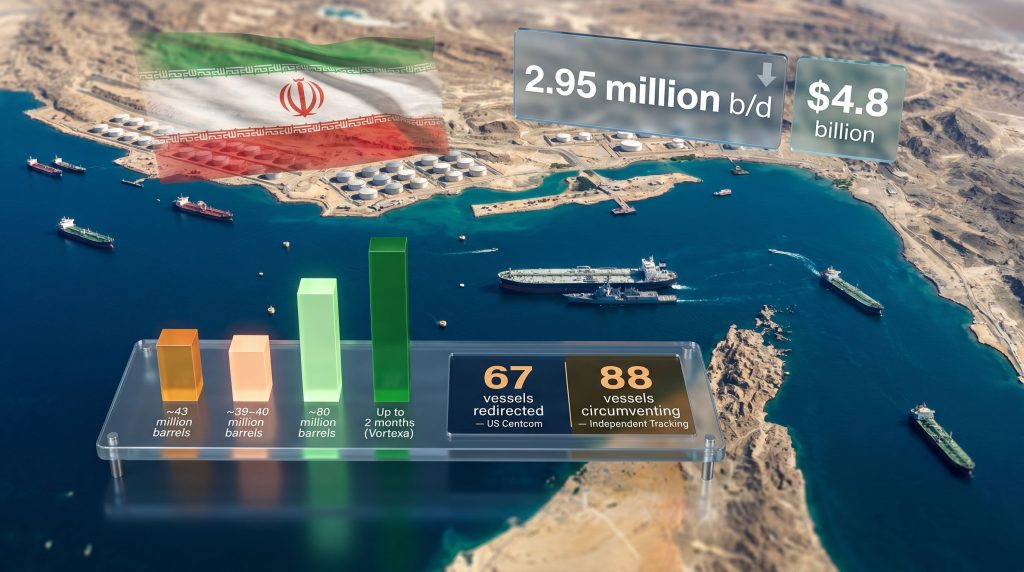
On the production disruption metric, however, the picture is starkly different. Argus estimates place Iranian crude output in April at approximately 2.95 million b/d, representing a decline of only 130,000 b/d from the prior month. This is among the smallest production reductions recorded across Gulf producers during the same period. The gap between export disruption and production impact is not a sign of blockade failure on its own terms. It is a function of a buffer mechanism that every oil analyst tracking this situation understands as the critical variable: storage capacity.
How the Pressure Chain Is Supposed to Work
The theoretical framework behind export-denial strategies applied to oil producers follows a sequential logic:
- Block seaborne exports to eliminate the primary revenue channel.
- Force produced-but-unsold barrels into storage, progressively filling available tank capacity.
- Once storage reaches physical capacity, producers face an impossible choice: continue producing with nowhere to put the oil, or shut in wells.
- Unplanned well shut-ins carry significant technical consequences, including reservoir pressure loss, water influx into producing formations, and formation damage that can permanently reduce a field's recoverable reserves.
- Reservoir damage forces production back online at materially lower rates, even after the geopolitical pressure eventually subsides.
The critical insight that separates theory from observed reality is step two. The rate at which storage fills is entirely dependent on how much storage capacity exists in the first place. And on this question, the analytical community is deeply divided.
The Storage Capacity Debate: The Number That Changes Everything
Three independent assessments of Iran's available crude storage capacity were circulating among energy analysts as of late April, and their divergence has profound implications for the blockade's effectiveness timeline.
| Source | Onshore Storage | Floating Storage | Combined | Implied Production Runway |
|---|---|---|---|---|
| Kpler | ~39 million barrels | ~4 million barrels | ~43 million barrels | Approximately 4-5 weeks |
| Vortexa | ~40 million barrels | Significant empty tanker fleet | ~40M+ variable | Up to 2 months |
| FGE Consultancy | ~80 million barrels | Not specified | ~80 million barrels | Approximately 8-9 weeks |
The spread between the conservative and expansive estimates is not a rounding error. It represents a potential doubling of the time available before Iran faces unavoidable production decisions. The FGE consultancy figure of approximately 80 million barrels of onshore storage capacity, if accurate, implies Iran could sustain output at or near current levels for roughly two months without exporting a single barrel.
Vortexa's assessment adds a further dimension: the availability of a significant number of empty tankers that could be repurposed as floating storage, potentially extending the production runway to a similar two-month timeframe through a different mechanism.
The wide gap between storage capacity estimates represents the single most consequential analytical variable in this situation. Forecasters working from the conservative 43-million-barrel figure and those working from the 80-million-barrel figure are effectively operating on different geopolitical timelines.
The Shadow Fleet Factor: Where Official Claims and Independent Data Diverge
US Central Command (Centcom) has reported that 67 commercial vessels were redirected, 15 humanitarian vessels were permitted passage, and 4 vessels were disabled to enforce compliance since the blockade began. These figures project an image of comprehensive interdiction. Independent vessel tracking data from Vortexa, however, tells a meaningfully different story.
According to Vortexa, 88 vessels carrying energy commodities successfully circumvented the blockade, with only 9 confirmed interdictions by US forces recorded.
| Metric | US Centcom Position | Independent Tracking (Vortexa) |
|---|---|---|
| Vessels redirected | 67 | Not specified |
| Vessels circumventing blockade | Not specified | 88 |
| Confirmed interdictions | Not specified | 9 |
| Vessels disabled | 4 | Not specified |
| Humanitarian vessels permitted | 15 | Not specified |
This enforcement gap is structurally predictable when the operational characteristics of Iran's maritime logistics network are considered. Furthermore, over decades of layered international sanctions on oil trading, Iran developed a parallel tanker infrastructure that operates outside conventional tracking systems. This network relies on several interlocking mechanisms:
- Automatic Identification System (AIS) signal manipulation, including disabling transponders or transmitting false location data to obscure vessel movements.
- Ship-to-ship (STS) transfers conducted in open water, allowing sanctioned crude to change vessels before entering monitored shipping lanes.
- Flag-of-convenience registrations that obscure the beneficial ownership of individual tankers and complicate enforcement decisions.
- Older, lower-value vessels deployed as sacrificial assets, reducing the economic cost of potential interdiction or seizure.
The implication is that while the blockade has eliminated Iran's ability to conduct conventional, large-scale crude exports through recognised channels, a residual flow of smaller volumes continues through non-standard routes. The nine confirmed interdictions out of 88 circumvention attempts suggests an interdiction success rate of roughly 10 percent for vessels actively attempting evasion.
Revenue Losses and Fiscal Pressure: The $4.8 Billion Calculation
The economic cost of the blockade to Iran is substantial and accumulating. Based on export volume reductions against prevailing crude price benchmarks across the blockade's duration, Iran's oil revenue losses since 13 April are estimated at approximately $4.8 billion, according to Argus Media reporting.
This figure compounds as the blockade extends. Iran's oil sector contributes a significant share of government revenue, making sustained export disruption fiscally destabilising over time. Secondary economic pressures intensify the impact:
- Currency depreciation erodes the domestic purchasing power of any hard currency reserves being drawn down to offset revenue shortfalls.
- Inflation accelerates as import costs rise and domestic monetary conditions tighten.
- Reduced import capacity constrains the government's ability to procure essential goods and industrial inputs.
US Defense Secretary Pete Hegseth, testifying before a Senate panel on 12 May, characterised the economic asymmetry in direct terms, arguing that the financial burden imposed on Iran substantially exceeds any pressure experienced by the United States. This represents the official US strategic assessment of the blockade's economic effectiveness.
Iran's parliamentary speaker Mohamed Ghalibaf publicly dismissed the Trump administration's predictions of rapid production collapse, specifically referencing President Trump's 26 April statement that Iranian oil infrastructure would implode within days due to the blockade pressure. Ghalibaf's public commentary framed the situation as manageable, signalling Tehran's intent to project resilience regardless of underlying operational conditions.
Three Scenarios for Iranian Production Over the Next 60-90 Days
The trajectory of Iranian crude output over the coming weeks will be determined by the interaction of storage fill rates, shadow fleet capacity, diplomatic developments, and pre-emptive strategic decisions by Iranian producers. Three distinct pathways are plausible:
Scenario A: Shadow Fleet Scaling and Floating Storage Expansion
Iran accelerates the conversion of older tankers into floating storage while routing smaller crude volumes through corridors that have demonstrated low interdiction rates. Production is maintained near current levels, revenue losses continue accumulating, but reservoir integrity is preserved. This scenario is supported by the observed enforcement gap between official interdiction claims and independent tracking data.
Scenario B: Pre-Emptive Production Curtailment
Rather than waiting for storage to reach physical capacity, Iran voluntarily reduces output by an estimated 300,000 to 500,000 b/d. This extends the storage runway, preserves negotiating leverage, and avoids the catastrophic well shut-in scenario. Iran's historical behaviour during previous sanctions cycles demonstrates a pattern of managed output adjustments rather than chaotic forced shut-ins. This scenario is consequently the most consistent with Iran's institutional capabilities and prior strategic conduct.
Scenario C: Negotiated Partial Resolution
Ongoing indirect diplomatic engagement produces a partial easing of enforcement, allowing some Iranian exports to resume through agreed channels. Production stabilises above 2.8 million b/d. Both sides have publicly characterised their most recent positions as containing reasonable elements, suggesting the negotiating floor has not been permanently removed.
The next major ASX story will hit our subscribers first
The Reservoir Physics Behind the Urgency
One aspect of this situation that receives insufficient attention in mainstream coverage is the technical asymmetry between export disruption and production shut-ins. Unlike natural gas pipelines, which can be throttled with relative operational simplicity, crude oil reservoirs respond poorly to abrupt production interruptions.
When a producing well is shut in without planned depletion management, several damaging processes can initiate:
- Reservoir pressure redistribution, which can alter fluid flow dynamics and reduce the natural drive mechanism supporting production.
- Water influx into previously oil-bearing zones, a process known as water encroachment, which permanently reduces the fraction of the reservoir accessible to production.
- Formation damage from scale precipitation, wax deposition, or asphaltene dropout under changed temperature and pressure conditions.
- Reduced ultimate recovery, meaning the total volume of oil extractable from a given field over its lifetime is permanently diminished.
This is precisely why Iran is more likely to pursue managed pre-emptive production reductions rather than allow storage to overflow and force emergency shut-ins. The long-term cost of reservoir damage substantially exceeds the short-term revenue loss from a controlled output reduction.
Global Supply Architecture: What the Strait of Hormuz Means in Numbers
The broader market significance of this disruption extends well beyond Iran's individual production profile. Prior to the conflict, approximately one-fifth of all global oil exports transited the Strait of Hormuz. The effective restriction of this chokepoint has sent cascading disruptions through the global crude supply architecture, particularly affecting Asian refineries that historically relied on discounted Iranian barrels as feedstock. In addition, the OPEC market influence over price stabilisation has been significantly tested by these developments.
OPEC's May 2026 Monthly Oil Market Report provides a data-rich snapshot of the cumulative supply damage:
- Gulf producers including Saudi Arabia, Iraq, Iran, Kuwait, the UAE, and Bahrain recorded a combined production decline of nearly 1.9 million b/d in April alone.
- Compared to pre-conflict February production levels, these Gulf producers have collectively lost approximately 10 million b/d in output.
- Total OPEC+ production including Mexico fell by 1.74 million b/d month-on-month to 33.19 million b/d in April.
On the demand side, OPEC's updated forecasts reveal the organisation's institutionally optimistic interpretation of the disruption's long-term impact. The group downgraded second-quarter 2026 demand by 500,000 b/d, bringing cumulative quarterly consumption revisions since the conflict started to 1 million b/d. Annual oil demand growth for 2026 was revised down by 210,000 b/d to 1.17 million b/d, placing total consumption at 106.33 million b/d. Notably, OPEC's 2027 demand forecast was simultaneously upgraded by 200,000 b/d to 1.54 million b/d, implying an expectation that disruption effects will prove temporary.
The IEA takes a sharply different view. Where OPEC projects continued demand growth, the IEA forecasts a decline of 420,000 b/d in 2026 global oil demand, treating the effective closure of the Strait of Hormuz as a structural adjustment event rather than a transitory disruption.
| Institution | 2026 Demand Outlook | Underlying Assumption |
|---|---|---|
| OPEC | +1.17 million b/d growth; 106.33 million b/d total | Disruption is temporary; global economy absorbs the shock |
| IEA | -420,000 b/d decline | Hormuz restriction structurally reduces accessible supply and dampens consumption |
Diplomatic Stalemate and the Extension of Uncertainty
The most significant single factor prolonging market uncertainty is the absence of a credible diplomatic pathway toward resolution. Direct face-to-face negotiations between the US and Iran have not resumed for several weeks. Iran characterised its most recent proposal as both reasonable and generous. The Trump administration, however, publicly labelled the same offer totally unacceptable, according to Argus reporting.
This rhetorical distance reflects a genuine divergence in the minimum conditions each side would require for any partial agreement to be viable. A negotiated partial resolution would likely require Iran to accept verifiable constraints on elements of its nuclear programme, while receiving in return some form of guaranteed export corridor or partial sanctions relief. Neither side has publicly signalled movement toward these positions. The geopolitical trade tensions underpinning this standoff are further compounded by the broader trade war economic impact reshaping global market dynamics.
The diplomatic stalemate is not a background variable. It is the primary mechanism extending the storage drawdown timeline and deepening the cumulative revenue losses that may eventually force Iran toward a production decision.
The storage arithmetic, the enforcement gap, the reservoir physics, and the diplomatic posturing are all converging on a single window, estimated at somewhere between four weeks and nine weeks depending on which storage capacity estimate proves closest to reality. According to ABC News reporting, the volumes of Iranian oil being stored aboard ships have risen sharply as the US blockade of Iranian oil exports tightens its grip. How Iran chooses to navigate that window, and whether either side blinks diplomatically before physical storage constraints force a production decision, will determine the next phase of the most consequential oil market disruption since the Gulf War era.
Disclaimer: This article contains forward-looking analysis, scenario projections, and storage capacity estimates sourced from third-party energy analytics firms including Kpler, Vortexa, and FGE Consultancy, as reported by Argus Media. These figures represent analytical estimates subject to revision. Nothing in this article constitutes financial or investment advice. Readers should conduct independent due diligence before making any decisions based on the information presented.
Want to Stay Ahead of the Next Major Commodity Market Shift?
Discovery Alert's proprietary Discovery IQ model delivers real-time alerts on significant ASX mineral discoveries, translating complex commodity market dynamics into actionable investment insights — explore the historic returns major discoveries have generated to understand the opportunity, then begin your 14-day free trial at Discovery Alert to position yourself ahead of the broader market.