July 22, 2026
The Hidden Bottleneck in Brazil's Nuclear Ambitions
Few energy stories illustrate the gap between geological wealth and operational reality as sharply as Brazil's uranium sector. The country sits atop one of the world's most significant uranium resource bases, yet its domestic production infrastructure remains thin, concentrated, and operating well below the scale demanded by its own nuclear energy targets. Understanding why requires looking not just at what lies underground, but at the complex chain of research, infrastructure, and policy decisions that must align before any tonne of uranium concentrate reaches a reactor.
The current INB uranium geological research in Caetité represents one critical link in that chain, and its significance extends far beyond routine fieldwork.
When big ASX news breaks, our subscribers know first
Brazil's Uranium Paradox: Vast Resources, Constrained Output
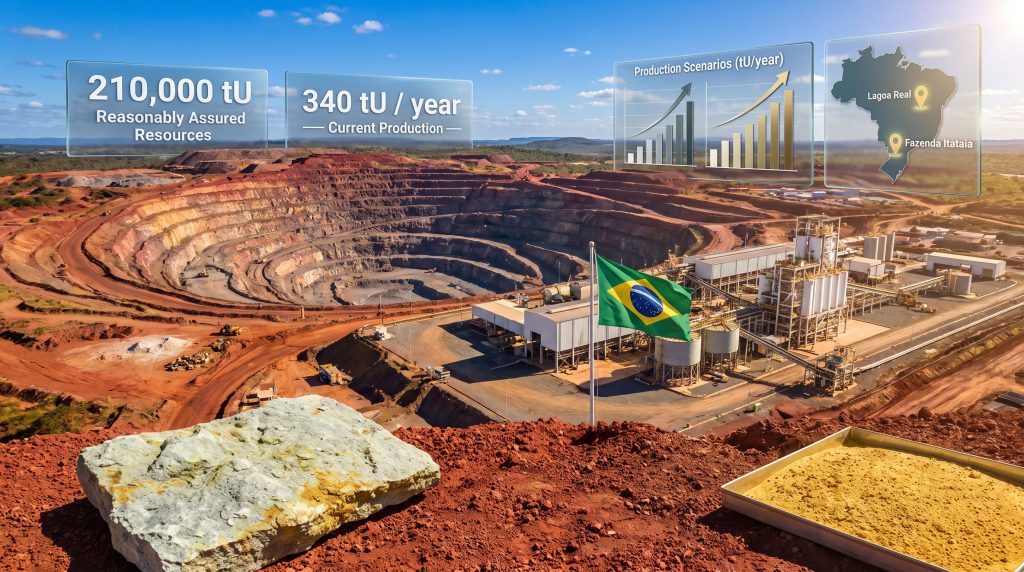
Brazil holds approximately 210,000 tonnes of reasonably assured uranium resources, placing it among the world's most uranium-endowed nations according to World Nuclear Association data. Yet the country's only operational uranium mine, located in the Lagoa Real province near Caetité in the state of Bahia, runs at a nameplate capacity of just 340 tonnes of uranium per year.
This is not a resource scarcity problem. It is a characterisation, infrastructure, and investment problem. Furthermore, understanding the broader context of uranium supply and demand helps explain why Brazil's constrained output carries implications well beyond its own borders.
The Lagoa Real/Caetité mine, operated by state-owned Indústrias Nucleares do Brasil (INB), holds known resources of 10,000 tU at a grade of 0.3% uranium — a commercially workable grade, but one that has never been fully translated into expanded production capacity. Brazil has mined uranium since 1982, meaning more than four decades have passed without a second operating mine reaching production stage.
On the demand side, the picture is shifting. Two pressurised water reactors, Angra 1 and Angra 2, currently generate approximately 3% of Brazil's national electricity. A third reactor, Angra 3, is under active development, and microreactor programs are also being explored domestically. Each new unit adds incremental uranium fuel demand that the current single-mine supply base is structurally ill-equipped to meet.
The tension between a resource-rich geological endowment and a capacity-constrained production base defines the entire strategic rationale behind Brazil's current uranium exploration push.
The Lagoa Real Province: Four Decades of Promise, Incomplete Characterisation
The Lagoa Real Uranium Province has been geologically documented since 1977, when exploration campaigns first formally identified uranium-indicative anomalies across the Bahia formation. Decades of subsequent work mapped numerous uraniferous occurrences throughout the province, building a substantial body of geological knowledge, yet leaving a significant portion of the deposit inventory insufficiently characterised for modern mine planning purposes.
This distinction is technically critical and often misunderstood by outside observers. Identifying a geological anomaly consistent with uranium mineralisation is a fundamentally different exercise from quantifying a deposit to the standard required for bankable resource estimation, environmental permitting, and investment-grade mine planning. Consequently, many occurrences within the Lagoa Real province sit in an intermediate state: geologically known, but insufficiently defined for production decisions.
The new phase of INB uranium geological research in Caetité is specifically designed to close this gap. INB's geological and mineral resources research coordinator, Jamyle Praxedes Franco, has described the data collection effort as aimed at quantifying deposits and providing the detailed geological information needed to assess which occurrences could realistically evolve into operational mine conditions. This is the foundational work that precedes every subsequent stage of development.
From Anomaly to Mine: Understanding the Resource Classification Ladder
For readers unfamiliar with mining sector terminology, resource classification follows a hierarchical structure:
- Inferred resources represent early-stage estimates based on limited data, with significant geological uncertainty
- Indicated resources reflect a higher confidence level, supported by more extensive sampling and modelling
- Measured resources carry the highest confidence, underpinned by detailed geological and geotechnical data
- Ore reserves represent the subset of measured and indicated resources that are economically extractable under defined conditions
Many of the Lagoa Real province's uraniferous occurrences are currently classified at the inferred level or below. The current INB research program is, in practical terms, a systematic effort to move these occurrences up the classification ladder, converting geological observations into quantified, investment-grade resource estimates. For a broader perspective, global uranium reserves data illustrates just how critical this classification process is to unlocking a nation's full production potential.
INB's Production Roadmap: Three Scenarios, One Critical Path
INB has articulated a tiered production expansion framework anchored to the Uranium Concentration Unit (URA), the central processing facility at Caetité that converts mined ore into uranium concentrate, commonly known as yellowcake. Yellowcake is the intermediate product that serves as feedstock for further enrichment and nuclear fuel fabrication.
| Production Phase | Annual Concentrate Target | Key Infrastructure Required |
|---|---|---|
| Initial | 200 tonnes | Existing URA capacity |
| Intermediate | 450 tonnes | New tailings settling basin, expanded processing area |
| Advanced | 800 tonnes | New waste rock pile, storage yard, full processing expansion |
Each step up this production ladder carries distinct infrastructure requirements that cannot be shortcut. Scaling from 340 tU per year at the current mine to 800 tonnes of uranium concentrate annually demands not just additional ore sources, but entirely new physical infrastructure components. The geological research currently underway is the prerequisite for determining which deposits can supply these future production scenarios, and in what sequence.
Without validated resource estimates from the current geological research program, none of the intermediate or advanced production scenarios can be credibly planned, financed, or permitted.
Pró-Urânio: Brazil's Structured Approach to Accelerated Exploration
INB launched the Pró-Urânio programme in 2024 as a structured national initiative to expand and accelerate uranium deposit exploration across Brazil. The programme is architecturally significant because it explicitly incorporates BNDES (Brazilian National Bank for Economic and Social Development) as a mechanism for developing partnership models with private mining companies, marking a departure from the historically state-exclusive nature of Brazil's uranium sector.
In December 2024, BNDES issued a formal Request for Information targeting consulting firms interested in contributing to Pró-Urânio's development, signalling active institutional momentum behind the programme's implementation. In addition, Brazil's resumption of uranium mining at Caetité earlier provided the operational foundation upon which these expanded ambitions now rest.
Simultaneously, a government proposal currently under consideration would permit private sector investment in uranium mining, subject to INB retaining a minimum 20% equity stake in each joint venture. This would represent a structural transformation of a sector that has operated under exclusive state control for its entire operational history.
Brazil's National Council for Mineral Policy has also established a dedicated working group to assess uranium's contribution to the broader national nuclear programme, adding another institutional layer to what is becoming a multi-stakeholder strategic mobilisation around uranium supply security.
Why Private Capital Changes the Development Calculus
The potential entry of private investment into Brazilian uranium mining carries implications that go well beyond funding alone:
- Private operators typically bring faster decision-making cycles than state-dominated development models
- Joint venture structures introduce commercial discipline to exploration and development timelines
- Private capital access expands the total financing envelope available for exploration across multiple deposit targets simultaneously
- International mining companies entering the sector would bring technical expertise in modern resource characterisation methodologies
The proposed 20% minimum INB stake preserves state strategic oversight while opening the door to accelerated private-sector-led exploration, a hybrid model that several other uranium-producing nations have employed successfully.
Santa Quitéria: Brazil's Largest Uranium Reserve and Its Dual-Commodity Complexity
While the Caetité research program addresses near-term production expansion at the existing operational site, Brazil's longer-term uranium supply strategy rests significantly on the Santa Quitéria Project, located at Fazenda Itataia in the municipality of Santa Quitéria in Ceará state.
The Itataia deposit is geologically unusual: its composition is approximately 99.8% phosphate and 0.2% uranium, making it a dual-commodity resource with distinct economics and regulatory considerations. This mineralogical character has important implications for both the development model and the environmental permitting pathway.
Key reserve and production parameters for the Santa Quitéria Project include:
- Total deposit uranium estimate: ~142,200 tU intermixed with phosphate mineralisation
- Exploitable ore reserves: 79.5 million tonnes at grades of 11% P₂O₅ and 0.0998% U₃O₈
- Equivalent recoverable content: approximately 8.9 million tonnes of P₂O₅ and 79,300 tonnes of U₃O₈
Projected annual production upon commissioning:
- Approximately 1.05 million tonnes of phosphate fertiliser
- Approximately 220,000 tonnes of dicalcium phosphate for animal feed
- Approximately 2,300 tonnes of uranium concentrate per year
That uranium concentrate production figure alone would dwarf current Caetité output by roughly six to seven times, and is designated to supply Angra 1, Angra 2, and future Angra 3 operations, with explicit export potential identified beyond domestic requirements.
The Licensing Constraint at Santa Quitéria
Despite its scale, Santa Quitéria remains in the preliminary environmental licensing stage with IBAMA, Brazil's Institute of Environment and Renewable Natural Resources. The project's environmental review was formally accepted by IBAMA in March 2022, but licensing progress represents the project's defining critical path constraint.
The dual-commodity nature of the deposit introduces additional regulatory complexity. Phosphate fertiliser production and uranium concentrate extraction involve different regulatory frameworks, environmental impact categories, and community consultation requirements. Navigating this intersection is considerably more complicated than permitting a single-commodity uranium mine.
The next major ASX story will hit our subscribers first
Brazil in the Global Uranium Supply Context
Positioning Brazil's current activities against global benchmarks helps clarify the scale of the challenge. While 210,000 tU in reasonably assured resources is a genuinely significant national endowment, Brazil's extraction-to-resource ratio remains extremely low by international comparison. However, shifting uranium market dynamics globally — including geopolitical pressures such as the Russian uranium import ban — are increasing the strategic urgency for nations like Brazil to develop their domestic production capacity.
Major global uranium producers operate at annual output levels measured in thousands of tonnes. Kazakhstan, the world's dominant producer, produces upward of 21,000 tonnes of uranium annually, according to World Nuclear Association data. Canada's Cigar Lake and McArthur River operations each produce thousands of tonnes per year from high-grade deposits.
Brazil's 340 tU annual output from a single, moderate-grade operation represents a fraction of what its resource base theoretically supports. Closing this gap is explicitly a matter of strategic national interest rather than purely commercial economics.
For Brazil, nuclear fuel self-sufficiency is a geopolitical asset as much as an energy policy objective. As a country with domestic enrichment capability and an operational reactor fleet, full fuel cycle independence carries strategic weight well beyond electricity economics.
A Developmental Timeline: From First Discovery to Current Research
| Period | Key Milestone |
|---|---|
| 1970s to 1980s | Active national uranium exploration; Lagoa Real province mapped |
| 1977 | First formal identification of uranium-indicative anomalies in Caetité region |
| 1982 | Uranium mining commences in Brazil |
| 2020 | Santa Quitéria Project plans announced with full reserve estimates published |
| March 2022 | IBAMA accepts Santa Quitéria for formal environmental review |
| 2024 | INB launches Pró-Urânio programme |
| December 2024 | BNDES issues Request for Information for Pró-Urânio programme consultancies |
| July 2026 | New geological research phase initiated at Caetité/Lagoa Real |
The timeline reveals a sector characterised by long cycles and persistent gaps between discovery, characterisation, and production. The current INB uranium geological research in Caetité is an attempt to compress one of those historical gaps through systematic, targeted fieldwork. Indeed, current uranium market trends suggest that the window for bringing new supply online is narrowing, making Brazil's accelerated research programme all the more timely.
Frequently Asked Questions
What makes the Lagoa Real province significant beyond the current mine?
The province contains numerous uraniferous anomalies extending well beyond the footprint of the currently operating mine. The key issue is that most of these occurrences have not been characterised to modern resource estimation standards. If the current geological research program successfully upgrades even a portion of these occurrences to indicated or measured status, it could materially expand the geological foundation available for future mine development planning.
What is yellowcake and why does it matter for Brazil's nuclear program?
Yellowcake is the common name for uranium oxide concentrate (U₃O₈), the intermediate product produced when uranium ore is processed at a concentration facility. At Caetité, the Uranium Concentration Unit converts mined ore into yellowcake, which then serves as the feedstock for further enrichment and nuclear fuel fabrication. All of Brazil's domestic fuel cycle economics trace back to the reliability and volume of yellowcake production from this facility. Detailed technical guidance from the IAEA further outlines the processing standards that govern this critical production step.
How does the collophanite deposit at Itataia differ from a conventional uranium deposit?
Collophanite is a phosphate mineral, and the Itataia deposit is principally a phosphate resource with uranium occurring as a minor but economically recoverable co-product. This geological character means the project's economics are substantially driven by phosphate fertiliser markets, with uranium providing supplementary revenue. The deposit's development case therefore depends on phosphate commodity dynamics alongside uranium pricing, creating a fundamentally different investment and regulatory profile compared to a pure uranium mining operation.
What would private investment in Brazilian uranium mining actually look like in practice?
Under the proposal currently under government consideration, a private company or consortium could invest in uranium exploration and development operations, with INB retaining a minimum 20% stake in each venture. In practical terms, this could mean private companies funding exploration programs on prospective Lagoa Real province targets, with INB providing regulatory access, geological data, and processing infrastructure leverage through its Caetité URA facility.
Disclaimer: This article is intended for informational purposes only and does not constitute financial or investment advice. Projections, timelines, and production targets referenced throughout are subject to geological, regulatory, and commercial risks. Readers should conduct independent research and consult qualified advisors before making investment decisions related to uranium or nuclear energy markets.
Want to Know When the Next Major Uranium Discovery Hits the ASX?
Discovery Alert's proprietary Discovery IQ model scans ASX announcements in real time, instantly identifying significant mineral discoveries — including uranium — and converting complex geological data into actionable investment insights for both short-term traders and long-term investors. Explore how historic mineral discoveries have generated substantial returns on Discovery Alert's dedicated discoveries page, and begin your 14-day free trial today to position yourself ahead of the broader market.