July 22, 2026
The Hidden Complexity Behind ISR Uranium Ramp-Ups: Why Pioneer Projects Face Unique Hurdles
The commercialisation of any first-of-kind extractive technology rarely follows a straight line. History across mining sectors consistently shows that the transition from a proven concept to reliable, scaled production involves an iterative process of solving problems that textbooks cannot fully anticipate. This dynamic is playing out in real time in the Wyoming uranium sector, where Peninsula Energy's Lance project is navigating the complex realities of bringing the United States' first commercial-scale low-pH in-situ recovery operation to full production capacity.
Understanding why Peninsula Energy withdraws guidance over the Lance uranium project flow rate issue requires moving beyond the headline number and examining the technical, operational, and strategic forces at work beneath the surface.
When big ASX news breaks, our subscribers know first
What Makes the Lance Project Strategically Significant
Domestic Uranium in a Supply-Constrained World
The United States generates roughly 20% of its electricity from nuclear power, yet its domestic uranium mining sector has contracted sharply over recent decades, leaving the country heavily reliant on imports from Kazakhstan, Russia, and other offshore sources. Against this backdrop, the development of viable, large-scale domestic uranium production has become a matter of increasing industrial and energy security importance. Consequently, shifting uranium market dynamics have intensified focus on projects capable of delivering reliable domestic supply.
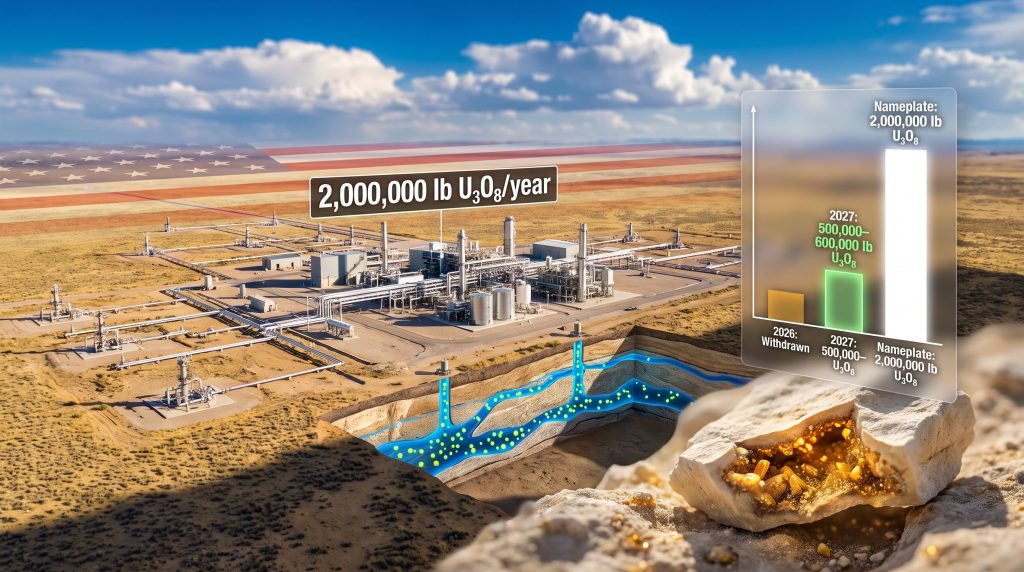
The Lance project in Wyoming sits at the centre of this dynamic. It hosts one of the largest permitted ISR uranium resources in the United States and is supported by a central processing plant with a nameplate capacity of 2,000,000 lb U₃O₈ per year. That installed infrastructure represents a significant long-term production asset, particularly as utilities seek to diversify and secure domestic nuclear fuel supply chains.
A Technology First for the United States
What sets Lance apart from other US ISR uranium operations is not simply its scale, but its extraction chemistry. Low-pH ISR uses an acidic lixiviant solution to dissolve uranium minerals within the host formation, contrasting sharply with the alkaline (bicarbonate-based) solutions used at most existing US ISR operations.
Low-pH ISR has been widely used internationally, particularly in Central Asia, but the Lance project represents its first commercial-scale application in the United States, requiring Peninsula to develop an entirely new operational knowledge base and a purpose-trained specialised workforce from the ground up.
This distinction is critical context for evaluating any production challenges encountered during the ramp-up phase. Furthermore, the in-situ leaching benefits associated with this approach offer compelling environmental and economic advantages over conventional open-pit or underground mining methods.
Key project metrics at a glance:
| Metric | Detail |
|---|---|
| Location | Wyoming, USA |
| Processing Method | Low-pH In-Situ Recovery (ISR) |
| Central Processing Plant Capacity | 2,000,000 lb U₃O₈ per year |
| Current Financial Position | $47M cash + $56M secured funding package |
| 2027 Production Outlook | 500,000–600,000 lb U₃O₈ |
| Mine Units Affected in 2026 | Mine Units 1, 3, and 4 |
How Low-pH ISR Actually Works and Why Flow Rate Is Everything
The Mechanics of In-Situ Recovery
In-situ recovery extracts uranium without physically excavating ore. A network of injection wells pumps a chemically reactive solution, the lixiviant, into the uranium-bearing sandstone formation. The solution dissolves the uranium minerals in place, and the resulting uranium-enriched liquid, called pregnant leach solution (PLS), is then pumped back to surface via extraction wells and processed at the central plant to produce yellowcake (U₃O₈).
The entire process depends on the ability to move sufficient volumes of solution through the wellfield at target concentrations. This is why flow rate is the single most critical operational variable in any ISR uranium operation.
Low-pH vs. Alkaline ISR: A Technical Comparison
| Parameter | Alkaline ISR (Historical) | Low-pH ISR (Lance, 2026) |
|---|---|---|
| Head Grade Range | ~25 mg/L U₃O₈ (baseline) | 50–60 mg/L U₃O₈ (HH-14) |
| Operational Complexity | Moderate | High |
| US Commercial Precedent | Established | First commercial-scale application |
| Workforce Specialisation Required | Standard | New capability build required |
The grade performance data from header house 14 at Mine Unit 4 is particularly striking. Head grades of 50 to 60 mg per litre of U₃O₈ recorded during May and June 2026 represent more than double the historical averages achieved during alkaline leach operations in Mine Units 1 and 2, according to reporting by Mining Weekly on July 22, 2026. This confirms the chemistry is working as intended where flow conditions allow it to perform. For additional context on how the Alta Mesa uranium project approaches similar extraction challenges, comparisons with that operation offer useful industry benchmarking.
Why Gas Accumulation Suppresses Flow
One underappreciated aspect of low-pH ISR is the tendency for gas to accumulate within the formation during acid leaching. When acidic lixiviant reacts with carbonate minerals in the host rock, carbon dioxide and other gases can be generated and become trapped in the pore spaces of the aquifer. This gas saturation effectively blocks fluid pathways, reducing the permeability available for solution flow.
The consequences compound quickly:
- Header houses operating significantly below design flow rates deliver less pregnant leach solution per unit time
- Preconditioning periods, during which the formation is prepared to accept and release uranium-bearing solution, extend beyond planned durations
- The combined effect of suppressed flow and extended preconditioning lags can render annual production targets unachievable within the remaining calendar window
At Lance, header houses operating at approximately 67% of design flow rate created precisely this compounding delay structure, ultimately making the original 2026 guidance range of 400,000 to 500,000 lb U₃O₈ unachievable within the year.
The 2026 Guidance Withdrawal: Timeline and Decision Logic
How the Situation Developed
The decision to withdraw guidance was not made lightly, nor was it anticipated at the start of 2026. The company had held confidence in meeting its original targets until operational data from multiple mine units indicated that flow rate recovery within the guidance year was no longer a realistic expectation.
| Period | Status |
|---|---|
| Early 2026 | Company confident in meeting 400,000–500,000 lb U₃O₈ guidance |
| May–June 2026 | Header house 14 (Mine Unit 4) records 50–60 mg/L head grades |
| Mid-2026 | Flow rate issues identified as unresolvable within the guidance year |
| July 22, 2026 | Formal guidance withdrawal announced |
Where the Disruptions Were Concentrated
The flow rate challenges were not evenly distributed across the project. Mine Units 1 and 3 were the primary sources of production shortfall, while Mine Unit 4 faced a different but related challenge: wellfield chemistry refinement across several header houses.
This distinction matters because it demonstrates that the issues are localised and operationally specific rather than systemic across the entire resource. The positive leach kinetics confirmed at header house 14 within Mine Unit 4 provide direct evidence that the low-pH process is performing as designed when wellfield conditions support adequate flow.
Is This a Permanent Problem or a Ramp-Up Phase Complication?
Reading the Operational Signals Correctly
The critical question for investors and industry observers is whether the 2026 disruption represents a fundamental flaw in the Lance project's approach or a manageable phase of a technology commercialisation arc. The operational evidence points clearly toward the latter interpretation.
Several data points support this reading:
- Gas accumulation in ISR wellfields is a well-documented and addressable phenomenon, not an unknown variable
- The leach chemistry refinement process in individual header houses is inherently iterative and improves with operational learning
- Head grade performance at Mine Unit 4's first header house provides a replicable technical template for subsequent units
- Management has explicitly classified the flow rate disruptions as temporary and unlikely to affect production beyond 2026
From a technology commercialisation perspective, what Peninsula is experiencing is consistent with what first-of-kind operations across extractive industries typically encounter. The learning curve associated with building an entirely new operational capability, from workforce training to wellfield chemistry management, does not compress simply because the underlying resource is high quality.
The 2027 Production Outlook in Context
With the 2026 guidance formally withdrawn, Peninsula has shifted its near-term production anchor to 2027, with a target range of 500,000 to 600,000 lb U₃O₈. Positioned against the plant's 2,000,000 lb annual nameplate capacity, this figure illustrates both where the project currently sits in its ramp-up trajectory and the considerable production growth runway that lies ahead. In addition, the broader US uranium production rebound occurring across the sector provides a supportive macro backdrop for Lance's longer-term output ambitions.
| Year | Guidance Range | Status |
|---|---|---|
| 2026 | 400,000–500,000 lb U₃O₈ | Withdrawn |
| 2027 | 500,000–600,000 lb U₃O₈ | Forward target |
| Long-term capacity | 2,000,000 lb U₃O₈/year | Central processing plant nameplate |
Strategic Responses: Operational and Financial Adjustments
The Owner-Operated Drilling Transition
One of the most strategically significant operational changes announced alongside the guidance withdrawal is the transition of wellfield drilling activities to an owner-operated model. This shift carries material implications across multiple dimensions:
- Cost reduction: Owner-operated drilling typically achieves lower per-metre costs compared to contractor-operated models, improving the economics of wellfield expansion
- Scheduling flexibility: Direct control over drilling activities allows management to respond more dynamically to wellfield performance data and derisking requirements
- Mine Unit 5 preparation: The transition positions the company to advance Mine Unit 5 development at lower capital intensity, supporting the medium-term production growth thesis
This operational pivot reflects a maturation in the project's development model, moving from a contractor-dependent startup phase toward a more self-sufficient operational structure.
Capital Position and Production Continuity
With $47 million in cash and a recently secured $56 million funding package, Peninsula holds sufficient capital to sustain production ramp-up through the resolution of current wellfield challenges and into the Mine Unit 5 development phase. The secured funding removes near-term capital risk as the primary concern for production continuity, allowing management to focus on solving the operational variables driving the 2026 shortfall.
A final investment decision on Mine Unit 5 is expected before year-end 2026, which would represent a meaningful catalyst for assessing the project's medium-term production trajectory. Furthermore, policy developments such as the Russian uranium import ban have reinforced the strategic case for expanding domestic production capacity, adding policy tailwinds to Peninsula's longer-term positioning.
The next major ASX story will hit our subscribers first
Frequently Asked Questions: Peninsula Energy and the Lance Uranium Project
What does withdrawing production guidance mean for investors?
Withdrawing guidance signals that a company no longer believes it can achieve a previously stated production range within the nominated period. It does not necessarily indicate a structural problem with the underlying asset. In Peninsula's case, the withdrawal reflects specific wellfield flow rate challenges in 2026, with the company maintaining forward confidence through a revised 2027 outlook.
Why does gas accumulation affect uranium wellfield flow rates?
When acidic lixiviant reacts with carbonate minerals in sandstone formations, it generates carbon dioxide gas. If this gas accumulates in the pore spaces of the aquifer, it reduces the effective permeability of the formation, restricting the volume of solution that can flow through the wellfield per unit time. This directly limits the volume of uranium-bearing solution that reaches the processing plant.
What is triuranium octoxide (U₃O₈) and why is it the standard measurement unit?
Triuranium octoxide, commonly called yellowcake, is the semi-refined uranium oxide product produced at ISR processing plants. It is the standard commercial form in which uranium is traded and delivered to nuclear fuel converters. Production volumes are universally quoted in pounds of U₃O₈, making it the industry benchmark for output measurement.
When will Peninsula Energy provide updated guidance for 2026 or 2027?
The company has not specified a timeline for reinstating 2026 guidance, given that the flow rate issues have been assessed as unresolvable within the current year. The 2027 production outlook of 500,000 to 600,000 lb U₃O₈ represents the company's current forward target, with further updates expected as Mine Unit 5 planning progresses toward a final investment decision. Peninsula Energy's operational update provides additional detail on the company's progress and near-term milestones.
Key Takeaways: What the Lance Experience Reveals About ISR Uranium Commercialisation
The Lance uranium project's 2026 production challenges offer a detailed case study in the realities of commercialising a first-of-kind extractive technology at scale in a jurisdiction where that technology has no prior commercial precedent. Several conclusions emerge from a thorough analysis:
- The guidance withdrawal reflects a technology ramp-up challenge, not a resource quality problem; the underlying uranium endowment remains intact
- Head grade performance of 50 to 60 mg/L U₃O₈ at Mine Unit 4 confirms the low-pH process delivers superior leach efficiency compared to historical alkaline operations when flow conditions are adequate
- Gas accumulation is a known and addressable wellfield phenomenon, and its identification as the root cause provides a clearer remediation pathway than an unknown geological or chemical problem would
- The gap between current output and the 2,000,000 lb annual nameplate capacity defines a substantial production growth runway that remains intact regardless of the 2026 setback
- The transition to owner-operated drilling and the anticipated Mine Unit 5 final investment decision signal continued management confidence in the project's long-term trajectory. Production reset milestones reported by industry observers further reinforce this constructive outlook
This article contains forward-looking statements and production outlook references that are subject to operational, technical, and market risks. Readers should not rely on forward-looking projections as guarantees of future performance. Independent financial advice should be sought before making investment decisions based on information contained in this article.
Want to Stay Ahead of the Next Major Uranium Discovery on the ASX?
Discovery Alert's proprietary Discovery IQ model delivers real-time alerts the moment significant mineral discoveries — including uranium — are announced on the ASX, turning complex data across 30+ commodities into clear, actionable insights for both short-term traders and long-term investors. Explore how historic discoveries have generated substantial returns on Discovery Alert's dedicated discoveries page, and begin your 14-day free trial today to position yourself ahead of the broader market.