July 22, 2026
The Forgotten Chokepoint: Why Uranium Conversion Defines America's Nuclear Future
The global nuclear energy revival is generating headlines at every stage of the fuel cycle, from new uranium mining operations to cutting-edge reactor designs. Yet one critical step sits quietly between these two poles, rarely discussed in policy circles and almost invisible to mainstream energy coverage. Uranium conversion, the chemical transformation that bridges raw uranium concentrate and the enrichment process, may be the single most structurally fragile link in the entire domestic nuclear fuel chain. Understanding why this step matters, and why Texas A&M uranium conversion research is drawing serious institutional attention, requires looking at both the chemistry and the geopolitics of modern nuclear energy.
When big ASX news breaks, our subscribers know first
The Chemistry Nobody Talks About: Understanding Uranium Conversion
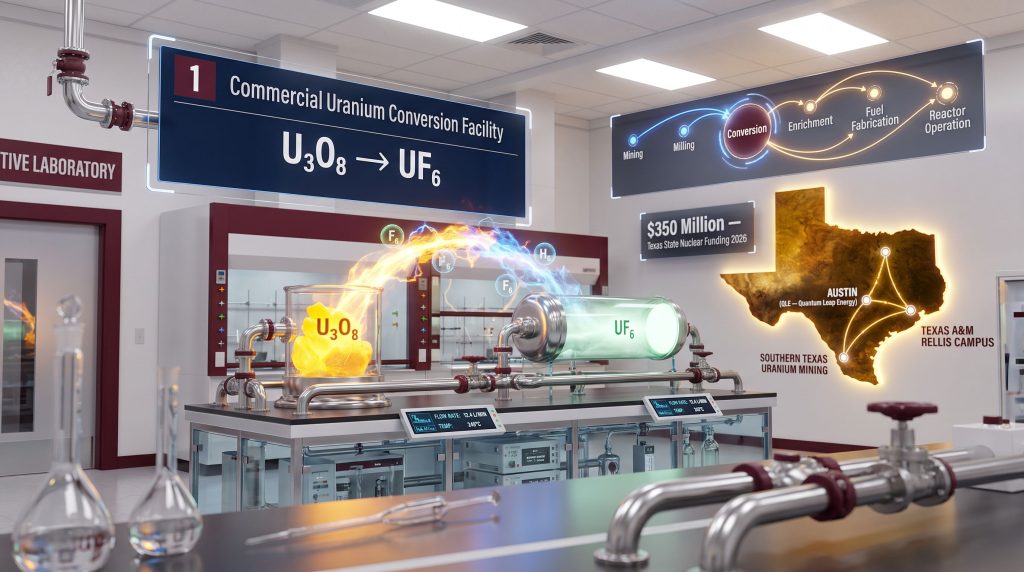
Before uranium can be enriched to power a reactor, it must first be converted into a specific gaseous form. Uranium ore, once mined and processed at a mill, becomes yellowcake, a powdery uranium oxide concentrate chemically designated as U₃O₈. This material cannot feed directly into an enrichment centrifuge. It must first be chemically transformed into uranium hexafluoride, or UF₆, a compound that behaves as a gas at relatively low temperatures and can therefore be processed through the gaseous diffusion or centrifuge enrichment technologies used commercially today.
This conversion step involves complex fluorine chemistry, requiring specialised knowledge, infrastructure, and safety protocols. Fluorine is one of the most reactive elements on the periodic table, and working with it at industrial scale demands precision engineering that is not easily replicated or scaled. The result is a process that functions as a genuine technical barrier, not simply a routine industrial operation.
The nuclear fuel cycle, laid out in sequence, clarifies exactly where conversion sits:
| Fuel Cycle Stage | Process | Output |
|---|---|---|
| 1. Mining | Uranium ore extraction | Raw uranium ore |
| 2. Milling | Ore processing and concentration | Yellowcake (U₃O₈) |
| 3. Conversion | Chemical transformation (U₃O₈ to UF₆) | Uranium hexafluoride (UF₆) |
| 4. Enrichment | Isotopic separation (increasing U-235 content) | Enriched UF₆ |
| 5. Fuel Fabrication | Conversion to solid fuel pellets | Reactor fuel assemblies |
| 6. Reactor Operation | Energy generation | Electricity and spent fuel |
What this table makes viscerally clear is that without conversion, enrichment cannot occur, regardless of how much yellowcake is available domestically. The pipeline stalls at step three.
One Facility, One Nation: America's Structural Vulnerability
Here is the statistic that should concern every energy security analyst: the United States currently operates only one commercial uranium conversion facility. A single plant is the sole domestic gateway between the nation's uranium mining output and its enrichment infrastructure. Any operational disruption, whether from equipment failure, regulatory action, or supply chain breakdown, creates an immediate and cascading bottleneck across the entire downstream nuclear fuel supply chain.
This is not a hypothetical risk. It is a structural reality that persists even as the U.S. moves aggressively to expand its nuclear generation fleet, build advanced reactors, and reduce dependence on foreign fuel suppliers. Furthermore, the uranium supply-demand volatility already affecting global markets makes this single-facility dependency even more precarious. Enrichment capacity means little if conversion capacity does not keep pace.
The existence of only one operating commercial uranium conversion facility in the U.S. creates a structural chokepoint in the domestic nuclear fuel cycle. Any disruption to that single facility could cascade across the entire enrichment and reactor fuel supply chain.
Advanced reactor programmes compound this problem significantly. Next-generation designs, particularly those requiring high-assay low-enriched uranium, or HALEU, demand conversion throughput that the current single-facility model cannot comfortably absorb at scale. HALEU contains uranium enriched to between 5% and 20% U-235, compared to the approximately 3-5% typical of conventional light water reactor fuel, and requires its own carefully managed conversion and enrichment pathways.
How Does Geopolitics Complicate the Picture?
Geopolitical pressures have further exposed this vulnerability. The ban on Russian uranium imports has forced a rapid reassessment of where the U.S. sources its converted nuclear fuel inputs. Consequently, the US uranium market disruption created by tariff threats and import restrictions has accelerated the urgency of developing domestic conversion alternatives. These are not distant policy abstractions; they are live commercial pressures reshaping investment decisions right now.
The TEES-QLE Research Agreement: What Is It and Why Does It Matter?
Against this backdrop, the research agreement between TEES and QLE — specifically the Texas A&M Engineering Experiment Station (TEES) and Quantum Leap Energy (QLE) — represents a calculated attempt to address the conversion gap through rigorous academic science before committing the capital required for full commercial facility construction.
The key parties involved in this collaboration are:
- Texas A&M Engineering Experiment Station (TEES): The applied research division of the Texas A&M University System, providing scientific infrastructure, laboratory capabilities, and physicochemical research expertise.
- Quantum Leap Energy (QLE): An Austin, Texas-based company focused specifically on the uranium conversion stage of the nuclear fuel cycle, operating as a subsidiary of ASP Isotopes (ASPI).
- ASP Isotopes (ASPI): The Dallas-headquartered parent company with proprietary isotope separation and enrichment technologies, operating enrichment facilities in Pretoria, South Africa.
The research itself centres on collecting fundamental physicochemical data on the chemical reactions involved in converting U₃O₈ into UF₆. This is not abstract basic science; it is applied research with direct commercial consequences. The four primary objectives of the work are:
- Improving production process efficiency at the reaction chemistry level
- Reducing conversion costs to support commercial viability at scale
- Enhancing scalability for industrial-scale deployment
- Optimising production pathways and informing process design modelling
The expected outputs extend well beyond data tables. Research results are intended to support engineering simulations, facility design parameters, and scale-up modelling that can be used to inform investment decisions for future commercial conversion plants.
Physicochemical data on the U₃O₈-to-UF₆ conversion pathway is foundational to any commercial-scale facility design. Without this empirical baseline, engineering scale-up remains speculative and capital-intensive.
How Academic Research De-Risks Commercial Nuclear Investment
The logic connecting university research to commercial capital allocation in nuclear fuel processing deserves closer examination. Nuclear infrastructure projects face a compounded challenge: they are capital-intensive, long-duration, and technically complex, making investors sensitive to technology risk premiums. Academic research partnerships provide a structured mechanism to reduce that risk premium before a shovel enters the ground.
The de-risking pathway works through a sequential logic:
- Collect fundamental reaction and process data at laboratory or pilot scale
- Use empirical data to build validated process models and engineering simulations
- Apply validated models to facility design and scale-up planning
- Reduce investor and lender uncertainty by demonstrating technical feasibility at controlled scale
- Attract commercial capital for full-scale facility construction with a measurably lower technology risk premium
This approach is particularly well-suited to Texas A&M uranium conversion research because the chemistry, while well understood in broad terms, has not been extensively studied at the process optimisation level in a domestic academic context for decades. The U.S. commercial nuclear industry effectively contracted this knowledge to existing facility operators, leaving a gap in publicly available process science that now needs to be rebuilt.
Texas as a Nuclear Fuel Cycle Hub: More Than One Partnership
The TEES-QLE agreement does not exist in isolation. Texas has assembled a remarkable concentration of nuclear fuel cycle activity in a short period, spanning mining, conversion research, enrichment, and advanced reactor siting within a single state's geography. In addition, the broader uranium market dynamics at play globally are making Texas's strategic positioning increasingly significant for long-term energy security.
Key developments in Texas's nuclear infrastructure buildout include:
- $350 million in state nuclear funding made available through Texas Public Utility Commission programmes (April 2026)
- Uranium Energy Corp. commenced production at the Burke Hollow in situ recovery (ISR) uranium mining operation in southern Texas (April 2026)
- Terrestrial Energy signed ground lease and research agreements with the Texas A&M University System for approximately 77 acres at the Texas A&M-RELLIS campus for advanced reactor siting (June 2026)
- GE Vernova and Blue Energy announced plans for what is described as the world's first gas-plus-nuclear power plant in Texas (May 2026)
- FluxPoint Energy unveiled plans to develop the first new U.S. uranium conversion facility in decades, launched at CERAWeek 2026 in Houston (April 2026)
Why Does Texas Have a Competitive Advantage?
What Texas offers that few other states can match is a combination of favourable regulatory conditions, existing industrial and petrochemical infrastructure transferable to fluorine chemistry operations, a deep university research ecosystem, geographic proximity to uranium mining operations in the state's south, and the kind of state-level political alignment with domestic energy priorities that accelerates permitting and investment decisions.
The petrochemical dimension deserves specific attention. The chemical engineering knowledge base concentrated in Texas's Gulf Coast industrial corridor, built over decades of refinery and chemical plant operation, has genuine applicability to uranium conversion. Workers familiar with high-temperature fluorine chemistry processes, pressure vessel engineering, and continuous chemical production represent a transferable workforce asset that other candidate states for conversion facilities simply do not possess at scale.
The next major ASX story will hit our subscribers first
ASPI's Institutional Network: A Multi-Node Strategy
ASP Isotopes and its QLE subsidiary have constructed a partnership network that spans the uranium enrichment and conversion landscape. Understanding the full architecture of these relationships reveals a coherent commercial strategy rather than isolated research agreements.
| Partner | Agreement Type | Focus Area |
|---|---|---|
| Texas A&M (TEES) | Research agreement | UF₆ physicochemical data and conversion process optimisation |
| Fermi America | Collaboration | Uranium enrichment research, development, and production |
| Texas Tech University | Collaboration | Uranium enrichment research and development |
| TerraPower | Financing and supply agreement | Uranium enrichment facility in South Africa; HALEU supply terms |
The TerraPower relationship is particularly significant from a commercial validation standpoint. TerraPower, backed by substantial private capital and building advanced sodium-cooled fast reactors requiring HALEU fuel, has reached financing and supply terms with ASPI for enrichment production in South Africa. This signals that at least one major advanced reactor developer has assessed ASPI's technology platform sufficiently to commit to supply chain terms, which represents a meaningful form of commercial due diligence that pure research agreements do not provide.
Texas A&M's Nuclear Research Legacy: Institutional Credibility Matters
The choice of Texas A&M as a research partner is not arbitrary. The university's nuclear science centre brings a documented institutional history in nuclear fuel cycle science that extends well beyond general engineering competence. Texas A&M has operated a research reactor on campus for decades and has conducted prior research in uranium purification and electrorefining through its Fuel Cycle and Materials Laboratory.
In 2006, Texas A&M participated in the NNSA Global Threat Reduction Initiative, converting its campus research reactor from highly enriched uranium fuel to low-enriched uranium fuel as part of a broader international effort to reduce proliferation risks associated with civilian research reactor operations. This participation demonstrates a working relationship with federal nuclear oversight bodies and familiarity with the regulatory and safety culture surrounding uranium fuel handling.
That institutional track record matters for commercial partners like QLE because it reduces the lead time required to establish appropriate safety protocols, regulatory frameworks, and laboratory infrastructure for uranium chemistry research. Working with an institution that has navigated NRC oversight and federal nuclear research programmes is fundamentally different from engaging a general chemistry department with no prior nuclear materials experience.
The DOE's Concurrent Push on Fuel Cycle Resilience
The TEES-QLE agreement arrives alongside a parallel federal effort to address the same structural gap from a policy direction. The U.S. Department of Energy's Office of Nuclear Energy, through its Defence Production Act Nuclear Fuel Cycle Consortium, launched a new initiative in April 2026 specifically targeting supply chain resilience across the domestic fuel cycle. Furthermore, the growing critical minerals demand associated with the broader energy transition is placing additional pressure on policymakers to secure every link in the nuclear fuel chain.
This consortium initiative reflects a recognition within federal energy policy circles that uranium conversion capacity, like enrichment capacity before it, cannot be rebuilt through policy statements alone. It requires technical data, process innovation, and commercial investment working in concert. Academic research partnerships of exactly the type represented by the TEES-QLE agreement provide the technical foundation that any credible commercial investment case must rest on.
The convergence of private sector research, state-level financial incentives, university partnerships, and federal fuel cycle initiatives creates a layered ecosystem around uranium conversion that did not exist in this form even three years ago. Whether this ecosystem produces a genuine expansion of domestic conversion capacity within this decade will depend heavily on the quality of the physicochemical data that research agreements like the one between TEES and QLE are now designed to generate.
Frequently Asked Questions: Texas A&M Uranium Conversion Research
What Is the Goal of the Texas A&M-QLE Uranium Research Agreement?
The agreement between the Texas A&M Engineering Experiment Station and Quantum Leap Energy is designed to collect physicochemical data on converting yellowcake uranium (U₃O₈) into uranium hexafluoride (UF₆), with the aim of improving process efficiency, reducing production costs, and enabling commercial-scale deployment of domestic uranium conversion technology.
What Is Uranium Hexafluoride (UF₆) and Why Is It Important?
UF₆ is the gaseous compound into which uranium must be converted before it can undergo isotopic enrichment. It serves as the essential feedstock for all commercial uranium enrichment processes, making its reliable domestic production a prerequisite for a self-sufficient nuclear fuel supply chain.
How Many Uranium Conversion Facilities Does the U.S. Currently Operate?
As of mid-2026, the United States operates only one commercial uranium conversion facility. This single-facility dependency has been identified as a critical vulnerability in the domestic nuclear fuel cycle, driving both policy initiatives and private sector research investments aimed at expanding capacity.
What Is Quantum Leap Energy's Role in the Nuclear Fuel Cycle?
Quantum Leap Energy is an Austin, Texas-based subsidiary of ASP Isotopes that specialises in the uranium conversion stage, specifically the chemical process of transforming yellowcake uranium into UF₆ prior to enrichment. The TEES agreement is intended to generate the technical data needed to advance QLE's commercial conversion technology.
Is This Texas A&M's First Involvement in Uranium Research?
No. Texas A&M has a documented history in nuclear fuel research, including participation in the NNSA Global Threat Reduction Initiative in 2006, which involved converting its campus research reactor from highly enriched uranium to low-enriched uranium fuel. The university's engineering research infrastructure has long supported nuclear fuel cycle studies, making Texas A&M uranium conversion research a natural extension of its institutional expertise.
Key Metrics: The TEES-QLE Agreement in Context
| Metric | Detail |
|---|---|
| U.S. commercial uranium conversion facilities | 1 (currently operating) |
| Texas state nuclear funding (2026) | $350 million |
| TEES-QLE research focus | U₃O₈ to UF₆ physicochemical data collection |
| ASPI headquarters location | Dallas, Texas |
| ASPI enrichment facility location | Pretoria, South Africa |
| Texas A&M RELLIS campus land (Terrestrial Energy) | Approximately 77 acres |
| ASPI institutional partners | TEES, Fermi America, Texas Tech University, TerraPower |
The most significant signal embedded in the TEES-QLE partnership is not the specific research objectives but what the decision to pursue this research reveals about the current state of domestic nuclear fuel cycle knowledge. The fact that fundamental physicochemical data on the U₃O₈-to-UF₆ conversion pathway needs to be formally collected and studied at a major U.S. engineering university in 2026 reflects decades of underinvestment in this segment of the fuel cycle. Rebuilding that knowledge base through rigorous academic research is the necessary first step before commercial scale-up can responsibly proceed.
Disclaimer: This article contains forward-looking statements and references to ongoing research agreements and commercial plans. These involve inherent uncertainties, and actual outcomes may differ materially from those described. Readers should not rely on this article as investment advice. Independently verify all claims before making investment decisions.
Want to Track the Next Major Uranium or Nuclear Fuel Discovery Before the Market Moves?
Discovery Alert's proprietary Discovery IQ model delivers real-time alerts on significant ASX mineral discoveries — including uranium and critical minerals driving the nuclear fuel renaissance — instantly translating complex data into actionable investment insights. Explore Discovery Alert's dedicated discoveries page to understand how historic mineral discoveries have generated substantial returns, and begin your 14-day free trial to position yourself ahead of the broader market.