May 21, 2026
Why is Brazilian Lithium Production Critical for Global Supply Chain Security?
The global lithium supply chain faces unprecedented pressure as electric vehicle adoption accelerates across major economies. Traditional mining powerhouses have dominated production for decades, yet emerging producers are reshaping market dynamics through innovative approaches to extraction, processing, and international partnerships. This transformation extends beyond simple capacity increases, encompassing technological advancement, geopolitical supply chain diversification, and vertical integration strategies that challenge established industry structures. The Brazilian lithium producer CBL expansion exemplifies this new approach to critical mineral development.
When big ASX news breaks, our subscribers know first
What Makes Brazil's Lithium Industry Strategically Critical for Global Markets?
Brazil's emergence as a significant lithium producer represents more than incremental supply additions. The country's strategic position within global critical mineral supply chains stems from unique geological advantages, established mining infrastructure, and proximity to major shipping routes serving both Asian and Western markets.
Geographic Advantages in South America's Mining Belt
Minas Gerais province dominates Brazilian lithium operations, hosting the majority of the country's approximately 13,000 tonnes of lithium carbonate equivalent production as of 2023. This concentration provides operational efficiencies through shared infrastructure, regulatory expertise, and supply chain optimisation. The region's centuries-old mining heritage has created robust transportation networks, power generation capacity, and skilled workforce availability that new lithium operations can leverage immediately.
The province's strategic location relative to global markets offers distinct advantages. Shipping routes from Rio de Janeiro and Santos ports reach Asian markets within 25-30 days, providing competitive logistics compared to other Western Hemisphere producers. This proximity becomes increasingly valuable as battery manufacturers seek supply chain diversification away from traditional Chinese processing centres.
Furthermore, infrastructure investments spanning decades support immediate scaling opportunities. Roads, power transmission lines, and port facilities originally developed for iron ore and other mineral exports provide foundation capacity for lithium operations. The Brazilian lithium producer CBL expansion plans leverage these existing advantages while building specialised chemical processing capabilities.
Integration Capabilities That Set Brazil Apart
Brazilian lithium operations demonstrate unique vertical integration potential, controlling production from underground extraction through battery-grade lithium refining. This end-to-end capability addresses critical supply chain vulnerabilities that affect single-stage producers globally. Unlike concentrate-only operations dependent on third-party processing, integrated Brazilian facilities can guarantee:
• Quality control across all production stages
• Reduced transportation and handling costs
• Direct customer relationships with battery manufacturers
• Premium pricing for specialty lithium compounds
• Independence from Chinese processing monopolies
Technical expertise in achieving 99.8%+ purity standards positions Brazilian producers for direct battery manufacturer qualification. Lithium carbonate and hydroxide specifications for electric vehicle applications require consistent quality control that integrated operations can maintain more effectively than multi-stage supply chains involving separate miners, processors, and refiners.
Industrial qualification processes outside Chinese control represent strategic value for Western battery manufacturers. European and North American OEMs increasingly prioritise supply chain security following semiconductor shortages and critical mineral disruptions observed between 2020-2023. Brazilian integration capabilities provide qualification pathways independent of geopolitically sensitive regions.
How Are Brazilian Producers Scaling Operations to Meet EV Demand?
Scaling lithium operations to match accelerating electric vehicle demand requires coordinated expansion across mining, concentration, and chemical processing stages. Brazilian producers are implementing aggressive growth targets that could multiply current production capacity within 24-month development cycles.
Production Capacity Multiplication Strategies
Current expansion plans target significant capacity increases across multiple production stages:
| Expansion Metric | Current Capacity | Target Capacity | Growth Multiple |
|---|---|---|---|
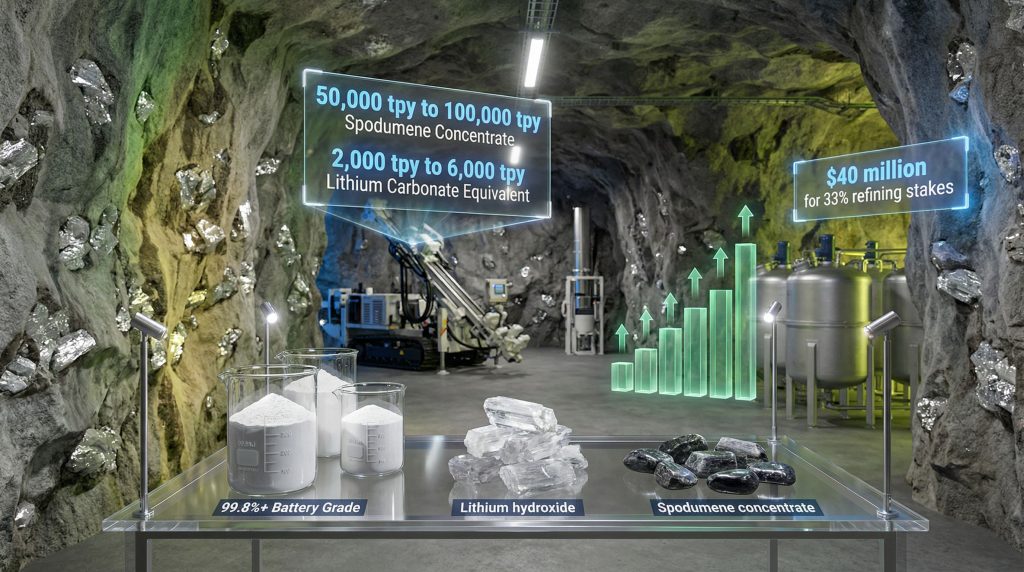
| Spodumene Concentrate | 50,000 tpy | 100,000 tpy | 2x |
| Lithium Carbonate Equivalent | 2,000 tpy | 6,000 tpy | 3x |
These expansion targets require substantial capital deployment estimated at $150-250 million for concentrate capacity doubling and $300-500 million for chemical processing tripling. The Brazilian lithium producer CBL expansion represents the most advanced example of this scaling approach, with secured funding supporting immediate implementation.
Spodumene concentrate scaling involves expanding ore processing infrastructure including additional crushing, grinding, and flotation circuits. Chemical processing capacity multiplication requires new leaching reactors, crystallisation vessels, and purification systems capable of producing both lithium carbonate and hydroxide simultaneously.
Energy requirements for expanded operations present both challenges and opportunities. Chemical processing demands approximately 8-12 MWh per tonne of lithium carbonate equivalent, requiring assessment of regional power availability and potential renewable energy partnerships.
Timeline and Implementation Phases
24-month development cycles for major expansions represent aggressive but achievable targets given Brazil's streamlined permitting for critical minerals. Implementation phases typically follow structured sequences:
- Months 1-6: Engineering design and equipment procurement
- Months 7-12: Construction and installation activities
- Months 13-18: Commissioning and process optimisation
- Months 19-24: Ramp-up to full production capacity
Regulatory approval processes in Minas Gerais benefit from established mining frameworks and environmental permitting expertise developed over decades. However, timeline risks include equipment supply chain constraints, skilled workforce availability, and potential environmental impact reassessments.
Infrastructure upgrades for doubled throughput require coordination across multiple systems. Processing plant expansions must align with material handling capacity, storage facilities, and transportation logistics to avoid bottlenecks that could constrain overall production increases.
What Role Do International Partnerships Play in Brazilian Lithium Expansion?
International partnerships have become essential mechanisms for Brazilian lithium development, providing both capital and technical expertise required for rapid scaling. Strategic investments from Asian markets particularly demonstrate how equity participation facilitates technology transfer and market access.
Strategic Investment Patterns from Asian Markets
Asian capital deployment in Brazilian lithium reflects broader supply chain security strategies. Investment structures typically combine equity participation with offtake agreements, creating integrated value chains that benefit both producers and consumers. These partnerships provide:
• Capital for expansion projects requiring $100+ million investments
• Technical expertise in battery-grade processing specifications
• Market access through established customer relationships
• Quality assurance protocols meeting international standards
• Supply chain integration reducing transaction costs
Technology transfer agreements address critical knowledge gaps in battery-grade processing. Asian battery manufacturers bring specialised expertise in impurity removal, moisture control, and particle size distribution required for lithium compounds used in high-performance applications.
Market access facilitation through equity partnerships creates stability for expansion planning. International investors typically commit to volume purchases proportional to their equity stakes, providing revenue certainty that supports expansion financing and operational planning.
Digital Innovation Adoption in Traditional Mining
Brazilian lithium operations increasingly integrate digital mining transformation technologies that enhance operational efficiency and market positioning. Price discovery platforms enable real-time market data integration for sales optimisation, while automated quality control systems ensure consistent product specifications.
Digital transformation initiatives include:
• Real-time analytical instrumentation for quality monitoring
• Process automation reducing manual oversight requirements
• Predictive maintenance systems minimising equipment downtime
• Supply chain visibility platforms improving logistics coordination
• Customer portal systems facilitating direct sales relationships
First-mover advantages in digital adoption position Brazilian producers competitively relative to traditional mining operations. Integrated data systems enable rapid response to market conditions and customer specification changes that batch-processed operations cannot match.
How Does Brazil's Integrated Production Model Compare to Global Competitors?
Brazil's integrated production approach differentiates the country from single-stage lithium producers dominating global markets. This vertical integration creates competitive advantages through supply chain control, quality assurance, and customer relationship management.
Vertical Integration Competitive Advantages
Key Insight: Brazil's integrated model allows control over the entire value chain from underground extraction to battery-grade chemical production, reducing supply chain vulnerabilities that affect single-stage operators.
Integrated operations provide multiple competitive benefits compared to concentrate-only producers:
Cost Structure Optimisation:
- Elimination of intermediate transportation and handling costs
- Reduced exposure to concentrate market price volatility
- Economies of scale across multiple production stages
- Shared infrastructure and support systems
Quality Control Integration:
- End-to-end specification management
- Reduced contamination risks from multiple handling stages
- Batch traceability from ore to finished product
- Rapid response capability for customer specification changes
Market Position Strengthening:
- Direct relationships with battery manufacturers
- Premium pricing for guaranteed quality and delivery
- Reduced dependency on third-party processors
- Strategic flexibility in product portfolio management
Quality Standards and Technical Capabilities
Battery-grade lithium carbonate production requires 99.5-99.9% purity for electric vehicle battery applications, while lithium hydroxide specifications typically exceed 99.8% purity for high-performance cathode materials. Brazilian producers have developed proprietary processes achieving these standards consistently.
Technical capabilities enabling premium quality production include:
• Advanced crystallisation and purification processes
• Real-time impurity monitoring and removal systems
• Polymorphic control for optimal battery performance
• Particle size distribution management
• Moisture content control below 0.5% for storage stability
Industrial qualification processes independent of Chinese suppliers provide strategic value for Western battery manufacturers seeking supply chain diversification. Brazilian producers can offer qualification pathways aligned with NATO and EU critical mineral security strategies.
What Market Dynamics Are Driving Brazilian Lithium Investment?
Global lithium demand growth creates compelling investment opportunities for Brazilian producers capable of scaling operations efficiently. Electric vehicle adoption curves, energy storage deployment, and supply chain security considerations drive sustained demand growth projections.
Export Performance Despite Global Volatility
Brazilian lithium exports have maintained volume growth despite significant price volatility affecting global markets. This resilience stems from diversified customer bases, long-term contract structures, and integrated production capabilities that provide operational flexibility during market downturns.
Export performance indicators demonstrate market strength:
• Sustained volume increases across multiple product categories
• Geographic diversification reducing single-market dependency
• Premium pricing for specialty lithium compounds
• Long-term offtake agreements providing revenue stability
• Market share gains in Western Hemisphere supply
Long-term contract structures provide revenue predictability supporting expansion investments. Battery manufacturers increasingly seek supply agreements extending 5-10 years with guaranteed volume and quality specifications that Brazilian integrated producers can reliably deliver. This approach aligns with broader lithium market insights suggesting sustained demand growth.
Supply Chain Security Considerations
Geopolitical supply chain risks have elevated the strategic value of Western Hemisphere lithium production. Brazilian operations offer supply chain security benefits including:
• Reduced exposure to Asian geopolitical tensions
• Alignment with USMCA and MERCOSUR trade frameworks
• Strategic mineral classification supporting policy tailwinds
• Time zone compatibility for North American customers
• Cultural and language advantages in hemispheric markets
Strategic reserve development potential positions Brazil as a critical supplier for Western critical mineral security initiatives. Government policies supporting domestic processing capabilities create additional investment incentives for integrated lithium operations.
The next major ASX story will hit our subscribers first
Which Operational Factors Enable Sustained Production Growth?
Operational excellence in Brazilian lithium production stems from geological advantages, processing optimisation, and infrastructure leverage that enable sustained growth without proportional cost increases.
Underground Mining Advantages
Underground mining operations in Minas Gerais provide multiple operational advantages over alternative extraction methods:
Environmental Benefits:
- Lower surface impact compared to open-pit operations
- Reduced dust generation and visual disruption
- Minimal groundwater interference
- Smaller infrastructure footprint
Operational Advantages:
- Weather-independent production capabilities
- Extended mine life through deeper resource access
- Higher grade ore selectivity
- Improved worker safety in controlled environments
Economic Benefits:
- Lower stripping ratios reducing waste handling costs
- Concentrated ore body access
- Scalable production through additional underground development
- Reduced rehabilitation and closure costs
Extended mine life potential through deeper resource access provides long-term operational security supporting major expansion investments. Underground mining enables selective extraction of higher-grade materials that improve overall processing economics.
Processing Plant Optimisation
Chemical plant capacity optimisation enables production increases without proportional infrastructure expansion. Process improvements focus on:
| Optimisation Category | Current Performance | Target Performance | Improvement Method |
|---|---|---|---|
| Energy Efficiency | 12 MWh/tonne LCE | 8 MWh/tonne LCE | Heat recovery integration |
| Recovery Rate | 92% | 96% | Advanced flotation control |
| Product Purity | 99.6% | 99.8%+ | Enhanced purification |
Energy-intensive process optimisation reduces production costs while improving environmental performance. Heat recovery systems, process integration, and renewable energy partnerships enable sustained expansion without proportional energy consumption increases.
Quality control systems ensuring consistent battery-grade output eliminate product segregation costs and customer qualification delays. Automated monitoring prevents off-specification production that requires reprocessing or discounting.
How Are Investment Flows Reshaping Brazil's Lithium Landscape?
Capital allocation patterns in Brazilian lithium demonstrate strategic focus on integrated value chain development rather than simple capacity expansion. Investment flows target technology advancement, market positioning, and operational optimisation. These developments mirror broader mining industry innovation trends transforming traditional operations.
Capital Allocation Strategies
Investment priorities reflect integrated production model requirements:
| Investment Category | Funding Source | Strategic Purpose |
|---|---|---|
| Mining Expansion | International Equity | Double extraction capacity |
| Chemical Processing | Asian Partnership | Triple refining output |
| Digital Infrastructure | Internal Capex | Market positioning |
International equity participation provides expansion capital while creating strategic partnerships that enhance market access and technical capabilities. The Brazilian lithium producer CBL expansion exemplifies this approach through structured fundraising supporting integrated development.
Asian partnership investments combine capital provision with technology transfer, ensuring Brazilian operations achieve international quality standards while maintaining operational independence. These partnerships create mutual benefits through supply chain security and market access.
Risk Management Through Diversification
Investment strategies emphasise diversification across multiple dimensions:
Product Diversification:
- Multiple lithium compounds from single processing infrastructure
- Specialty chemicals for niche applications
- Custom specifications for specific customer requirements
Geographic Diversification:
- Customer base spanning North America, Europe, and Asia
- Export logistics supporting multiple market regions
- Regulatory compliance across different jurisdictions
Technology Diversification:
- Partnerships reducing operational risk
- Multiple processing pathways for different ore types
- Digital systems enhancing operational flexibility
Technology partnerships reducing operational risk enable rapid scaling while maintaining quality standards. Collaboration with established battery manufacturers provides technical validation and market credibility supporting customer acquisition.
What Future Scenarios Could Accelerate Brazilian Lithium Development?
Multiple convergent trends could significantly accelerate Brazilian lithium industry development beyond current expansion plans. Electric vehicle adoption, energy storage deployment, and supply chain security policies create compounding demand drivers.
Demand Growth Projections for Battery Materials
Global lithium demand projections indicate sustained growth through 2030 and beyond:
• Electric vehicle sales reaching 50+ million units annually by 2030
• Energy storage system deployment exceeding 500 GWh annually
• Consumer electronics requiring high-performance batteries
• Industrial applications expanding lithium compound usage
• Grid stabilisation systems creating baseload demand
Energy storage system deployment represents the fastest-growing lithium demand category, with 50%+ annual growth rates creating secondary demand for both lithium carbonate and hydroxide. This market expansion provides additional revenue opportunities for integrated Brazilian producers.
Consumer electronics evolution toward higher-performance applications drives demand for premium lithium compounds with enhanced specifications. Brazilian integrated operations can capture premium pricing for specialty products that single-stage producers cannot reliably deliver.
Regulatory Environment Evolution
Policy development supporting critical mineral security creates favourable conditions for Brazilian lithium investment:
Environmental Permitting:
- Streamlined approval processes for strategic mineral projects
- Reduced timeline requirements for expansion permits
- Simplified environmental impact assessment procedures
Tax Incentive Structures:
- Value-added processing incentives encouraging local refining
- Export facilitation for processed lithium compounds
- Research and development tax credits for technology advancement
Strategic Classification:
- Critical mineral designation supporting policy tailwinds
- Supply chain security initiatives favouring Western Hemisphere production
- Trade agreement provisions supporting hemispheric mineral trade
Export facilitation for strategic mineral security enhances Brazilian competitive positioning relative to traditional suppliers. Policy frameworks supporting Western Hemisphere critical mineral development create structural advantages for integrated Brazilian operations. These trends align with global lithium industry innovations supporting sustainable development.
How Should Investors Evaluate Brazilian Lithium Expansion Opportunities?
Investment evaluation in Brazilian lithium requires comprehensive analysis spanning operational capabilities, market positioning, and strategic partnerships. Financial performance indicators must be assessed alongside technology differentiation and regulatory positioning.
Financial Performance Indicators
Key financial metrics for evaluating Brazilian lithium investments include:
Production Economics:
- Operating costs per tonne of lithium carbonate equivalent
- Capital efficiency in expansion project execution
- Energy costs and renewable energy partnership potential
- Transportation and logistics cost optimisation
Revenue Diversification:
- Product portfolio breadth across lithium compounds
- Customer concentration and contract terms
- Geographic market exposure and pricing dynamics
- Premium pricing achievement for specialty products
Growth Investment Returns:
- Capital allocation efficiency across expansion projects
- Technology investment returns through process optimisation
- Partnership value creation through market access
- Digital transformation returns through operational efficiency
Capital efficiency in expansion project execution distinguishes successful operators from capital-intensive projects with limited return potential. The Brazilian lithium producer CBL expansion provides benchmarks for evaluating integrated development approaches.
Strategic Positioning Assessment
Long-term investment value depends on sustainable competitive advantages:
• Market share potential in Western Hemisphere supply chains
• Technology differentiation in battery-grade processing capabilities
• Partnership quality with established industrial players
• Regulatory positioning supporting operational continuity
• Resource base sustainability through geological development
Technology differentiation in battery-grade processing creates sustainable competitive advantages that commodity producers cannot replicate quickly. Integrated operations with proven quality control capabilities command premium valuations reflecting reduced supply chain risk.
Furthermore, partnership quality with established industrial players provides market access and technical validation that supports customer acquisition and operational scaling. These relationships create strategic value beyond simple capital provision. According to Brazilian lithium producers expanding despite market pressures, companies are maintaining aggressive growth targets through strategic partnerships.
Recent developments indicate sustained momentum in the sector. CBL's strategic fundraising efforts demonstrate continued confidence in Brazilian lithium expansion potential despite market volatility.
Disclaimer: This analysis contains forward-looking statements regarding lithium market development, production capacity expansions, and investment opportunities. Actual results may vary significantly from projections due to market volatility, operational challenges, regulatory changes, and other factors beyond company control. Investors should conduct independent due diligence before making investment decisions.
Ready to Discover the Next Major Lithium Breakthrough?
Discovery Alert instantly notifies investors about significant ASX mineral discoveries using its proprietary Discovery IQ model, turning complex mining data into actionable insights across all commodities including critical battery materials. Explore Discovery Alert's discoveries page to understand how major mineral discoveries have generated exceptional returns, then begin your 14-day free trial today to position yourself ahead of the market.