June 18, 2026
The New Architecture of Battery-Metal Finance: Why Development Capital Is Reshaping Mining
The economics of large-scale mining have always been governed by a fundamental tension: the assets that matter most to industrial civilisation are also the ones most difficult to finance. Laterite nickel deposits in emerging markets, for example, require enormous upfront capital, carry complex processing risks, and sit within sovereign environments that institutional investors typically treat with caution. Yet these are precisely the assets that the global clean energy transition now depends on.
This structural contradiction is at the heart of one of the most consequential critical minerals financing efforts currently underway in the Southern Hemisphere. The search by Brazilian Nickel for a Brazilian Nickel anchor investor for the Piauí nickel project cuts directly to the core of how battery-metal supply chains are actually built in practice, and what happens when commercial capital markets alone cannot bear the risk of building them.
When big ASX news breaks, our subscribers know first
What the Piauí Nickel Project Actually Represents
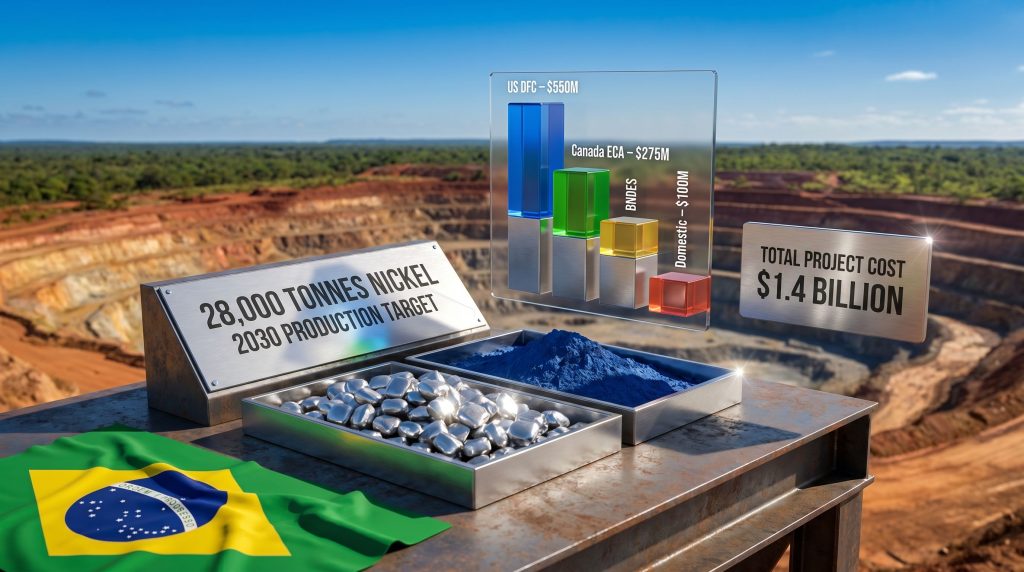
Situated in Brazil's northeastern Piauí state, the project targets production of 28,000 tonnes of nickel per year alongside 1 million metric tonnes of cobalt annually across the first decade of operation. Total development capital required stands at approximately $1.4 billion, making it one of the largest pre-production nickel commitments currently active outside of Indonesia and the Philippines.
| Metric | Detail |
|---|---|
| Total Project Cost | $1.4 billion |
| Target Nickel Output | 28,000 tonnes per year |
| Target Cobalt Output | 1 million metric tonnes per year (first decade) |
| Production Start Target | First half of 2030 |
| Location | Piauí State, Northeastern Brazil |
| Project Type | Laterite nickel, battery-material focused |
The 2030 target is both ambitious and logistically significant. Battery manufacturers supplying automotive OEMs are now operating with procurement timelines that extend five to seven years forward. Consequently, a project achieving first production before 2031 still enters a supply window where demand from European and North American gigafactories will be structurally undersupplied. Missing that window by even two or three years shifts Piauí from a strategic asset into a late-cycle entrant.
How Does This Compare to Other Global Nickel Projects?
In the context of the broader battery metals investment landscape, Piauí stands out for its scale and strategic positioning. Furthermore, the project's combination of nickel and cobalt output places it at the intersection of two commodity markets simultaneously facing structural supply constraints, making the financing outcome particularly consequential for Western battery supply chains.
Laterite Nickel: The Technical Complexity That Drives Financing Risk
One of the lesser-understood dimensions of the Piauí project is why laterite deposits attract higher financing risk premiums than sulphide nickel deposits, even when their resource scale is comparable.
Laterite ores are formed through prolonged tropical weathering of ultramafic rocks, producing a layered deposit profile where nickel concentration varies significantly by depth and mineralogy. Unlike sulphide deposits, which can be processed through conventional flotation, laterite ore typically requires either high-pressure acid leaching (HPAL) or atmospheric heap leach methods. Both are capital-intensive and technically demanding.
HPAL facilities in particular have a documented history of cost overruns and commissioning delays across projects in Australia, the Philippines, and Madagascar. Lenders and equity investors with experience in the sector assign meaningful technical risk premiums to laterite projects, which directly influences the pricing of debt facilities and the threshold at which institutional equity investors will participate.
The specific mineralogy of Piauí's deposit, situated within a deeply weathered laterite profile in a semi-arid region of northeastern Brazil, adds local variables around water availability, reagent logistics, and processing chemistry that international lenders model carefully. This is precisely why the sequencing of capital commitments matters so much: a development finance institution with technical due diligence capability provides credibility to the processing risk narrative in a way that commercial lenders alone cannot.
How the Capital Stack Is Structured
Brazilian Nickel has engaged a dual-adviser model that reflects the project's dual capital market exposure. Rothschild & Co. manages global debt and equity outreach, while Bradesco BBI targets the domestic Brazilian institutional market with a raise of approximately $100 million targeting local funds and investors.
| Funding Source | Type | Estimated Contribution |
|---|---|---|
| Canada's Export Credit Agency | Debt Financing | ~$275 million |
| Ecora Royalties Plc | Royalty-Linked Loan | ~$62 million |
| US DFC (letter of interest) | Project Debt | Up to $550 million (LOI) |
| BNDES (Brazil Development Bank) | Government Equity/Debt | Under negotiation |
| Bradesco BBI (domestic round) | Equity | ~$100 million |
| European Government Agencies | TBD | Under negotiation |
The US International Development Finance Corporation issued a letter of interest in 2024 indicating potential support for the project. It is important to note that a letter of interest is not a funding commitment. It signals that the DFC has conducted preliminary due diligence and considers the project consistent with its mandate, but formal approval processes, environmental assessments, and congressional notification requirements would follow before any disbursement could occur.
Canada's export credit agency has been identified as a potential provider of approximately $275 million in debt financing, while Ecora Royalties Plc may contribute around $62 million through royalty-linked loan structures. European government agency participation is described as under active negotiation.
What Role Does Each Capital Source Play?
Each component of the capital stack serves a distinct function. In addition, the layered structure reflects lessons learned from previous large-scale laterite projects where over-reliance on a single capital source created structural vulnerability when market conditions shifted during construction.
The Anchor Investor Mechanism: Why the Sequencing Problem Is Critical
What is an anchor investor in mining finance? An anchor investor is a cornerstone capital provider, typically a development finance institution, sovereign fund, or major strategic entity, whose commitment to a project signals credibility and risk acceptance, thereby enabling smaller institutional investors to participate with greater confidence. In large-scale mining projects, an anchor investor often provides the first tranche of equity or debt that unlocks the broader syndication process.
The behavioural dynamic that underpins this mechanism is well-documented in institutional capital markets. Fund managers in São Paulo, London, and New York managing mandates with fiduciary constraints cannot lead a position in a pre-production laterite project in an emerging market without cover. The reputational and regulatory risk of being the first institutional name attached to a project that subsequently faces delays or cost overruns is professionally significant.
A development finance institution such as BNDES or the DFC carries a different risk profile. Its investment mandate is explicitly linked to strategic objectives rather than pure financial return maximisation, which means it can absorb first-mover uncertainty in a way that commercial funds structurally cannot.
The practical consequence is what financing professionals describe as a syndication flywheel: once an anchor commits, smaller funds treat that commitment as a form of validated due diligence, which accelerates their own internal approval processes. The absence of an anchor, by contrast, creates a paralysis state where every prospective investor waits for someone else to move first.
Geopolitical Supply Disruptions Driving Western Capital Urgency
The financing timeline for Piauí is not occurring in isolation. Two concurrent commodity disruptions have materially shifted the calculus for Western government-linked capital allocators.
| Commodity | Key Disruption | Market Impact |
|---|---|---|
| Nickel | Indonesian quota reductions and cost escalation | Tightening global supply projections |
| Cobalt | Democratic Republic of Congo export controls | Price surge exceeding 160% since prior year |
| Both | China's processing dominance across refining | Accelerated Western supply chain prioritisation |
Indonesia accounts for more than half of global nickel mine production. Furthermore, mining quota reductions implemented by Indonesian authorities, combined with rising operational costs across the archipelago's nickel laterite operations, have compressed the supply outlook for Class 1 nickel, the refined grade required for battery cathode materials. The Indonesian nickel price volatility has consequently intensified the search for alternative supply sources across Western markets.
The cobalt situation is structurally more acute. The Democratic Republic of Congo supplies roughly 70% of global mined cobalt, and export controls implemented by Kinshasa have created a price environment where cobalt has appreciated by more than 160% year-on-year. Battery manufacturers and automotive supply chains dependent on cobalt-containing cathode chemistries, including NMC variants, are acutely exposed to this disruption. Indeed, the cobalt mining industry has rarely faced a more complex supply environment than it does today.
For capital allocators at institutions like the DFC or Canada's Export Development Canada, these supply events do not merely represent commodity price volatility. They represent precisely the geopolitical supply chain risk that their institutions' mandates are designed to address through strategic investment.
The next major ASX story will hit our subscribers first
TechMet's Role and What It Signals to Institutional Investors
Brazilian Nickel's controlling shareholder, TechMet Ltd., is not a conventional mining investor. The firm was established with an explicit mandate to build equity positions in critical minerals assets that serve Western supply chain interests as a counter to Chinese dominance across the battery materials value chain. TechMet has previously raised capital from US government-linked investors as part of this strategic orientation.
For institutional investors evaluating Piauí, TechMet's involvement functions as a form of strategic signalling. It indicates that the project has already been assessed through a geopolitically aware investment lens, and that the asset is positioned within a network of relationships with Western development finance institutions. This does not eliminate investment risk, but it does suggest that the project's alignment with DFC and Export Development Canada mandates has been actively cultivated rather than incidentally achieved.
Risk Factors That Could Derail the 2030 Timeline
Several structural risks bear careful consideration:
-
First-mover paralysis: If neither BNDES nor the DFC formalises an anchor commitment within a financing window consistent with a 2030 production start, engineering procurement and construction contracts cannot be awarded on schedule.
-
Currency and sovereign risk: International lenders pricing Brazilian project debt must account for real-dollar exchange rate volatility, regulatory change risk, and infrastructure adequacy in Piauí state, a region with lower industrial development density than Brazil's southeast.
-
Technical execution risk: HPAL or equivalent laterite processing facilities are among the most operationally complex assets in the mining sector. Cost overruns at comparable facilities globally have exceeded 50% of initial estimates in several documented cases.
-
Dual capital market tension: Simultaneously managing a domestic Brazilian institutional raise and a multi-sovereign international debt syndication introduces coordination complexity. Divergent investor expectations around governance, return hurdles, and exit mechanisms may complicate execution.
Projects of this scale in emerging markets frequently encounter a first-mover paralysis dynamic where no single institutional investor is willing to take the lead position without prior commitment from a development finance institution. The entire capital strategy depends on resolving this sequencing bottleneck before 2027 if the 2030 production target is to remain structurally viable.
Brazil's Strategic Position in the Global Critical Minerals Competition
Brazil occupies a distinctive position in the emerging Western critical minerals architecture. Its laterite nickel endowments are substantial, its political environment is broadly compatible with Western investment norms, and BNDES has signalled appetite to participate in strategic minerals projects as part of Brazil's own industrial policy agenda.
Unlike Australia and Canada, which have established formal critical minerals strategies with bilateral agreements linking their export credit agencies to allied-nation supply chains, Brazil's framework remains less institutionally formalised at the international level. This creates both opportunity and uncertainty: opportunity because Piauí could become a flagship asset in a Western-aligned Brazilian critical minerals narrative, and uncertainty because the domestic policy environment around BNDES participation is subject to shifting government priorities.
However, the broader critical minerals demand driven by the energy transition is creating urgency that transcends individual project timelines. Comparing peer jurisdictions is instructive:
| Country | Critical Minerals Policy Maturity | Key Financing Mechanism |
|---|---|---|
| Australia | High | EFIC, bilateral agreements with US/Japan/Korea |
| Canada | High | EDC, Critical Minerals Strategy, IRA alignment |
| Brazil | Developing | BNDES, sector-specific legislation in progress |
| European Union | High | European Raw Materials Act, EIB financing |
Key Takeaways for Investors and Industry Observers
-
Large-scale battery-metal projects now require coordinated multi-sovereign financing architectures rather than single-source capital, reflecting both the scale of capital required and the geopolitical complexity of critical minerals development.
-
Development finance institutions have become structural gatekeepers in the critical minerals financing ecosystem, with their first-mover decisions functioning as catalysts for broader institutional capital syndication.
-
Commodity supply disruptions in Indonesia and the Democratic Republic of Congo are not temporary price events. They represent structural supply chain vulnerabilities that are directly accelerating Western government appetite for alternative production sources.
-
The anchor investor model reflects a deeper shift from purely commercial mining finance toward strategic, policy-driven capital deployment in which risk is shared between sovereign-linked institutions and private capital.
-
Brazil's Piauí project represents one of the most significant non-Indonesian laterite nickel development opportunities currently in active financing, at a moment when the global supply picture for battery-grade nickel and cobalt is under sustained geopolitical pressure. The Brazilian Nickel anchor investor for the Piauí nickel project search remains, consequently, one of the most closely watched capital formation events in the critical minerals sector.
This article contains forward-looking statements and projections regarding project timelines, capital structures, and commodity market conditions. These involve material uncertainties and should not be interpreted as investment advice. Financing outcomes, production timelines, and commodity prices are subject to change. Readers should conduct their own independent research before making any investment decisions.
Want to Stay Ahead of the Next Major Critical Minerals Discovery?
Discovery Alert's proprietary Discovery IQ model delivers real-time alerts on significant ASX mineral discoveries — cutting through complex commodity data to surface actionable opportunities the moment they are announced. Explore historic discoveries and the extraordinary returns they have generated, then begin your 14-day free trial at Discovery Alert to position yourself ahead of the broader market.