June 18, 2026
The Conglomerate Discount and Why Breaking Apart Can Create More Than the Sum of Parts
Corporate history is littered with examples of diversified giants that traded at persistent discounts to their underlying asset values. The phenomenon known as the conglomerate discount reflects a fundamental tension in capital markets: when too many unrelated businesses sit under a single listed roof, institutional investors struggle to price them accurately, allocate capital efficiently, or build targeted sector exposure without unwanted cross-contamination. The solution, increasingly favoured by resource majors worldwide, is deliberate unbundling.
The Vedanta demerger listing of four independent companies in June 2026 represents one of the most significant corporate restructurings in Indian market history. What was once a single diversified natural resources conglomerate has been transformed into five separately listed sector leaders, each with a distinct mandate, capital structure, and growth trajectory. Understanding the mechanics, the rationale, and the long-term implications of this restructuring requires examining the event through multiple lenses: corporate strategy, India's industrial ambitions, global commodity cycles, and the evolving demands of institutional capital.
When big ASX news breaks, our subscribers know first
How the Vedanta Demerger Works: Structure, Mechanics, and Share Entitlements
From One Listed Entity to Five: The New Corporate Architecture
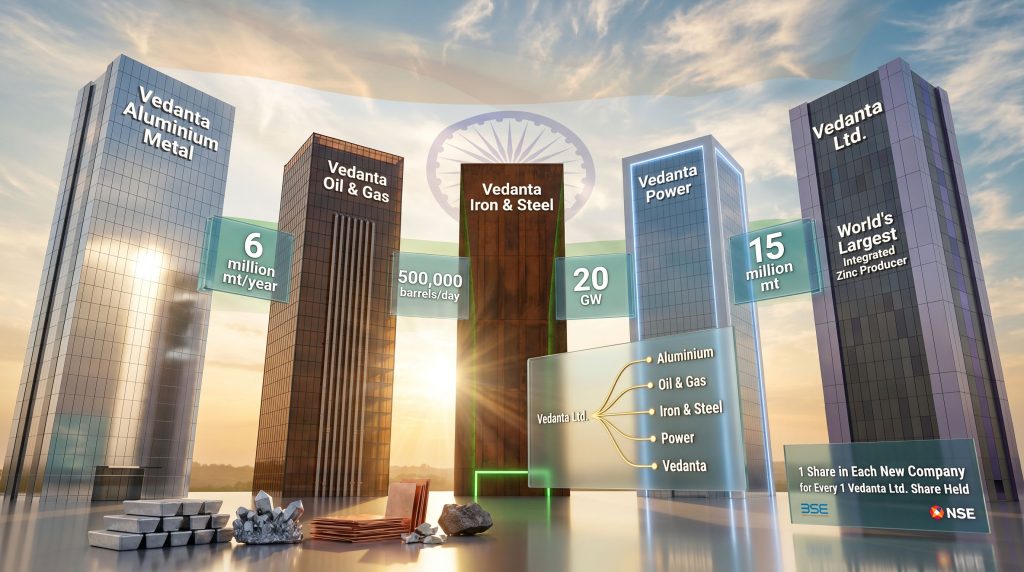
Prior to the restructuring, Vedanta Ltd. operated as a single diversified natural resources business encompassing aluminum, oil and gas, power generation, iron and steel, zinc, copper, nickel, and ferro alloys under one listed umbrella. The demerger created four newly independent entities while retaining a residual flagship, producing five separately listed companies in total.
All five entities are listed on both the Bombay Stock Exchange (BSE) and the National Stock Exchange (NSE), giving them access to the full depth of India's equity capital markets from day one. The four newly listed businesses are Vedanta Aluminium Metal, Vedanta Oil & Gas, Vedanta Iron & Steel, and Vedanta Power, with the residual critical minerals and zinc business continuing under the Vedanta Ltd. name.
How Were Shares Distributed to Existing Shareholders?
The share allocation mechanism was straightforward but consequential for portfolio composition:
- Shareholders on the eligible record date received 1 share in each of the four newly listed companies for every 1 Vedanta Ltd. share held
- All five entities trade on both the BSE and NSE, ensuring liquidity across exchanges
- The four new companies initially traded in the Trade-for-Trade (T2T) segment for the first 10 trading sessions, restricting all activity to delivery-based transactions only
- After the T2T window closes, the shares transition to standard trading with full intraday access
This 1:1:1:1:1 allocation means that every existing shareholder woke up the morning after listing holding five separate positions rather than one, with each position representing a pure-play bet on a distinct sector of India's industrial economy. According to reports on the listing day, the combined value of all five entities topped Rs 930 per share, underlining the immediate market recognition of the unlocked value.
What Is Trade-for-Trade (T2T) Trading and Why Does It Apply Here?
The T2T segment is a regulatory mechanism applied by Indian exchanges to newly listed or restructured securities during their initial price discovery phase. Its purpose is to prevent speculative intraday activity from distorting early valuations before genuine long-term price discovery can occur.
| Feature | Standard Trading | Trade-for-Trade (T2T) |
|---|---|---|
| Intraday trading allowed | Yes | No |
| Delivery obligation | Optional | Mandatory |
| Typical application | Established stocks | Newly listed or restructured entities |
| Duration for new listings | N/A | First 10 trading sessions |
For investors, the T2T window creates a structurally unique environment. Index funds and sector-mandated institutional investors who receive allocations outside their investment mandate may become forced sellers, potentially creating short-term pricing dislocations that longer-term investors can exploit through deliberate positioning.
The Five Entities Created: A Sector-by-Sector Breakdown
Vedanta Aluminium Metal: Building India's Largest Integrated Aluminum Platform
Vedanta Aluminium Metal begins its independent life as India's largest aluminum producer and ranks third-largest globally outside China by production volume. Its flagship asset is the world's largest single-location aluminum smelter at Jharsuguda in Odisha, a facility that underpins the company's claim to industrial scale few peers can match.
The growth ambition is substantial:
- Current output is to be doubled to 6 million metric tons (mt) per year
- Long-term objective: Become the world's largest integrated aluminum producer
- Strategic significance: Aluminum is a core input for electric vehicles, aerospace, renewable energy infrastructure, and AI data centre construction
What is less commonly appreciated is the degree to which integrated aluminum production confers a structural cost advantage. Integrating bauxite mining, alumina refining, and smelting into a single operational chain allows producers to capture margin at every stage rather than paying spot prices between steps. Vedanta Aluminium's scale at Jharsuguda positions it to pursue this integration more aggressively as a standalone entity with its own capital allocation discipline.
Vedanta Oil & Gas: Anchoring India's Private-Sector Energy Security
The oil and gas entity is positioned as one of India's largest private-sector hydrocarbon producers, with an ambitious production target of 500,000 barrels per day at globally competitive cost structures. The strategic framing here is explicit: reducing India's chronic dependence on crude oil imports, which represent one of the country's largest structural current account vulnerabilities.
India currently imports over 85% of its crude oil requirements, making domestic upstream production one of the most strategically valuable industrial activities the country can pursue. A private-sector operator with the scale, capital discipline, and operational focus of an independently listed entity is arguably better positioned to pursue aggressive production ramp-ups than a division competing for capital allocation within a diversified parent.
Vedanta Iron & Steel: Infrastructure-Scale Steel with a Green Transition Mandate
This entity is built on a resource foundation that few steel companies globally can rival:
- ~4 billion mt of iron ore resources secured at the asset level
- ~800 kilotons per year of metallurgical coke production capacity already in place
- Gas connectivity infrastructure already accessible at site, reducing future capital expenditure for low-emission steelmaking
- Target capacity of 15 million mt of steel, with a deliberate focus on value-added, specialty, and green steel products
The green steel angle is particularly significant. As the European Union's Carbon Border Adjustment Mechanism (CBAM) begins to reshape global steel and iron ore market economics, Indian producers with low-emission production pathways will carry a meaningful pricing premium in export markets. Vedanta Iron & Steel's gas infrastructure access positions it ahead of peers who will need to retrofit for lower-carbon production at considerably greater cost.
Vedanta Power: Baseload Stability with a Nuclear Horizon
Power generation is the infrastructure enabler that underpins everything else in India's industrial expansion, and Vedanta Power enters the market as the country's fifth-largest power producer with 4.2 GW of operational generation capacity anchored by long-term power purchase agreements and secured coal supply linkages.
The expansion roadmap targets 20 GW of total capacity, which would represent a nearly fivefold increase. More unusually, the company has flagged an intention to venture into nuclear power generation, a segment that remains largely state-dominated in India and where private-sector participation would represent a significant structural development in the country's energy landscape.
Vedanta Ltd. (Residual Entity): The Critical Minerals and Zinc Flagship
The residual Vedanta Ltd. is arguably the most globally significant of the five entities when assessed against the lens of the energy transition and critical minerals demand. Its anchor asset is Hindustan Zinc, which holds the distinction of being the world's largest integrated zinc-lead producer and the third-largest silver producer globally.
The critical minerals portfolio extends well beyond zinc:
- India's only domestic nickel producer, with a scale-up target of 60,000 mt per year
- Copper operations serving a significant share of India's domestic consumption base
- Subsidiary FACOR positioned to become India's largest special-grade ferro chrome producer and the country's only private-sector manganese producer in key segments
- A 1.5 million mt fertilizer plant under development through Hindustan Zinc to support domestic agriculture
The nickel ambition deserves particular attention. Indonesian nickel supply and its export policy decisions have repeatedly created price shocks that ripple through EV battery supply chains worldwide. India's ability to develop a domestic nickel production base through a scaled, independently listed vehicle addresses a genuine strategic vulnerability in the country's electric vehicle manufacturing ambitions.
Key Metrics at a Glance: The Vedanta Demerger by the Numbers
| Entity | Key Metric | Scale or Target |
|---|---|---|
| Vedanta Aluminium Metal | Global rank outside China | 3rd largest |
| Vedanta Aluminium Metal | Capacity expansion target | 6 million mt/year |
| Vedanta Oil & Gas | Production ambition | 500,000 barrels/day |
| Vedanta Iron & Steel | Iron ore resource base | ~4 billion mt |
| Vedanta Iron & Steel | Steel capacity target | 15 million mt |
| Vedanta Power | Current operational capacity | 4.2 GW |
| Vedanta Power | Long-term capacity target | 20 GW |
| Hindustan Zinc | Global zinc rank | World's largest integrated producer |
| Hindustan Zinc | Global silver rank | 3rd largest producer |
| Vedanta Ltd. (Nickel) | Domestic nickel scale target | 60,000 mt/year |
| Hindustan Zinc (Fertilizer) | Fertilizer plant capacity | 1.5 million mt |
Why Did Vedanta Choose to Demerge? The Strategic and Macroeconomic Rationale
Unlocking the Conglomerate Discount: How Focused Entities Attract Differentiated Capital
A natural resources conglomerate blending aluminum, oil and gas, power, steel, zinc, and nickel under one ticker creates a fundamental problem for institutional capital allocation. A pension fund seeking clean exposure to the energy transition cannot own the Vedanta conglomerate without also taking exposure to upstream hydrocarbons. A commodity fund building an aluminum position cannot avoid the earnings volatility of a power generation subsidiary priced on regulated returns.
Demerging into sector-specific entities solves this problem. Each of the five businesses now attracts capital from the universe of investors whose mandate precisely matches its operational profile. This structural alignment between business character and investor mandate is the mechanism through which conglomerate discounts are dissolved.
Aligning Business Units With India's National Industrial Priorities
India's long-term development framework, oriented around the concept of Viksit Bharat or Developed India by 2047, requires building domestic dominance across metals, energy, and critical minerals rather than continuing to import these inputs from geopolitically uncertain sources. The five independently listed entities collectively span every major industrial sector identified as foundational to this national ambition:
- Aluminum for clean energy infrastructure and advanced manufacturing
- Domestic hydrocarbon production for energy security
- Green steel for infrastructure and export competitiveness
- Reliable baseload power for industrial and data economy expansion
- Critical minerals for the EV transition and advanced technology manufacturing
Each entity, now independently capitalised and managed, can align its investment cycle, management incentives, and strategic partnerships to a single sector objective rather than competing for resources within a diversified parent.
The Global Macro Backdrop: Why This Restructuring Is Timed Precisely
The convergence of AI infrastructure buildout, high-tech manufacturing reshoring, and the global energy transition is creating a simultaneous demand surge across aluminum, copper, nickel, zinc, and reliable baseload power. The Vedanta demerger positions five independent entities directly at the intersection of each of these structural demand drivers.
This is not coincidental timing. AI data centre construction is intensely aluminum and copper-intensive. Electric vehicle manufacturing creates derived demand for nickel, zinc, and copper. Renewable energy infrastructure requires steel, aluminum, and zinc at scale. The unbundling of Vedanta's portfolio into five focused businesses allows each entity to credibly communicate its specific role in this broader commodity supercycle narrative to the investors best positioned to value it.
What the Vedanta Demerger Means for India's Critical Minerals Strategy
Nickel, Copper, and Zinc: The Energy Transition Supply Chain Imperative
One of the less-discussed dimensions of the Vedanta restructuring is its strategic relevance to India's domestic EV supply chain. The country has set ambitious electric vehicle adoption targets, yet its upstream critical minerals production has historically been inadequate to support domestic battery and drivetrain manufacturing at scale.
The residual Vedanta Ltd. entity directly addresses three of the most acute vulnerabilities in this supply chain:
- Nickel: Scaling domestic production to 60,000 mt per year reduces reliance on Indonesian supply, which has been subject to unpredictable export restrictions
- Zinc: Used in galvanising steel for EV chassis and structural components, Hindustan Zinc's scale provides pricing and supply certainty for downstream manufacturers
- Copper: Copper is the backbone of EV motors, charging infrastructure, and renewable energy cabling, and domestic production capacity is directly relevant to India's manufacturing ambitions
Furthermore, India's lithium supply strategy similarly seeks to address upstream critical minerals dependency, reflecting a broader national policy shift toward domestic resource sovereignty across the entire battery metals value chain.
Ferro Chrome and Manganese: The Specialty Metals Dimension
FACOR's positioning as India's future largest special-grade ferro chrome producer and potentially the country's only private-sector manganese producer in key segments represents a less-publicised but strategically important element of the portfolio. Ferro chrome is essential for stainless steel production, and manganese is a key input for certain lithium-ion battery chemistries, particularly the lithium-manganese-oxide and lithium-nickel-manganese-cobalt-oxide formulations increasingly favoured for cost and stability reasons.
Comparing Vedanta's Demerger to Global Precedents in Resource Sector Unbundling
| Company | Demerger Type | Strategic Outcome |
|---|---|---|
| BHP (ASX: BHP) | Petroleum spin-off to Woodside | Enhanced mining focus; petroleum shareholders unlocked value |
| Rio Tinto | Coal asset divestment | Repositioned portfolio toward future-facing minerals |
| South32 (ASX: S32) | Spun out of BHP | Created independent diversified miner with distinct capital identity |
| Vedanta Group | Four-way sector demerger | Five independently listed entities with sector-specific mandates |
The BHP spin-off strategy is instructive. When BHP spun out South32 in 2015, both entities subsequently outperformed the combined structure on a total return basis over the following years, suggesting that the market's ability to correctly price focused operators exceeds its ability to value conglomerates. The Vedanta demerger listing of four independent companies is structurally more complex, producing five entities rather than two, which amplifies both the potential value unlock and the short-term complexity for portfolio management.
The next major ASX story will hit our subscribers first
Investor Implications: What Shareholders and Market Participants Need to Know
Understanding the T2T Trading Period and Its Implications for Liquidity
The initial 10-session T2T window is not merely a technical procedural detail. It creates a specific market microstructure with identifiable consequences for price behaviour:
- Index-tracking funds and ETFs holding legacy Vedanta Ltd. positions may need to rebalance immediately, creating selling pressure across some or all of the new entities regardless of fundamental value
- Sector-mandated institutional investors who receive allocations outside their permitted investment universe are effectively compelled to sell during the T2T window
- Because intraday speculation is structurally prevented, any forced selling that occurs during the T2T period must be absorbed by genuine long-term buyers willing to take delivery
Historically, the T2T period for significant restructurings has produced early-session pricing that does not reflect equilibrium valuations, as the seller universe is temporarily larger than the natural buyer universe. Patient investors who understand this dynamic may be positioned to acquire shares at valuations that normalise once standard trading resumes.
This represents a speculative observation based on market structure analysis and historical patterns, not a guarantee of future price outcomes. All investment decisions should be made with reference to individual risk tolerance and professional financial advice.
Risk Factors to Monitor Across the Five Entities
Each independently listed entity now carries sector-specific risks that were previously diversified within the conglomerate structure:
- Vedanta Aluminium: Exposure to global aluminum price cycles and energy cost intensity at the smelting stage; alumina feedstock procurement risk
- Vedanta Oil & Gas: Regulatory complexity in India's upstream hydrocarbon sector; production ramp timelines dependent on government-administered acreage frameworks
- Vedanta Iron & Steel: Steel demand sensitivity to India's infrastructure spending cycle and export market conditions affected by CBAM and global trade dynamics
- Vedanta Power: Regulatory pathway for nuclear generation entry; PPA renewal risk as existing contracts mature; coal supply security in a decarbonising energy policy environment
- Vedanta Ltd.: Zinc price cycle exposure; nickel market pressure from Indonesian supply overhang; copper price volatility tied to global demand conditions
Frequently Asked Questions: Vedanta Demerger and the Four New Listed Companies
When Did the Four Vedanta Companies List?
The four new entities, namely Vedanta Aluminium Metal, Vedanta Oil & Gas, Vedanta Power, and Vedanta Iron & Steel, were listed on both the BSE and NSE in June 2026, with listing ceremonies at both exchanges.
How Many Shares Do Vedanta Shareholders Receive in the New Companies?
Eligible shareholders received one share in each of the four newly created companies for every single Vedanta Ltd. share held on the record date, resulting in simultaneous holdings across all five listed entities.
What Is Vedanta Ltd. After the Demerger?
Vedanta Ltd. continues as the group's flagship listed entity, retaining its critical minerals portfolio anchored by Hindustan Zinc, the world's largest integrated zinc producer and third-largest silver producer globally, alongside copper, nickel, ferro alloys, and strategic minerals operations.
What Is the Trade-for-Trade Restriction and How Long Does It Last?
The T2T restriction applies to all four newly listed entities for their first 10 trading sessions. During this period, all transactions require full delivery settlement and intraday trading is not permitted.
What Are the Long-Term Growth Targets for Each New Entity?
- Aluminium: 6 million mt per year capacity, representing a doubling of current output
- Oil & Gas: 500,000 barrels per day in domestic production
- Iron & Steel: 15 million mt of steel capacity with a green steel focus
- Power: 20 GW of total generation capacity, including a planned foray into nuclear
Five Sector Leaders Built for the Next Economic Cycle
The Vedanta demerger listing of four independent companies is not simply a corporate housekeeping exercise. It represents a deliberate structural response to the convergence of several powerful forces: the demand that institutional capital places on sector clarity, India's urgent need to build domestic industrial sovereignty across metals and energy, and the global commodity cycle reshaping driven by decarbonisation and the AI economy.
What makes this restructuring particularly significant is that each of the five entities has been architected around a specific bottleneck in India's industrial development pathway. The aluminium entity addresses the country's need for a domestic supply base for clean technology manufacturing. The oil and gas entity targets import dependency reduction. The iron and steel entity is oriented toward infrastructure-grade and green steel competitiveness. The power entity fills the baseload gap that constrains industrial expansion. The residual critical minerals entity builds the upstream supply chain for the energy transition itself.
Whether this restructuring delivers on its long-term promise will depend on execution, commodity cycles, regulatory developments, and global demand trajectories. However, as a statement of strategic intent and corporate architecture, the Vedanta demerger listing of four independent companies sets a compelling template for how India's largest resource businesses can align themselves with the country's next phase of industrial development while simultaneously unlocking the latent value that conglomerate structures have historically suppressed.
This article is intended for informational purposes only and does not constitute financial advice. Forecasts, targets, and projections referenced throughout are sourced from company announcements and public disclosures. Readers should conduct their own due diligence and consult a licensed financial advisor before making any investment decisions. Past corporate restructuring outcomes are not necessarily indicative of future results.
Want to Catch the Next Major Mineral Discovery Before the Broader Market Does?
While corporate restructurings like the Vedanta demerger illustrate how unlocking hidden value can generate substantial returns, Discovery Alert's proprietary Discovery IQ model delivers real-time alerts on significant ASX mineral discoveries the moment they are announced — turning complex mineral data into actionable opportunities for both short-term traders and long-term investors. Explore how historic discoveries have generated extraordinary returns on Discovery Alert's dedicated discoveries page, and begin your 14-day free trial today to position yourself ahead of the market.