June 18, 2026
The Iron Grade Gap That Could Determine Australia's Export Future
Every major industrial transition creates winners and losers not just through the technologies that succeed, but through the feedstocks those technologies require. The global steel industry's shift toward low-carbon production routes is no exception. At its centre sits a quiet but consequential materials problem: the world's most advanced green steelmaking processes were engineered around ore grades that Pilbara low-grade iron electric smelting is now being designed to challenge. Understanding why that gap exists, how researchers and miners are attempting to close it, and what is at stake commercially, is essential context for anyone tracking the future of Australian iron ore.
Steel decarbonisation is no longer a distant policy ambition. Blast furnace operators across Europe, Japan, South Korea, and China are under intensifying regulatory and financial pressure to transition toward lower-emission production routes. The direct reduction ironmaking and electric smelting furnace pathway has emerged as the most technically mature alternative at scale, yet it was designed around premium iron ore grades that Australia's dominant Pilbara region has historically struggled to supply. The consequence is a structural misalignment between Australia's vast iron ore reserve base and the fastest-growing segment of future steelmaking capacity.
When big ASX news breaks, our subscribers know first
Why the Pilbara Grade Gap Is a Strategic Problem, Not Just a Technical One
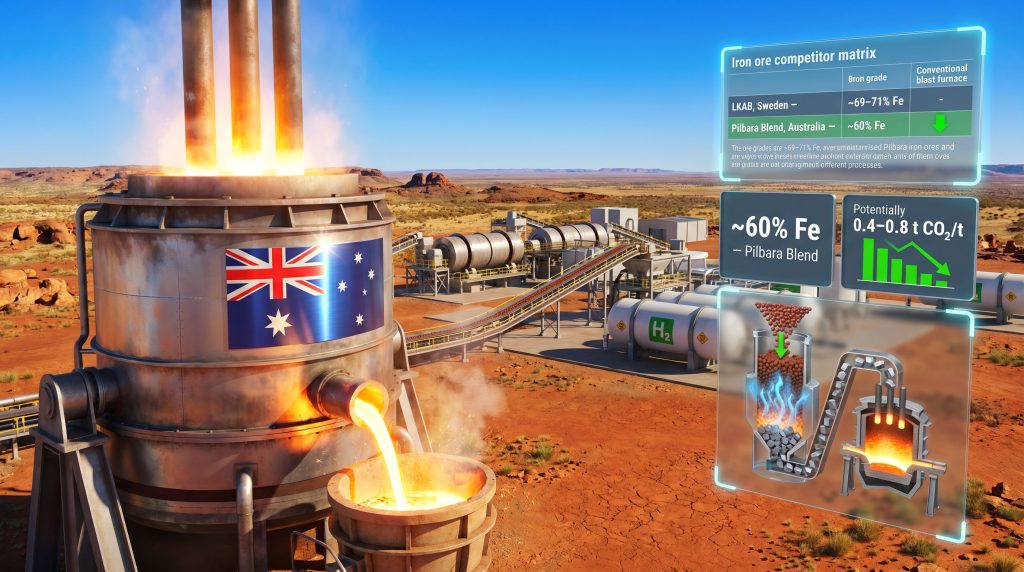
Conventional direct reduction ironmaking requires feed ore at or above approximately 67% iron content to function efficiently within shaft furnace environments. Pilbara Blend ore, which underpins the majority of Australian iron ore exports, averages around 60% Fe. That roughly seven percentage point gap has historically disqualified Pilbara ores from low-carbon steelmaking pathways, but the chemistry problem runs deeper than iron grade alone.
Pilbara ores carry elevated concentrations of gangue minerals relative to premium direct reduction pellet sources. Key impurities include:
- Alumina (Al₂O₃): Present at levels that increase slag viscosity and energy consumption in electric smelting furnaces
- Silica (SiO₂): Contributes to higher slag volumes and complicates furnace chemistry management
- Phosphorus: Creates downstream steel quality challenges that must be managed in basic oxygen furnace steelmaking after the ESF stage
- Goethitic ore types: Common across many Pilbara deposits, these hydrated iron oxides behave differently from hematite-dominant ores under reduction conditions, affecting reduction kinetics and DRI quality
Australia holds one of the world's largest iron ore reserve bases, yet without a viable pathway into direct reduction plus electric smelting furnace steelmaking, it faces structural exclusion from the route attracting the most new capital investment in low-carbon steel production globally. Furthermore, Australia's iron ore leadership position depends on solving this grade compatibility problem before global steelmakers lock in alternative supply chains.
The commercial stakes are substantial. Australia's iron ore sector generates over A$120 billion annually in export revenues, making it the country's single largest export earner. If Pilbara ores cannot be adapted to serve hydrogen-based DRI and electric smelting furnace routes, long-term demand erosion becomes a credible scenario rather than a theoretical risk as global steelmaking decarbonises over coming decades.
"The commercial viability of Pilbara low-grade iron electric smelting is not merely a technical question. It is a strategic question about whether Australia's iron ore industry can remain relevant in a decarbonising global steel market."
What Is the DRI–ESF Steelmaking Route and How Does It Work?
A Step-by-Step Breakdown of the Process
The direct reduction ironmaking to electric smelting furnace pathway represents a fundamental departure from the conventional blast furnace and basic oxygen furnace steelmaking model that has dominated global production for more than a century. Understanding its mechanics is essential to grasping both its promise and its current limitations for Pilbara feedstocks.
- Ore Preparation: Raw Pilbara iron ore undergoes beneficiation, a physical separation process that removes gangue minerals, followed by pelletisation to produce feed material suitable for shaft furnace processing.
- Direct Reduction: Pellets enter a shaft furnace where a reducing gas, either hydrogen or natural gas during transitional phases, strips oxygen from the iron oxide lattice, producing direct reduced iron or hot briquetted iron without melting the material.
- Carburisation: The DRI is carburised to adjust its carbon content, which critically influences downstream melting behaviour and hot metal chemistry in the electric smelting furnace stage.
- Electric Smelting Furnace Processing: DRI feeds into an ESF where electrical energy melts the material, separating molten iron from the slag phase that carries impurities.
- Hot Metal Output: Molten iron exits the ESF and transfers to a basic oxygen furnace for final steel chemistry adjustment and casting.
- Slag Management: Impurities from lower-grade ores concentrate heavily in the slag phase. For Pilbara-grade feedstocks, managing slag volume, viscosity, and basicity is the most operationally complex variable in the entire process chain.
How the DRI–ESF Route Compares to Conventional Blast Furnace Steelmaking
| Parameter | Blast Furnace–BOF Route | DRI–ESF Route (Pilbara Application) |
|---|---|---|
| Primary reductant | Metallurgical coal (coke) | Hydrogen or natural gas (transitioning to H₂) |
| CO₂ intensity | ~1.8–2.0 t CO₂ per tonne of steel | Potentially 0.4–0.8 t CO₂/t with green H₂ |
| Ore grade requirement | Flexible (sinter feed acceptable) | Historically ~67% Fe; ESF adaptation lowers this threshold |
| Impurity tolerance | Higher (slag chemistry managed in BF) | Requires careful slag engineering for Al₂O₃ and SiO₂ |
| Capital intensity | Very high (integrated steelworks) | Modular potential; pilot scale achievable |
| Pilbara ore compatibility | Established (via sintering) | Under active development and trial |
When powered by green hydrogen and renewable electricity, the DRI–ESF route has the potential to reduce steelmaking CO₂ emissions by approximately 80–90% compared to conventional blast furnace operations. Even the transitional phase using natural gas as a bridging reductant delivers meaningful emissions reductions of 40–60% relative to the blast furnace baseline, making it commercially attractive well before a full green hydrogen transition is achieved.
What Projects Are Currently Testing Pilbara Low-Grade Iron Electric Smelting?
The Kwinana Pilot Plant: Australia's Most Advanced ESF Demonstration
In late 2024, BHP, Rio Tinto, and BlueScope jointly selected Kwinana, Western Australia as the location for Australia's largest ironmaking electric smelting furnace pilot facility. The plant is designed to produce between 30,000 and 40,000 tonnes of molten iron per year, a throughput scale large enough to generate commercially meaningful process data across extended operational campaigns rather than short-run laboratory conditions.
The initial operational phase will use natural gas as the reductant in the direct reduction stage, with a planned transition to hydrogen as technology matures and green hydrogen supply infrastructure develops at commercial scale in Western Australia. This sequencing reflects a pragmatic engineering approach: generate operational knowledge now while building toward full decarbonisation capability as infrastructure permits.
BlueScope's involvement as a domestic flat steel producer is particularly significant from a commercial architecture standpoint. It provides a downstream market anchor for the hot metal output, strengthening the investment case for Australian-based ironmaking rather than exporting ore for processing offshore.
University of Wollongong, CSIRO, and ARENA: The Research Foundation
A collaborative research program involving the University of Wollongong, CSIRO, and the Australian Renewable Energy Agency is systematically evaluating whether low- to medium-grade Pilbara ores can function reliably within an ESF-based steelmaking route. The ARENA-funded University of Wollongong research tests multiple ore format inputs, including:
- Lump ore direct from mine
- Fines processed through pelletisation
- Pellets across the full process sequence from pelletising through reduction, carburisation, melting, and slag behaviour characterisation
The stated objective is to advance both the Technology Readiness Level (TRL) and Commercial Readiness Level (CRL) of the DRI–ESF process specifically for Pilbara feedstocks. These outputs are intended to directly inform investment decisions by major miners and steelmakers considering full-scale facility commitments. Advancing TRL requires not just demonstrating that the process works in controlled conditions, but proving consistent performance across the range of ore types present across different Pilbara deposits, which vary meaningfully in mineralogy.
Rio Tinto and China Baowu: Industrial-Scale Validation
Rio Tinto, in collaboration with China Baowu, the world's largest steelmaker by production volume, has completed industrial-scale pelletisation trials using Pilbara Blend ore. The resulting DRI was subsequently tested in an ESF environment, providing the first large-scale validation that Pilbara Blend can be integrated into a hydrogen-compatible direct reduction plus electric smelting pathway. This progress is particularly relevant given the broader context of China steel and iron ore market dynamics, where decarbonisation pressures are intensifying rapidly.
The strategic significance of this collaboration extends beyond metallurgy. China Baowu's willingness to co-invest in process adaptation signals that the world's largest steel-producing nation is actively evaluating Pilbara ore as a viable feedstock for its own decarbonisation transition rather than simply defaulting to higher-grade alternative sources. Chinese steelmakers collectively consume the majority of Pilbara ore exports, so their engagement in developing Pilbara-compatible ESF processes is a market signal with profound long-term implications for Australian export volumes.
"The Rio Tinto and China Baowu collaboration is not simply a technical exercise. It is a market signal that Chinese steelmakers are willing to co-invest in process adaptation rather than switching to higher-grade alternative sources."
The Core Technical Challenges of Processing Low-Grade Pilbara Ore in an ESF
Slag Engineering: The Critical Operational Variable
The impurity profile of lower-grade Pilbara ores creates a fundamentally different slag chemistry environment compared to premium DR-grade ores such as Brazil's Carajás deposit, which grades at 65–67% Fe, or LKAB's Swedish magnetite concentrate, which reaches 69–71% Fe. In an ESF environment, alumina and silica report almost entirely to the slag phase, producing three compounding challenges:
- Higher slag volumes per tonne of hot metal produced, increasing both energy consumption and material handling complexity
- Elevated slag viscosity at processing temperatures, requiring precise control of slag basicity through flux additions to maintain flowability
- Accelerated furnace lining wear driven by both slag chemistry and the thermal cycling associated with higher-gangue feedstocks, which affects campaign life and capital cost assumptions at commercial scale
Optimising slag basicity, which involves balancing the ratio of basic to acidic oxide components in the slag, is the primary technical focus of current pilot and research programs. Getting this balance wrong either increases energy consumption substantially or risks furnace operational disruptions that would be commercially catastrophic at full scale.
Beneficiation Economics and Pelletisation Requirements
Pilbara fines and lump ore must typically be upgraded through beneficiation before pelletisation, adding a processing step that high-grade DR pellet producers from Brazil and Sweden do not require at the same level. The economics of this additional processing represent a material cost addition to the Pilbara-based process chain.
Pellet quality specifications are more demanding than many outside the industry appreciate. The physical and chemical characteristics that matter include:
- Crush strength: Pellets must survive the mechanical stresses of shaft furnace burden without fragmenting, which would impede gas flow and reduce reduction efficiency
- Reducibility: The rate at which iron oxides surrender their oxygen to the reducing gas, influenced directly by ore mineralogy and pellet microstructure
- Swelling behaviour: Some iron ore types expand significantly during reduction, which can cause shaft furnace operational disruptions if not controlled through pellet chemistry and thermal pre-treatment
Current research programs are working to quantify the economic crossover point at which beneficiation and pelletising costs are offset by the strategic advantage of using Pilbara ore rather than paying premium prices for imported high-grade DR pellets.
Reduction Kinetics and Goethitic Ore Behaviour
A lesser-known challenge within Pilbara ore processing is the behaviour of goethitic iron ore under reduction conditions. Goethite is a hydrated iron oxide mineral that is abundant across many Pilbara deposits, particularly in near-surface and detrital ore zones. When heated during reduction, goethite undergoes dehydration before reduction proper begins, which affects the internal pore structure of the pellet and can influence both reducibility and mechanical strength.
This mineralogical characteristic means that reduction kinetics and carburisation behaviour must be calibrated specifically for Pilbara-derived DRI rather than simply applying parameters developed for hematite-dominant ores from other global sources. The University of Wollongong and CSIRO research program is specifically designed to generate this ore-specific kinetic data. In addition, advances in hydrogen iron ore reduction technology are informing how these goethitic ore challenges can be mitigated at scale.
Comparing Pilbara's Global Competitive Position
| Iron Ore Source | Typical Fe Grade | DRI Compatibility | ESF Adaptation Required | Key Competitive Factor |
|---|---|---|---|---|
| Carajás, Brazil (Vale) | ~65–67% Fe | High (with pelletising) | Minimal | Premium grade, established pellet supply chain |
| LKAB, Sweden | ~69–71% Fe | Very High | Minimal | Highest commercial grade globally |
| Pilbara Blend, Australia | ~60% Fe | Moderate (with beneficiation + pelletising) | Significant | Scale, Asian proximity, existing logistics infrastructure |
| Fortescue ores, Australia | ~57–60% Fe | Lower (requires substantial upgrading) | High | Volume; active internal R&D program underway |
This competitive landscape underscores why the technology development timeline is not just a scientific question. Every year that Pilbara-adapted DRI–ESF technology remains at pilot stage rather than commercial deployment is a year in which high-grade ore producers from Brazil and Scandinavia consolidate their relationships with steelmakers building new low-carbon capacity.
The next major ASX story will hit our subscribers first
The Narrow Commercial Window: Why Timing Matters More Than Technology
Global DRI Capacity Build-Out Is Already Underway
Global steelmakers are actively commissioning DRI and electric arc furnace capacity, primarily using high-grade pellets from established suppliers. As this capacity scales, feedstock supply relationships will be locked in through long-term offtake arrangements, potentially before Pilbara-adapted processes reach commercial readiness. The window during which Pilbara miners can influence the feedstock specifications of new DRI–ESF facilities is measurably finite.
Analysis published by the Institute for Energy Economics and Financial Analysis has highlighted that as of mid-2026, only one project is reported to be in active construction positioned to benefit from Pilbara low-grade iron electric smelting technology. This concentration of near-term commercial activity illustrates the urgency of the development timeline clearly.
The Investment Decision Framework for Major Miners
Final investment decisions for commercial-scale DRI–ESF facilities designed around Pilbara feedstocks will likely depend on several converging factors:
- Pilot plant performance data from the Kwinana facility, expected through the late 2020s
- Green hydrogen cost trajectories in Western Australia, which directly determine the long-run operating economics of a fully decarbonised process
- Steel customer demand signals from Asian buyers, particularly Chinese and South Korean steelmakers, who must themselves commit to new low-carbon steelmaking configurations
- Carbon pricing developments in key steel-consuming markets, including the EU's Carbon Border Adjustment Mechanism and China's evolving emissions trading system
"The commercial urgency for Pilbara miners is driven not by technology risk alone, but by the convergence of global capacity build-out timelines, policy incentive windows, and the finite patience of steel industry partners who will otherwise source from alternative suppliers."
The Hydrogen Infrastructure Dependency
The DRI–ESF route's full decarbonisation potential is only realised when the direct reduction stage uses green hydrogen rather than natural gas. Western Australia's abundant solar and wind resources position it as a potential low-cost green hydrogen producer at scale, but the infrastructure required to deliver hydrogen at volumes sufficient for commercial-scale DRI operations does not yet exist.
Furthermore, the broader trajectory of green iron production in Australia depends critically on this hydrogen infrastructure development keeping pace with process technology maturation. Current pilot projects using natural gas as a bridging reductant are explicitly designed to generate operational data while hydrogen supply chains are developed in parallel.
This parallel track approach is commercially sensible but creates a timing dependency: commercial-scale Pilbara DRI–ESF operations using green hydrogen will require both mature process technology and mature hydrogen infrastructure to converge simultaneously.
Frequently Asked Questions: Pilbara Low-Grade Iron Electric Smelting
What makes Pilbara iron ore low grade in the context of electric smelting?
Pilbara iron ore typically grades around 60% iron, while the conventional direct reduction process feeding into electric smelting furnaces was designed around ores grading 65–67% Fe or higher. The gap also reflects elevated concentrations of alumina, silica, and other gangue minerals that complicate slag management and increase energy consumption in the ESF stage.
Can electric smelting furnaces process Pilbara ore without beneficiation?
Current research and pilot data suggest that beneficiation and pelletisation are required to make Pilbara ore suitable for shaft furnace direct reduction ahead of ESF processing. The CSIRO and University of Wollongong research program is specifically investigating the minimum processing requirements and their cost implications relative to importing premium DR pellets.
What is the carbon reduction potential of the DRI–ESF route for Pilbara ore?
When powered by green hydrogen and renewable electricity, the DRI–ESF route has the potential to reduce steelmaking CO₂ emissions by approximately 80–90% compared to conventional blast furnace operations. The transitional phase using natural gas delivers reductions of approximately 40–60% relative to the blast furnace baseline.
What happens if Pilbara miners miss the commercialisation window?
If Pilbara-adapted DRI–ESF technology does not reach commercial readiness before global steelmakers lock in feedstock supply chains for new low-carbon capacity, Australian miners risk structural demand disadvantage. Steel producers would consequently rely instead on high-grade DR pellets from Brazil and Scandinavia, potentially causing a long-term reduction in Pilbara ore demand in a decarbonising market. The China iron ore outlook is particularly relevant here, given Chinese steelmakers' dominance as buyers of Pilbara exports.
The Path Forward: What Commercial-Scale Deployment Requires
Technology Milestones Before Full-Scale Investment Is Justified
The gap between research readiness and commercial deployment remains the most critical risk factor for Pilbara low-grade iron electric smelting. Specific milestones required before major capital commitments become defensible include:
- Demonstration of consistent DRI quality from Pilbara pellets across extended operational campaigns, not just isolated short-run trials under controlled conditions
- Validation of ESF slag management protocols capable of handling Pilbara-grade impurity loads at commercial throughput rates without unacceptable furnace lining degradation
- Techno-economic modelling confirming cost competitiveness against imported high-grade DR pellets across a range of green hydrogen price scenarios
- Environmental and regulatory approvals for commercial-scale facilities in Western Australia, which involve their own timelines independent of technology readiness
What the Research Ultimately Needs to Prove
The central question the Kwinana pilot plant and the CSIRO and University of Wollongong research program must answer is not whether Pilbara ore can work in a DRI–ESF configuration in controlled conditions. Early trials have already indicated it can. The question is whether it can do so consistently, economically, and at commercial throughput across the full range of Pilbara ore types and across campaign durations measured in months rather than days.
Answering that question credibly will require several years of operational data from the Kwinana facility. Given that global DRI capacity build-out is already accelerating, the timeline for generating, publishing, and acting on that data is not generous. The MRIWA research into electric smelting furnaces for Australian ores provides important parallel de-risking work that may help compress this timeline. However, the convergence of technical readiness, hydrogen infrastructure development, and evolving steel market procurement decisions creates a window that, once closed, may not reopen on favourable terms for Australian iron ore producers.
Disclaimer: This article contains forward-looking statements and projections related to technology development timelines, market conditions, and commercial outcomes. These involve significant uncertainty and should not be construed as financial advice. Readers considering investment decisions should conduct independent due diligence and seek professional financial guidance.
Want to Stay Ahead of the Next Major Australian Resources Discovery?
Discovery Alert's proprietary Discovery IQ model delivers real-time alerts on significant ASX mineral discoveries — instantly translating complex geological and commodity data into actionable investment insights for both short-term traders and long-term investors. Explore historic examples of exceptional discovery returns and begin your 14-day free trial today to position yourself ahead of the broader market.