
June 17, 2026
When the World's Largest Explosives Supplier Sounds the Alarm, Markets Should Listen
The commercial explosives industry sits at the intersection of virtually every force shaping global resource markets. It is not a sector that generates headlines on its own, but when the company that supplies more blasting products than any other organisation on earth begins cataloguing simultaneous threats across multiple continents, the signal is worth examining carefully. The confluence of a deadly African disease outbreak, a fatal Chinese mining accident, and shifting energy geopolitics is creating a uniquely complex operating environment for mining service providers in 2026.
Orica flags Ebola and coal risks as two of the most immediate challenges bearing down on global mining activity, and understanding why these two seemingly unrelated events matter requires a deeper look at how demand for commercial explosives actually works, and what it tells us about the health of the broader resource sector.
When big ASX news breaks, our subscribers know first
The Mechanics of Explosives Demand and Why Disruption Compounds Quickly
Commercial explosives are not a discretionary purchase for mining operations. Every tonne of ore extracted from hard-rock deposits requires drilling and blasting, making explosives demand an almost perfect real-time proxy for mining activity volumes. Unlike commodity prices, which can remain elevated even as production falls, explosives consumption reflects what is actually happening at the face of a mine.
This creates a distinctive dynamic for companies like Orica (ASX: ORI), the world's leading commercial explosives manufacturer. When a mine pauses for any reason, whether regulatory, logistical, or health-related, explosives contracts compress almost immediately. The revenue impact is not lagged; it is near-instantaneous.
What makes the current environment particularly challenging is not any single disruption, but the fact that multiple demand-suppressing events are occurring simultaneously across geographically dispersed markets. That kind of multi-front pressure is genuinely unusual and carries implications that extend well beyond any single company's quarterly result.
The Ebola Threat to DRC Mining Corridors
Why the Democratic Republic of Congo Represents Irreplaceable Supply
The DRC is not merely an important mining jurisdiction. It is the dominant global source of cobalt, accounting for roughly 70% of worldwide production, and a significant contributor to copper supply. The eastern and central regions of the country, where many of the most significant mineral deposits are concentrated, sit within or adjacent to the zones currently experiencing Ebola activity. Furthermore, the DRC cobalt export suspension adds another layer of complexity to an already strained supply chain.
Africa's Centres for Disease Control and Prevention has warned publicly that the current trajectory of the DRC outbreak could represent the most severe episode in the disease's recorded history. That assessment carries extraordinary weight given the historical context of previous outbreaks.
The Operational Logic of a Mine-Site Shutdown
Unlike the gradual demand erosion caused by falling commodity prices, a confirmed Ebola case at an active mining operation triggers a categorically different type of disruption. Site closure is not a management decision made after weighing costs and benefits. It is effectively mandatory, driven by workforce safety protocols, host government requirements, and the biological reality of how the disease spreads in enclosed working environments.
Key operational consequences include:
- Immediate isolation of all personnel who had contact with the confirmed case
- Full suspension of blasting, drilling, and ore processing activity
- Supply chain interruption affecting everything from reagents to fuel deliveries
- Regulatory engagement with health authorities before any reopening can occur
- Reputational and legal exposure if protocols are found to have been inadequate
The critical distinction between Ebola and most other operational risks is that there is no defined reopening timeline. A commodity price slump allows operations to continue at reduced throughput. An Ebola closure does not.
Orica has indicated it is working to reactivate COVID-19 era containment frameworks and adapt them to the specific characteristics of Ebola transmission, which carries a fatality rate dramatically higher than SARS-CoV-2. The adaptation challenge is significant because COVID protocols were designed around a disease with much lower lethality and a longer incubation period.
Major Operators With Active DRC Exposure
Several of the world's largest mining companies carry direct operational risk from this outbreak:
| Company | Key DRC Assets | Primary Commodity |
|---|---|---|
| Glencore (LON: GLEN) | Katanga, Mutanda | Copper, Cobalt |
| CMOC (SS: 603993) | Tenke Fungurume, Kisanfu | Copper, Cobalt |
| Barrick Mining (TSX: ABX) | Kibali gold mine | Gold |
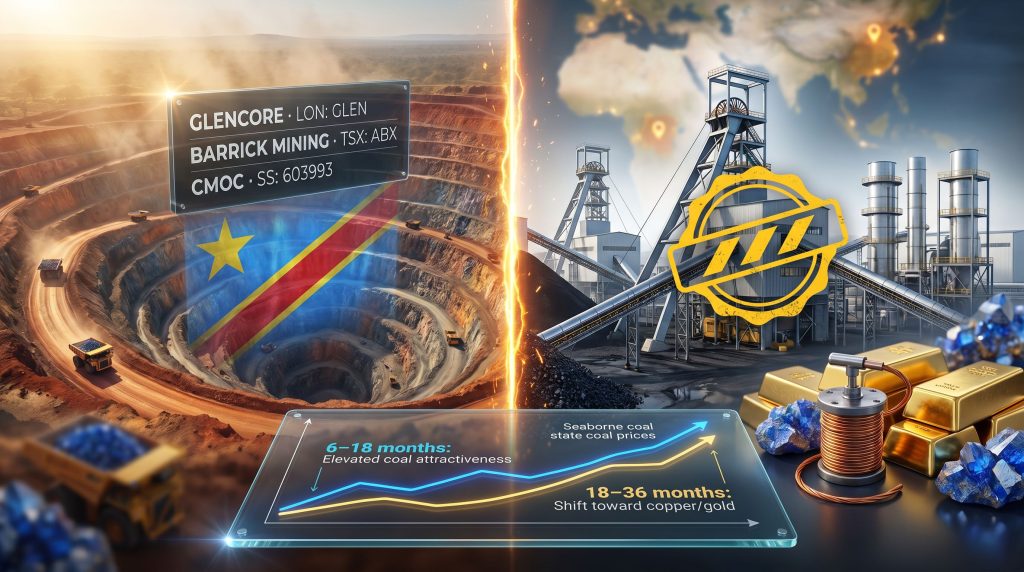
Barrick has already publicly confirmed it has increased Ebola precautionary measures across its DRC operations. The broader supply chain implications, particularly for cobalt flowing into electric vehicle battery manufacturing, could become significant if multiple sites face concurrent disruptions.
China's Coal Safety Crisis and the Explosives Market Headwind
How a Single Accident Becomes a Nationwide Production Constraint
A gas explosion at a Chinese coal mine has set in motion a regulatory response pattern that is well-established in China's industrial history. Following major safety incidents, Chinese authorities typically initiate broad-based inspections, license reviews, and operational suspensions across the affected sector, not just at the site of the original incident.
China produces approximately half of the world's coal. Even a moderate reduction in national output driven by safety-related shutdowns carries significant weight in global energy markets. The near-term expectation is for what industry observers would describe as massive curtailment, a period during which safety audits, license checks, and operational reviews suppress blasting activity across dozens or potentially hundreds of sites simultaneously.
For an explosives supplier with material Chinese market exposure, this translates directly into compressed contract volumes with no commodity-price offset. In addition, China's industrial demand outlook suggests that broader structural headwinds may further complicate any near-term recovery in mining activity volumes.
The Paradox: Short-Term Demand Loss, Medium-Term Price Support
Here is where the analysis becomes more nuanced. While Chinese production curtailment reduces explosives demand within China, it simultaneously tightens global thermal coal supply. This dynamic tends to elevate seaborne coal prices, which benefits producers in Australia, Indonesia, and Colombia. Higher coal prices incentivise production expansion in those jurisdictions, which ultimately creates new explosives demand outside China.
| Time Horizon | Primary Market Dynamic | Explosives Market Implication |
|---|---|---|
| 0 to 6 months | Chinese safety review suppresses output | Reduced blasting volumes in China |
| 6 to 18 months | Seaborne coal prices elevated, non-China producers expand | Growing demand in Australia, Indonesia |
| 18 to 36 months | Energy transition pressures re-emerge | Demand shift toward copper and gold sectors |
| 3 to 5 years | AI-optimised mine planning adoption | Higher productivity per blast, changed volume dynamics |
Indonesia's Regulatory Volatility as a Concurrent Pressure
Compounding the China situation, Indonesia's mining sector is experiencing its own period of sudden regulatory change. Indonesia is among the world's top producers of both thermal coal and nickel, making it a significant market for commercial blasting services. Unpredictable shifts in licensing and permitting requirements create planning uncertainty that affects procurement decisions across the entire service provider ecosystem.
Coal's Unexpected Medium-Term Relevance
The Post-Conflict Energy Rebalancing Thesis
There is a counterintuitive argument gaining traction in energy market analysis: the resolution of conflict in major oil and gas producing regions does not necessarily reduce coal's strategic value. During the period when oil and gas supply chains are rebuilt, reconfigured, and repriced following a geopolitical disruption, coal serves as a critical bridging fuel for economies that cannot absorb sudden energy cost volatility.
This transitional dynamic positions coal as an unusually attractive commodity in the medium term, particularly for energy-intensive economies in Asia that lack domestic gas reserves and cannot rapidly scale renewable capacity. The pricing implications of this dynamic would, once Chinese safety reviews conclude, support a resumption of production activity and, with it, a recovery in explosives demand.
The Strategic Repositioning Toward Gold and Copper
Under-Investment in Exploration Creates a Structural Price Floor
One of the least appreciated dynamics in the current commodity cycle is the extent to which chronic under-investment in new mine development over the past decade has constrained the supply pipeline for gold and copper. This is not a short-cycle problem. Bringing a new mine from discovery to production typically requires ten to fifteen years, meaning decisions not made in the 2010s are now manifesting as supply constraints in the mid-2020s.
Against this supply-side deficit, demand for both metals is accelerating from multiple structural drivers. The ongoing copper supply crunch is one of the most pressing examples, with electrification and infrastructure investment outpacing the development of new productive capacity:
- Electrification of transport networks requiring vastly larger volumes of copper
- AI infrastructure buildout driving demand for data centres with significant copper wiring requirements
- Defence spending increases across NATO and Indo-Pacific nations consuming both copper and gold
- Central bank gold buying, with a record 45% of central banks indicating plans to increase gold holdings according to the World Gold Council's 2026 survey
This structural mismatch between constrained supply and accelerating demand is expected to sustain elevated prices and capital investment in gold and copper mining over an extended cycle, making exposure to these sectors strategically valuable for service providers.
The next major ASX story will hit our subscribers first
AI Integration: The Business Model Transformation in Commercial Blasting
From Product Vendor to Productivity Partner
Perhaps the most consequential long-term development in the commercial explosives sector is the emergence of AI-driven mine planning as a differentiated service offering. This shift is not incremental. It represents a fundamental change in the commercial relationship between explosives suppliers and their mining customers. Consequently, the role of AI in mining is rapidly evolving from a novelty into a core operational capability that underpins competitive positioning.
Orica has been developing a division specifically designed to apply artificial intelligence to the proprietary datasets generated through decades of drilling and blasting operations. The value proposition rests on several interconnected capabilities:
- Real-time fragmentation analysis that enables immediate adjustment of blast parameters to optimise downstream processing
- Predictive blast modelling that reduces ore loss, dilution, and overbreak at the mining face
- Dynamic mine sequencing that integrates blasting schedules with equipment availability and processing plant capacity
- Site-specific optimisation that adapts to the unique geological characteristics of each deposit
The transition from selling explosives to selling mine productivity outcomes changes everything about how service contracts are structured, priced, and retained. A company embedded in a customer's mine planning workflow is categorically harder to displace than one competing on product price alone.
What This Means for Competitive Dynamics
Mining companies that adopt AI-integrated blasting services are likely to achieve measurable reductions in cost per tonne extracted. For service providers, the data collected across hundreds of mine sites globally creates a compounding competitive advantage: each new dataset improves the predictive accuracy of the AI models, which improves the service offering, which attracts more customers, which generates more data.
This flywheel dynamic suggests that early movers in AI-integrated mine services will establish durable competitive positions that are difficult for later entrants to replicate.
Health Risk, Regulatory Shock, and the New Framework for Mining Investment Analysis
Why Epidemic Risk Is Now a Core Due Diligence Category
The COVID-19 pandemic permanently altered how institutional investors assess operational risk in extractive industries. What was previously treated as a tail-risk scenario has been reclassified as a recurring operational variable. The current situation where Orica flags Ebola and coal risks is accelerating this shift, particularly for assets in sub-Saharan Africa.
ESG-focused funds and institutional lenders are increasingly requiring documentation of epidemic and pandemic preparedness protocols as a condition of investment or financing. Mine operators without formal health emergency response frameworks face growing scrutiny from capital markets, independent of their commodity price exposure.
The Broader Lesson for Mining Sector Portfolio Management
The convergence of health, regulatory, and geopolitical risks playing out simultaneously across Africa, China, and Southeast Asia illustrates a broader truth about the current mining investment environment. Single-variable risk models, those that focus exclusively on commodity prices or country-specific political risk, are no longer adequate.
Investors and analysts tracking the mining services sector should monitor:
- Disease outbreak trajectories in resource-rich developing regions
- Chinese regulatory response patterns following industrial safety incidents
- Seaborne coal price movements as an indicator of non-Chinese production incentives
- Gold and copper exploration pipeline data as a leading indicator of future service demand
- AI adoption rates in mine planning as a signal of service contract value evolution
The world's largest commercial explosives supplier is navigating all of these dynamics simultaneously. The way it manages this period will offer a template for how the broader mining services sector adapts to a more complex, multi-front risk environment than anything seen in previous commodity cycles.
This article is intended for informational purposes only and does not constitute financial advice or a recommendation to buy or sell any securities. References to commodity price forecasts, demand projections, and market outlooks involve inherent uncertainty. Readers should conduct independent research and consult qualified financial advisers before making investment decisions.
Want to Identify the Next Major Mineral Discovery Before the Broader Market?
Discovery Alert's proprietary Discovery IQ model delivers real-time alerts on significant ASX mineral discoveries across gold, copper, cobalt, and beyond — instantly transforming complex geological data into actionable investment insights for traders and long-term investors alike. Explore how historic discoveries have generated substantial returns on Discovery Alert's dedicated discoveries page, or start your 14-day free trial today to position yourself ahead of the market.