
June 17, 2026
The Hidden Vulnerability Inside Europe's Battery Supply Chain
When analysts examine the structural weaknesses embedded in Europe's energy transition ambitions, graphite rarely commands the same urgency as lithium or cobalt. Yet this oversight may represent one of the most consequential blind spots in the continent's industrial planning. Graphite is not a peripheral input in battery manufacturing. It is the dominant material in lithium-ion battery anodes, accounting for roughly 95% of anode composition by weight in most commercial cell chemistries. Without a reliable, locally processed supply, Europe's battery gigafactory buildout rests on a foundation with a single point of failure.
That single point of failure is China, which currently controls an estimated 70% to 80% of global graphite processing capacity. For European manufacturers operating in sectors ranging from electric vehicles to grid-scale energy storage and advanced defence systems, this concentration is not merely an inconvenience. It is a structural vulnerability with real geopolitical dimensions, particularly as trade friction between major economies continues to escalate. Furthermore, the global graphite shortage compounds the urgency for Europe to act decisively on domestic processing capacity.
When big ASX news breaks, our subscribers know first
Europe's Graphite Processing Gap and the Regulatory Clock Ticking Toward 2030
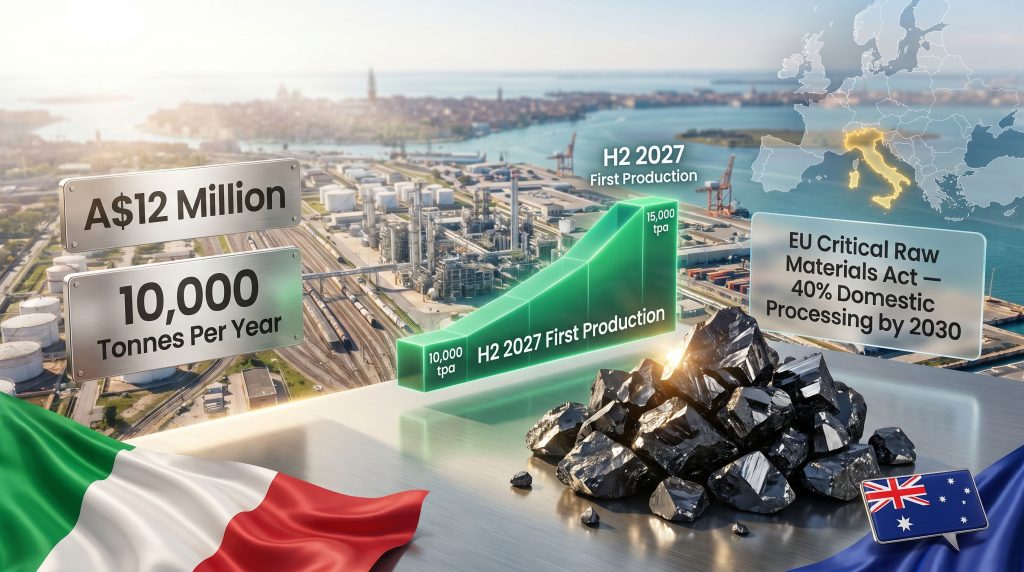
The European Union's Critical Raw Materials Act formally designates graphite as a strategic material, and the legislation includes a binding target requiring that at least 40% of the EU's annual consumption of critical raw materials be processed domestically by 2030. This is not an aspirational benchmark. It is a legally anchored obligation that places pressure on both policymakers and private industry to construct viable processing infrastructure within European borders within a compressed timeframe.
The challenge is that building graphite processing capacity from scratch in Europe is an extraordinarily capital-intensive and time-consuming undertaking. Permitting timelines for new industrial chemical facilities in the EU can stretch across years. Environmental compliance frameworks are rigorous. Sourcing specialised processing reagents such as hydrofluoric acid requires established industrial relationships. These barriers have historically deterred greenfield investment and left the continent's graphite processing gap largely unaddressed.
The structural solution emerging in response to this challenge is a partnership model: pairing non-European graphite resource developers with EU-based industrial operators who already hold the permits, infrastructure, and technical expertise to accelerate project deployment. This is precisely the logic underpinning the joint venture between International Graphite and Alkeemia (ASX: IG6) and Italian chemical manufacturer Alkeemia to establish a graphite processing hub at Porto Marghera, near Venice.
What the International Graphite Alkeemia Italy Graphite Processing Hub Actually Involves
The agreement executed in June 2026 establishes a joint venture in which Alkeemia holds a 51% ownership stake and International Graphite retains the remaining 49%. Notably, despite the asymmetric equity split, profits will be distributed equally between the two partners, a structure that reflects the complementary nature of each party's contribution. Alkeemia brings permitted industrial infrastructure, operational workforce, and chemical processing expertise. International Graphite contributes A$12 million (approximately USD $8.48 million) in development capital alongside its upstream graphite supply chain position.
JV Structure at a Glance:
| Parameter | Detail |
|---|---|
| Majority Owner | Alkeemia at 51% |
| Minority Owner | International Graphite (ASX: IG6) at 49% |
| Profit Distribution | Equal between both partners |
| Capital Contribution | A$12 million (~USD $8.48 million) from International Graphite |
| Processing Location | Porto Marghera, Venice, Italy |
| Initial Annual Capacity | ~10,000 tonnes per year |
| Expanded Capacity | ~15,000 tonnes per year within 3 years of first production |
| Final Investment Decision | Targeted Q3 2026 |
| Construction Commencement | Targeted Q3 2026 |
| First Production Target | H2 2027 |
The facility will process graphite concentrate into micronized graphite products, a form specifically engineered for use across industrial manufacturing, energy storage applications, and defence procurement channels. Micronized graphite is produced through precision particle size reduction, and the specific distribution of particle sizes determines its suitability for end applications. Battery-grade micronized graphite, for instance, requires extremely tight tolerances that demand sophisticated processing equipment and quality control systems.
Why Porto Marghera Is More Than Just a Location on a Map
Industrial site selection in the chemical processing sector involves far more than real estate logistics. The choice of Porto Marghera as the processing hub carries significant operational and economic implications that distinguish this project from conceptual competitors.
Porto Marghera is one of Italy's largest industrial zones and has functioned as a major chemical manufacturing district for decades. This heritage means the site benefits from:
- Established utility infrastructure including power, water treatment, and waste management systems calibrated for industrial-scale chemical operations
- Access to hydrofluoric acid and other specialised reagents through existing supplier relationships within the regional chemical ecosystem
- Proximity to Venice's port facilities, enabling efficient import of graphite concentrate and export of finished micronized products across European markets
- Rail connectivity supporting multimodal logistics for both raw material intake and finished goods distribution
- A skilled industrial workforce with relevant chemical processing experience already available in the regional labour market
Perhaps most critically, Alkeemia's existing industrial permits at Porto Marghera eliminate what is frequently the longest lead-time item in European chemical facility development. Regulatory approvals for new industrial chemical processing operations in the EU can consume two to four years. By anchoring the joint venture within Alkeemia's permitted operational footprint, the project potentially compresses this timeline substantially, which directly supports the feasibility of the H2 2027 first production target.
Investors evaluating critical minerals processing projects in Europe should pay close attention to permitting status as a primary de-risking factor. A project with capital but without permits faces a fundamentally different risk profile than one operating within an already-approved industrial framework.
International Graphite's Two-Node Strategy: Collie and Porto Marghera
Understanding the Porto Marghera facility requires viewing it within the context of International Graphite's broader operational architecture. The company operates a micronising facility at Collie in Western Australia, which functions as its upstream processing hub serving Asia-Pacific and global export markets. Porto Marghera is designed as the European downstream complement, creating a geographically distributed production network with distinct market orientations.
In addition, the International Graphite Alkeemia Italy graphite processing hub directly addresses concerns highlighted across the battery raw materials market regarding Europe's overdependence on Asian-processed inputs.
Dual-Facility Strategic Comparison:
| Attribute | Collie, Western Australia | Porto Marghera, Italy |
|---|---|---|
| Primary Function | Upstream micronising and primary processing | European downstream processing hub |
| Target Market | Asia-Pacific and global export channels | European industrial and energy sectors |
| Regulatory Framework | Australian mining and processing regulations | EU Critical Raw Materials Act aligned |
| Strategic Purpose | Resource extraction and primary processing | Regional supply chain localisation |
This dual-node model offers a form of strategic resilience that single-location producers cannot replicate. Disruptions to logistics, regulatory changes, or demand shifts in one hemisphere do not automatically impair the other production centre. For a company operating in a sector where supply chain concentration risk is the defining challenge, geographic diversification of production infrastructure carries genuine competitive value.
The Three Demand Pillars Underpinning Porto Marghera's Commercial Rationale
The facility's commercial design targets three distinct end-use categories, each with materially different demand drivers and procurement dynamics.
Industrial Manufacturing
Industrial manufacturing represents the broadest and most established demand base for micronized graphite. Applications span lubricants, thermal management materials, refractory linings for high-temperature industrial processes, and conductive coatings. European industrial demand for these applications has historically been met predominantly through Chinese-processed graphite, creating both supply risk and a commercial opening for domestically processed alternatives.
Energy Storage
Energy storage is the highest-growth demand category and arguably the most strategically sensitive. Graphite is the standard anode material in lithium-ion batteries. European gigafactories producing cells for electric vehicles and grid storage applications require assured, traceable, and ideally locally sourced graphite supply. As battery manufacturers come under increasing pressure to demonstrate supply chain due diligence, the provenance and processing location of graphite inputs becomes a commercial differentiator, not merely a compliance exercise. Consequently, critical minerals demand growth driven by the energy transition continues to accelerate this shift.
Defence Procurement
Defence procurement is the least-discussed but potentially most inelastic demand segment. Advanced defence applications including specialist lubrication systems, nuclear shielding materials, and certain electronic components rely on high-purity graphite grades. European defence procurement agencies have intensified focus on domestically sourced critical materials, particularly following the strategic reassessments triggered by recent geopolitical disruptions. This sector typically demands premium pricing and long-term supply contracts, characteristics that can provide meaningful revenue stability for a processing facility.
By targeting three structurally distinct demand sectors simultaneously, the Porto Marghera facility is designed for demand resilience rather than concentration risk. A slowdown in one segment does not automatically threaten the facility's overall utilisation rate.
The next major ASX story will hit our subscribers first
Key Milestones and the Risk Landscape Investors Need to Map
Project Milestone Timeline:
| Milestone | Target Date |
|---|---|
| JV Agreement Executed | June 2026 |
| Final Investment Decision | Q3 2026 |
| Construction Commencement | Q3 2026 |
| First Production | H2 2027 |
| Capacity Expansion to ~15,000 tpa | Within 3 years of first production |
The Final Investment Decision in Q3 2026 represents the pivotal gate event. Prior to this decision, the project remains subject to conditions that could alter its scope or timeline. Investors should monitor several risk categories:
- Capital adequacy: International Graphite's A$12 million contribution must be sufficient to fund its share of construction and commissioning costs through to first production without requiring additional equity dilution.
- Offtake agreements: The commercial viability of the facility at scale will ultimately depend on securing binding purchase agreements with European industrial, battery, or defence customers ahead of or concurrent with the Final Investment Decision.
- Permitting scope: While Alkeemia's existing permits provide a significant advantage, any modifications to the facility's design or processing volumes may require supplementary regulatory approvals that could introduce timeline variability.
- Graphite concentrate supply: The facility's operational continuity depends on reliable feedstock delivery from International Graphite's upstream operations, making the Collie facility's production consistency a directly relevant risk variable.
- Currency dynamics: With capital denominated in Australian dollars and revenue expected in euros, movements in the AUD/EUR exchange rate introduce earnings variability that investors in ASX-listed IG6 should factor into return modelling.
A Replicable Template for European Critical Minerals Processing
The structural architecture of the International Graphite Alkeemia Italy graphite processing hub partnership is worth examining beyond the specifics of this transaction. The model of pairing a non-European upstream resource developer with an in-country, already-permitted industrial operator is gaining recognition as one of the most pragmatic pathways to accelerating European critical raw materials supply capacity.
Greenfield industrial facility development in Europe is expensive, slow, and procedurally demanding. The alternative, as demonstrated by this joint venture, is to leverage existing permitted industrial infrastructure by injecting upstream supply chain relationships and development capital. This approach reduces the permitting risk, compresses development timelines, and distributes capital requirements across two partners rather than concentrating them on one balance sheet.
For European policymakers seeking to meet the 2030 processing targets embedded in the Critical Raw Materials Act, this partnership structure may represent a more scalable path than relying exclusively on large-scale greenfield investment programs. However, the broader challenge remains significant. Europe's critical minerals supply chain faces structural dependencies that no single project can resolve in isolation. For investors, it suggests that the opportunity set in European critical mineral processing extends well beyond the largest announced projects to include capital-efficient joint ventures structured around existing industrial assets.
The Porto Marghera facility will not single-handedly resolve Europe's graphite processing dependency. However, as an early operational example of how the continent's processing gap can be addressed through commercially structured industrial partnerships rather than policy mandates alone, it carries significance that extends beyond its initial 10,000 tonne annual production capacity.
Frequently Asked Questions: International Graphite Alkeemia Italy Graphite Processing Hub
What is the International Graphite and Alkeemia joint venture?
It is a formally executed partnership in which Australian-listed graphite developer International Graphite (ASX: IG6) holds a 49% interest and Italian chemical manufacturer Alkeemia holds 51%, with the objective of establishing a graphite processing facility at Porto Marghera, Italy. Profits are shared equally between both parties despite the asymmetric ownership structure.
Where is the Porto Marghera graphite processing facility located?
Porto Marghera is a major industrial zone located near Venice in northeastern Italy. It is one of Italy's most significant chemical manufacturing districts and offers established infrastructure, logistics connectivity, and regulatory approvals that benefit the joint venture's development timeline.
How much is International Graphite investing in the Italian processing hub?
International Graphite has committed A$12 million (approximately USD $8.48 million) as its capital contribution to the joint venture.
When will the Porto Marghera facility begin production?
First production is targeted for the second half of 2027, contingent on a Final Investment Decision expected in Q3 2026 and construction commencement in the same quarter.
What products will the facility produce and for which industries?
The facility will produce micronized graphite products for three primary end markets: industrial manufacturing applications, energy storage systems including battery anodes, and defence procurement.
How does this project relate to EU critical minerals policy?
The EU's Critical Raw Materials Act establishes a binding target for 40% of critical material consumption to be processed domestically within Europe by 2030. Establishing European graphite processing capacity is structurally consistent with this regulatory objective, though the project has not been publicly confirmed as a designated beneficiary of any specific EU funding programme or accelerated approval mechanism.
What is International Graphite's ASX ticker?
International Graphite trades on the Australian Securities Exchange under the ticker IG6. The Porto Marghera joint venture represents a material addition to the company's asset base, complementing its existing Collie micronising facility in Western Australia.
This article is for informational purposes only and does not constitute financial advice or a solicitation to buy or sell any securities. Investors should conduct independent due diligence and consult a licensed financial adviser before making investment decisions. Forward-looking statements regarding project timelines, production targets, and financial outcomes are subject to risks and uncertainties that could cause actual results to differ materially from those anticipated.
Want to Stay Ahead of the Next Major Critical Minerals Discovery on the ASX?
Discovery Alert's proprietary Discovery IQ model delivers real-time alerts on significant ASX mineral discoveries across graphite, battery materials, and more than 30 other commodities — instantly translating complex data into actionable insights for both short-term traders and long-term investors. Explore how historic discoveries have generated extraordinary returns on Discovery Alert's dedicated discoveries page, and begin your 14-day free trial today to position yourself ahead of the broader market.