June 18, 2026
The Hidden Architecture Problem Blocking Congo's Infrastructure Future
Large-scale infrastructure investment has always operated on a fundamental tension between the time horizons of capital providers and the economic lives of the assets they finance. A hydropower dam built today will generate revenue for 40 to 50 years. A rail corridor, once constructed, reshapes trade flows for generations. Yet the financial instruments most commonly available to governments in Sub-Saharan Africa remain stubbornly short in duration, punishingly expensive, and structurally misaligned with the assets they are meant to fund.
Nowhere is this mismatch more consequential than in the Democratic Republic of Congo, a country that holds an estimated 70% of the world's cobalt reserves, vast copper deposits, significant lithium resources, and the untapped hydroelectric potential of the Congo River basin. The DRC natural resources endowment represents the raw ingredients for industrial transformation on a continental scale. What it has lacked, persistently, is access to patient, affordable capital capable of financing the infrastructure required to unlock that potential.
A new proposal from a three-institution DRC infrastructure financing consortium aims to address precisely that structural gap, and understanding how it works requires unpacking the financial engineering at its core.
When big ASX news breaks, our subscribers know first
Why Conventional Borrowing Cannot Fund 25-Year Assets
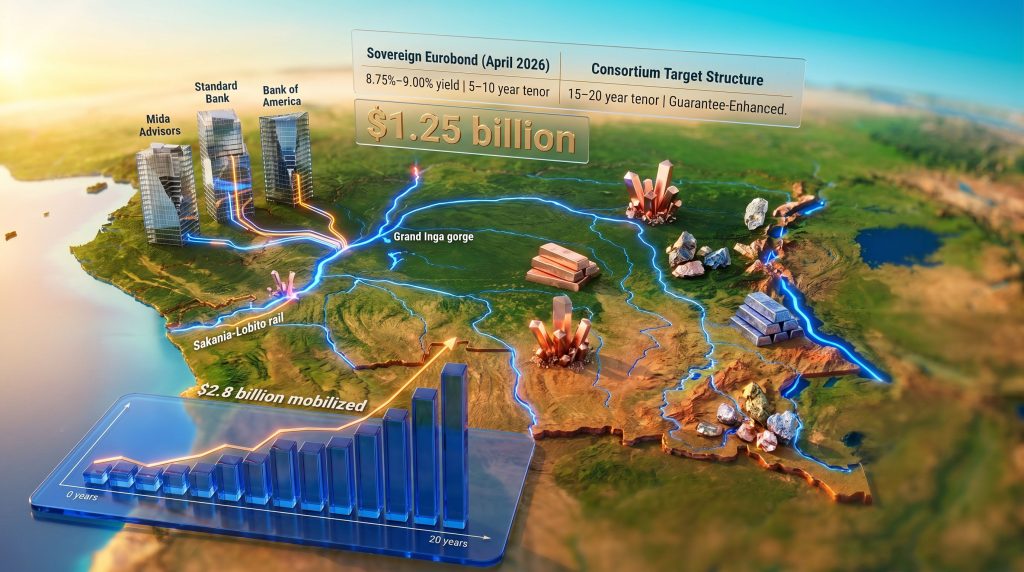
When the DRC debuted on international sovereign bond markets in April 2026, raising $1.25 billion across two tranches priced at yields of 8.75% and 9.00%, with average maturities of just five and ten years respectively, the transaction confirmed something important and troubling in equal measure. International investors have an appetite for Congolese sovereign paper, but the terms at which that appetite operates are fundamentally incompatible with long-duration infrastructure financing.
Consider the arithmetic of a major hydropower project. Construction timelines alone often consume five to seven years. Revenue ramp-up periods extend for several years beyond commissioning. Debt service coverage ratios only reach comfortable levels after a decade or more of operations. When a sovereign borrower is paying close to 9% annually on ten-year paper, the implied cost of capital for a project with a 25-year payback cycle becomes mathematically unworkable without some form of structural intervention.
"When sovereign borrowing costs approach 9% on decade-long paper, the financing mathematics of a 25-year infrastructure asset become structurally untenable without deliberate credit enhancement. This is the foundational problem the new consortium architecture is designed to solve."
The cost-of-capital problem in Central Africa is not simply a function of fiscal fundamentals. Furthermore, perceived political instability, currency convertibility risk, and the absence of liquid secondary markets for African sovereign debt all contribute to yield premiums that bear limited relationship to the underlying project economics of the assets being financed. The result is a persistent financing gap that cannot be bridged by sovereign borrowing alone.
Who Comprises the DRC Infrastructure Financing Consortium
Institutional Roles and Strategic Positioning
On June 11, 2026, representatives of three institutions met with DRC Prime Minister Judith Suminwa in Kinshasa to present a structured financing proposal designed to break through the cost-of-capital barrier. The consortium brings together complementary capabilities across three distinct institutional profiles:
- Mida Advisors, a U.S.-based financial advisory and project development firm specialising in emerging market capital mobilisation, positioned as lead arranger. The firm reports having mobilised more than $2.8 billion across emerging markets, supported more than 75,000 jobs, and built a network of over 80 institutional investors.
- Standard Bank, Africa's largest bank by total assets, contributing deep regional execution capability and on-the-ground knowledge of the DRC's regulatory and financial environment.
- Bank of America, providing access to U.S. capital markets infrastructure and the institutional relationships required to place large-ticket, long-duration debt with American pension funds and insurance companies.
The three-party structure is deliberate. Advisory origination, regional execution, and global distribution are distinct functions in infrastructure finance, and combining them within a single consortium reduces the coordination costs that typically slow project financing timelines in frontier markets.
The Proposed Financing Mechanism
The consortium's core proposition centres on 15 to 20-year financing tenors, a duration that aligns with the actual asset lives of energy generation, rail, port, and mineral processing infrastructure. To achieve this at borrowing costs below what the DRC's sovereign credit profile would otherwise command, the structure relies on layered risk mitigation instruments.
| Financing Parameter | DRC Sovereign Eurobond (April 2026) | Consortium Target Structure |
|---|---|---|
| Tenor | 5 to 10 years | 15 to 20 years |
| Yield / Cost | 8.75% to 9.00% | Below-market, guarantee-enhanced |
| Investor Base | International bond markets | U.S. pension funds and insurers |
| Risk Mitigation | Sovereign credit rating only | Guarantees plus insurance instruments |
| Use of Proceeds | General sovereign budget | Designated strategic project pipeline |
How Guarantee Engineering Unlocks Institutional Capital
The Structural Barrier Facing U.S. Pension Funds
U.S. pension funds collectively manage trillions of dollars in long-duration liabilities, making them theoretically ideal investors for long-tenor infrastructure debt. In practice, however, fiduciary constraints imposed by state and federal regulations require most institutional allocators to maintain investment-grade or near-investment-grade credit profiles across their fixed income portfolios. The DRC's current sovereign credit rating environment sits materially below that threshold, effectively locking out the largest and most patient pool of infrastructure capital in the world.
The guarantee-and-insurance model attempts to resolve this disconnect by engineering creditworthiness at the instrument level rather than relying on sovereign credit alone. Three primary tools are deployed:
- Partial credit guarantees cover a defined tranche of principal repayment, elevating the effective credit quality of the instrument to levels that satisfy institutional investment mandates.
- Political risk insurance protects against expropriation, currency inconvertibility, and breach of contract, which consistently rank as the three primary concerns cited by U.S. institutional allocators when evaluating frontier market exposure.
- Blended finance tranching positions concessional capital from development finance institutions in a subordinated position within the capital stack, absorbing early losses before commercial investors are affected.
Precedents for this approach exist across emerging market infrastructure finance. Instruments operated by multilateral bodies such as the Multilateral Investment Guarantee Agency and managed co-lending programmes structured by the International Finance Corporation have demonstrated that properly engineered guarantee structures can indeed shift the risk profile of frontier market paper to levels acceptable to institutional allocators, though the supply of such instruments remains constrained relative to demand.
"It is important to recognise that guarantee-and-insurance structures do not eliminate risk. They redistribute it. The DRC government, development finance institution partners, and insurance providers absorb risks that commercial investors would otherwise price into their yield requirements. The net effect is a lower borrowing cost, but the aggregate risk within the system remains unchanged."
The U.S.-DRC Strategic Partnership as the Policy Foundation
From Bilateral Agreement to Project Pipeline
The DRC infrastructure financing consortium's engagement with Kinshasa is anchored in the bilateral strategic partnership agreement signed between the DRC and the United States on December 4 of the prior year. The US-Congo minerals partnership established a formal framework for identifying and financing designated strategic infrastructure and critical minerals projects, creating the institutional architecture through which the consortium's financing model can operate.
Under the agreement, a joint steering committee was established to validate and prioritise projects. A first list of 52 candidate projects has been submitted to this committee. The Congolese government is actively working to identify the top 15 priority initiatives from that pool, a selection process that will determine which projects enter the bankability development pipeline first.
Priority Sectors Within the Partnership Framework
The agreement identifies four broad infrastructure categories as central to the cooperation framework:
- Critical minerals value chain development: encompassing exploration, extraction, refining, smelting, hydrometallurgical processing, downstream value addition, and tailings reprocessing. The surge in critical minerals demand makes this sector the most strategically significant for both parties.
- Strategic transport corridors: the Sakania-Lobito corridor is explicitly named as a flagship multimodal logistics route connecting the DRC's mineral-rich interior to Atlantic export infrastructure.
- Large-scale clean energy: the Grand Inga hydroelectric project, widely regarded as one of the world's largest undeveloped hydropower sites, is identified as a long-term anchor for industrial electrification and export-scale power generation.
- Port and rail modernisation: enabling processed mineral export capacity and reducing logistics cost premiums that currently erode the competitiveness of in-country processing operations.
Comparing U.S. and Chinese Infrastructure Financing Models in the DRC
Understanding the consortium proposal requires situating it within the broader competitive landscape of infrastructure capital competing for access to the DRC's strategic asset base.
| Dimension | U.S. Consortium Model | Sicomines Resource-Backed Model |
|---|---|---|
| Repayment Security | Sovereign guarantee plus insurance | Mineral revenue streams |
| Primary Investor Type | U.S. pension funds and insurers | Chinese state-linked banks |
| Financing Tenor | 15 to 20 years | Multi-decade, extended to 2040 under 2024 amendment |
| Conditionality | Project bankability standards | Resource extraction rights |
| Governance Standards | Western institutional frameworks | Variable; subject to ongoing external scrutiny |
The Sicomines resource-for-infrastructure arrangement, under which Chinese-linked financing was secured against future mineral revenue rather than sovereign creditworthiness, has represented the dominant alternative capital architecture in the DRC for over a decade. Research from AidData estimated Chinese financial commitments linked to Sicomines-related projects between 2008 and 2022 at approximately $13.5 billion, with a 2024 amendment reportedly authorising an additional $5.8 billion in infrastructure financing spanning the period through 2040.
The DRC's simultaneous engagement with both financing architectures reflects a deliberate capital diversification strategy rather than an either-or choice. Consequently, Kinshasa is structuring a competitive environment in which multiple financing sources bid for access to its strategic asset base, a posture that strengthens its negotiating position with all parties.
The next major ASX story will hit our subscribers first
Key Risks That Could Prevent the Model from Scaling
Structural and Execution Risks
The existence of a well-structured financing consortium does not guarantee capital deployment. Several execution risks could prevent the model from achieving scale:
- Project preparation capacity: the DRC's institutional capacity to develop fully bankable project documentation remains the single most significant bottleneck. A list of 52 candidate projects does not equate to 52 investment-ready opportunities. Each project requires engineering studies, financial modelling, legal documentation, and risk allocation frameworks before it can be presented to institutional investors.
- Guarantee instrument supply constraints: the pool of available DFI guarantees and political risk insurance is finite. Competition for these instruments across Sub-Saharan Africa is intense, and the DRC will need to move quickly to secure allocations before capacity is absorbed by other markets.
- Currency convertibility exposure: the Congolese franc's historical volatility creates material foreign exchange risk for projects generating local-currency revenues while servicing dollar-denominated debt obligations.
- Political continuity risk: changes in mining code provisions, shifts in government priorities, or alterations to the bilateral relationship with the U.S. could materially alter the risk profile of individual projects during multi-year construction periods. The DRC cobalt market risks further compound this uncertainty for investors evaluating long-duration commitments.
Investor-Side Constraints
- U.S. institutional investors operate on annual allocation cycles with multi-year due diligence timelines, meaning capital deployment will not be rapid even once structures are formally agreed.
- Pension funds targeting 7% to 9% risk-adjusted returns on emerging market allocations may find that guarantee-enhanced DRC paper still falls short of internal return thresholds once ESG screening, reputational risk, and portfolio concentration limits are applied.
- Growing pressure on U.S. institutional investors to apply rigorous environmental, social, and governance filters creates additional complexity for investments adjacent to artisanal mining supply chains in Central Africa.
Converting Consortium Interest into Deployed Capital
The Bankability Imperative
The bankability development process for any given project involves a sequence of interdependent steps, each of which requires specialised expertise that the DRC government currently lacks at scale:
- Technical feasibility validation: independent engineering assessments, resource studies, and construction cost verification.
- Financial modelling: debt service coverage ratio projections stress-tested across multiple commodity price and operational scenarios.
- Legal and regulatory framework completion: concession agreements, environmental permits, and long-term off-take contracts.
- Risk allocation structuring: clear assignment of construction risk, operational risk, political risk, and currency risk to parties capable of bearing each.
- Guarantee and insurance sourcing: matching available DFI instruments to specific risk categories within the project capital structure.
- Investor roadshow preparation: packaging complete project documentation for presentation to U.S. institutional allocators.
Recommendations for Accelerating the Pipeline
To convert the consortium's stated interest into committed financing, Kinshasa will need to take deliberate institutional steps:
- Establish a dedicated Project Preparation Facility funded jointly by the DRC government and development finance institution partners to accelerate feasibility documentation across priority projects.
- Focus immediate preparation resources on two to three anchor projects rather than distributing effort across all 52 candidates. For instance, a defined segment of the Sakania-Lobito corridor or a specific development phase of Grand Inga would generate the credibility and investor familiarity needed to catalyse the broader pipeline.
- Engage the U.S. International Development Finance Corporation early in the structuring process to secure guarantee commitments before investor roadshows begin, avoiding the risk that financing interest dissolves before creditworthy structures are in place.
- Develop a standardised project documentation framework aligned with U.S. institutional investor due diligence requirements, reducing transaction costs and approval timelines across the full project pipeline. Furthermore, large-scale copper projects elsewhere demonstrate that investor confidence grows significantly when standardised documentation frameworks are deployed consistently.
The DRC infrastructure financing consortium represents a genuinely innovative attempt to solve a problem that has constrained African infrastructure development for decades. However, whether it succeeds will depend less on the sophistication of the financial engineering and more on the speed and quality with which the DRC can produce the bankable project documentation that institutional capital requires before it moves.
This article contains forward-looking analysis and assessments of financing structures, project pipelines, and institutional frameworks. Readers should treat projections regarding financing terms, investor participation, and project timelines as indicative rather than confirmed. Infrastructure financing in frontier markets involves material execution, political, and market risks that can alter outcomes significantly from those described.
Want to Stay Ahead of the Next Major Mineral Discovery Linked to the DRC's Critical Minerals Boom?
Discovery Alert's proprietary Discovery IQ model delivers real-time alerts the moment significant ASX mineral discoveries are announced, transforming complex geological and commodity data into actionable investment insights for both short-term traders and long-term investors. Explore how historic discoveries have generated substantial returns on Discovery Alert's dedicated discoveries page, and begin your 14-day free trial today to position yourself ahead of the broader market.