May 22, 2026
Global supply chain disruption patterns have fundamentally altered how nations approach critical materials security. Traditional centralised production models face unprecedented challenges from geopolitical tensions, environmental regulations, and infrastructure vulnerabilities. The convergence of these pressures creates opportunities for strategic partnerships between democratic allies to establish resilient supply networks. Furthermore, the Brazilian Nickel Westwin supply chain agreement reduces dependency on single-source suppliers whilst maintaining cost competitiveness and quality standards.
Strategic Framework: Understanding the New Geopolitical Minerals Landscape
Critical minerals classification in 2026 encompasses materials essential for national security, economic competitiveness, and technological advancement where supply chains present vulnerability risks. The United States imports substantial quantities of refined nickel, with approximately 37,000 metric tons imported in 2023 according to the U.S. Geological Survey. Roughly 60% of U.S. nickel supply historically depended on processing imported raw materials, with Indonesia dominating global production at approximately 34% of world output.
Supply chain regionalisation represents a structural shift toward what industry analysts describe as nearshoring, establishing secondary production centres within allied economic blocs. This approach creates redundancy in processing capacity whilst maintaining internationally recognised quality standards. Democratic governance alignment and transparent regulatory frameworks provide substantially lower geopolitical risk profiles compared to single-nation suppliers concentrated in politically volatile regions.
Brazil emerges as a strategic minerals partner due to its substantial laterite nickel reserves, estimated at approximately 5.9 million metric tons of proven reserves representing 8% of global nickel reserves. The majority of these deposits are located in northeastern states, particularly Piauí and Bahia regions. Geopolitical stability advantages over traditional suppliers include consistent regulatory frameworks, established rule of law, and alignment with Western environmental and social governance standards.
Transportation and Logistics Advantages
Atlantic shipping routes from Brazil to the U.S. East Coast require approximately 12-14 days transit compared to Pacific-dependent routes from Southeast Asia to the U.S. West Coast requiring 15-20 days plus additional rail transportation inland. This timing advantage translates into working capital benefits and reduces inventory carrying costs for downstream processors.
The U.S. Department of Energy and U.S. Geological Survey jointly classify nickel as critical due to its essential role in battery production. In addition, demand projections show nickel requirements could increase by 500% by 2030 to meet electric vehicle deployment targets. National security implications extend beyond commercial applications into defence manufacturing, aerospace components, and strategic infrastructure systems requiring domestic supply chain control.
Moreover, recent developments in global trade dynamics highlight the significance of this critical minerals strategy. The US‑China trade war impacts have accelerated the need for alternative supply chains, making partnerships with democratic allies increasingly valuable.
When big ASX news breaks, our subscribers know first
The Economics of Transatlantic Nickel Supply Chains
Mixed Hydroxide Precipitate represents an intermediate nickel product containing nickel, cobalt, and manganese in hydroxide form, serving as suitable feedstock for refinery operations producing Class 1 nickel with 99.8% purity minimum. The Brazilian Nickel Westwin supply chain agreement specifies production targeting up to 10,000 tonnes per year of nickel in MHP form, with cobalt production estimated at 240-400 tonnes per year as byproduct from the Piauí Nickel Project.
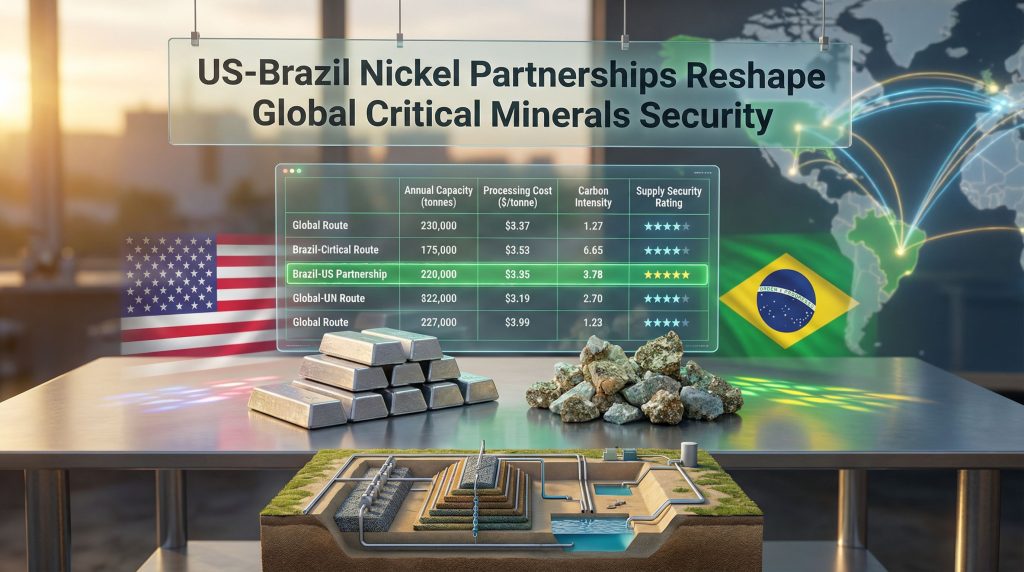
Processing Cost Comparative Analysis:
| Supply Route | Annual Capacity (tonnes) | Processing Cost ($/tonne) | Carbon Intensity | Supply Security Rating |
|---|---|---|---|---|
| Indonesia-China | 180,000+ | $8,500-9,200 | High | Medium |
| Brazil-US | 10,000-18,000 | $7,800-8,400 | Low | High |
| Philippines-Japan | 25,000-35,000 | $9,100-9,800 | Medium | Medium |
Industry analysis indicates heap leaching operations in laterite-rich regions demonstrate processing costs ranging from $7,800-$8,400 per tonne, compared to traditional smelting approaches requiring $8,500-$9,200 per tonne when including energy and capital amortisation costs. These cost advantages reflect both technological efficiencies and reduced energy requirements in heap leaching methodologies.
Financial Architecture of Long-Term Offtake Agreements
Long-term offtake agreements function as risk allocation mechanisms between producers and processors, incorporating price adjustment mechanisms responding to London Metal Exchange nickel pricing whilst establishing floors and ceilings protecting both counterparties against extreme market volatility. Producer revenue certainty enables project financing at favourable debt service terms by reducing commodity price risk.
Working capital management in international supply chains involves significant timing mismatches between raw material payment, processing costs, and final product sales. Processors typically receive advance payment terms from automotive or defence customers whilst maintaining 30-60 day payment terms with raw material suppliers. MHP supply chain arrangements reduce this working capital gap compared to traditionally longer supply chains involving multiple intermediary processors.
Hedging strategies for commodity-linked contracts employ futures markets through LME nickel contracts, physical forward contracts, and derivative instruments including collars and participating forwards. The relative simplicity of hedging MHP supply contracts versus complex multi-party arrangements demonstrates advantages of vertically integrated regional supply chains.
The shift toward critical minerals supply chain regionalisation reflects broader strategic concerns about concentrated supply dependencies whilst creating investment opportunities across mining, processing, and logistics infrastructure within democratic partnerships.
Operational Deep Dive: From Laterite to Battery Grade
Brazilian laterite nickel deposits contain nickel grades typically ranging from 1.0-1.8% nickel content by ore weight, substantially lower than Indonesian laterite ores at 1.3-2.0% grades but requiring comparable processing volumes. Cobalt recovery from laterite processing yields byproduct cobalt at ratios of approximately 0.024-0.04 cobalt per nickel recovered, providing additional revenue streams supporting project economics.
Heap Leaching Technology: The Brazilian Advantage
Heap leaching operations process ore through several integrated stages:
- Ore sizing and preparation (0-10mm optimal particle distribution)
- Pad construction with impermeable synthetic liner bases
- Stack leaching with sulfuric acid application at 50-100 kg/tonne ore
- Pregnant liquor collection over 60-120 day leaching periods
- Solution recovery achieving 75-85% extraction rates
Capital requirements for laterite heap leaching operations range from $2,000-$3,500 per daily tonne of capacity, substantially lower than traditional pressure acid leach operations requiring $5,000-$8,000 per daily tonne capacity. Operating costs emphasise acid consumption, solution management, and residue handling rather than energy-intensive smelting operations.
Environmental performance improvements reflect both technological advancement and regulatory compliance requirements. Heap leaching operations consume approximately 1,500-2,500 litres of water per tonne of nickel produced, representing lower water intensity than pyrometallurgical smelting at 3,000-5,000 litres per tonne. Carbon dioxide emissions from heap leaching typically range from 2.5-3.0 tonnes CO2 per tonne nickel when including acid production and solvent extraction stages.
US Refining Capacity Renaissance
Westwin Elements intends to refine MHP feedstock into Class 1 nickel powder and briquettes, indicating domestic capacity development targeting precision applications in advanced manufacturing and defence sectors. Class 1 nickel powder requires minimum 99.8% nickel purity, particle size distribution typically between 50-200 microns for powder applications.
Furthermore, advances in data‑driven operations future are revolutionising processing capabilities. The MHP refining pathway involves hydrometallurgical processing where intermediate material undergoes solvent extraction, selective precipitation, and electrowinning to achieve Class 1 product specifications.
Historical decline of American nickel processing capabilities created strategic vulnerabilities that current partnerships aim to address. Investment requirements for domestic refinery construction involve specialised technical expertise in hydrometallurgical processing, environmental compliance systems, and quality control laboratories capable of certifying products for defence and aerospace applications.
Market Intelligence: Competitive Positioning Analysis
Cost curve positioning within global nickel production demonstrates Brazilian laterite operations competing favourably against established suppliers through lower processing costs and reduced transportation expenses to North American markets. Quality differentiation strategies focus on premium markets requiring certified supply chains with transparent environmental and social governance compliance.
Customer relationship development in defence and automotive sectors requires sustained performance demonstration, quality consistency, and supply reliability over multi-year periods. Automotive OEM sourcing strategies increasingly prioritise regional supply chain resilience over pure cost optimisation, creating market opportunities for established Western hemisphere suppliers.
Strategic Implications for Battery Supply Chain Localisation
Energy storage deployment and critical materials planning reflect growing recognition that supply chain security impacts national economic competitiveness. Consequently, the Brazilian Nickel Westwin supply chain agreement addresses energy transition security challenges by providing reliable access to essential battery materials.
Previous agreements with European processors EMME and Königswarter & Ebell Chemische Fabrik demonstrate precedent-setting relationships establishing international market credibility for Brazilian production capabilities. These arrangements advance sustainable and low-CO2 European CRM facility development whilst validating technical specifications and commercial viability.
According to recent industry analysis, Westwin Elements has secured approximately $1.4 billion in offtake agreements, positioning the company as a significant player in domestic nickel processing. Moreover, Brazilian Nickel's strategic focus on strengthening the U.S. critical minerals supply chain demonstrates the broader implications of these partnerships.
Trade policy impacts on mineral sourcing decisions include tariff considerations, Buy American provisions, and Committee on Foreign Investment in the United States review processes for mining investments. Regulatory alignment between Brazil and United States facilitates streamlined approval processes compared to investments involving non-allied nations.
Risk Assessment and Scenario Planning
Currency fluctuation impacts on long-term contracts require sophisticated hedging mechanisms addressing Brazilian real and U.S. dollar exchange rate volatility. Political stability assessment favours Brazil versus alternative suppliers due to established democratic institutions, transparent judicial systems, and consistent mining sector regulatory frameworks developed over decades of international investment.
Geopolitical Risk Factors in Minerals Trading
Trade relationship dynamics between the United States and Brazil benefit from established bilateral investment treaties, mutual defence cooperation agreements, and aligned positions on international trade disputes. These foundations reduce contract disruption risks compared to suppliers located in geopolitically contested regions.
Potential disruption scenarios requiring contingency planning include:
- Transportation infrastructure failures affecting shipping routes
- Regulatory changes impacting environmental compliance requirements
- Market demand fluctuations affecting project economics
- Technology disruption altering processing methodologies
- Force majeure events including natural disasters or political instability
Environmental and social governance considerations encompass community engagement requirements in Brazilian mining regions, water usage optimisation, environmental impact management, and labour standards implementation. Carbon accounting across complete supply chains enables customers to meet sustainability reporting requirements and corporate environmental commitments.
Future Scenario Modelling: 2026-2030 Outlook
Electric vehicle adoption rates and nickel intensity requirements project substantial demand growth over the forecast period. Energy storage deployment scenarios indicate additional material needs beyond automotive applications, including grid-scale battery installations and residential energy storage systems. Defence spending implications for critical minerals stockpiling create sustained demand independent of commercial market cycles.
Demand Projections and Supply Gap Analysis
Industrial demand growth across manufacturing sectors reflects nickel applications in stainless steel production, chemical processing equipment, and specialised alloys for aerospace applications. Brazilian mining sector investment pipeline indicates expanding production capacity development targeting international markets with established offtake arrangements.
U.S. processing capacity development roadmaps require coordinated investment in refining infrastructure, technical workforce development, and environmental compliance systems. Transportation infrastructure optimisation opportunities include port facility upgrades, rail connectivity improvements, and logistics automation enhancing supply chain efficiency.
Technology transfer and joint venture possibilities between Brazilian producers and U.S. processors enable knowledge sharing, operational optimisation, and risk distribution across integrated supply chain partnerships. These arrangements facilitate continuous improvement in processing technologies and environmental performance standards.
The next major ASX story will hit our subscribers first
Strategic Recommendations for Stakeholders
For Mining Companies: Positioning in the New Paradigm
Partnership development strategies with U.S. processors require long-term relationship building, technical specification alignment, and mutual risk sharing arrangements. Technology investment priorities focus on process optimisation, environmental compliance enhancement, and quality control systems meeting international certification requirements.
ESG compliance frameworks for international markets demand transparent reporting, community engagement protocols, and environmental impact mitigation demonstrating sustainable development principles. Risk management approaches for long-term contracts include currency hedging, political risk insurance, and performance guarantee mechanisms.
For Investors: Evaluating Critical Minerals Opportunities
Due diligence frameworks for mining project assessment encompass technical feasibility studies, environmental impact evaluations, regulatory compliance verification, and market demand analysis. Portfolio diversification across the nickel value chain reduces exposure to single-point failures whilst capturing value creation opportunities throughout processing stages.
Regulatory risk evaluation for cross-border investments requires understanding of both source country and destination country legal frameworks, tax implications, and compliance requirements. Exit strategy considerations in cyclical commodity markets include asset liquidity assessments, market timing factors, and strategic buyer identification.
For Policymakers: Supporting Strategic Supply Chain Development
Incentive structures for domestic processing capacity development include tax credits, accelerated depreciation schedules, and loan guarantee programmes reducing private sector investment risks. Trade policy optimisation for critical minerals security involves tariff structures, bilateral investment treaties, and strategic partnership agreements with allied nations.
International cooperation frameworks with allied nations facilitate information sharing, coordinated investment strategies, and mutual support during supply disruption events. Strategic reserve management and emergency preparedness require stockpiling policies, release mechanisms, and coordination with private sector inventory management.
Building Resilient Critical Minerals Networks
Economic benefits of supply chain diversification extend beyond risk reduction to include competitive pricing, technological innovation, and market development opportunities. National security enhancements through allied partnerships create strategic advantages whilst supporting democratic values and transparent governance standards.
Environmental advantages of cleaner processing technologies contribute to corporate sustainability goals and regulatory compliance requirements. Innovation catalyst effects across related industries include advanced materials development, processing technology improvements, and supply chain optimisation methodologies.
Implementation Roadmap for Success
Milestone tracking for project development phases requires integrated planning across mining operations, processing facility construction, and market development activities. Performance metrics for supply chain reliability encompass delivery consistency, quality standards maintenance, and cost competitiveness versus alternative suppliers.
Continuous improvement frameworks for operational excellence emphasise technological advancement, environmental performance enhancement, and customer satisfaction optimisation. Stakeholder engagement protocols for sustainable development ensure community benefits, environmental protection, and economic development alignment with long-term regional prosperity goals.
However, the Brazilian Nickel Westwin supply chain agreement represents a foundational element in establishing secure, sustainable, and economically viable critical minerals networks serving North American markets whilst demonstrating the strategic value of democratic partnerships in global supply chain development.
Looking to Capitalise on Critical Minerals Supply Chain Opportunities?
Discovery Alert's proprietary Discovery IQ model delivers real-time notifications on significant ASX mineral discoveries, empowering subscribers to identify actionable opportunities in the critical minerals sector ahead of the broader market. Begin your 30-day free trial today and position yourself strategically as supply chain partnerships reshape the global minerals landscape.