May 22, 2026
Brazilian steel slab exports have emerged as a critical component in global steel supply chains, demonstrating remarkable resilience amid evolving trade policies and market dynamics. The sector's performance reflects Brazil's strategic positioning in international markets, leveraging cost advantages and environmental compliance benefits to capture growing market share across multiple regions.
Understanding Brazil's Steel Slab Export Landscape
Market Position and Production Capacity
Brazil has established itself as a formidable player in the global semi-finished steel supply chain, leveraging its abundant raw material resources and strategic geographic positioning. The country's steel production infrastructure combines modern technological capabilities with access to high-quality iron ore deposits, enabling competitive production costs that translate into export advantages.
The nation's steelmaking capacity utilises integrated production methods that benefit from relatively low-carbon energy sources, positioning Brazilian producers favourably under emerging environmental compliance frameworks. This technological foundation supports consistent slab quality while maintaining operational efficiency across multiple production facilities.
Brazilian steel slab exports demonstrate the country's ability to serve diverse international markets simultaneously. The export volume reached 835,327 metric tonnes in February 2026, representing a remarkable 117.4% increase from the previous year's 384,170 tonnes. This dramatic expansion reflects both increased production capacity utilisation and successful market penetration strategies.
Export Volume Trends and Performance Metrics
The February 2026 performance metrics reveal significant momentum in Brazilian steel slab trade flows. Monthly export data indicates sustained growth patterns across multiple regional markets, with particular strength in North American and European destinations.
Key Performance Indicators:
- Total monthly exports: 835,327 tonnes (February 2026)
- Year-over-year growth: 451,157 tonnes increase
- Market diversification: Seven primary destination countries
- Average pricing range: $447-561 per metric tonne FOB
Price trajectory analysis shows Brazilian exporters maintaining competitive positioning despite global market volatility. The FOB pricing structure reflects transportation cost optimisation and regional market demand characteristics, with pricing differentials accounting for logistics complexity and delivery timeframes.
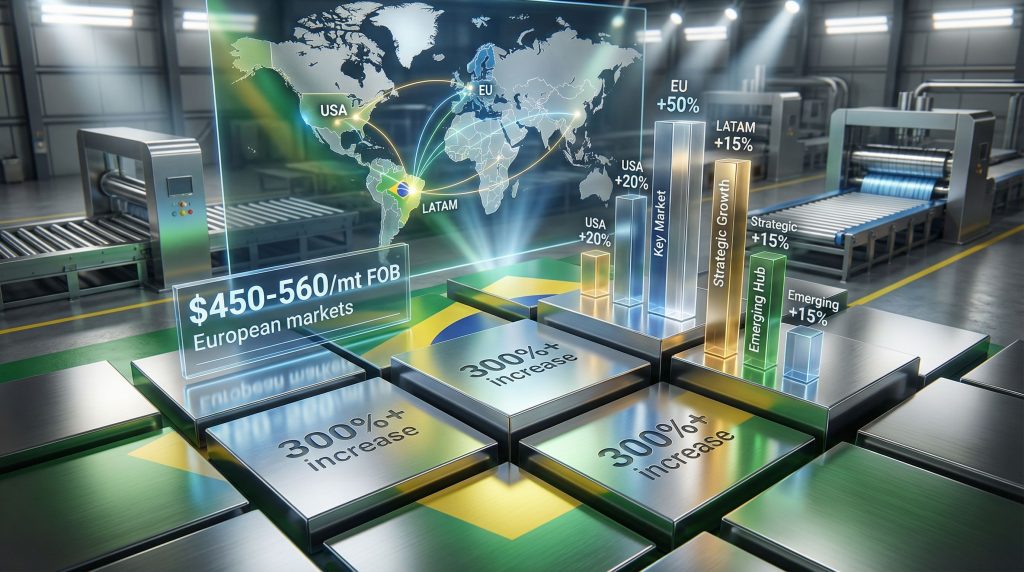
Regional distribution patterns demonstrate strategic market allocation, with the United States commanding 64.3% of total exports, followed by European Union markets at 25.1%, and Latin American destinations comprising 10.6% of shipment volumes.
When big ASX news breaks, our subscribers know first
How Do Trade Policies Shape Brazilian Steel Export Strategies?
US Tariff Impact Assessment
The implementation of 50% import duties on steel products created significant market disruption, yet Brazilian exporters demonstrated remarkable resilience in maintaining trade relationships. US imports of Brazilian slab increased by 54% to 536,940 tonnes despite the tariff barriers, indicating successful adaptation strategies.
This tariff resilience stems from multiple factors including elevated downstream steel prices that offset import cost increases. Domestic US steel mill production constraints created supply gaps that imported slab continues to fill, supporting sustained demand despite higher landed costs. Furthermore, the US tariff effects on iron ore demonstrate how trade policies create interconnected market dynamics across the steel supply chain.
Market participants report that tight domestic supply conditions, combined with several US mills facing production constraints, have supported price levels sufficient to absorb tariff impacts. This dynamic illustrates how supply-demand imbalances can override protectionist policy intentions.
Volume redistribution patterns following tariff implementation reveal strategic timing adjustments, with exports to the US showing monthly volatility that suggests advance-buying behaviours and inventory management responses to policy uncertainty. However, broader tariff economic implications continue to reshape global trade flows beyond the steel sector.
European Market Expansion Opportunities
The European Union's Carbon Border Adjustment Mechanism (CBAM) has created unexpected competitive advantages for Brazilian steel producers. Brazil's relatively low default emissions values under CBAM regulations provide preferential treatment compared to higher-emission competitors from other regions.
European market expansion metrics demonstrate extraordinary growth:
- February 2026: 210,000 tonnes to EU member states
- February 2025: 50 tonnes to EU member states
- Growth rate: 419,900% increase year-over-year
This expansion reflects both regulatory advantages and supply chain integration opportunities. European mills experiencing production issues have increasingly turned to South American subsidiaries to cover supply gaps, indicating corporate strategy alignment with trade policy frameworks.
The CBAM regulatory framework rewards efficient production processes and lower-carbon energy utilisation, areas where Brazilian steelmakers maintain structural advantages. This regulatory environment creates sustainable competitive positioning that extends beyond traditional cost-based competition. Moreover, these developments intersect with wider global trade disruptions affecting multiple commodity markets.
Which Regional Markets Drive Brazilian Steel Slab Demand?
North American Market Dynamics
The United States remains Brazil's primary export destination, absorbing 536,940 tonnes in February 2026 despite sustained tariff pressures. This market dominance reflects deep industrial integration and established supply chain relationships that prove resistant to policy disruption.
US Market Characteristics:
- Share of total Brazilian exports: 64.3%
- Price range: $545-550 per metric tonne FOB
- Growth trajectory: 54% year-over-year increase
- Market resilience: Sustained demand despite 50% tariffs
Mexican steel trade represents a unique vertical integration model, with Brazilian steelmakers supplying their own rolling mill operations. Mexico received 46,571 tonnes in February 2026, all destined for a Brazilian steelmaker's rolling mill facility. This internal supply chain arrangement demonstrates strategic asset deployment and market capture through ownership integration.
Canadian steel processing requirements contribute to regional demand stability, though specific volume data remains limited in available trade statistics. The North American market collectively provides scale and consistency that supports production planning and capacity utilisation optimisation.
European Union Trade Relationships
European demand patterns reveal both geographic diversification and concentration trends. France emerged as the primary EU destination with 73,171 tonnes, representing 34.8% of total EU imports from Brazil. This concentration suggests specific industrial relationships or mill integration strategies.
EU Member State Import Distribution:
| Country | Volume (tonnes) | EU Market Share | Growth Rate |
|---|---|---|---|
| France | 73,171 | 34.8% | New market entry |
| Spain | 60,647 | 28.9% | New market entry |
| Poland | 40,514 | 19.3% | New market entry |
| Germany | 28,832 | 13.7% | New market entry |
Production gap coverage represents a critical demand driver, as European steel mills face operational constraints that require external supply sources. The reference to mills turning to South American subsidiaries indicates corporate integration strategies where multinational companies leverage Brazilian operations during domestic production disruptions.
Supply chain integration with South American subsidiaries provides operational flexibility and risk management capabilities. This arrangement allows European steelmakers to maintain production schedules while addressing domestic capacity constraints through corporate asset optimisation.
Latin American Regional Integration
Regional integration dynamics demonstrate the impact of trade protection measures on market opportunities. Colombia imported 19,981 tonnes in February 2026, up from zero the previous year, directly attributed to safeguard measures extended against Asian producers.
These safeguard measures create protected market opportunities for regional suppliers, illustrating how trade policy frameworks can reshape competitive landscapes. Brazilian exporters benefit from geographic proximity and established trade relationships that facilitate rapid market penetration when protection mechanisms favour regional suppliers.
Peru showed consistent growth with 20,325 tonnes imported, representing a 127% increase from the previous year's 8,954 tonnes. This expansion indicates sustained industrial demand growth and successful relationship development in the Peruvian steel processing sector.
Regional hub development opportunities emerge as Latin American countries implement industrial policies that favour regional suppliers. This trend supports supply chain consolidation and logistics optimisation across South American markets. In addition, these policy developments reflect broader tariff market impacts affecting regional trade patterns.
What Economic Factors Influence Brazilian Steel Export Pricing?
Currency and Cost Structure Analysis
Exchange rate dynamics significantly impact Brazilian export competitiveness, with Real valuation affecting both production costs and export revenues. Currency depreciation periods typically enhance export margins while strengthening phases can pressure competitiveness against international competitors.
Raw material cost fluctuations create margin pressures that require active management strategies. Iron ore price trends constitute the primary variable cost component that influences production economics and export pricing decisions alongside coking coal costs and energy expenses.
Energy cost advantages represent a structural competitive factor for Brazilian steel producers. Access to hydroelectric power and renewable energy sources provides cost stability and environmental compliance benefits that translate into market positioning advantages under emerging carbon pricing frameworks.
Production efficiency considerations encompass both technological capabilities and operational optimisation. Modern steelmaking facilities in Brazil utilise integrated production methods that optimise material flows and energy utilisation, supporting cost competitiveness in international markets.
Global Steel Market Price Dynamics
FOB pricing trends reflect complex interactions between regional demand characteristics, transportation costs, and competitive positioning. Brazilian slab pricing ranges from $447-561 per metric tonne FOB, with variations reflecting destination market specifics and delivery requirements.
Regional Pricing Analysis:
- United States: $545-550/mt FOB
- European Union: $450-560/mt FOB
- Latin America: $447-561/mt FOB
Freight cost variations significantly impact landed costs and competitive positioning. Transportation expenses from Brazilian ports to destination markets constitute substantial cost components that influence both pricing strategies and market selection decisions.
International benchmark correlations reveal how Brazilian exporters position products relative to competing suppliers from Asia, Europe, and other regions. Pricing strategies must account for quality differentials, delivery reliability, and service capabilities that justify premium or discount positioning.
How Do Production Constraints Affect Global Steel Supply?
Domestic Production Challenges
Brazilian steelmaker capacity utilisation rates influence export availability and pricing dynamics. Production planning must balance domestic market requirements with export opportunities, requiring sophisticated allocation strategies that optimise revenue generation across market segments.
Infrastructure limitations can constrain growth potential, particularly transportation networks connecting production facilities with export terminals. Port capacity, rail systems, and logistics coordination capabilities determine the practical limits of export volume expansion.
Technology upgrades and efficiency improvements represent ongoing investment priorities that enhance competitive positioning. Modern steelmaking equipment, environmental compliance systems, and automation technologies support both cost reduction and quality enhancement objectives.
Expansion plans require careful market analysis and capital allocation decisions. Investment timing must consider market demand projections, competitive dynamics, and regulatory evolution to ensure optimal returns on deployed capital.
International Supply Gap Analysis
European mill production issues create supply opportunities that Brazilian exporters can address through established corporate relationships and trade channels. Production constraints at European facilities directly translate into import demand that benefits competitive suppliers.
Supply gap drivers include:
- Equipment maintenance and operational disruptions
- Energy cost pressures affecting production economics
- Environmental compliance requirements limiting operations
- Raw material availability constraints
US domestic steel supply limitations result from multiple factors including capacity constraints, maintenance requirements, and operational challenges. These limitations create sustained import demand that supports premium pricing for reliable suppliers.
Asian producer market positioning faces challenges from trade restrictions, transportation costs, and quality perceptions that create opportunities for alternative suppliers. Brazilian exporters can capture market share by demonstrating superior service capabilities and product consistency.
What Are the Strategic Implications for Steel Industry Stakeholders?
Investment and Expansion Considerations
Capital allocation priorities must balance capacity expansion with market development initiatives. Investment decisions require careful analysis of demand projections, competitive positioning, and regulatory compliance requirements that influence long-term profitability.
Market diversification strategies reduce dependency on single regions while capturing growth opportunities across multiple geographic markets. Portfolio approaches to market allocation optimise risk-adjusted returns and provide flexibility during demand fluctuations.
Technology investments for emission reduction compliance become increasingly important under evolving environmental regulations. CBAM compliance, carbon footprint reduction, and sustainability certification requirements influence investment priorities and competitive positioning.
Risk management frameworks must address currency volatility, commodity price fluctuations, and trade policy uncertainty. Hedging strategies, contract structuring, and operational flexibility provide protection against adverse market movements.
Supply Chain Optimisation Opportunities
Logistics efficiency improvements focus on transportation cost reduction and delivery reliability enhancement. Port operations optimisation, shipping contract negotiation, and multimodal transportation coordination support competitive positioning and margin improvement.
Regional hub development enables market penetration and customer service enhancement through strategic facility location and inventory management. Distribution centres and processing facilities near key markets reduce lead times and transportation costs.
Integration with downstream steel processing facilities creates value-added opportunities and customer relationship strengthening. Vertical integration strategies can capture additional margins while providing supply chain security for key customers.
The next major ASX story will hit our subscribers first
Key Export Performance Metrics and Comparative Analysis
Brazilian Steel Slab Export Performance by Destination
| Market Region | Volume Growth | Price Range ($/mt FOB) | Strategic Importance |
|---|---|---|---|
| United States | 54% increase (188,345t) | $545-550 | Primary revenue driver with tariff resilience |
| European Union | 419,900% increase (209,950t) | $450-560 | Fastest growing segment with CBAM advantages |
| Latin America | Regional expansion | $447-561 | Integration opportunities with protective measures |
Performance Analysis Highlights:
- Total export growth: 117.4% year-over-year increase
- Market diversification: Seven primary destination countries
- Volume concentration: US represents 64.3% of total exports
- Price stability: Narrow pricing ranges across regions indicate market efficiency
Comparative analysis reveals Brazil's competitive positioning strength across multiple markets simultaneously. The ability to maintain growth in high-tariff environments while expanding rapidly in regulatory-advantaged markets demonstrates strategic flexibility and operational excellence.
Export performance metrics indicate sustainable competitive advantages rooted in cost structure, environmental compliance, and supply chain reliability. These factors support continued market share expansion opportunities across targeted regional markets.
Future Outlook and Market Projections
Short-term Market Expectations
Volume recovery patterns suggest continued growth momentum supported by sustained international demand and Brazilian production capacity expansion. Seasonal variations may influence monthly export patterns, but underlying demand drivers remain supportive for near-term performance.
Price stabilisation factors include supply-demand balance optimisation and competitive positioning maintenance across key markets. Market sentiment indicators suggest continued strength in steel consumption sectors that drive slab demand, particularly as Brazilian steel slab exports benefit from established trade relationships.
Trade policy developments require ongoing monitoring as regulatory frameworks evolve. CBAM implementation details, tariff policy adjustments, and regional trade agreement modifications will influence market access and competitive positioning.
Short-term Projections:
- Sustained US market presence despite tariff environment
- Continued European market expansion under CBAM advantages
- Regional Latin American integration acceleration
- Price stability within established trading ranges
Long-term Strategic Positioning
Sustainability compliance requirements will increasingly influence competitive positioning and market access. Environmental performance standards, carbon footprint certification, and emission reduction capabilities become critical success factors.
Market share expansion opportunities exist across multiple regions as Brazilian steel slab exports demonstrate consistent competitive advantages. Geographic diversification strategies can optimise risk-adjusted returns while capturing growth opportunities.
Competitive advantages in global steel trade stem from integrated production capabilities, cost structure optimisation, and environmental compliance leadership. These foundational strengths support sustained market position enhancement and revenue growth potential. Furthermore, developments in Brazilian slab export markets continue to demonstrate strong performance across multiple regions.
Investment in production technology, environmental compliance systems, and supply chain optimisation will determine long-term competitive positioning. Strategic capital allocation decisions must balance near-term profitability with sustainable competitive advantage development. Consequently, market participants monitor current steel slab reference pricing to inform strategic planning decisions.
Frequently Asked Questions About Brazilian Steel Slab Exports
What makes Brazilian steel slabs competitive globally?
Brazilian steel slab competitiveness derives from multiple structural advantages including low default emission values under EU CBAM regulations, which provide preferential treatment in carbon-regulated markets. Production cost advantages result from integrated steelmaking facilities utilising efficient technologies and renewable energy sources.
Geographic positioning enables access to diverse international markets with competitive transportation costs. Raw material availability, including high-quality iron ore deposits and energy resources, supports consistent production capabilities and cost optimisation.
Quality consistency and delivery reliability establish strong customer relationships that translate into sustained market share. Technical capabilities meet international specifications while maintaining competitive pricing across multiple market segments.
How do tariffs affect Brazilian steel export strategies?
Market diversification reduces dependency on single regions while capturing opportunities across multiple geographic markets. The 54% growth in US exports despite 50% tariffs demonstrates successful adaptation through pricing strategies and supply gap utilisation.
Price adjustment mechanisms enable tariff cost absorption through elevated downstream steel prices and supply-demand optimisation. Long-term relationship building with alternative buyers provides market flexibility during policy disruption periods.
Strategic timing adjustments help optimise shipping schedules and inventory management to minimise policy impact. Corporate integration strategies, including subsidiary operations, provide market access alternatives during restrictive policy periods.
What factors drive pricing in the global steel slab market?
Raw material costs including iron ore, coking coal, and energy inputs constitute primary variable cost components that influence production economics. Energy price fluctuations directly impact production costs and competitive positioning relative to international suppliers.
Freight and logistics cost variations significantly affect landed costs and market competitiveness. Transportation expenses from production facilities to destination markets require active management and optimisation strategies to maintain competitive positioning.
Supply-demand imbalances in key consuming regions create pricing opportunities and market dynamics that favour efficient suppliers. Production constraints at competing facilities, regulatory advantages, and quality differentials influence pricing power and market positioning.
Investment Disclaimer: The information presented in this analysis is for educational and informational purposes only. Steel market dynamics, trade policies, and export performance metrics can change rapidly based on economic, political, and regulatory developments. Readers should conduct independent research and consult qualified professionals before making investment or business decisions based on this information. Past performance does not guarantee future results, and all international trade activities involve inherent risks including currency fluctuation, policy changes, and market volatility.
Looking for Investment Opportunities in the Steel and Mining Sectors?
Discovery Alert's proprietary Discovery IQ model provides instant notifications on significant ASX mineral discoveries, empowering subscribers to identify actionable investment opportunities in commodity markets before the broader market reacts. With Brazilian steel slab exports demonstrating how global supply chains create downstream opportunities for mining companies, explore Discovery Alert's historic examples of major discoveries that have generated substantial returns and begin your 14-day free trial today to position yourself ahead of market movements.