
May 22, 2026
The Landlocked Coal Corridor That Could Reshape China's Western Energy Supply
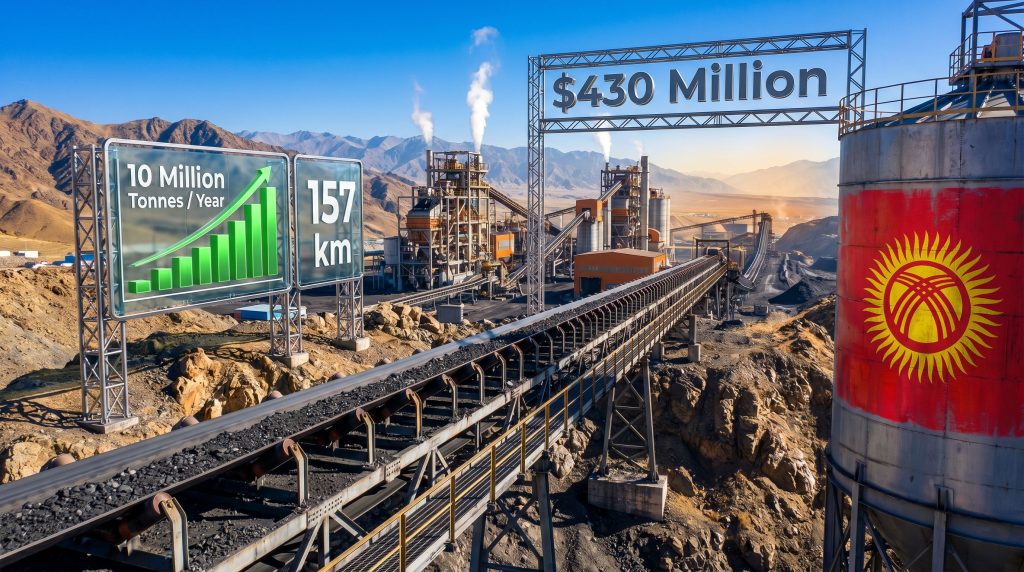
Across the global energy landscape, the most consequential infrastructure deals rarely make headlines in proportion to their strategic weight. While seaborne coal markets dominate analyst attention, a quieter transformation is unfolding across Central Asia's landlocked interior, where geographic proximity to China's industrial heartland is proving more valuable than access to ocean shipping lanes. The Kyrgyzstan coal project backed by China is one of the clearest expressions of this dynamic: a $430 million logistics commitment that links underdeveloped mountain coal reserves to one of the world's most energy-hungry industrial regions.
Understanding why this matters requires stepping back from the project itself and examining the structural forces that made it inevitable.
When big ASX news breaks, our subscribers know first
Why Overland Coal Supply Routes Are Gaining Strategic Value
China's coal import strategy has historically leaned heavily on seaborne supply from Indonesia, Australia, and Russia. But each of these channels carries exposure to shipping cost volatility, port congestion, and, in some cases, diplomatic friction. Indonesia, the world's largest thermal coal exporter, shipped approximately 524 million tonnes in 2025 according to Argus Media, accounting for more than half of total global seaborne supply. Yet Jakarta's recent decision to route commodity exports through state-owned enterprises has injected significant uncertainty into existing supply contracts.
Traders and utilities across Asia are consequently scrambling to assess the commercial implications of these shifts. Furthermore, commodity price impacts on downstream buyers have amplified the urgency of finding more stable overland alternatives.
This kind of policy-driven supply disruption is precisely what motivates Chinese resource planners to pursue overland alternatives. Central Asian coal, delivered via direct land corridor, bypasses port logistics entirely and reduces exposure to maritime policy risk. For Xinjiang's industrial base specifically — which includes heavy manufacturing and power generation facilities far from coastal infrastructure — proximity to Kyrgyz coal deposits represents a structural cost advantage that is difficult to replicate through seaborne imports.
The $430 Million Kyrgyzstan Coal Logistics Complex: What Is Actually Being Built
Physical Scope and Infrastructure Components
The development is anchored in Kyrgyzstan's southern Osh region, a location selected primarily for its proximity to the Irkeshtam border crossing with China's Xinjiang province. This crossing functions as the critical dry bulk trade artery between the two countries and is one of the few viable overland export routes available to Kyrgyz coal producers.
The infrastructure programme encompasses:
- Two coal enrichment facilities designed to upgrade raw coal to export-grade quality specifications
- A coal conveyor belt system connecting mine output to border logistics points, reducing dependence on road-based haulage through difficult mountain terrain
- An initial 7.7-kilometre conveyor segment funded through a first-stage allocation of approximately $50 million
- A long-term expansion target extending the conveyor network to 157 kilometres at full build-out
- A target throughput capacity of 10 million tonnes per year upon completion
The coal enrichment component is particularly significant from a technical standpoint. Raw coal extracted from Central Asian deposits often contains elevated ash and moisture content, which reduces its calorific value and competitiveness in export markets. Beneficiation — coal washing and sorting — raises the effective energy density of the product, lowering per-gigajoule transport costs and making Kyrgyz coal more price-competitive against seaborne alternatives at the Chinese border.
The Tekelik Deposit and Irkeshtam Corridor
Coal feedstock for the complex will be sourced from the Tekelik deposit, with the processed output directed through the Irkeshtam checkpoint into Xinjiang. The conveyor-based logistics model is particularly well-suited to this terrain: road haulage through mountainous passes incurs high fuel costs, vehicle wear, and seasonal disruption from weather events.
A continuous conveyor system, once constructed, offers lower operating costs per tonne and more consistent throughput capacity across seasonal conditions. In addition, the Kara-Keche Coal Mine provides a useful regional comparison for how Central Asian coal infrastructure scales once initial logistics frameworks are established.
Key Project Stakeholders
| Stakeholder | Role |
|---|---|
| Kyrgyzkomur | State-owned coal producer; primary Kyrgyz counterparty |
| Kyrgyz Energy Ministry | Government policy oversight and coordination |
| Xinjiang Dacheng Yuanlong Technology | Chinese investment and technology partner |
Kyrgyzstan's Reserve Base: A Geological Profile With Unresolved Questions
One of the more striking features of Kyrgyzstan's coal sector is the substantial divergence between reserve estimates produced by different methodologies. The International Energy Agency places Kyrgyz coal reserves at approximately 2 billion tonnes, while older national government assessments suggest the figure could reach 24 billion tonnes. This twelve-fold gap is not simply a rounding error.
It reflects the difference between independently audited resource estimates applying modern geological classification standards and legacy Soviet-era survey data that frequently used different definitions of economically recoverable tonnage.
The Kyrgyz energy ministry's announcement in 2025 that five new coal seams had been discovered adds further complexity to this picture. New seam identification without independent resource estimation does little to narrow the reserve uncertainty range, but it does signal that the country's geological inventory remains materially incomplete. From an investment perspective, this uncertainty cuts both ways: it represents exploration upside, but also introduces risk around the scalability assumptions underpinning the logistics infrastructure.
Kyrgyzstan's coal reserve uncertainty is itself a form of strategic ambiguity. Until independent audit methodologies are applied uniformly across all identified deposits, the investment case for large-scale logistics infrastructure rests partly on geological assumptions that have not been fully verified by international standards.
Chinese Investment Across Kyrgyzstan's Energy Sector: A Pattern, Not an Isolated Deal
The Osh logistics complex does not exist in isolation. It forms part of a broader and accelerating pattern of Chinese resource engagement across Kyrgyzstan's coal sector. However, understanding this pattern requires examining how government intervention in mining shapes the commercial framework within which these bilateral deals are structured.
Separately from the Osh project, Chinese firm Huaxin Coal Industrial Company has entered into a joint development agreement with Kyrgyzkomur covering the Tilak and Markai sections of the Kök-Janggak coal deposit in the Jalal-Abad region. This agreement was one of seven energy and industrial deals concluded under a bilateral forum, with the combined package valued at $1.151 billion.
Collectively, Chinese involvement now spans the full coal value chain in Kyrgyzstan:
- Mine development at multiple deposit locations across different regions
- Coal processing through enrichment and beneficiation technology
- Logistics infrastructure via the conveyor and border crossing system
- Export facilitation through the Irkeshtam corridor into Xinjiang
This vertical integration of Chinese investment is a recognisable pattern in Belt and Road resource strategy. Rather than taking equity in individual mines, Chinese partners frequently structure involvement around the infrastructure layer, which creates durable influence over export economics regardless of which entity holds mining rights.
Three Scenarios for the Project's Long-Term Trajectory
Given the range of variables involved, it is worth modelling distinct possible outcomes rather than assuming a single linear path to full build-out.
Scenario A: Full Logistics Build-Out and Export Scale-Up
The conveyor network reaches its 157-kilometre target, throughput achieves the 10 million tonne per year design capacity, and Kyrgyzstan establishes itself as a meaningful supplementary coal supplier to Xinjiang's industrial base. Under this scenario, export revenue flows strengthen Kyrgyzstan's fiscal position, but concentration risk intensifies as China becomes the dominant buyer of a single primary export commodity.
Scenario B: Partial Completion with Domestic Energy Prioritisation
Infrastructure is partially built, but Kyrgyzstan's structural domestic power generation shortfall absorbs available coal volumes before export targets can be met. The energy ministry has already signalled that closing the domestic supply deficit is a concurrent priority alongside export development. If domestic demand growth outpaces logistics capacity expansion, the export ambition may be scaled back without any single triggering event.
Scenario C: Geopolitical Friction and Financing Constraints
Kyrgyzstan carries existing sovereign debt obligations to China's Eximbank, a structural constraint on its negotiating leverage in new investment agreements. If public concern about debt dependency intensifies, or if local political conditions shift, project approval timelines could extend materially. The broader geopolitical mining landscape across Central Asia demonstrates that infrastructure-for-resources arrangements can generate political backlash once the debt servicing implications become visible in national budgets.
The next major ASX story will hit our subscribers first
Economic Implications: Upside Potential and Structural Risks
The Logistics Cost Equation
The economic case for the conveyor system rests on straightforward but impactful arithmetic: road-based haulage through mountainous terrain in the Osh region carries substantially higher per-tonne costs than a purpose-built conveyor system operating at scale. By reducing the break-even export price for Kyrgyz coal at the Chinese border, the infrastructure widens the competitive window against other coal sources reaching Xinjiang.
This includes seaborne imports transiting through eastern Chinese ports and re-routed overland. Employment generation across construction, operations, and ancillary services in southern Kyrgyzstan represents an additional economic benefit, though the magnitude will depend heavily on how much of the skilled workforce and equipment is sourced locally versus imported from China — a distinction that has been a recurring point of tension in BRI projects across the region.
Debt Concentration and Export Dependency Risks
Regional observers and multilateral development institutions have consistently flagged the structural trade imbalance between Kyrgyzstan and China as a fiscal vulnerability. New coal infrastructure investment, while economically beneficial in the near term, risks deepening rather than diversifying this asymmetry if export revenues flow predominantly back to Chinese-linked financing arrangements.
The risk of export revenue concentration is compounded by the fact that the Irkeshtam corridor effectively channels Kyrgyz coal exports toward a single buyer market. Furthermore, trade war supply chains increasingly influence how bilateral resource agreements are structured, adding another layer of commercial risk. Unlike seaborne exporters who can redirect cargoes across multiple demand centres in response to price signals, landlocked conveyor infrastructure is inherently directional.
The Fertiliser Pathway: An Underappreciated Option
Kyrgyz authorities are also exploring the feasibility of converting domestic coal into agricultural fertiliser feedstocks, specifically through coal-to-chemicals processing pathways. If viable at scale, this industrial application would represent a significant structural shift in how the country monetises its coal endowment, adding value domestically rather than exporting the raw commodity. Coal-based fertiliser production is technically established in China and parts of South Asia, making knowledge transfer feasible, though the economics depend heavily on local gas prices, water availability, and export market access.
How Kyrgyzstan Compares to Regional Coal Peers
| Country | Estimated Coal Reserves | Key Export Markets | Chinese Investment Presence |
|---|---|---|---|
| Kyrgyzstan | 2bn to 24bn t (range) | China (primary) | High and growing |
| Kazakhstan | ~25bn t | Russia, China, Europe | Moderate |
| Uzbekistan | ~1.9bn t | Domestic-focused | Limited |
| Tajikistan | ~4bn t | Domestic-focused | Emerging |
Note: Reserve estimates vary by assessment methodology. Figures sourced from IEA and national government data.
Kyrgyzstan's position in this table is distinctive in two respects. First, the reserve estimate uncertainty range is far wider than any comparable country in the region, suggesting the geological inventory is less well-characterised. Second, Chinese investment presence is both the highest and the fastest-growing, creating a bilateral dependency structure that none of the region's other coal producers currently faces to the same degree.
Environmental and Climate Governance Considerations
The project's long-term commercial viability is partly a function of Chinese domestic coal demand trajectory through 2030 to 2035. This variable is increasingly subject to policy intervention under China's carbon neutrality commitment for 2060. China's coal plant strategy, which emphasises deploying new capacity as renewable backup rather than baseload, adds further complexity to long-term demand modelling for imported overland coal supplies. While near-term industrial coal demand in Xinjiang remains robust, the regulatory environment for coal infrastructure is tightening across multiple jurisdictions simultaneously.
In May 2025, the United Nations General Assembly adopted a resolution welcoming the International Court of Justice's advisory opinion on states' obligations to protect the climate system from greenhouse gas emissions. The resolution passed with 141 votes in favour, with only eight countries opposing. While ICJ advisory opinions are not legally binding, they carry significant normative weight and are increasingly cited in domestic and international climate litigation.
For a project with conveyor infrastructure designed to operate over multiple decades, this shifting legal and reputational environment represents a material long-term consideration, even if it does not alter near-term project economics.
Local environmental considerations also warrant attention. Coal enrichment facilities generate process water and fine coal waste streams that require careful management in mountainous terrain with limited water treatment infrastructure. The ecological sensitivity of the Osh region's watershed systems adds complexity to the environmental compliance framework governing the project. Analysts tracking Kyrgyzstan's growing debt exposure to China note that environmental compliance costs could further complicate the project's financing structure over time.
Frequently Asked Questions: Kyrgyzstan Coal Project Backed by China
What is the total investment value of the Kyrgyzstan coal logistics project?
The total investment commitment stands at $430 million, with the initial first-stage allocation of approximately $50 million directed toward constructing a 7.7-kilometre conveyor system in the Osh region.
Which Chinese company is the primary partner in the Kyrgyzstan coal project backed by China?
Xinjiang Dacheng Yuanlong Technology is the Chinese investment and technology partner, working alongside state-owned coal producer Kyrgyzkomur and the Kyrgyz energy ministry.
What is the target annual coal transportation capacity of the logistics complex?
Upon full development, the system is designed to support a throughput capacity of 10 million tonnes per year.
Which deposit will supply the logistics complex?
The complex is designed to process and export coal from the Tekelik deposit, with output routed through the Irkeshtam border crossing into China's Xinjiang province.
How large are Kyrgyzstan's coal reserves?
The IEA estimates reserves at approximately 2 billion tonnes, while older national government assessments place the figure as high as 24 billion tonnes. The wide range reflects differences in assessment methodology rather than geological certainty.
Is this the only Chinese coal investment in Kyrgyzstan?
No. Huaxin Coal Industrial Company has separately agreed to jointly develop sections of the Kök-Janggak deposit with Kyrgyzkomur, as part of a bilateral package of seven deals totalling $1.151 billion.
What other industrial uses is Kyrgyzstan exploring for its coal reserves?
Kyrgyz authorities are investigating the feasibility of using domestic coal as a feedstock for agricultural fertiliser manufacturing, a value-added processing pathway that would reduce dependence on raw coal exports.
What the Kyrgyzstan Project Signals for Asian Coal Market Dynamics
The emergence of overland Central Asian coal supply as a credible volume source for western China introduces a new variable into Asian coal trade flow modelling. Incremental supply from Kyrgyzstan, even at the 10 million tonne per year design target, is modest relative to Indonesia's 524 million tonne annual export volume. However, its significance is not purely volumetric.
The development of the Irkeshtam corridor as a functioning dry bulk trade artery demonstrates that landlocked coal deposits can be commercially integrated into Chinese supply chains through targeted logistics investment. If the Osh model proves replicable, it could accelerate similar investments across Tajikistan and potentially southern Kazakhstan, progressively building an overland coal supply buffer for China's interior industrial regions.
For seaborne coal exporters competing for Chinese market share, this trajectory is worth monitoring. Each tonne of domestically proximate overland supply that reaches Xinjiang is a tonne that does not need to travel by sea from Kalimantan or the Hunter Valley. The competitive pressure is currently marginal, but infrastructure investment horizons in this sector are measured in decades, not quarters.
This article is analytical and informational in nature. It does not constitute financial or investment advice. Readers considering investment decisions in commodity markets or related sectors should seek independent professional guidance. Projections and scenario analyses represent possible outcomes and should not be interpreted as forecasts or guarantees.
Want To Stay Ahead of Major ASX Mineral Discoveries Before the Broader Market?
Discovery Alert's proprietary Discovery IQ model delivers real-time alerts on significant ASX mineral discoveries — instantly transforming complex geological and commodity data into actionable investment insights for both short-term traders and long-term investors. Explore how historic discoveries have generated substantial returns and begin your 14-day free trial today to secure a market-leading edge.