May 22, 2026
Trade Policy as a Price Mechanism: How Export Restrictions Distort Domestic Sulphur Markets
Commodity markets operate on a relatively simple premise: prices converge toward a level where buyers and sellers from different regions can trade freely. When that freedom is removed through trade restrictions mechanics, the pricing architecture fractures. What emerges is a two-tier market where domestic participants transact well below levels accessible to international buyers, not because of any change in the underlying commodity, but purely because policy has closed the exit door.
This is precisely the dynamic playing out in Turkey's sulphur market throughout 2026. Understanding why Tupras sulphur awards remain below Med export prices requires more than reading tender results in isolation. It demands a structural analysis of how export bans mechanically suppress domestic pricing, what the global sulphur backdrop looks like from the outside, and what the downstream consequences are for fertilizer producers operating within Turkey's borders.
When big ASX news breaks, our subscribers know first
Turkey's Sulphur Export Ban: The Policy Mechanism Behind the Price Gap
How an Export Restriction Converts Surplus Into a Captive Market
Sulphur is not a primary product. It is an involuntary by-product of petroleum refining, extracted through hydrodesulphurisation processes that remove sulphur compounds from crude oil to meet fuel quality standards. Turkey's refinery network, operated primarily by Tupras, produces sulphur continuously as a function of crude throughput regardless of market conditions. Unlike other commodities, production cannot simply be reduced when prices are unfavourable.
This creates a structurally inelastic supply dynamic. When export channels are open, refinery-produced sulphur competes with international supply and prices anchor to Mediterranean or global benchmarks. When an export ban is imposed, that same volume becomes captive to the domestic market, forcing sellers to transact with a far narrower pool of buyers at whatever price the local market will bear. Furthermore, the industrial sulphur demand within Turkey's refining sector adds another layer of complexity to this dynamic.
The practical consequence of closing export channels for a refinery by-product like sulphur is that sellers lose their outside option entirely. Without the credible alternative of exporting, domestic buyers gain disproportionate negotiating leverage, pushing awarded prices well below international parity regardless of what global benchmarks are doing.
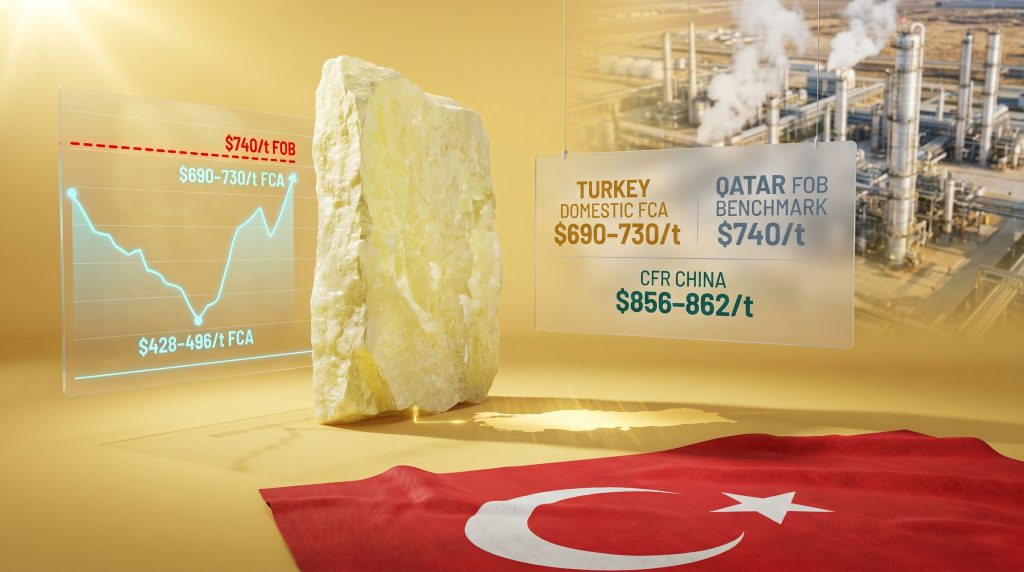
The April 2026 tender results illustrated this dynamic with unusual clarity. Awards came in at $428 to $496 per tonne FCA, a level that stood in stark contrast to Mediterranean export values. One lot from the Izmit facility was reportedly cancelled outright after bids fell below acceptable thresholds, signalling a bid-ask spread breakdown that is characteristic of policy-induced market distortion rather than organic demand weakness.
Why Lot Fragmentation Amplifies the Discount
An often-overlooked structural feature of Tupras tender activity is the size of individual lots. The May 2026 tender saw lot sizes ranging from 100 to 1,200 tonnes across the Izmit, Kirikkale, and Izmir facilities. These volumes are modest by industrial standards. Large sulphuric acid producers and fertilizer manufacturers typically require consistent, bulk-volume supply to justify logistics and procurement investment.
When tender volumes are fragmented, three compounding effects emerge:
- Large industrial buyers who could bid close to export-equivalent levels are deterred by the logistics inefficiency of small parcels.
- The buyer pool narrows to smaller regional traders and processors, reducing competitive tension in the bidding process.
- Price discovery becomes less reliable, with awarded levels reflecting a thin domestic market rather than a genuine supply-demand equilibrium.
This lot fragmentation dynamic is not unique to Turkey, but it becomes particularly consequential when combined with an export ban that simultaneously restricts who can buy and how much competitive pressure sellers can apply.
The May 2026 Tender in Detail: Recovery, But Not Parity
Tender Awards Across Three Refinery Sites
The 21 May 2026 Tupras tender was awarded in full, covering June-loading volumes across three refinery locations:
- Izmit facility: Lots of 100 to 1,200 tonnes awarded at $690 to $723/t FCA
- Kirikkale facility: Lots of 200 to 900 tonnes awarded at $725 to $730/t FCA
- Izmir facility: Lots of 150 to 650 tonnes awarded at $701 to $713/t FCA
The average uplift from the prior April tender represented approximately $248/t, a substantial recovery in absolute terms. However, the context of that recovery matters enormously. The April lows were themselves extreme, driven by the acute shock of the export ban's implementation. The May rebound reflects partial normalisation within a still-constrained domestic market, not a return to export parity. According to Argus Media's reporting on the Tupras sulphur tender, these below-parity awards are consistent with the broader pattern of domestically distorted pricing.
How Tupras Domestic Awards Compare to Global Benchmarks
The gap between Turkish domestic tender outcomes and international reference points is the defining feature of the current market structure. The table below contextualises May 2026 Tupras sulphur awards below Med export prices against relevant benchmarks:
| Price Reference | Level | Basis |
|---|---|---|
| Tupras tender (March 2026) | $662–672/t | FCA domestic (pre-ban) |
| Tupras tender (April 2026) | $428–496/t | FCA domestic (post-ban shock) |
| Tupras tender (May 2026) | $690–730/t | FCA domestic (partial recovery) |
| QatarEnergy sulphur (May 2026) | ~$740/t | FOB Ras Laffan/Mesaieed |
| Delivered China assessment (May 2026) | $856–862/t | CFR |
Even at the upper end of the May recovery, Turkish domestic awards trail the QatarEnergy FOB benchmark by at least $10 to $50 per tonne before accounting for the structural incomparability between FCA and FOB pricing terms. On a like-for-like logistics-adjusted basis, the gap is wider still.
Understanding FCA vs FOB: Why Delivery Terms Matter to Price Interpretation
FCA, or Free Carrier, pricing transfers risk and cost responsibility to the buyer at the named delivery location, in this case the refinery gate. The buyer bears all subsequent transportation, port handling, and export or import costs. FOB, or Free On Board, pricing includes delivery to the vessel at the nominated port, absorbing inland logistics and port loading costs.
This distinction is material when comparing Tupras domestic tender outcomes to Mediterranean export benchmarks. A sulphur cargo awarded at $730/t FCA Kirikkale would need to absorb inland trucking to a Black Sea or Aegean port, port handling fees, and loading costs before it could be meaningfully compared to a $740/t FOB Ras Laffan cargo. On an equivalent-basis comparison, the domestic Turkish price discount to international parity is structurally understated by the FCA pricing convention used in Tupras tenders.
The Global Backdrop: Why Turkey's Policy Discount Is Especially Pronounced in 2026
Geopolitical Disruption and Record Mediterranean Sulphur Prices
The divergence between Turkish domestic prices and global benchmarks is not occurring against a backdrop of weak international markets. Quite the opposite: global sulphur is experiencing structurally elevated pricing driven by a cascade of supply-side disruptions centred on the Middle East. Indeed, the broader geopolitical mining landscape illustrates how conflict and policy intersect to reshape commodity flows across multiple sectors.
The effective closure of the Strait of Hormuz since late February 2026, following escalating conflict involving US and Israeli military action against Iran, has dramatically constrained sulphur export volumes from major Gulf producers. Iran's establishment of the Persian Gulf Strait Authority and the introduction of mandatory vessel permitting for Hormuz transit has added further friction to an already disrupted shipping corridor. Front-month ICE Brent futures trading above $110 per barrel reflect the depth of this geopolitical premium embedded in energy markets.
Saudi and Qatari producers have responded by rerouting shipments via alternative corridors, adding freight premiums that have elevated delivered costs. Saudi Arabia's Sabic has gone so far as to truck urea from Jubail to the Red Sea port of Yanbu for export, a logistical workaround that speaks to the severity of Hormuz constraints. The same dynamics are compressing sulphur export volumes from the region, tightening Mediterranean availability precisely when global fertilizer demand is generating strong pull from Asian markets.
While global sulphur benchmarks are at or near record highs due to conflict-related supply disruptions and constrained Hormuz transit, Turkish domestic tender outcomes are moving in the opposing direction. This divergence is entirely a product of trade policy rather than underlying market fundamentals, creating a price anomaly with measurable downstream consequences.
QatarEnergy's sulphur benchmarked at approximately $740/t FOB Ras Laffan and Mesaieed in May 2026 represents record territory. Delivered assessments to China have reached $856 to $862/t CFR, reflecting both the record FOB base and the elevated freight costs associated with rerouted supply chains. Turkey, as a net sulphur producer insulated from these global price forces by its export ban, occupies a paradoxical position: sitting on material volumes while its domestic prices remain structurally disconnected from the record international market.
Downstream Implications: Who Benefits From Turkey's Price Distortion?
The Fertilizer Value Chain and Sulphur's Critical Role
Sulphur's economic importance extends far beyond its function as a refinery by-product. It is the foundational feedstock for sulphuric acid production, and sulphuric acid is indispensable to the manufacture of phosphate fertilizers including DAP (diammonium phosphate), SSP (single superphosphate), and MAP (monoammonium phosphate). The agricultural supply chain is structurally dependent on sulphur availability and pricing at every point upstream of crop nutrition.
When Turkish sulphur is available at $690 to $730/t FCA while international competitors are sourcing equivalent material at $740/t FOB or higher on a logistics-adjusted basis, the domestic advantage compounds through the value chain:
- Turkish sulphuric acid producers face lower input costs relative to Mediterranean competitors sourcing at export parity.
- This cost asymmetry improves the competitiveness of Turkish-produced phosphate fertilizers in regional export markets, particularly North Africa and the Eastern Mediterranean.
- Turkish fertilizer exporters may find themselves at a structural pricing advantage in markets such as Egypt, which itself has been actively tendering for DAP at $915 to $917/t FOB and SSP at $340 to $375/t FOB Ain Sokhna in recent weeks.
Regional Fertilizer Market Context: May 2026 Tender Landscape
The broader Mediterranean and regional fertilizer tender market in May 2026 provides useful context for the downstream implications of Turkey's domestic sulphur discount. Furthermore, the relationship between tariffs and supply chains in 2025 established many of the preconditions that now shape how regional buyers respond to these pricing differentials.
| Market | Product | Recent Tender Price | Basis |
|---|---|---|---|
| Egypt (NCIC) | DAP | Up to $915–917/t | FOB Adabiya/Damietta |
| Egypt (NCIC) | Granular Urea | Up to $865/t | FOB Adabiya |
| Egypt (NCIC) | SSP | $340–375/t | FOB Ain Sokhna |
| Turkey (Tupras) | Sulphur | $690–730/t | FCA domestic |
| Qatar (QatarEnergy) | Sulphur | ~$740/t | FOB Ras Laffan/Mesaieed |
The elevated DAP and SSP pricing in Egypt reflects the upstream sulphur cost pressures being absorbed by non-Turkish producers. Turkish fertilizer manufacturers sourcing sulphur domestically at discounted levels avoid this cost pass-through, at least for as long as the export ban persists.
Scenarios for Price Normalisation: Three Pathways Forward
The trajectory of Tupras domestic sulphur pricing from here depends primarily on policy decisions rather than market fundamentals. Three credible scenarios exist, each carrying distinct implications for commodity price impacts across the region.
Scenario A: Export Ban Removed
If Turkey's sulphur export restrictions are lifted, domestic tender prices would be expected to converge rapidly toward Mediterranean FOB parity, likely within one to two tender cycles. The current discount would compress as sellers recover their outside option and buyer bargaining power normalises.
Scenario B: Export Restrictions Prolonged or Made Permanent
A sustained ban would entrench the domestic price discount indefinitely. This scenario could incentivise Turkish downstream industries to invest in expanded sulphuric acid and fertilizer production capacity, absorbing the captive sulphur supply within a deepened domestic industrial base. The downstream competitiveness advantage would become structural rather than cyclical.
Scenario C: Global Sulphur Price Correction
A de-escalation of Middle East conflict, partial reopening of Hormuz transit, or softening of global fertilizer demand could bring international benchmarks down toward current Turkish domestic levels, reducing the visible policy discount without any change in Turkey's export restrictions. This scenario would mask the distortion rather than resolve it.
The next major ASX story will hit our subscribers first
Frequently Asked Questions: Turkish Sulphur Market Dynamics
Why do Tupras sulphur awards consistently fall below Mediterranean export prices?
Turkey's sulphur export ban restricts domestic refiners from accessing international markets, creating a captive supply situation. Without the competitive pressure of export alternatives, sellers accept prices below international parity and buyers leverage reduced competition to extract lower award levels. The impact of global commodity tariffs on market access further compounds this structural disadvantage for domestic sellers.
How significant was the price drop between March and April 2026?
Between the March 2026 tender at $662 to $672/t FCA and the April 2026 tender at $428 to $496/t FCA, average award prices fell by approximately $205/t. This decline is attributable to the initial shock of the export ban creating acute domestic oversupply. Historical context from Argus Media's December tender reporting shows how sharply this diverges from prior tender norms.
What does the May 2026 price recovery indicate?
The $248/t average uplift between April and May suggests partial market normalisation within the constrained domestic framework. However, awards continuing to trail international benchmarks confirms the policy discount remains structurally intact.
How should market participants interpret Tupras tender outcomes?
Tupras FCA tender results should be treated as a policy-distorted domestic price signal rather than a Mediterranean benchmark. Until export restrictions are removed, these prices reflect captive market dynamics rather than freely determined supply-demand equilibrium.
What is the current international sulphur benchmark?
As of May 2026, QatarEnergy sulphur is assessed at approximately $740/t FOB Ras Laffan and Mesaieed, with delivered costs to China at $856 to $862/t CFR, both representing record or near-record levels driven by Hormuz supply disruptions.
Key Takeaways: Policy Distortion in Turkish Sulphur Markets
The Turkish domestic sulphur market in 2026 is a case study in how trade policy can mechanically sever the link between domestic and international pricing, even when global benchmarks are at historically elevated levels. The core conclusions for market participants are:
- Turkey's export ban has created a persistent and measurable domestic price discount, with May 2026 Tupras sulphur awards below Med export prices trailing international FOB benchmarks by a logistics-adjusted margin that understates the true gap when FCA and FOB terms are properly compared.
- The April tender collapse to $428 to $496/t FCA and subsequent May recovery to $690 to $730/t FCA illustrate the volatility inherent in a captive market, where price discovery is impaired and bid-ask breakdowns are more likely.
- Global sulphur prices are at or near record highs driven by Hormuz disruption, making Turkey's domestic discount even more pronounced in relative terms than the nominal numbers suggest.
- Turkish fertilizer and sulphuric acid producers may be deriving a temporary but material input cost advantage from this distortion, with potential implications for their competitiveness in regional fertilizer export markets.
- Price normalisation is primarily a function of policy reversal rather than market forces, and the three scenarios outlined above carry very different implications for both domestic and regional fertilizer supply chains.
This article is intended for informational purposes only and does not constitute financial, investment, or trading advice. Commodity price data referenced reflects publicly available market reporting. Forecasts and scenarios are speculative in nature and subject to change based on geopolitical developments, policy decisions, and market conditions.
Want to Identify ASX Commodity Opportunities Before the Broader Market Does?
Discovery Alert's proprietary Discovery IQ model delivers real-time alerts on significant ASX mineral discoveries — instantly translating complex commodity data into actionable investment insights, whether you're navigating supply disruptions, policy-driven price distortions, or emerging exploration plays. Explore how historic mineral discoveries have generated substantial returns on Discovery Alert's dedicated discoveries page, and begin your 14-day free trial today to secure a market-leading edge.