August 9, 2026
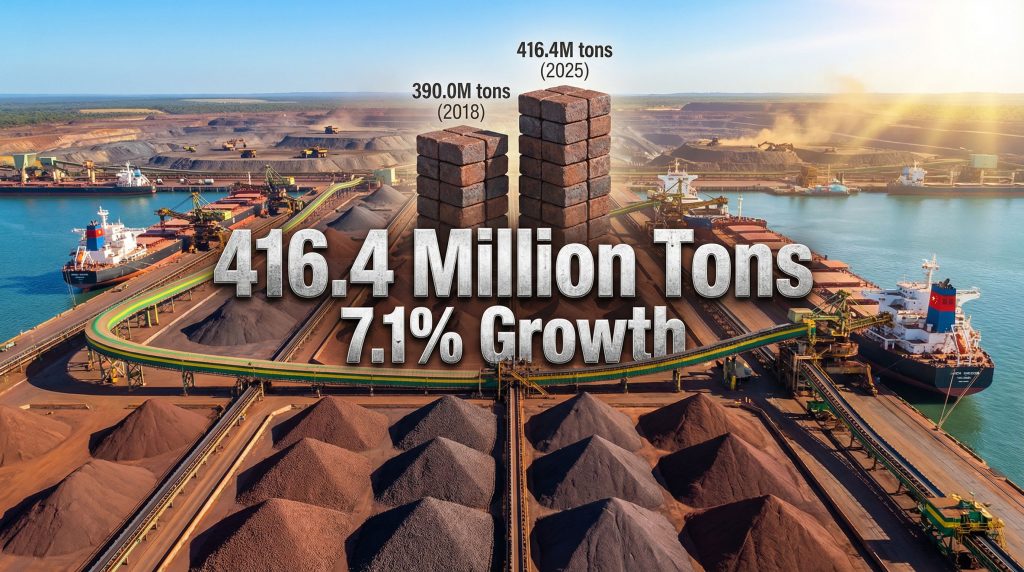
Brazil's position as a global iron ore powerhouse reached unprecedented heights in 2025, with the country achieving its first-ever annual exports exceeding 400 million tons. This remarkable milestone of 416.4 million tons represents a 7.1% increase from 2024 levels and establishes new performance benchmarks for Brazil's iron ore exports record 2025. Furthermore, this achievement demonstrates the successful integration of enhanced safety protocols with operational excellence, creating a foundation for sustained growth in global commodity markets.
How Rising Global Steel Demand Transformed Brazil's Mining Landscape
Global steel production cycles create ripple effects throughout commodity supply chains, with iron ore price trends serving as critical barometers of industrial activity. When steel mills operate at elevated capacity levels, particularly across major manufacturing economies, the demand for high-grade iron ore intensifies correspondingly.
This fundamental relationship between steel output and raw material requirements has shaped international trade patterns for decades. Moreover, it creates opportunities for suppliers capable of meeting sustained volume demands while maintaining competitive cost structures.
Brazil's position within this global framework represents a convergence of geological advantages, infrastructure investments, and operational expertise developed over multiple decades. The country's iron ore deposits, concentrated primarily in the Minas Gerais region, contain some of the world's highest-grade ores, averaging 60-67% iron content compared to global averages of 55-62%.
When big ASX news breaks, our subscribers know first
Brazil's Path to Historic 416.4 Million Ton Export Achievement
Brazil's iron ore exports record 2025 reached an unprecedented 416.4 million metric tons, representing a 7.1% increase from the previous year according to data released by the Ministry of Development, Industry, Trade and Services. This milestone marked the first time annual exports surpassed the 400 million ton threshold, establishing a new benchmark for the nation's mining sector performance.
The achievement represents successful completion of a multi-year recovery cycle following operational disruptions that began in 2019. The previous record, established in 2018 at approximately 390 million tons, had remained unmatched for seven years as the industry navigated regulatory adjustments and safety protocol implementations.
Production Recovery Through Operational Excellence
Vale's operational turnaround served as the primary catalyst for Brazil's export surge. The company reported its highest quarterly iron ore production since 2018 during Q3 2025, demonstrating successful adaptation to enhanced safety requirements implemented following the 2019 Brumadinho dam incident.
This quarterly performance milestone provided the foundation for sustained high-volume shipments throughout the remainder of 2025. Additionally, the recovery trajectory reflects systematic improvements across multiple operational dimensions:
- Mine productivity optimization through advanced extraction techniques
- Processing efficiency gains via upgraded beneficiation systems
- Transportation capacity expansion across rail and port infrastructure
- Supply chain coordination enabling consistent shipment scheduling
Secondary producers including CSN (Companhia Siderúrgica Nacional) and Usiminas contributed additional capacity, with their combined output supporting the overall volume increase. These companies implemented their own operational improvements, focusing on maximizing utilization rates at existing facilities rather than pursuing major capacity additions.
Monthly Export Acceleration During Q4 2025
The final quarter of 2025 witnessed exceptional export performance, with both October and December recording shipments exceeding 40 million tons monthly. October's performance represented approximately 16% growth compared to the same month in 2024, while December maintained similar momentum approaching monthly record levels.
This quarterly acceleration pattern indicates several underlying factors. For instance, seasonal demand optimization from Chinese steel mills preparing for spring construction activity played a crucial role. Furthermore, port infrastructure utilization reached near-maximum efficiency levels, while weather conditions provided advantages enabling consistent loading and shipping operations.
The capacity to sustain 40+ million ton monthly volumes demonstrates Brazil's infrastructure systems functioning as integrated logistics hubs. Consequently, these systems can process record quantities during concentrated shipping windows, showcasing remarkable rail logistics improvements across the sector.
Economic Forces Driving Brazil's 7.1% Export Growth
China's position as the world's largest iron ore importer created the demand foundation enabling Brazil's record export performance. Chinese steel production requirements, driven by both domestic construction activity and manufacturing output, generated sustained purchasing throughout 2025.
Industry data suggests China likely concluded 2025 with record iron ore imports, providing consistent market demand for Brazilian suppliers and supporting brazil's iron ore exports record 2025 achievement.
Chinese Steel Production and Import Dynamics
The relationship between Chinese steel output and Brazilian iron ore exports operates through direct correlation patterns. Each percentage point increase in Chinese crude steel production typically generates 15-20 million tons of additional iron ore demand annually, given the country's production scale and raw material requirements.
China's steel production expansion during 2025 created favorable conditions for Brazilian exporters:
- Construction sector activity requiring structural steel inputs
- Manufacturing output growth across automotive and machinery sectors
- Infrastructure development programs consuming rebar and other steel products
- Export manufacturing serving global markets through Chinese production facilities
This demand profile enabled Brazilian suppliers to maintain consistent pricing while achieving volume growth. However, it also helped avoid the supply-demand imbalances that typically constrain either pricing power or volume expansion.
Global Supply Chain Positioning Advantages
Brazil's geographical positioning provides inherent advantages in seaborne iron ore trade. Shipping routes from major Brazilian ports (Tubarão, Sepetiba, and others) to Chinese destinations require 30-40 day transit periods, compared to 45-60 days from Australian suppliers.
This difference translates to lower capital costs per unit shipped and enhanced competitiveness in both spot and contract markets. Moreover, freight cost considerations further support Brazilian market positioning through several key factors.
These logistical advantages compound over large volume transactions, creating meaningful cost differentials that support sustained market share gains. Furthermore, the benefits align with broader Australian ore advantages in terms of global supply chain optimization.
Historical Context: Surpassing Previous Records
Brazil's 2025 export achievement of 416.4 million tons exceeded the previous 2018 record of approximately 390 million tons by 26.4 million tons, representing a 6.8% improvement over the earlier benchmark. This comparison demonstrates that the post-2019 recovery has not merely restored previous performance levels but established new operational capabilities.
| Year | Export Volume (Million Tons) | Year-over-Year Growth | Key Performance Drivers |
|---|---|---|---|
| 2018 | 390.0 | – | Peak pre-incident production |
| 2019-2023 | 350-380 (variable) | Constrained | Safety review implementation |
| 2024 | 389.0 | +5.2% | Production normalization |
| 2025 | 416.4 | +7.1% | Full capacity restoration |
Breaking the 400 Million Ton Threshold
The achievement of Brazil's first-ever annual crossing of 400 million tons represents more than a statistical milestone. This performance level requires coordination across the entire supply chain, from individual mine sites through rail networks to port loading facilities.
Sustaining this volume throughout an entire calendar year demonstrates systematic capability rather than short-term performance peaks. Additionally, the 2025 performance exceeded 2024 levels by 27.4 million tons, indicating acceleration in growth trajectory rather than gradual improvement.
Recovery Timeline From 2019 Disruptions
The Brumadinho dam incident in January 2019 triggered comprehensive safety reviews that impacted production capabilities for multiple years. The recovery progression demonstrates the mining sector's systematic approach to operational restoration:
2019-2020: Initial Response Phase
- Emergency safety protocol implementation
- Production capacity constraints during system redesign
- Regulatory compliance framework development
2021-2023: Stabilization Period
- Gradual production increases as new safety measures proved effective
- Infrastructure modifications to support enhanced safety requirements
- Supply chain optimization within revised operational parameters
2024: Normalization Achievement
- Return to near-2018 production levels (389 million tons)
- Demonstration of sustainable operations under new safety standards
- Market confidence restoration in Brazilian supply reliability
2025: Expansion Beyond Previous Capabilities
- Record-breaking 416.4 million ton exports
- First-time 400 million ton annual threshold crossing
- Establishment of new operational benchmarks
Production Factors Enabling Export Breakthrough
Vale's operational renaissance provided the cornerstone for Brazil's export achievement. The company's Q3 2025 production of 94.4 million tons represented its highest quarterly iron ore output since 2018, demonstrating successful integration of enhanced safety protocols with production efficiency.
This performance level, sustained across multiple quarters, enabled the consistent high-volume shipments that characterized brazil's iron ore exports record 2025. Furthermore, the achievement showcases how operational excellence can drive sustained competitive advantages.
Vale's Technology Integration and Efficiency Gains
The path from 2018 production levels to 2025's record performance involved comprehensive technology adoption across Vale's operations. These improvements enabled the company to exceed previous output while maintaining enhanced safety standards:
- Predictive maintenance systems reducing unplanned equipment downtime by 15-20%
- Automated mining equipment increasing extraction efficiency per operational hour
- Digital logistics coordination optimizing ore flow from mines to ports
- Real-time quality monitoring ensuring consistent grade specifications for export contracts
"The integration of safety requirements with production optimization has created more robust operational systems than existed prior to 2019, resulting in both enhanced worker protection and improved output consistency."
Secondary Producer Contributions
While Vale's performance provided the foundation for Brazil's export record, secondary producers delivered crucial additional capacity. CSN and Usiminas, along with smaller regional operators, collectively contributed millions of tons to the overall export total through their own operational improvements.
CSN's Production Enhancement:
- Upgraded beneficiation processes improving ore grade recovery
- Transportation infrastructure investments reducing logistics costs
- Long-term supply contract optimization with international buyers
Usiminas Manufacturing Integration:
- Coordination between mining operations and steel production requirements
- Export surplus optimization during domestic demand fluctuations
- Quality specification improvements for premium international markets
These contributions, while individually smaller than Vale's output, provided essential volume and market diversification supporting Brazil's overall export achievement. Moreover, they demonstrate the sector-wide improvements contributing to the record performance.
Infrastructure Capacity Utilization
Brazil's port infrastructure demonstrated remarkable efficiency during 2025, consistently processing monthly volumes exceeding 40 million tons during peak periods. This performance level requires coordination across multiple facilities and represents significant logistical achievements.
Key Infrastructure Performance:
- Tubarão Port Complex serving as primary export terminal with capacity utilization approaching maximum design specifications
- Sepetiba Terminal supporting diversified producer shipments with infrastructure upgrades completed during 2024-2025
- Railway Network Optimization through dedicated ore trains operating on precise scheduling systems
Global Market Implications of Brazil's Export Surge
Brazil's achievement of 416.4 million tons in annual iron ore exports has significant ramifications for global commodity markets, supply chain security, and international trade relationships. The volume increase of 27.4 million tons over 2024 levels represents a substantial addition to global seaborne iron ore availability.
This development influences pricing dynamics and competitive positioning across the industry. In addition, it provides important insights for 2025 demand insights and future market projections.
Impact on Global Iron Ore Pricing Mechanisms
The increased Brazilian supply entering global markets during 2025 contributed to supply-demand balance stabilization, particularly during periods when alternative suppliers faced operational constraints. Brazil's consistent high-volume exports provided market stability that supported both producer revenues and consumer supply security.
Key Pricing Implications:
- Spot market stability through consistent Brazilian volume availability
- Long-term contract leverage for Brazilian producers in annual negotiations
- Premium grade pricing supported by Brazil's high-quality ore specifications
- Freight rate optimization through efficient shipping route utilization
The reliability of Brazilian supply throughout 2025, demonstrated by sustained monthly volumes exceeding 40 million tons during Q4, enhanced the country's reputation as a dependable supplier. Consequently, this performance supports long-term contract commitments and pricing stability.
Competition Effects on Global Suppliers
Brazil's record export performance occurred within a competitive global market where Australian producers maintain significant market share. The Brazilian volume increase likely captured market share through several mechanisms:
- Contract renewal advantages based on demonstrated supply reliability
- Quality premium positioning leveraging Brazil's high-grade ore characteristics
- Shipping cost advantages for Asian markets, particularly China
- Production flexibility enabling rapid response to market demand variations
Australian iron ore exports, while maintaining substantial volumes, faced increased competition from Brazilian suppliers offering competitive pricing combined with superior ore grades in many applications. However, both nations continue to benefit from strong global steel demand trends.
The next major ASX story will hit our subscribers first
Investment Opportunities and Market Positioning
Brazil's iron ore exports record 2025 creates multiple investment opportunities across the mining value chain, from direct producer exposure to infrastructure and technology providers supporting the industry's continued growth. These opportunities align with broader 2025 investment strategies across commodity sectors.
Direct Mining Sector Investment Themes
Vale's operational success and central role in Brazil's export achievement makes it a primary beneficiary of the country's enhanced market positioning. The company's demonstration of highest quarterly production since 2018 combined with sustained high-volume exports throughout 2025 reinforces its fundamental strength.
Vale Investment Considerations:
- Production capacity utilization approaching optimal levels across key operations
- Safety protocol integration reducing operational risks while supporting output growth
- Market share consolidation through reliable supply performance
- Technology adoption benefits improving both efficiency and safety metrics
Secondary producers including CSN also present investment opportunities based on their contributions to Brazil's overall export success. Furthermore, their potential for continued operational improvements creates additional value propositions for investors.
Infrastructure and Logistics Investment Opportunities
The successful handling of record export volumes highlights the critical importance of transportation and port infrastructure in supporting Brazil's mining sector growth. Investment opportunities exist across the logistics value chain:
Port Development Projects:
- Terminal capacity expansion at existing facilities
- New port development supporting emerging mining regions
- Equipment upgrades improving loading efficiency and reducing vessel turnaround times
Railway Infrastructure Modernization:
- Track capacity increases supporting higher freight volumes
- Rolling stock investments in specialized ore transport equipment
- Signaling and control system upgrades enabling more efficient scheduling
Technology Provider Opportunities:
- Mining automation systems improving extraction efficiency
- Predictive maintenance solutions reducing equipment downtime
- Digital logistics platforms optimizing supply chain coordination
Future Outlook and Market Expectations
Brazil's achievement of 416.4 million tons in iron ore exports during 2025 establishes a new benchmark for the country's mining sector capabilities. The successful integration of enhanced safety protocols with record production levels demonstrates sustainable operational improvements that provide a foundation for continued growth.
According to recent industry analysis, Brazil's record iron ore shipments reflect broader structural improvements in the sector that position the country for sustained high-performance operations.
2026 Export Projections and Growth Potential
The momentum established during 2025, particularly the sustained high-volume performance during Q4, suggests potential for further record-breaking achievements in 2026. Several factors support continued growth:
- Production system optimization through technology integration and efficiency improvements
- Infrastructure capacity utilization approaching but not yet exceeding maximum design specifications
- Market demand sustainability from major importing nations, particularly China
- Competitive positioning strength based on ore quality and logistics advantages
Conservative projections suggest Brazil could achieve 430-440 million tons in annual exports by 2026, assuming continued favorable market conditions and successful execution of planned infrastructure improvements. However, this growth will depend on sustained global steel demand and continued operational excellence.
Strategic Market Position Consolidation
Brazil's demonstrated ability to consistently deliver high volumes of quality iron ore has reinforced its position as a critical supplier in global markets. This enhanced reputation provides strategic advantages in contract negotiations and market development:
Market Position Advantages:
- Supply reliability demonstration through consistent performance during 2025
- Quality premium positioning leveraging Brazil's high-grade ore characteristics
- Logistics efficiency supporting competitive pricing in key export markets
- Regulatory stability providing confidence for long-term supply commitments
Long-term Industry Evolution
Brazil's success in achieving record exports while maintaining enhanced environmental and safety standards represents a model for sustainable mining operations that may influence industry practices globally. The integration of technology, regulatory compliance, and operational efficiency demonstrated during 2025 provides insights into the future evolution of large-scale mining operations.
The country's ability to exceed previous production records while operating under more stringent regulatory requirements suggests that apparent trade-offs between safety and productivity can be successfully managed. Furthermore, this achievement demonstrates how appropriate technology adoption and operational system design can deliver superior results.
"Brazil's record-breaking export performance in 2025 demonstrates that enhanced safety protocols and operational excellence can coexist, creating a sustainable foundation for continued growth in global iron ore markets."
Disclaimer: This analysis is based on publicly available data and industry reports. Future projections involve inherent uncertainty and should not be considered as investment advice. Readers should conduct their own research and consult with qualified professionals before making investment decisions.
Brazil's iron ore exports record 2025 represents more than a statistical achievement, demonstrating the successful evolution of a major mining industry through operational challenges toward sustainable high-performance capabilities. The foundation established through this record-breaking year positions Brazil to maintain its critical role in global steel production supply chains while continuing to set new benchmarks for mining sector performance.
Ready to Position Yourself in the Iron Ore Investment Landscape?
With Brazil's record-breaking iron ore exports demonstrating the massive potential in global commodity markets, Discovery Alert's proprietary Discovery IQ model provides real-time alerts on significant ASX mineral discoveries, instantly turning complex mining data into actionable investment opportunities. Begin your 30-day free trial today and discover why savvy investors rely on Discovery Alert to identify the next major mining breakthrough before the broader market catches on.